
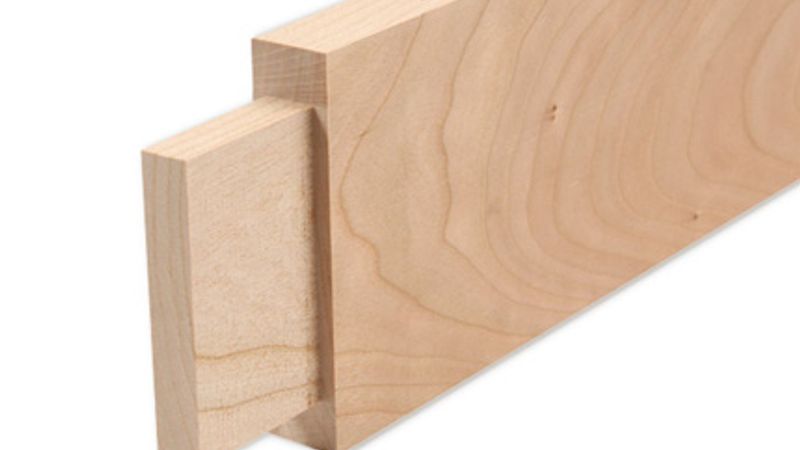
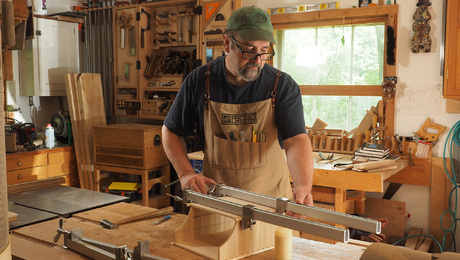
We editors would like to think we know exactly what belongs in Fine Woodworking magazine and what doesn’t. Every once in a while however, we run across a different take on a traditional technique that leaves us scratching our heads, at least a little bit. That was the case when the staff recently huddled around a tablesaw to discuss the overall safety and merits of what Chris Bescksvoort has dubbed the “speed tenon.
MORE CHRIS BECKSVOORT
20 Years of Quality
Free Plan: Cherry Chest of Drawers
Shaker Harvest Table 
Classic Shaker Cupboard
I first learned about this technique many years ago, in an article written by our own Chris Becksvoort. He’s been cutting tenons this way for 30 years, but I was never sold until I saw him do it for myself last month. Why change out to a dado set or box-joint blade when you can bang out super-smooth tenons with your standard saw blade in just minutes?
The question is: is this technique safe enough to be included within the pages of Fine Woodworking magazine. We need your help in evaluating this technique for speedy tenons. It definitely requires close attention to hand position and feed rate, etc. So, is it safe enough for Fine Woodworking? Let us know in the comments section at the bottom of this post.
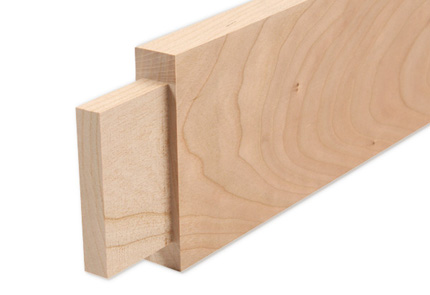
Sure, the "speed tenon" is fast, but is it safe enough for the pages of your favorite magazine?






Comments
Behold the speed tenon! This looks like a very efficient technique in the hands of a person who probably understands the risks associated with a tablesaw and has spent years working on one. However, here are some of the risk factors that may present to the average home hobbyist who may be tempted to try this:
- taking too much off in a single pass creating excess side deflection on the blade (have the blade manufacturers weighed in on this?)
- the piece accidentally coming off the mitre fence when passing over the blade and getting pulled from the operator's hands with the potential of hand to blade contact or getting hit with a wooden rocket
- what, if any, issues did Chris Becksvoort experience when he first adopted this technique?
According to recent articles in FW and other news sources, tablesaw accidents cause billions of dollars in injury every year. Based on this fact and combined with the recent lawsuit and damage award (Ryobi), is it really worth promoting this technique for the sake of saving the average user 10-15 minutes worth of setup.
I suspect that the professional woodworker who would benefit the most from the time saving aspect of this is either already aware of this technique or has developed their own.
Out of an abundance of caution, and the difficulty I see of teaching this technique properly through the pages of FW, I would recommend this not be included in a future issue. But then again, my family have always referred to me as Mr. Safety!
As a woodworking student/assistant in a large program I have had the benefit of seeing techniques performed by experienced instructors. Quite often one will have a technique that another would never attempt, the latter typically going a "safer" route. I use quotations because it is all relative. Safety is all about yourself staying in control of the work piece. That can be anything from a clamp system to simply having a confident grip with your own hands. In the video Asa appeared to have a very controlled grip of the work piece. Combine that with taking very light cuts and I am confident this a safe procedure.
I know students who have cut themselves on a freshly honed chisel but by no means should we ever stop teaching how to obtain a razor sharp edge. Accidents happen when you underestimate the tool whether it be the sharpness or the power. Notice that the technique requires you to move slow and take very small cuts. If Asa had just gone full bore taking a heavy cut this video would be much more graphic. He respects the table saw without fearing it and produced a great tenon.
By working with wood we have all chosen to be around sharp objects, most of which spin at high speeds. Be confident and stay in control. If the situation is preventing you from being those (i.e. work piece slipping off the mitre fence) then adjust accordingly so that it doesn't.
I can see this technique being very helpful to both hobbyist and professional. It saves time which is always on the mind of the pro and it gives the hobbyist another option for making tenons that doesn't cost hundreds of dollars.
Experience matters!
I've been working wood as a hobbyist for over 15 years. I've used a similiar technique when I just need a single tenon. But I would NOT show this technique to an inexperienced woodworker.
The inexperienced tend to fear the tablesaw; that's probably a good thing, until they have enough experience for that fear to devolve to respect.
After a while, the clumsiness of where to put your hands and fingers disappears; one learns how much pressure to use (both down and back), without thinking; body mechanics become second nature; dexterity is developed for handling typically sized pieces of wood. Most importantly, mistakes happen and one acquires JUDGEMENT.
But no one starts out with this skill set, and it takes many hours of working the craft to gain these skills. As a hobbyist with limited time to devote, it took probably a decade before I started doing something like that. I think I'm probably a typical reader.
In an article, you might want to point to a website video of the technique, but with a sterm disclaimer that this is an advanced technique. And be explicit: "If you have less than 500 hand-on hours using your tablesaw, DO NOT TRY THIS AT HOME!"
First saw this with Norm Abram some 12-15 years ago. Tried it and liked it. Then I learned some other techniques. I think it is a technique you can reach for in certain conditions, but I would only recommend it to somebody highly experienced, and highly safety conscious. I like having several ways to do it, and therefore have the option to fit the circumstances with the technique best suited to it. My own mentor and teacher never showed me this, and I suspect it was due to safety. My vote would be to leave it out of an issue except for a master class type piece, and only with an abundance of safety warnings about this technique. An experienced guy makes this look easy. I would not show my wife or kids this technique, and then turn them loose on a saw with it-they are rank beginners. The same thing could happen to a rank beginner who looks at such an article, and runs out to try it. It makes me shudder to think.
This is "safe", but I don't think this is why I subscribe. I think it is within your rights to identify a different way ( it does exist) exists. I also think a bookmark could exist on your site after an existing method that you are trying to get readers to follow is shown.
I have done a few cuts like this in the past. The idea of doing it in a small production run for the parts to a single piece of furniture seems plausible for an experienced confidant craftsman. I would use a heavy blade with a large stabilizer.
I would not recommend a tired or inexperienced woodworker even consider the attempt. Light passes and constant attention is required. If you have lots of tenons to cut, set up and do it in a more controlled manner. Even as a pro tip with tons of cautions it could still be tempting to an over confidant hobbyist.
In my shop techniques like this are labeled
" Watch this but don't try it! "
Been working like this for several years, it's just not a technique for the average weekend woodworker but it definitely has a place in full time professional woodworking. It´s good for tenons and even short dado cuts. I never had any bad experiences with this method; as long as your workpiece is firmly supported on both mitre gauge/fence and you know where your fingers are at all times there should be no problem. I think a good concise article explaining this technique thoroughly would place it within the reach of experienced FW readers.
It's safe as long as you remember not to advance the work piece too quickly up the blade on each pass.
It's good to be concerned about the safety of your readers.
It's bad to withhold techniques because you're afraid of litigation.
Now that you posted this video of the technique in use safely, and you bring up the question of "safety" you can prove in any "reasonable" court that you are not liable for injuries someone suffers while using it.
Now, just find a "reasonable" court.
The Ryobi suit was heavily influenced by behind-the-scenes negotiations carried out by representatives of a famous saw-safety device. Because the safety device was created by a lawyer, and because that lawyer has connections to powerful allies in congress, the Ryobi suit was engineered to scare other manufacturers into kowtowing to new regulations.
Now, here are four pertinent facts:
It is a fact that the famous safety device works, in dry wood. Yay.
There are new saw safety devices on the horizon that work as well or better.
Nothing will ever replace common sense and caution.
Many of us have cut tenons like this for decades and never had a problem.
_______
So Dear ASA, Don't worry... You will still get your advertising bucks from the famous saw safety-device company. If an unwary woodworker injures himself while trying this for the first time, lawyers will try to attack the saw manufacturer, not magazine publishers or videographers or editors. You guys are their friends! Other manufacturers are competition. Besides, large tool manufacturers have deeper pockets, so that's who lawyers will attack.
You can show this video to any reasonable court, so long as the jury isn't stupid, the lawyers are all ethical and the judge isn't bought.
Unless the entire legal system is rigged, How hard could that be?
I mean, unless someone got into high public office through an illegal last-minute ruling by the supreme court, or the courts decide something absurd like "corporations are people" you can still trust our legal system. It's not like we see MAJOR crimes committed by the financial industry going totally unpunished, right? Unless we see police getting away with beating, shooting, pepper-spraying, & tazing peaceful citizens the courts should still be fair, ...right?
So long as we don't see any of the above-mentioned corruption in our legal-system, you should be OK.
Go ahead. Show the video.
Good luck.
I've been using this technique for many years. But I'm much more careful than he seems to be.
Most importantly, the article doesn't explain why this technique is unsafe. Also, it doesn't provide any tips on how to do this safely. I think it is irresponsible to show the process without discussing why you think it's unsafe or techniques to use to make it safer. Somebody is going to read your little blurb, go try it out, and cut off a few fingers. Hope you sleep well tonight.
Why is this unsafe? Because you are pushing your hand toward the saw. You slip and your fingers end up in the saw.
Here is what you need to do to use this technique safely:
First, I've a very healthy respect for the saw (so much so that I now own a SawStop.)
Second, I don't do this free handed. I brace the palm of my hand on the miter gauge to guide the wood. The other hand, pushing the wood toward the saw, is holding the far end of the wood, no where near the saw.
Lastly, I don't try to rush it. I only take a little off at a time. If you take too big of a cut, you're pushing harder and your hand might slipe toward the saw, not a safe condition.
I learned this technique from Jim Dion at the Dogwood Woodworking Institute in Atlanta in 2008. (http://www.dogwoodwoodworking.com/Instructors) Jim is an safe and professional woodworker. I'd suggest you reach out to him as a source.
Initially, I was taken aback. And, if the school shop hadn't been equipped with a Saw Stop, I might not have tried it.
Since then, I've used the technique infrequently (not a professional and lots of casework recently). I believe the method to be safe but requires care and attention; The same can be said of all operations at the table saw.
Beyond speed, this technique is excellent for tuning the tenon that last few 1/64's to get a snug fit. When batch cutting tenons, I cut oversize and then come back and fit mortise-by-mortise. (I don't own a shoulder plane, nor feel I need one.)
Information about this process is already out there. One way of looking at editorial responsibility is to help woodworkers make informed choices. The responsible approach may be to explain the potential hazards and sound things to do to minimize the risks and be clear about the remaining risks. The one thing that gives me pause is the side forces on the blade. I for one have an under powered table saw and tend to use thin kerf blades a lot. What are the implications of that. The other issue is the potential for accelerated wear on bearings and potential to altering the alignment of the blade over long term use. Something for saw manufacturers to weigh in on. The idea of using this technique for doing a few tenons makes sense to me. Doing a large number of tenons with this technique would involve more risk as well as making the wrist and fingers tired which leads to mistakes.
I agree with others who wanted a better explanation of why the technique seems unsafe, and the commenter who wondered whether the technique would work safely with a thin-kerf blade.
It would also help, I think, to explain why this technique might seem unsafe, but it's OK to cut a cove on the tablesaw in a series of light passes across the blade.
Finally, would the speed tenon be safer if it were done with a crosscut sled and stop block instead of with a miter gauge and rip fence together?
Bet some on who is very clever could invent an adjustable width jig that fits on the front of the miter bar to hold the work tight and parallel. Then you could safely move the tenon back and forth over the blade, keeping your hands away from the blade.
This is a great technique, I use it quite often. As for the safety aspect I think that is up to the individual and their
experience, as well as, comfort level they have with their machinery. If you have taken the time to learn how to operate your machinery properly then "you" will know what it is capable of doing.
Thanks for sharing and I know I would not have a problem with seeing this in your pages, but I am not the "safety police" either ; )
Cheers
Nothing new here, this technique has been around for years ... even Norm used it to clean up non-through cuts on NYW. It is also within the purview of the time honored technique of making cove cuts on a table saw.
Having said that, and having been a paid subscriber since the beginning, I can't help but observe what seems to be an increasing tendency for FWW to serve warmed over content, and this appears to be more of the same. Leading viewers to believe that you will be using their 'opinion' as to the use of what amounts to a liability issue for you is suspect at best ... here's hoping neither party is that naive.
You asked for opinions. Mine: ask your legal department, that's what you pay them for.
And speaking of paying. I don't mind paying for a subscription fee, but having paid you what you asked to view your content, you need to reconsider forcing a paid subscriber to sit through even 15 seconds of commercials before a video begins.
If you insist on aligning your business model with the cable TV industry, as with both the above issues , there will be no further renewal from this subscriber when my current subscription expires.
Not sure when, whom, how i learned but 4sure add to pages,..
keeping in mind the Safety aspect. i on the other hand, have repetitiously pushed & pulled the piece back & forth & fwd @ the same time,... "get er done" !
BTW,. have been searching jewelery box plans, made a few in the late 80's-eaarly 90's that was a plan from FW with a rolltop & drawer, have not been able to locate? now searching for small 2 door & 2 drawer, appox 16"H X 8ish D X 12ish W
any ideas ? or must i design/build my own?
Safe enough? Probably not, considering the stupidity exhibited by both end users and the courts these days. First, you're using a powered machine (the table saw, which everyone knows to be a man-eater). Second, you've removed the safety guard. Third, you actually have a saw blade in the machine, with all those finger-gobbling teeth exposed. Fourth, the technique requires that the rip fence be properly adjusted in order to be safe. All of these requirements are well beyond the capability of a worker (or, juror and judge) with a single-digit IQ, particularly if they are doing this with one hand, while drinking coffee with the other. Thus, the only safe recommendation is to outsource the work to a Chinese factory not subject to the American judicial system. (Yes, this is all sarcasm, prompted by recent court decisions.)
>>>Strope. There is a plan for a jewelry box with a drawer and rolltop cover in the April, 2011, Woodworkers Journal.
Pretty sure the founder of Fine Woodworking Tage Frid documents how to do this in "Tage Frid Teaches Woodworking Volume 1."
Personal safety aside, has anyone considered the impact on the saw and/or blade? The blade and arbor are designed to handle the stresses of normal cutting. The cutting angle is 90 degrees when cutting with the side of the teeth. I don't have any experience with this technique, so I can't argue with results from those who do. I'm curious as to how things like arbor bearings, blade teeth, and blade flatness are impacted.
Safety-wise, I'm thinking it's not all that different than the various jigs for using the tablesaw to cut a cove. If you don't know what I'm talking about search on Google for "cove jig table saw".
While handy, I imagine trial lawyers are now gathering 'expert witnesses' to testify about saw blade manufacturer's neglect in providing unbendable blades for this application.
History has taught me that safe practices are the first thing to be tossed when greater 'efficiency' is wanted.
Thanks for the tip, but I'll pass.
Frank
I like the single set-up. I don't have to match the cheek cut to fit exactly to the shoulder cut. One idea might help to give a smooth slide: Add a layer of UHMW (white plastic used for cutting boards and bushings) to the face of the miter. It would slide easier than wood on wood.
Hmm, let's see if I get this. We're not sure it's a safe-enough technique to put into print....but it's safe enough to post on the same magazine's web site. Really? After the table saw verdict?
I taught this method for the last three decades in a high school with inexperienced students. I too have tried many different methods, but I still go back to this tried and true method. I first do test cuts on the first 1/8" to make sure of my tenon fit. After the fit is correct, then I cut the shoulder cut and do as the video shows.
If you are the kind of person that needs a colonoscopy to find your head, then this cut is NOT for you.
Surely you jest. This technique is an example of the classic Chinese attitude that "if it looks the same, it must be the same" - which among other things has yielded dazzling but poisonous toys. This method is a poorly conceived shortcut.
As with any other method of utilizing a powered tool, this one can remove human body parts when practiced by one inexperienced or untrained. There are specific safety violations (see below), but my foremost objection lies in encouraging readers to "do it the wrong way" in hopes that some may eventually come to realize that their joints aren't any good.
As to having ones' digits in close proximity to the blade - - how does one perform accurate and delicate work without such closeness? That's about learning and practicing good technique with fanatic diligence. Otherwise, we lose body parts. Good methods, good sense, and enough smarts to use both are the basic prerequisites for safe work.
Classic techniques for tenon-making include hand-planing to fit, so as to maximize joint efficiency. The technique demonstrated for this table saw routine can only leave a surface that's not flat - it's not good practice, and is likely to lead all but the most experienced worker to produce a surface that only fits the mortise at 0.002" clearance in a couple of places. It may, however, suffice as a rough-sizing operation provided the operator has sufficient experience to visualize and correct a surface that's not only rough, but not planar (that is, it's curved, not flat.)
There are references in some letters to cove-making jigs, but that technique, if exercised at proper speed, can yield a surface with virtually no imperfections because the blade is in near-parallel orientation and is guaranteed to contact the entirety of the surface similarly if the workpiece is not advanced too quickly - 100% of the workpiece is made to glide at a very shallow angle to the blade angle with the blade.
Conversely, the feed method for the table saw tenon relies upon unregulated manual advance for each successive cut, which guarantees flaky surface character. At 90 degrees, as in the proposed method, the results can never be made to yield a 100% contact cut unless the manual advancement method is controlled at something like exactly 0.020" per pass - good luck with that. As well, the non-flat-bottom characteristic of tablesaw blades (other than dado blades with straight-face chippers)also guarantees that the surface rendered cannot possibly be even close to flat enough for a glue joint.
The practice of simultaneously guiding against both fence and miter gauge face is an open invitation to trouble - the slightest problem can instantly escalate into a finger-buster. Stoopid, in my opinion.
The best bet is to make your own tenoning jig if you can't afford a good one, then cut 'em right and plane to fit. If you've the patience, they can be rough-cut with a tenoning jig and then recut to near-perfection with a dado blade, with only minor planing adjustments left to complete. The method is great for large numbers of identical tenons, but for one or two it's just a s fast to use a marking device, a vise, and a fine backsaw.
Finally, I suggest that FWW forget about trying to teach every yahoo everything he needs to know to make toothpicks and sawdust. Either you're about fine woodworking, or you're competing with the handy-homey rags - your choice. Stick with handy-homey, and watch my subscription evaporate.
Been doing them this way for a long time... Helps if you use a thicker blade. Heck, I've even made large cove molding using a saw blade as well. It's safe if the right precautions are taken.
Probably not a big deal safety wise , esp. if using a saw stop.
However I wouldn't consider this to be "Fine Woodworking " , seems more like production woodworking to me . I'm sure a CNC machine can route a tenon faster than that but if I am going to pay a master craftsman to make something for me I want traditional I doubt the Shakers that Mr. Bescksvroot specializes in emulating used this technique.
Sure been there done that .... only on my sliding Makita chop saw I use the stop on the down limit. (Yawn)
I'm thinking that you should lock your left hand on the end of the board and the right one(closest to the blade) is used to stabilize the cut, then help with the return for the next pass. The only movement delivered by the right is in pushing away from the blade.
As for me, I'll be leaving this method for others to hazard.
You should be asking your lawyers, not your subscribers. And, be very friendly with your legal advisors, because if you endorse this unsafe method you may need them. . . . .
I have been reading Fine Woodworking for many years and I have learned a lot about safe practices when it comes to using power tools - I still consider myself a novice at woodworking. I am quite surprised at your quesiton since you apparently think it is good enough to put the 'how to video' on your website.
I think it gives novices and the generally inexperienced the idea that Fine Woodworking stands behind this as a safe practice rergardless of level of experience.
I believe you need to give this more thought as it concerns your liability the first time an inexplerienced person attempts this and has a tragic experience.
I have accomplished this procedure with success but only after I gave it a great deal of thougth and actually made a dry run (Saw was off) to examine my hand and finger positions relative to the blade.
The cat is already out of the bag.
Having just constructed Ernie Conover's Horizontal router table (FW 147) for just this task, I don't see any speed advantage with this technique. If the router has a simple depth adjustment, and an accurate screw system with a precise scale is added to control depth of cut, it is easy to set up depth and size of tenon, and cut them very quickly.
You still need to use it safely, but there is a lot less risk to fingers than in the video. It may not be an option for some, but if you have a suitable router it has a big safety advantage.
If CB has been doing tenons this way for 30+ years (As your article infers), and he still has all his fingers, then it is god enough for me! I have just tried it and it works really well.
It belongs in the pages of FWW
I've been doing this for thirty years, swear by it. When your used to something and focus, no problem, but there are people I've witnessed, klutzy enough I'd bite my tongue and close my eyes.Only problem I ever had was joining a board exactly as the cover of a fine woodworking magazine cover illustrated, bad hand position, and like carrot easy half inch, lots of years gotta to something stupid, I wasn't copying the mag cover I saw that after the fact, said I must write a letter, never did.
I've been using that method to make my tenons for close to twenty years and I still have all my fingers. This to me has always been the 'normal' way to make tenons.
Of course I use a saw with a sliding table so I push into the cross fence which feels more secure. I wouldn't like to try it with a mitre gauge.
I usually make a few more cross cuts before cleaning off the excess material, probably because I'm working with very hard and cranky Australian timbers.
The one caution I would add is, if you are machining large or heavy pieces, beware of nudging the fence over with the repetitive taps from the end of the tenon. I've sometimes found that my shoulder cuts are out of line because I've nudged the fence over a little during the process.
As for safety, this feels safer to me than a lot of the convoluted tenoning jigs I've seen over the years in Fine Woodworking. As others have mentioned, take very small nibbles each time. The saw will quickly let you know if you attempt to trim too much!
Why take any risk, no matter how slight, with your table saw?
Three quick (repetion) operations using x3 settings and x6 cuts on your bandsaw get you a neat tenon...
Are you really in that much of a hurry that you need take risks?
Here in UK we use splitters and guards for nearly all our cuts. no Dadoes as our saws won't allow them... in spite of this we get the job done!
Your choice folks!
I've been doing tenons this way for at least thirty years.
I have been using this method for many years and it works fine. As somebody mentioned the table saw is not designed for high forces from the side of the blade. Too decrease to force to the sawblade I do a lot 90 degree cuts that takes away most of the material.
The shown method is used only too clean up the tenon.
This type of tips should be a part of Fine Woodworking Magazine
I live in the UK. I subscribe to Fine Woodworking and have done for years. I respect the magazine for delivering what it says in the title and maintaing high standards of both hand tool and machine tool woodworking. I also respect CHRIS BECKSVOORT as a fine craftsman. However you must remove this video immediately as it functions as a teaching video and not a subject for opinion and is frankly dangerous. As 'fine woodworkers' we should be in persuit of quality not a never-ending quest for speed. I was taught 45yrs ago to never rush anything when using either hand or machine tools as in doing so you will have an accident sooner or later. Our lives have become packed with an urgency for everything to happen instantly....for the safety of our young and less experienced craftsmen - please remove this video - this technique is not reliably safe - ever!! Thanks - Perry
Perhaps one way to approach issues like this is to develop a risk scale. Industry uses them all the time to rate risk - they make you consider things like the severity of the consequences, and the likelihood of an adverse event. You might then be able set up a scale started at 'suitable for beginners' up to 'marginally acceptable for pros' (assuming 'unacceptables' don't make it to print). Not perfect but at least provides some guidance.
No more unsafe than any other cut on the saw table. However I woud prefer to have a saw guard installed as an extra safety measure
Has the video been deleted and if it hasn't why can't I view it.
Perfectly Safe...probably not. Liable to insight litigation if exposed in your pages...probably, if someone unthinkingly follows your instruction without using thoughtful common sense. Besides, why show it other than to support a practice most of us safely use to one extent or another already!!!
I'm open to almost any technique that gets the job done right.
But this one isn't the right one for this job.
The first set up would be to cut the cheeks of the tennon, with the part in the vertical position, then the shoulder cuts in the horizontal position. This can be done safely with a follow up piece of wood with the possibility of using an extension fence for support.
When I have a tennon to cut, there are usually many others to cut, the set up I'm talking about is easy, safe, fast and accurate, and doesn't put side stress on the TS bearings.
Any setup time is divided by many tennons to cut and is probably faster per tennon than the technique shown in the video.
The repetitive (cove cuts) in the video leave a rough and uneven surface, which may be OK for a closed tennon, but a smoothe surface is a better glue surface.
Like I said, there is a use for many different techniques, but the one shown in the video to cut tennons, "doesn't make the grade for me".
Birdie Miller
As HOTDOG says, over here in the UK the Health and Safety officer would turn off the power and take away your keys to the shop. Every workplace must be run with the dumbest possible person in mind when setting up procedures. I remember seeing this techiques demonstrated years ago, given with the sensible instructions and pre-cautions (size of piece, type of saw blade, positioning of hands, etc.) by someone who assumed we had at least an idea of which end of the screwdriver to use. That's the trouble here. Too many idiots just watch a video (the slightly smarter can read an article) and "have a go."
I wouldn't put it in the magazine. The very first cut violates one major safety rule.
You should never cross cut a long board with the end rubbing the fence. That cut should always be made with a step attached to the fence so the end of the board clears the step before it touches the blade.
It may not happen often but a dangerous binding of the blade can happen very easily.
I've used this method in the past. After having an occasional kick back, I decided to use the tenon jig method. And as for speed, I think if I have a lot of tenons to cut, I could do them faster by cutting the shoulders using the miter gauge with a stop and finishing with the tenon jig.
Surprises me that Chris would settle for a "quick" method of cutting tenons, when he cuts his dovetails by hand. Cutting tenons by hand is easier and quicker than cutting dovetails.
I agree with others. This is not a teaching/demo technique that should be featured on the pages of Fine Woodworking. Just like Sam Maloof's technique of cutting the legs on the bandsaw. It worked for him but it is not for everyone.
PS. cutting tenons with a sharp tenon saw is just as fast, clean and safer with no high pitch noise and saw dust flying everywhere.
I have seen some slick tricks but that was one I will remember. I definetly think that it should be included in the pages of your magazine. I have some projects that I am goingto start and this would come in handy. Thanks for the tip.
Michael
I think this would be a great article! Just make sure you put it in the April edition.
I won't comment as to whether or not this technique is "safe," other than to say that it could be made quite a bit safer than Asa shows it in the video.
If I were to try this technique, and I undoubtedly will at some point, I would add an extension of scrap wood to the miter gauge that would back up the stock nearly to the fence. That would help counteract the rotational forces that feeding the stock into the blade sets up.
The prospect of the blade biting off too much and catching the wood, and then rotating off the face of the miter gauge, would seem to be one of the potential problems with the setup. Adding a backer would help alleviate at least one of the safety issues.
Zolton
In a nutshell, this sort of thing is why I'm skeptical of FWW.
This is a technique for people with more projects than time available to them. That's not me, or any of the hobbyist woodworkers I know. Why would I want to work this fast?
It requires a tablesaw. I hate tablesaws. How many woodworkers have amputatations from handsaws, bowsaws, chisels or bandsaws? I detest having a tool dictate the way I work.
Your reluctance to print this article is a gut check.
Are you really under that much pressure to sell power tools?
Looks like it's time for a Rob Cosman or Frank Klausz "5 Second Tenon" video. Frank will do it all without measuring and Rob will do it with his new "Rob Cosman Hockey Stick Grip Tenon Saw."
There's dumb and then there's dumb. Doing something unwittingly dumb is excusable. This exercise is not.
I've been doing this for more years than I can remember.
Safety is in the hands of the worker - not the method of work.
I'd move my hands back from the cutting area more - but the fact of the matter is the blade is BELOW the top surface.
Print it....
This is a fast technique if you have only a couple tenons to cut, as you save the time to set up a tenon jig or other equipment. But if you have a lot of tenons to cut, it is definitely slower, and more dangerous.
Indeed, repeating this technique over and over will inevitably lead the operator to go faster and eating up more material with each pass, and that's when it gets dangerous.
For cutting a lot of tenons, the time spent to set up a proper jig is quickly gained back as it takes much less than 30 seconds to cut each face and shoulder of the tenon. It also makes for more precise tenons.
In fact, the technique shown here, if not done slowly and carefully, will give tenons with a slightly ridged surface, not a flat one. Therefore, the surface contact between tenon and mortise is uneven, making for a poor gluing surface and a much lower joint strength.
My two cents of advise...
This makes me think of the current "flesh sensing" upheaval in the world of tablesaws. This may be a neat trick for experienced woodworkers but not something for the masses. Just think what overzealous attorneys could do with this when (not if) somebody gets hurt.
I see no problem with demonstrations of techniques like this. Personally I would much rather be presented with a technique, it pros and cons, and then make my own mind up. I start from the basic understanding that we are all adults, and don't require nanny to watch over our every move! (also I live in the UK, and we have not quite reached the US levels or professional ambulance chasing that you guys seem to suffer).
Yes I think it would be essential to point out the care needed to use the technique safely, and any description in print needs to be detailed and explicit.
Obviously blades and bearings etc are not designed for large lateral loads, however used with care it seems that this is unlikely to place any more lateral load on a blade than carrying out some of the more tricky longer rip cuts where maintaining a perfectly square feed can be difficult. Certainly no more than that from performing cove cuts.
As to quality of finish, I suspect that the concerns over flatness of the result may be more theoretical than practical, especially when making passes with the typical size of table saw blade. (My back of envelope calculation suggests that for a 5mm advance of the work there is a 0.1mm difference in blade height from the apex to the trailing arc on a 10" blade. The next arc will intersect with the first and reduce that difference further). A quick lick with a shoulder plane would soon fix that level of imperfection. A second "shoulder cut" made half way down the tenon after it has been cut would also give a quick visual indication of any surface irregularity.
Why use a tablesaw when a router does a better job, and faster? Just make sure there is a backing board to prevent blowout.
I am not convinced that this is appropriate for the mag. Although I'm always interested in efficiency, I'm mostly interested in the BEST way to do things, not the fastest. And this technique screams litigation, especially given the recent climate around tablesaws.
This technique breaks many of the "cardinal" rules of safety when using a table saw, namely making simultaneous use of the fence and mitre gauge. Combined with the fact that you are having to provide pressure laterally towards the blade in order to slide the wood along the mitre gauge only increases the probability of an incident that results in guiding your fingers into the blade.
I tend to use a dado to slightly oversize my tenons, and then clean them up with handplane. Really quick, can achieve a tight and clean joint, and I know I'm going to walk away from my hours in the shop with all fingers still fully intact.
Even on my SawStop, it's not that big a deal to swap out for a dado. Takes all of 2 or 3 minutes, including swapping the brake cartridge. Folks who don't have a SawStop have even fewer steps to take, and can proceed even more quickly.
Are 2 minutes really that big a deal now?
Josh
You're hesitation to publish is the first indication of problem. In safety you should identify the hazards, assess the risks, eliminate or control the risks and move on if successful in control. In this case you have identified, but do not have a control method using this technique. That means use a different method! What is a couple of minutes of time saved compared to an emergency room visit and several weeks of healing.
Add it with a clear safety warning. The reason I subscribe to your magazines is to get insight into different ways of doing things to achieve great results. Speed allows me to make money doing it which is the reason I work. Chris's work habits have always been "right on" in my books.
Pushing a piece sideways across a blade seems unwise to me. However minor it might be in any given situation, you are putting forces on the blade and arbor that they are not intended to withstand, I think. Further, as a side note, any person who does not know how to keep hands away from blade should not have a power tool anyway.
My only concern was the tenon being smooth enough. From what Asa said about it I imagine that moving the wood forward in small increments would handle that potential problem.
I'll be trying the technique next time I do a tenon. Sure beats setting up a stacked dado set.
Hi. Though I am a humble female (I can hear you snorting) I have a set of Danish design chairs that has all the tenons done in this way. Someone (I believe to be male) decided to tighten a few things up & has completely & raggedly broken one of these tenons in the mortise. To say that I am not happy, is an understatement. I do not like this tenon. I have to now go through a major production to repair the tenon & mortise join, probably by dowelling. Geez. Anyhow, if you publish this technique you (I would deeply plead) should include in the article how to fix said mess.
This technique is akin to trying to shave your face with a straight razor. Many have done it successfully, and yet given a choice, why would you bother when there are safer alternatives... Around power tools, you gain experience and confidence, and yet you don't take chances with table saws because they tend to be very unforgiving. This technique relies on user dexterity. One could alternately push and slide a loose piece of wood varying in length and width, and control it like a fine instrument. Truth be told, if I was on the jury on this one, I would unfortunately have to vote guilty as charged. Given what we know about table saw mishaps, a judge would likely say shame on you!
Why? What's the rush? By the time he had one shoulder/cheek cut, I could have used my hand saw and completed the same tenon, and a lot safer. This is not something I would expect to see in Fine Woodworking. By the way, I do have a Delta Tenoning jig for sale if anyone is interested.
Note: Frank Klaus would have both tennons cut accurately in the time you were half way done with one on the table saw! Do a speed demonstration and publish the results.
I have used this technique to clean up tenons, not cut them, so it certainly nothing new. I use a back saw and probably could cut them just as quick, and safer, than this, Not something I would want to see in Fine Woodworking
I would not consider this a "fine Woodworking" approach to making tennons. I might consider this as a method to make one off after a production piece turned out too small to fit properly and good to know so you don't have to make all the setups to do it right for one piece. When you consider what could go wrong, it should probably not be recommended. Spend more time on how to cut accurate tennons by hand. Also, I agree that the practice of making paid subscribers watch a commercial message for each video is not reasonable. You asked us a question and instructed us to watch a video preceded by a commercial so we could answer the question?? That’s a bit much and how about the same commercial in front of each of nine parts of a video series. I’m sure you get a tick for each of those showings, but at what cost?
I used to make this type of cut when I was a young and ignorant lad. I didn't know any better AND it worked. That was 30 years ago, still have my fingers - mostly I figure because I learned safer ways to work. 20, 30, 40 years of doing something doesn't make you safe, it makes you lucky! I don't want to leave my well-being up to luck.
Would you be doing this if it were not on a SawStop Table. Not trying to turn this into THE LAWSUIT discusion. But it seems with a SawStop or similiar tool, too many will be pushing the edge of what should be, relying on the safety valve of the machine if the worse case happens, not good process and procedure.
This seems unsafe to me and is using the table saw and blade in ways it is NOT designed to be used creating an unsafe process and procedure.
High School woodworking teacher here: Whomever said that you should teach techniques to the least talented person in the room is a wise person. While I've personally done this method , I won't teach it to my students.
Why? Because kids are inherently impatient. They'll push it too hard, too fast and I'll watch the piece fly across the room (or worse). If you're an impatient person, this will happen to you as well. And since this is billed as a quick tenon procedure, impatient people will be drawn to it.
Leave it out.
A true paradox. And the question. Why would anyone, woodworker or other craft, working with power tools, be in a hurry to get it done fast?????
There is no way I would put this in the pages of FineWoodworking ... your readers are of all skill levels, and this technique requires a little more skill than some have ... safty first .. I have done this process myself, but would never recommend it to anyone below my skill level ...I am sure this procedure would never be taught at a legitmate woodworking school, such as Marc Adams
This method is - imho - inherently unsafe and should not be promoted by FWW. The risk of binding to the fence during the first cut is very real, specially if fence and blade are not perfectly parallel. If they happen to converge even slightly when pushing the workpiece through you are really playing with fire, specially when working on a piece of hardwood. The dimensions of the piece also play a role.
Secondly, pushing the blade sideways will spoil the blade bearings.
It takes hardly more time to use a light sled with proper hinge-removable(!) stop-block and pushing it through several times, moving the wood each time a few mm towards the left (away from the blade), afterwards cleaning-up with chisel, file or sandpaper if necessary. Excellent jigs have been described in various issues of FWW that promote safe practice. They work quicker BECAUSE they are safer!
My suggestion: ignore Chris Becksvoort's "technique" even if it works for him!
Everybody critisizing Mr Becksvoort's technique, would you dare criticize Mr Sam Maloof's bandsaw techniques?
I don't see anything unsafe with this method. I have done this and many other setups not written in "safety first" tips.
The first safety tip here is a sharp blade. Second is your machine is in great working order. Then it's the operator. In this case all the above is in check.
I believe that FW had an article about cove cutting on a tablesaw where you set up a diagonal fence and push material along it while making repeated shallow cuts until you reach the desired depth and width of cove.
I hope most would agree that accidents are caused by the operator not the machine whether it's in your car, hunting or in your shop. Cars, guns and power equipment don't kill, it's the person handling it.
I suppose that FW would have to get their "lawyers" involved in order to print this article and to me that is a real crime.
One of the first things I noticed on the video was the table saw fence: it was labeled SawStop! When we think of the possible accidents which might occur on the table saw, why put in added risk? I don't have a SawStop and know too many very careful people who didn't expect what happened. As a question, will our subscription rates go up if someone sues you for recommending this approach? I know people seem to run to their lawyers too quickly but must we give an excuse? Perhaps the ones who should answer this question are the weekend carpenters who are weekday lawyers.
I have been using this method safely since the 60's. Each and every time, I have to remember how potentially dangerous it is. Given that, the cutting process is in the video. What isn't said is that the key (at least for me) is to firmly hold the wood piece against the miter gauge fence with fingers and just as firmly hold the back of the fence with your thumbs. The pressure forms a clamping affect that keeps the wood from shifting or kicking during the cutting process. That same pressure keeps one's hands from sliding towards the blade.
I think that publishing techniques like this is reasonable and prudent. There is always an element of danger when using power tools. Letting people know about different ways to enhance their skills and alternative ways to craft projects is what keeps Fine Woodworking in business. At least, it is why I keep coming back.
It's an interesting production technique, that's not especially productive.
If you want to use a table saw, I think a tenoning jig is a better solution.
I personally use a shaper. Others may prefer hand tools. I am dismayed again to see blatantly unsafe practices in FWW videos, with no blade guard, and no spacer block on the fence. Admittedly the table mounted blade guard would be a liability, and It's been pretty well replaced by a suspended one w/ a dust port in my shop. If you're going to say safety comes first, then demonstrate what that looks like.
Love it! And have been doing it for years. You can use a push block with a handle in your right hand to make it even safer!
I don't really care whether you will publish this or not. I won't be renewing my subscription - no way I'm going to pay to watch 15-second commercials before a 2-minute video.
What a waste fo money!
I am in agreement with Zolton regarding the waste material backer for the miter gauge to backup the cut. In addition to that I think I would clamp another to the rip fence to cover the blade when it was possible. Since you can't see the blade when it is cutting the tenon anyway there is probably no issue with the blade being shielded by a scrap of wood that might prevent your hand from coming in contact with the sharp spinning object. The hand that i would use nearest the blade would be a adjustable clamp. As is the case with many objects in a woodworking shop the best guard is the one located between your ears. If the task at hand does not feel correct (safe) then try another method. To answer the question regarding whether the technique demonstrated should grace the pages of Fine Woodworking, I would say that it should be included.
This method is an accident waiting to happen. It cannot be used at a business - as a business is covered by OSHA and clearly the guards required to operate the equipment in compliance with the standards cannot be used with this method. When you practice safety you practice it at home and at work. As a business owner you would not want your employee to do this method at home and because they were successful do it at work.
Teaching it or even showing it was a mistake. Your next question should be how many of you were injured using that technique. As someone else said just because you did it without being hurt for 40 years does not make it right. Just means you were lucky.
Like many others noted this is not a new technique to me. It was taught in high school shop long long ago. It should have stayed in the history books with pictures of woodworkers without fingers...
I like the risk scale idea...readers should know the technique exists and that it holds certain risks. I hesitate to go in the "run it" category, but here's why:
The last time I was cutting tenons, this method occurred to me as a potential way forward. However, rather than introducing the wood at the front of the blade, I was going to push it through the crest of the blade (after already having "nibbled" much of the material away through convention tenoning passes on the saw). I didn't b/c I it just didn't feel right, and I decided to do the rest of my tenons by cutting the shoulders on the table saw and then the cheeks with my hand saw (which is more fun and less dangerous). My bottom line: show people how to do dangerous things correctly and as safely as possible, instead of having them try some cowboy maneuver without the benefit of your advice.
Time is money when woodworking is your livelihood. I have no problem with this technique. I have done it hundredes of times myself. It is no different than any other trick of a trade. If it makes you uncomfortable don't do it.
I too have used this technique only because I was too lazy to set up my dado blade or build a tenoning jig. I don't think it is a very safe method and would not reccomend publishing it in the magazine. There are too many other, safer alternative methods to cutting tenons.
I too have used this technique only because I was too lazy to set up my dado blade or build a tenoning jig. I don't think it is a very safe method and would not reccomend publishing it in the magazine. There are too many other, safer alternative methods to cutting tenons.
Although this method works there are too many variables that will change in practice. A soft wood verses a hard wood, just to mention one. For newer woodworkers that rely on your publication for expert advice this could lead to problems in their shop. I recomend against using it.
I have used this technique although I make a series of crosscuts before pushing the wood across the blade. I also move the miter gauge forward and use it for support when moving the wood across the blade. I know it's not as fast but I feel more comfortable. I have also found that if the wood is moved too far forward it not only requires more force which increases the chance of a kick back, but if successful the cheek may have waves in it from the blade radius. This requires you to repeat the procedure and takes more time.
I do a lot of furniture repair. Therefore this procedure is saves me a lot of time because I am cutting only one or two tenons at a time for a replacement part. If cutting multiple tenons I think it would be worth installing a dado blade because the time for installation it would be divided among all the tenons.
I think this procedure is appropriate for Fine Woodworking as long as the importance of taking light cuts is emphasized. Also if it is possible to instruct readers on how to ease into a procedure such as this and if there is any apprehension about doing it, or any other procedure, then don't use it.
The numbers on the page are a little confusing. 120 would recommend from 94 comments?? This is not a safe procedure for the novice or experienced woodworker. Others have stated: a disaster waiting to happen. True. If this magazine is to remain a trusted resource for woodworkers, this type of procedure should not be published.
Very slick. I'll definitely add this to my growing list of ways to do things. This is a variation of what Norm Abram of New Yankee Workshop calls "nibbling" and uses in his shows routinely. I have encountered portrayals of other pros using nibbling variations as well. I see no glaring reason to avoid using or showing this. Like most special techniques there are places where it shouldn't be used. Knowledge of and appropriate application of such techniques has another name: skill.
Having the experience of a kick back and almost losing two fingers many years ago, I am some what nervous in using this technique, therefore, I believe this technique offers a risk that is not worth propagating for readers, some who do not have the depth of understanding of all the risks
For those who think that this technique is unnecessarily unsafe, they will probably have to remove the table saw from their shop and all the sharp knives from their kitchen. There is no shop machine that can be depended on for total safety. That will only come from the operator. Even a short lack of attention with a sharp hand chisel can result is a serious injury. I say print it. Let the reader decide if they have the skill and comfort to execute the technique properly.
I consider myself a novice woodworker and have used this method several times. As with any operation involving power equipment, attention to detail is necessary to avoid miscuts and accidents.
Yes, print it. Use all of your discretionary and cautious language, even thought that won't stop a careless accident.
To amplify the difference between the skeptics of a "proper" fit, and the "sloppy" speed freaks, why not do an "engineered" runoff? A tenon made exactly like the video VS one with carefully crafted and loving tenderness (read:slow) which yield a perfect .002" hand-honed fit to its mortise.
Do this for a couple of hundred joints that are then glued-up. After the glue dries and all samples are destroyed with calibrated presses, let's see if there is an iota of difference. My guess is there will be a measurable, but insignificant, difference.
That result would give both sides a victory, and yet leave the issue of safety an open matter, just as it is (and will be) for every other table saw operation. Can't stop that, eh?
If joint strength is non-discriminating, the entire topic becomes an esoteric discussion of beauty and hand work VS a few minutes of set-up times avoided, at some added risk of safety.
I've always wondered about the sloppy VS 'perfect-fit' mortise and tenon strength test. What does a poll of FW authors and experts say? Any empirical data on tenon strength to share?
I have been using this technique for 40 years. I also do the same on my router table. The set up time can be a bit tricky for some. It never dawned on me that this was not a common practice until now. Of course it is a dangerous practice and I would hesitate to recommend it to a novice and I am not certain that I would publish it if I had liability issues to consider. I do far more dangerous tricks then this on my table saw every day. I can't even imagine keeping the safety guards on a table saw. If they had to be on I would have to change virtually every cost cutting and labor saving practice I have in my shop. One more note: I have never been injured using a table saw using this or any other short cut. Ya gotta watch what you are doing and where your fingers are!
It seems to me that if you are in that much of a hurry you should probably find some activity other than woodworking! I'm sure the technique can be practiced safely, but...
For the inexperienced, no. For the experienced, maybe. It seem problematic, especially if you feed the piece too fast.
With all due respect to my fellow well experienced woodworker's commenting in favor here, no way would do I recommend that you publish or recommend this technique. It is just too risky! First and foremost, we need to council those new to our most loved craft towards patience and remind the rest of us of that same virtue. It is only through virtue that our most prized work emerges and it is almost always through impatience that disaster strikes!
Ok enough philosophy, never is it a good idea to use the miter gauge along with the fence. Since that blade moves so very fast if the blade and fence are our of parallel, by even millimeters, the wood could bind hurting operator and saw alike. Worse yet, if the wood is not held very firm against table and miter fence it could strike the blade out of parallel and throw the wood. Also, pushing against the side of the blade while it is spinning damages the saw's bearings and can work to knock it out of alignment with the fence thereby leading to the problem just mentioned. All of these risks elevate as the blade dulls, which even with carbide happens faster than we'd like when working with fine well figured hardwoods.
We should not be inviting impatience into our shops. There are plenty of techniques that produce fine tenons in a short time, safely! Take a stance and tell your readers to avoid the unsafe ones even if some of your readers view the risk as less likely.
As with all procedures, with due caution this is not an unsafe method. I'd put it in the magazine with a caution not to rush the procedure; rushing would be the only thing to make it unsafe.
Although it is a quick and very good method for the experienced woodworker, I think not for everyone. Too many novices read FWW and are anxious to learn the quick tricks. They will take their portable TS with less than sharp blade, questionable fence, and make a mess. And the 1st time someone takes too big a bite and jabs it at the fence, there will be wood and teeth flying. Left to those who absolutely understand what they are doing, it is safe. I wouldn't broadcast it even this far.
My 2Ct's
Regis
If you're cutting a number of similar tenons, I'd agree with others that the conventional methods they like are fine, be it router, dado blades, band saw, or tenoning jig. This method has worked fine for me for 40 years for singles or a pair, although you really need a flat-cut tooth to get a smooth cheek. To use a standard ABT blade would leave a considerably rough finish.
Why is it that I'm torn between the YES and NO? It's because I've run across many "woodworkers" who are NOT comfortable at the saw. They've got the money to buy the fine equipment, but they don't have the experience or exposure to problem-solving that build up like coats of lacquer on yout skill level. Add to that today's outrageous lawsuit environment where no one is responsible for his own actions anymore, I'd say, "protect yourself" and don't bother to publish it. You've reached the audience most likely to benefit from it here anyway.
This technique has its place--for woodworkers experienced enough to discover it on their own. Although it take a good touch, they will probably not get hurt.
You are teaching woodworking in a vast classroom, and have no control over who makes up your student body, or how much attention they are paying. It would be reckless to present this technique in such a context--I can't imagine why you would even consider it.
don't publish as it is not for a general audience of readers.
To answer your question, no I am not in favor of this technique. It worries me just like the articles about cutting molding at an angle relative to the blade on the table saw. Both require careful hand manipulation of the work piece. I also agree with the statements other people have made about operating equipment without the guards is not setting a good example; even if a lot of people to remove them. Fine Woodworking should be up to the challenge to make figs & fixtures that keep safety intact.
I would like to see if someone can install a strain gage on the blade and determine the stress and lateral forces on the bearing. Ball bearings can take a certain amount of load. Some more than others depending upon the inner and outer race contact angles. If the load was exceeded, it would make it a pretty simple decision. Statements without facts are just opinions.
I too use this and variations of it in many joints. If safety is a concern, perhaps add a sacrificial support to the miter gauge to support to work further towards the fence?
I prefer his method to the one I usually use which is to make a dozen or so passes and then clean it up by passing it over the blade. This produces small enough pieces of waste that kick-back is not an issue, BUT you end up with dozens of tiny bits of off-cut waste flying at you.
I think any experienced wood-worker capable of pulling this off safely, has probably already come up with this one on their own, and perhaps that should answer your question.
Normally I create tenons with a dado head on a table saw fitted with a sliding table. However I have used the featured method occasionally to make a tenon or two that got left out of a batch run. BUT tenoning often has to happen on many parts and sometimes on a larger more cumbersome piece than is shown in video. If this method is widely used hands will slip and fingers will be lost.
i guess i'm a little confused. a video is shot, edited, produced.it even has a commercial at the front.
in a sue-happy world, the part that carries weight in court is often: "They showed it to me, I tried it and I got hurt."...and that part is already in place.
that horse has left the barn and is on the ship that's already sailed.
regarding whether or not you should publish it...you already have.
One further thought, that I myself would not be willing to test, what if an amateur, without a feel for how much waste to remove, had a thin kerf blade and zero-clearance insert in the table?
The more I think about presenting this method to everyone, the more I'm leaning towards NO.
This technique, like any, can be unsafe if not performed properly. Using the mitre gauge and the rip fence at the same time is *usually8 unsafe, but in this case it's perfectly fine.
I see this technique only saving time if you have a few tenons to cut. I could cut a tenon with a dado stack faster, but the setup time would be slow. If I was cutting 10 tenons I think this technique would actually be slower than the traditional dado blades.
Regarding printing it....50/50. I'm the editor of Canadian Woodworking Magazine. I would go for it, but I would give a warning off the top regarding who it is best used by, and in what situation. If performed right it's no more dangerous than many other techniques. It does get people talking though, and that's always fun!
As long as you only use a SAWSTOP, this look like a great idea.
The main problem I see is that beginners don't have sharp blades and don't keep the table slick. If the piece does not slide smoothly on the table, it will catch and the fingers will slide toward the blade. You have already published the technique on the website for all to see, that is probably sufficient.
I see no problem with this at all. A similar strategy, pushing the workpiece sideways across the blade, is used to make cove moulding on the table saw. The only problem is some careless or reckless person will hurt themselves and probably sue. Today nobody will take responsibility for their own actions. This is going to eventually cause serious problems for our entire society. Is this safe enough for my favorite magazine is a question that should not even have to be asked.
I have been doing this for years. It works with dowels too. Like any other use of the table saw, you have to use caution. We all can't afford every mechanical jig made.
Another shop teacher here - a few years ago a student came back to school after a summer at the Center for Furniture Craftsmanship where she learned this technique and proceeded to teach it so several of my woodworking students without my knowledge. Each and every one of the students that tried it had a kickback indecent. This technique takes coordination that many beginning woodworkers just do not have. Perhaps the video could live online in a advanced-users-only section, titled 'at your own risk' but PLEASE don't advertise it as a time-saving tip in your magazine.
IMO, a dangerous practise for beginners. It might work for a seasoned woodworker, with a sharp blade, a smooth, clean saw-table, and a shiny mitre gauge. But it's too technique-dependent for the average-Joe home woodworker.
A beginner might take too big of a bite on the lateral cut, and if not holding the work very tightly to the mitre, the piece could cock, flip out of his hands, and maybe fly off harmlessly, maybe push him into the blade.
Also, all that moving around is apt to confuse a beginner, and confusion leads to missing body parts. Even your expert demonstrator seems to have lost track of where he was in the process, a couple of times.
SO... if you do publish it, CYA with a very clear disclaimer.
oops, though often indecent, I meant kickback incident.
This way of cutting tenons is marvelous but could be improved by making the first cut and then several other
cuts every 1/4" before starting the 90 degres cuts. This would reduce the side stresses on the blade and would increase the safety because the wood will split because of the multiple cuts. The result should be the same but safer
CoDesPro
No, speed and shortcuts will get folks into the habit of taking doing just that. And as many of us know, it catches up eventually. Work smart, take your time (esp. with a table saw), and be safe.
I use this technique frequently in many similar applications. For beginners I recommend a no. There are several subtle things already mentioned above that make it a more advanced technique. But as was said, you have already published it and I think that's good. I like it.
Charles Darwin made an excellent argument FOR publishing it, with all cautionary suggestions.
As this publication used to be geared toward the professional, this would not have been a question - except those who constantly railed against using power tools, and would deride a tablesaw as a carpenter's tool.
Understanding how the cutting action takes place, and being aware of the dynamics is critical for both safety and fine results. It is up to each of us to understand and apply that information.
I have a young grandson who I would trust to be safe If I taught him this technique, but I know his dad would probably cut off his fingers and end up with the cut-off parts stuck in his eyes. We are working with hazards all around us and those that can't adapt maybe should do something else.
Like most demonstations, this one simplifies the process of the task at hand, however it downplays the tedium and extreme care that must be taken to repeat these steps again and again. It can be hard on the fingers and hands to maintain firm pressure on the workpiece throughout the entire run of stock to be tenoned, and one mistake in introducing the work too quickly could result in a projectile. Over the course of tenoning multiple pieces, I find it easier, and more enjoyable, to saw the shoulders as these have been done, albeit in a saw sled, then removing the waste with either a nicely tuned bandsaw or vertically on a tablesaw using a jig. Top and bottom waste pieces can be removed by clamping all of the pieces together and ganging them against the fence. There is something satisfying about producing the various blocks and pieces by sawing them and they make great cauls when gluing or play pieces for kids.
(I'm not saying it's good or bad, but offering an alternative stance from which the article would be most beneficial to ALL woodworkers)
I'd do an article that explores every method of M&T joinery. Each method could have a short video demonstrating the technique, and 3 paragraphs (intro, explanation [maybe with bullet points], conclusion) explaining how it's done & benefits & shortcomings & possible enhancements to augment any of the qualities indicated in the chart (see next sentence). And, you should include a chart that does a side-by-side executive comparison summary to indicate safety, ease, complexity, speed, accuracy, etc. If you do it this way, you can include LOTS of techniques that might not otherwise be considered "right" for woodworkers in various stages of skill development, but that would become a reference that would enable us to grow from/into different techniques based upon what's "right" for the situation.
That said, for just this one method, some kind of dual-direction sliding miter jig would be a welcome safety addition. I'd challenge you to design that piece of safety equipment so that it could be used on both the tablesaw and the router table.
I don't feel it is appropriate to continue to show open blades like you do. I realize people have been doing it for years. You may get away with unsafe practices in a one man shop where you don't have a production rate to keep up and there are no other distractions but in a production situation it doesn't make any sense at all. After almost 20 years in commercial construction I did manage to catch fingers in an open blade. This slows production for the whole crew and ruined other aspects of my life. It is not worth it and we are smart enough to engineer appropriate safety devices and rules to keep people safe in the workplace and at home. It is time Fine Woodworking and Fine Homebuilding take a more responsible and proactive approach to the safety of their readers.
I do not detect a safety issure with this method of cutting tenons.
I've used this technique and find it useful when there are a few pieces to be done. All of the pushing toward the fence should be done with the hand farthest from the blade. As has been stated, attention must be paid to take reasonably light cuts and because most guards are out of the question. I hesitate to say you must be extra careful because there is never any other time you can be less careful while operating a table saw.
It would be interesting to see if any blade manufacturer's lawyer would let them make any comment other than "not recommended". Tooth wear would be uneven, but if you're spending any significant amount of time using this method, you need to consider some other technique.
As for whether or not you should publish this technique, I think you just did.
I think it should be. Of course, I'm sure you will point
out the posssible dangers and how to avoid them.
E Neese
I think it should be. Of course, I'm sure you will point
out the posssible dangers and how to avoid them.
E Neese
Years ago we saw Norm do this, on NYW. I think it is an advanced method. Sharp blade, smooth table are a must.
Publish it with appropriate safety advise. Others have
submitted plenty of good information.
"There's more than one way to skin a cat" is what I often told my students and this is yet another way to cut a tenon. It's too bad that the safety/liability issue is so huge that we're all afraid of the lawsuits. I guess that's a sign of our times. The way I look at it is this; here is a method, try it and if you're comfortable with it go ahead and use it. If you have a kickback, injury, and feel awkward without your SawStop and guards in place do something else!! YOU can decide based on your own experience, tools, and comfort levels whatever way you want to accomplish your own work. So whether you use a CNC router or a highly trained beaver to cut your joints, take responsibility and enjoy woodworking -- that's the bottom line.
It's sure is unorthodox method. What if, instead of pushing the piece from left to right with one's hands, rather come on to the left of the saw table and push it forward holding the other side of the work piece. I'm not sure but just wondering!
Help. How do I add this to Favorites?
I got to go with the majority, this does not belong in either the hands of the inexperienced or commercial applications where production is an issue. For the average woodworker working in his shop, the time earned using this method in lieu of traditional methods is not worth the dangers associated with this procedure. But each woodworker will make his own decision based on his comfort level.
All,
It's a great technique and it's one of the first thing I teached myself years ago including the about the same technique as edging a raised panel on the same table saw. Thanks for sharing.
And by the way, who is talking about safety on a table saw? What country again was the last one in the whole world that came with a riving knife on a table saw?
This technique is a good one and I will probably use it myself, but it is not one I would want my grandson to learn — yet. He is very ingenious and is always trying new things — too often self taught. Like most kids his age he is a firm believer that it is easier to get forgiveness than permission. I guarantee he will figure out other cuts using this technique and he has neither the experience or judgement to do so safely. So while a your target audience is not a fourteen year old he does read Fine Woodworking and he does put the published techniques into practice. I don't want to get a phone call from my daughter telling me my grandson is short a few fingers, and I am sure you don't either.
This side cutting method works for many instances where setting up a dado and/or router is not an efficient solution for the task at hand. Of course the safest way to cut tenons is with a tenon saw and chisel, but that takes more skill and practice. I would have said time, but I have seen a few cut tenons that fast by hand. My only suggestion (my method) is to do this using a crosscut sled with stops instead of a fence. I have never experienced any kickback using this method for of 30 years. I would also wear wrap around safety glasses. One comment suggested using multiple cross cuts before engaging this method. This is a big no-no! The side force of the saw blade can break of blocks of wood in between the cut and then get slung around dangerously as they reenter the blade. This is very easy to repeat if you have doubts.
To other comments about level of experience required - all power tools take experience and care! The router is the most dangerous tool in any shop (and the nosiest and messiest)! Drum sanders and belt sanders constantly eat finger tips! We pick too much on one of the safest power tools in the shop because of carelessness and lack of proper use. Its like the large number of people that mow over their own feet - DUMB!
I don't see where this is any more dangerous than making cove molding on the Tablesaw. Most of what we do in the woodshop can be dangerous for the inexperienced. I still remeber the first time I used my router table to make a raised panel. That big bit spinning at 10000+ RPM and all of that bit that was exposed. This seems less dangerous to me.
That's my 2 cents
It would seem that all woodworking activities could be evaluated for safety simply in terms of the amount of time body parts spend in close, non-protected proximity to moving parts that could cause injury. What is deemed or not deemed "safe" is just an arbitrary point on a "likely injury" scale. Since saw blades are not designed for this type of cut (though I have seen it used to make diagonal passes when hogging out curved moldings), I have to wonder what Fine Woodworking's legal council would say about its potential liability if/when someone attempts to do this and slices a finger. Imagine what would have happened in the recent Ryobi table saw suit if Carlos Osorio had had his accident while executing the "speed tenon" technique after reading about it in Fine Woodworking!
As noted by other comments above, this and any other table saw procedure would certainly be less likely to cause injury with a SawStop. Fine Woodworking might want to consider presenting this technique as part of a series in which readers are challenged to create jigs or safety equipment/procedures that would eliminate operator blade exposure time. However, my understanding is that even a SawStop could not prevent a carbide tip from breaking off at high speed due to side pressure it was not designed to with stand. Absent blades designed to operate this way, I would not be willing to do this without some assurance that the blade can perform.
This is in the same category as using an angled jig to make a cove - cutting with the side of the blade. A good carbide blade probably doesn't care much how it engages the wood in respect of wear.
Suggest the article should highlight the SAFE way to do this and also the less-safe practices, such as the one the reader mentioned of making several spaced cuts and risking thrown chucks when any side-cutting is attempted.
A variation that is possible (I suppose) is simply to slide the work sideways on the miter gauge by one kerf-width on each straight pass. Sounds very safe if you advance the work no more than a kerf-width, but who could guarantee that? And probably slower.
A wide resaw blade on a bandsaw along with a good fence and some stops can be set up to cut tenons much, much faster than this technique does, and with more safety margin as well.
Seems as safe as most things done in the shop.
Well, I don’t think I’d try it if I read about it. I woodwork to relax, to enjoy myself. Thankfully, I am not trying to produce as much as possible, as fast as possible. This type of get-it-done-quick technique does not appeal to me.
I have been using this technique for 15 years ---- no problems
I agree that this is not something I would teach my beginning adult woodworking students. No doubt it works.I have used it and feel if the correct amount of focus is given to it's use it's fine. I feel it's better for FWW to show it as a technique so the new woodworker will know the hazards involved.
Perhaps it could be run in an article that is titled
"unsafe techniques that work" or and article that is titled"questionable table saw techniques"or "techniques for pros beginners beware" or as others have suggested put a safety rating on techniques from 1-10 .FWW has a safety and disclaimer already and you have run the video already so If FWW was really concerned about the liability you would not have put it on line in the first place.
Fast, but a bit risky for my blood. My name is "Ugly_Thumb" for a reason; it made contact with the top of a saw blade while coming in from the side. I am not a fan of purposly moving your hand towards a cutting edge. Any slip or change in force, or anything, and your hand moves into the blade. My doctor still used me as an example.
Also, I never have just one tenon to do, it is usually 8-12 at a time. To me it is worth seting up the tenoning jig or dado set.
Trust me, the few seconds I thought I would save by reaching across the blade to get another peice was more than offset by the trip to the ER, the months of NOT being able to wood work, and the years of still having pain. Plus, I can't reach the radio controls on my car steering wheel anymore ;)
I wouldn't publish this, there are safer ways.
In general I agree with most of the comments. It is a good, if somewhat advanced, technique, and should therefore be demonstrated/published with appropriate cautions. One thing which might make it a bit safer would be to cut one face of a tenon on a scrap piece, then screw that scrap to the mitre gauge as a backing piece. It would take away most of the possibility of the workpiece cocking and jamming.
I've used this technique fairly frequently with no problems. I've also generated cove mouldings and raised panels using a similar technique. One thing I discovered along the way is that, especially for things like raised panels and cove moulding, a dado head, especially an adjustable 8- or 16-tooth style, works much better than a saw blade, though it may well be somewhat more dangerous.
As for publishing this technique? As many have pointed out, it's a moot point. You already have.
Strangly enough; this was how I made tenons until I was taught differently, and still use it when I'm feeling lazy. But I agree that it is not a technique that the casual or novice woodworker should attempt; and you would probably open yourselves to nasty litigation when someone tries it that does not pay VERY close attention to what they are doing.
I've used this technique several times when only building a door or two,you must maintain your patience and never hurry the process. If I were building 20 doors for for say a set of kitchen cabinets I would still set up my dado set, the time wasted changing blades kind of gets evened out by the length of the project. Safe for Fine Woodworking? Considering the recent rediculous settlement in the SawStop case, you have to wonder.
Have used my saw like this for years. Looks like a winner to me.
Have used my saw like this for years. Looks like a winner to me.
Lot's of opinions here. Why don't you ask the guys who make the blades and the saws if it's a safe practice for their products? Are the blades made to withstand side stresses? Ask the saw manufacturers. I think I know what their answer will be and that is probably your answer as well.
No, this is a technique which should not be recommended by FWM. Your hesitation to do so is evidence of concern and lack of safety of the technique. I agree that the "Speedy Tenon" method is "speedy", yet those who have experienced saw accidents as have I likely agree ... "SAFETY FIRST!". I spent 7 days in a hospital following surgery, then months in (partial) recovery following a table saw accident. The "trade" of injury for "time saved" is not of good value. Someone, at sometime, WILL have a serious accident using this method, all in the attempt to save time. Just because some have used this method for a period of years, without accident, does not mean nobody will. Serious injury is NOT worth the saving of a few minutes. The posted suggestion of using a bandsaw with fence and "stops" is a much better option!
I suggest the technique itself is not what should be questioned. It's the combination of technique, and a dozen other variables : operator experience, confidence, floor traction, blade tooth style and sharpness, tenon size, operator fatigue level, lighting, blood alcohol content, etc. etc.
I'm not inclined to suggest it's safe for anyone but me. I do this type of operation, along with other 'questionable' things, every day in my shop. If it doesn't feel right at the time, I don't do it. Some days I'll pass and use a 'slower' technique, because it makes sense to do so, all things considered. I wouldn't use this technique if I were hurried, or trying to take a 'shortcut'. I'd use it because it's efficient, simple, and I'm comfortable doing so.
With re: to FWW liability, or teaching this to 'beginners'... I would hope that a simple disclaimer of 'Hey, we like to show you techniques that master-level woodworkers use, but we neither suggest it nor imply that it's safe for you to use. Use your own head, and make your own decisions' would suffice.
For me safety always trumps speed when it comes to working with power tools in the shop. This is not a technique I would include as you have readers of all levels of skill. Too fast a feed rate or failure to firmly hold work piece can result in serious injury.
This technique is essentially using the saw as a router. Which leads me the question: Would it be safer if adapted for and performed on a router table?
I have to admit that I've used handheld circular saws as "rotary rasps" at times, though that was trimming back the entire end of the board rather than trying to take out only a shoulder.
This does feel like something which would be safer in a sled with a stop than on the bare table, to keep the hands clear of the blade. The sled could be equipped with featherboard (or even solid backing block) to help keep the piece flat, and the edge of the sled could be marked with appropriate-size indexes to be gauged against a reference point on the table so each pass takes off the same (known) amount.
If that seems like a reasonable compromise, you can consider this a "Methods Of Work" submission.
I think the reader is the one who should decide if it is a safe enough technique for their particular situation. We already have too many people trying to make decisions for us (e.g., Sawstop trying to mandate the use of a particular technology). I expect Fine Woodworking to present me the facts and I can make up my own mind about whether or not it is suitable for me.
This technique is essentially using the saw as a router. Which leads me the question: Would it be safer if adapted for and performed on a router table?
I have to admit that I've used handheld circular saws as "rotary rasps" at times, though that was trimming back the entire end of the board rather than trying to take out only a shoulder.
This does feel like something which would be safer in a sled with a stop than on the bare table, to keep the hands clear of the blade. The sled could be equipped with featherboard (or even solid backing block) to help keep the piece flat, and the edge of the sled could be marked with appropriate-size indexes to be gauged against a reference point on the table so each pass takes off the same (known) amount.
If that seems like a reasonable compromise, you can consider this a "Methods Of Work" submission.
I find the comments about real accidents most useful, like the one where the guy slid his thumb into the blade. A forum on actual accidents would be help. The worst accident I've heard of "close to home" is someone who cut their fingers off over a table saw blade. She was a pediatric surgeon who would not play volleyball!
It would be more helpful to write the article on the main ways the techique can go wrong.
I watched the video on the speed tendon and was surprised to see you using the rip fence and the miter gauge together. I have always thought that this was very dangerous and not recommended by any saw maker.
thanks,
Tom Hazlewood
Having just finished reading the commentary about SawStop in "Woodshop News" (I am not a professional woodworker) but with an Industrial Engineering background, and having dealt with safety issues, I can say I do like this method - but! The red flags are flying. First if this was a standard method in my production shop, there would be documented methods and training with emphasis on safety. The machine would be a SawStop or equivalent plus an appropriate guard that does not obstruct the view but does protect body parts. It's always that one distraction, a pat on the back, a stray thought, a hiccup or snag that leads to disaster. Illustrated articles always warn that "the guards have been removed for clarity - never do this with guards removed." Table saws are functional but they are scary as well as they should be - they take no prisoners. Even with blade stopping or equivalent technology, redundancy, as Martha would say, is a good thing.
Most things in the shop are fairly dangerous and require your full attention to be done safely. I think this technique is great and I will probably use it. Nice and fast and produces smooth tenon surfaces instead of the lines left by a dado setup. As mentioned in some of the replies, in the present legal climate of the US anyone can sue you for anything and get away with it, even if they are blatantly careless and stupid but have the resources to hire a great legal team. So liability is an issue. But on the other hand liability is always an issue not just in this case but for any "suggested" technique. If you want to be totally safe don't write woodworking articles.
I hate to tell you this Asa, but the cat's out of the bag already. After having posted this in Fine Woodworking Online, whether safe or not, it is in the digital archive and has to potential to spread faster than in print form. Is it safe? There is nothing inherently safe using a table saw, that's why one must always be vigilant when using them.
I have used this technique for many years and have also done rabbits and dado's with it. Is it more dangerous, perhaps but it is a judgment call between the operator and his skill level with his machine/tool. At least with a table saw you have 3 solid control surfaces; the table, the fence and the miter gauge, I personally would use a longer backup on the miter gauge to prevent twisting.
Have you ever been on a construction site and watched an experienced carpenter do the same things freehand with a worm drive saw. The only control surfaces he has are his hand a sawhorse and his knee.
Confidence and experience and intimate knowledge of ones tooling has to be the deciding factor if you are in doubt .... DON'T DO IT..!
This is not new. I have been doing this without incident for years. I do recommend this technique.
The question is: "is this technique safe enough to be included within the pages of Fine Woodworking magazine."
Interesting that the question follows FW's decision to go ahead and publish this technique in cyberspace, including a well made video. You've answered it already, eh?
Got more questions on other techniques that you've already answered on-line?
Yes, you should include the speed tenon technique. If for no other reason, to explian the hazards. I have done similar move on the table saw, but not a cmplete tenon. It seems to be relatively safe. As always, ya gotta pay attention.
A long time ago I was taught, before pushing any workpiece into a cutting blade, to ask myself, "Where will my fingers go if my hand slips?" I still ask myself that question everytime I use a cutting tool, whether it's a table saw, shaper, router table, etc, and I am always able to position my hands so that, in the event of a slip, they will not go into the blade. This technique, however, requires the woodworker to push his hand toward the blade in such a way that a slip could result in his fingers entering the blade. For that reason, I would not recommend this technique. I wouldn't put speed before safety. If I did, my woodworking practices would be very different than they are today. (My number of intact fingers might be different as well.)
It's true that a skilled woodworker might be able to use this technique for years and never have an accident. But hands do slip, and it only takes one accident to mangle or sever ones fingers. And that could really ruin your day.
The technique works for me as well on a radial arm saw which I've been using for almost 30 years now. If think if you're going to use these powerful tools and you're not constantly safety aware, you shouldn't be doing modern woodworking. It's like driving a vehicle, pay attention.
I have done things like that, but it is not the type of thing you should encourage readers who might not have sufficient experience to do it safely.
I agree with Loxmyth; this is much safer when using a sled. I teach this method in some of my advanced classes at Cerritos College, although I first evacuate most of the material out with a series of cross cuts. The sliding action is only to smooth the tenon cheek.
I would not allow a student to use the method as shown in the video. Too many simultaneous or nearly simultaneous motions.
I 'discovered' this method several years ago and have used it without incident. I use a full cross cut sled with a stop block clamped to the back rail, this feels safer to me than the miter gauge/rip fence combo shown in the video. Also cutting away waste with successive cross cut before the lateral cut probably makes this operation safer.
Some other commenters mention that this method creates a inherently scalloped surface on the tenon face. I've been curious about this too so i did the math. Given a 10" blade and 1/4" offset between the lateral clean-up cuts, the maximum deviation from flat on the tenon face would 1/640" or .0015625. That's flat enough for me.
I have been using a similar technique for over 50 years and will continue to do so. One variation I apply is to make several "cross cut" cuts virtually adjacent to each other removing 95% of the wood. Then I go back and slide the piece back and forth perpendicular to the blade removing some more. Then, using a sanding block or a plane, I do a cleanup and fit as required. I feel in this way the loading in the piece is reduced improving safety. Regarding safety, this depends on your skill and experience level and how much "bite" you take. Fine woodworking subscriber since day one.
Jack
I'm definitely going to try this! My only real caution would be that you need to be confident in the condition of your blade and that you should likely be using a thicker (wide curf) blade. You're putting stresses in the blade and teeth that it wasn't necessarily designed for - horizontal rather than vertical. A blade stiffener might be a good idea too. Not sure which blade would be better; cross cut or ripping. Sounds like some experimentation's in order. Of course the big advantage here is speed, so changing to a different blade for this operation kind of defeats the purpose of the technique.
If you put this in the magazine, be prepared for some gnashing of teeth - pardon the pun.
PS - I'm surprised at some of the silly comments.
You're in business to show woodworking techniques. Your readers are not preschoolers - they're adults. It's not your job to protect them from themselves. Withholding what you know to be a legitimate way that pro woodworkers work is just foolishness. Show the necessary disclaimers Taunton legal dept. suggests and call it a day.
Please show this method in your fine magazine. I usually setup my tenon jig rarely changing settings, but this is an alternative method that deserves mentions with all the appropriate cautions.
I would like to see a better method than a mortising jig on a small drill press for making mortises, maybe using a router or router table covered in the magazine with video support as backup.
Thanks for showing this technique.
Please show this method in your fine magazine. I usually setup my tenon jig rarely changing settings, but this is an alternative method that deserves mentions with all the appropriate cautions.
I would like to see a better method than a mortising jig on a small drill press for making mortises, maybe using a router or router table covered in the magazine with video support as backup.
Thanks for showing this technique.
Yes.
I have tried this technique and find it worries me. No way can anyone's fingers overcome the spinning blade force and keep the workpiece held down in case of a catch or thrown piece - simple physics. The other problem with it is, it results in a lousy tenon. Using an AT or ATB blade leaves little ridges in the shoulder and the face. Any lack of perfection on the scrubbing motion and the blade may impinge the shoulder and wreck it. The tenon never came out square and clean. I abandoned this method for better ones - router table leaves a good finish and is fast, bandsaw too. I use handcut tenons now primarily, I don't have a 'need for speed' and the results are better and more satisfying.
OMG! Sure it's safe. BUT, as a university woodshop safety instructor and Sculpture teacher for 30+ yrs., I've ALWAYS said "safety is a 'concept' which can be quantified in direct proportion to operator ability", or skill or competence or experience etc. I would NEVER let any of my students, even 3rd yr. grad students, do this procedure for liability reasons. This, despite the fact that I've been using it myself, almost exclusively, for 40 yrs. I even had to be careful who, in the shop, saw me using it for fear of them trying to duplicate it when I was not present.
The other professors were the worst at trying to copy my tricky techniques w/their own minimal/marginal skills. They were very confident, understandably, in their own particular field of expertise which, unfortunately, spilled over into other fields (mine) and to which they had access (the Wood Lab). Some/most of the serious accidents in my lab at the university happened to other teachers using the equipment without proper training and experience and with way too much personal confidence.
Over confidence can be a killer......or at least a finger killer. No fatalities.
I could scan & attach some gruesome photos if you'd like.
Shhh! Don't put this outstanding method in your magazine. Not! I've been using this method since my grandfather taught it to me over fifty five years ago when I was in junior high school. Matter-of-fact when I used it in my eighth grade woodworking shop, Victor Zaia, my teacher almost flipped when he saw me using it. I've also tried this with a dado blade, and while even quicker, it does require a fair amount of sanding block to clean up the area. However because of the "roughness" of the cut, it actually leaves more "surface area" for a glue up the joint. If I'm making a tenon that does not require a really tight fit and and might be disassembled later, don't use a really strong glue. Just saying.
I would avoid this method at the the high school level or any other educational institution. First and always demonstrate safe, acceptable techniques. In a grad program, this could be an exception to the rule with clear understanding when it could be used. The tool wins when you are engaged in a struggle. Personally, I would use this technique and would use a crosscutting sled to minimize the work piece from torquing in my hand.
Is Fine Woodworking concerned with liability issues that might arise from someone claiming "I read it in FW" and becomes injured? Everyone today wants a 100% guarantee for everything. Use common sense and good judgement at all times.
Like may others who've commented, I've used this technique (ie using the side of the blade to remove waste) for many years. I've used it for half-lap joints as well as tenons.
Apart from keeping your hands safe the main risk is accidentally moving the stock too far forward for each side-cut, thereby accidentally trying to remove too much waste for the side of the blade to cope with safely. When this happens the blade can cause the stock to lift and as it lifts the blade grab the stock and pulls it out of your hand.
I can see the time savings if you are only doing one or two tenons, but I'm not convinced it would be all that much quicker if you had more cuts to do. Also, I don't think the idea of manually working the workpiece into the blade sideways is very safe, for two reasons.
First, the feed rate into the blade is obviously going to be critical for a smooth cut, and since there is nothing but your hand to guide the end to end movement, it seems to contradict the basic rules of working with a table saw and an unobstructed blade. If the workpiece jumps because of a knot or improper feed rate, the only thing controlling the workpiece are fingers that are right out there by the blade. Second, I don't think the blade is designed to receive the workpiece that way, and I wonder what effect that will have on the durability of the blade, especially with harder woods.
For me, I'll spend the extra few minutes to unplug the saw and change blades. A few minutes saved at the cost of a finger seems a bad tradeoff.
I feel that your concern about, "is this SAFE enough to be included in the magazine" is not really a concern. Safety, ultimately, is fully dependent upon the operator. Now, is it unique enough and worthy to be included in the magazine?? ABSOLUTELY!!
It is this very uniqueness that I have grown accustomed to in your publication. You are always finding new, innovative and quicker methods of doing work; and, that is what woodworking is all about. Sure we all want to produce the best quality of product possible with the skills we have. However, thanks to your publication, the skills we have are constantly growing.
Thanks for showing this method. I have never been able to afford a "set" of blades to do the "fancy" stuff. With this method, I won't have to.
PS. I forgot to say that inorder to speed it up just a little more I usually take a cut in both directions. That is, both into the fence and on the way back out. It looks like most of you folks agree with me. Thanks.
I would add some form of holding device for positive control of the wood. I noticed your hands slipping the odd time.
I have never seen such an outcry one articles the deal with making cove cuts with a table saw.
A novice on a lathe is just as likely to cut to aggressively!
Don
I think you should not include this tip in the magazine. Even though you have already made it available to anyone who visits your web site, teaching this potentially dangerous method to less that careful woodworkers is not a good idea. I can see where it might save a few minutes and the results would be a very smooth cut (though a lot of the comments seem to think there would be rough results, but they are wrong). In the wrong hands this method is just too risky.
After reading all of the previous comments I am surprised at how many people say they already use this method. I would be willing to bet that most of them are confusing this with the nibbling method that Norm Abram has demonstrated for years. They are not the same. When Norm does it he makes all of his cuts directly into the teeth of the blade, never at 90° to the blade. Then he may do a little side to side motion to clean up the cut. The direction of force is parallel to the blade and his hands are off to the side. If his hand slipped it would not go toward the spinning blade. In the method used by Chris Becksvoort the force is directed at the blade where a slip could be disastrous.
Comparing this method with cutting coves on the table saw is also wrong. The cove cuts are almost always made at an angle less than 90° to the blade so the wood comes into contact with saw teeth first. Even a cut at 90° you would only have the tips of the teeth exposed above the saw table (unless you are really stupid, then you shouldn't be allowed to use power tools).
If you do decide to put this tip in the magazine (and you really shouldn't), please stress that the speed part is in the time saved by not having to change blades or set up a tennoning jig, not that the cuts should be made quickly.
For those worried about blade stress & etc., how is this really different from the method of cutting a cup down the length of a board on its face by affixing rails to the table and running the board diagonally across the blade. Haven't "tried that at home" either, but mostly because I haven't yet had the interest in a cup down the length of a board.
I have been using this technique for 40 years and also using this idea to hog out material on inside curves for 40 years (using my radial arm saw), but having said that I would say no to including this in your magazine keeping in mind the ridiculous ruling down south regarding the table saw user with no experience who cut off some fingers and the judge ruled it was the fault of the saw manufacturer.
I have used this method several times. The way I set up is to use some slick tape
or you can also use piece of the 1/4 in material, and attach it to miter gage board.
This makes the tenon material slide much easier, and less likely to catch. Try it
out works great.
Its
like eany thing thing else, it depends the person doing it,i liikeit ive been doing that for a quite awile,you juts got be carefull
Yes!
Yes, of course this should be in print!
It's already in cyberspace and the video almost stands alone; its descriptive explanation doing move than any text and photos.
As others have said..........your readership market doesn't target children and careless speed freaks. Nonetheless, all the more, even so............you can be assured those types have already watched the video and probably have tried it.
FW.........just do your thing. Let the idiots fend for themselves.
I do not think you should print this. Safety has to be above every other consideration when instructing others. Suggesting an operation that carries an increased safety risk exposes the publication to unavoidable liability. As a physician, I have learned it is never wise to advise a patient to do something when there is a safer, equally effective alternative. Disclaimers, cautions and warnings are not enough to dissuade personal injury attorneys who are always waiting in the wings. The decision to advocate a method unfortunately has to be based on business considerations. I would consider pulling this from the web site as well. Fine Woodworking as already raised the issue of safety itself, which could ultimately be self incriminating.
How about including the technique in an article describing the benefits of crosscut sleds?
Yes, by all means.
As stated earlier, natural selection works just fine on topics like this.
Looks like a great, speedy solution to oft tedious tenon cutting.
I've been making tenons like this for more years than I can recall. I own 2 quality dado sets, a 6" and 8" but I don't get the same quality tenon as using a good single blade like the author shows in the video. The tenon comes out smooth and blends right in with the shoulder cut. One problem though is if I have a bunch to do, it's hard to grip the board with my finger tips and they get sore. The solution I've found is to use "Rubber Finger Tips" like secretaries use handling paper. Any office supply carries them. This is the only way I make tenons unless there is a special need for a miter or so. I think it is a safe practice but again FWW needs to protect itself and doesn't need to publish this procedure. Someone, somewhere will always find a way to hit the "self destruct" button. I thought I was the only one out there that cuts tenons this way. I need to get out more often.
I've been doing that for a longtime and I've never had a problem.
To walnutrat: we're always putting sandpaper or some non-slip material on our miter gauge fences to hold the material in place. This is the one instance where the material needs to slide. I keep sticky back teflon tape around the shop for certain jig applications. I'll sure give it a try on my next tenon project. Thanks for the tip.
If speed AND safety are your concerns, then why not compare this technique to somebody cutting the tenons by hand (using proper tools, of course)? I would wager that a person skilled with a tenon saw (not me) could cut tenons of the same quality in roughly the same amount of time, with exactly zero chance of losing a digit.
Not sure if other commenters have suggested the same thing, but it's a head-to-head that I'd be very interested in reading. And an interesting look at speed relative to danger to let your readers weigh their options based on the results.
I saw a woodworking class instructor make a tenon like that one time and was amazed so I went home and tried it. It is fast and accurate for sure. Whether the stock I was using was smooth and slippery or whether I was not holding the piece tight enough I am not sure, but my hand tended to slip toward the blade and I for one was very uncomfortable with the procedure. As stated in many of the comments above, we are all responsible for our own safety and this method is one that will hurt you if you are not extremely careful.
The consensus of the comments thus far is to publish the article and I am OK with that as long as a safety warning is included concerning the possible hazards of this practice.
Since the courts have ruled that we now all have to be using SawStop technology, it seems safe enough.
Oh, I guess there are still a few die hard legacy hold-outs not using SawStop. But since they haven't had the intelligence to convert to the new technology, who cares if they get hurt?
Okay, maybe sarcasm wasn't what you were looking for in your comments. If so, though, too bad!
I've done this many times and on a radial arm saw no less. The fact that I still have my fingers is not proof that this is either safe nor desirable - one thing I find with this technique is the tenon surface cut is not as flat as I'd like. Frankly, I'd leave this out as anyone prone to do this probably already has and the CPSC doesn't need any more ammo to require all saws to include ornerous and expensive "safety" add-ons.
Before I can answer the question, I need more information that might require some experimentation (and I am not sure how to do it safely). What would happen if the feed rate and/or the increment advanced into the blade were too great or the miter gauge were not square or the workpiece catches on the miter gauge or fence or your technique is not otherwise perfect? Commentators have conjectured on this but I have not seen hard evidence on what would happen. If a disaster is possible, then I would say no.
I think this is a great technique that should be put in your magazine sometime.
I like others have done this type of tenon with great sucess and I do believe that I have seen this in an article in another magazzine sometime ago. As long as the woodworker practices safety and is fully aware of what he/she is doing this is a safe alternative to cutting tenons.
This looks like a great way to cut tenons but can this done on a thin kerf blade or does it have to be a full kerf blade?
This may be fine for only 1 or 2 pieces but I would not use it for a project. It seems like you would need a rough cutting blade with a lot of set in the teeth to cut the crossing grain and that you will get ridges, although small, that will have to be trimmed out with a chisel. For my time I will still use the old fashioned method of table saw & tenon jig for overall safety & accuracy.
I like it! I'm not going into detail as the above blogs (whatever a blog is...)) cover the pro's and con's very well.
The technique appears to work well, the big concern is safety. In the hands of the experienced demonstrator, taking the required precautions, it appears safe. Keep in mind though, that the readers of the magazine are of various skill levels: novice to near-professional (I believe). Think of it this way: a person who has recently acquired a table saw sees this and says "Great! I will try it." Then, his idea of an incremental increase is different from that of the demonstrator. The stock flies off; which way does his hand move? I do not believe this is safe for general use.
My one word answer is no. The reason being that there are too many inexperienced hobby types who will do dumb things.
Having said that, a few words spend pointing out how to reduce the risk of catastrophe might help: for example where to hold the piece so that should your fingers slip you dont lose too many, or, be careful not to feed to big a bite.
Just another tidbit, the first time I saw this done it was with a circular saw during the building of a post-and-beam home in Vermont. The guy had been doing it for years.
In the final analysis the risk is a variable with the technique as one factor and how it is executed as another. If one is experienced and careful then even an inherently risky procedure can be executed at reasonable risk.
Very Nice! YES! include this in our magazine. Perhaps use a block of wood with a slot cut through it attached to the miter gauge that the stock passes through that would keep the fingers away from the blade (that is how I am going to set it up and USE IT). That way if you slip during the sliding process your fingers, or mine, will simply hit the block of wood, not the blade. Simple, but very effective. Then, reclamp the block of wood after turning it 90 degrees to cut the sides of the tenons, or make two blocks.
As to all the chatter about using the sides of the blade, it is no different than cutting a cove on the tablesaw using the sides of the blade. As long as you don't hog it off, no harm, no foul.
Thanks for the good tip! Rory
While I don't see any problem demonstrating this technique, I am also of the opinion that if you get hurt doing something un-orthodox or stupid it's your own fault. In light of recent table saw litigation blaming the manufacturer for the user's stupidity it seems that advocating this technique, no matter how much you warn people to be careful, if they screw up they'll be looking for the deepest pockets to paper over their own dumb stunts.
You'll never get a nice flat tendon cheek like you need for a good joint.
Want fast? Get a Festool Domino. It's safe too.
I am also one of the ones who have been doing this for a long time without ever having a problem. If you can't stay focused on what your doing you are going to hurt no matter the tool and you have no business being around anything sharp or moving. Yes, it should go in the magazine with a link to this video.
Excellent technique. Safe enough for any reasonably careful woodworker. If not reasonably careful, they shouldn't be using power tools anyway.
Maybe a group of unorthodox tricks like this could be presented in one article, with a theme something like "things you shouldn't do; but...". A discussion of why it is dangerous would be helpful. They're great for discussion if nothing else.
I've used this technique before for just a couple tennons. It save a lot of time. Then I took a larger job, and found that the repetitive motion wore on my hands and forearms. Now I design tennons with cheeks and shoulders cut at the same depth and either dado or tennon jig.
NO. NO. NO. ...
Doesn't pass the "Read, understand, etc. ..." TS manual safety instructions. Too many people out there that could/would/will screw this up.
Also, this technique uses the fence AND the miter gauge - not safe - I know, not a through cut, but...
Larry
Yes, I saw this done earlier by carpenters in a wooden box fabrication shop. I wouldnt try it if your just a novice. For those who have a familiarity and experience with table saw its ok and fast
Jabe
been using this for years, but it gets tiring on the hands after a while. so for one or two its ok, but for larger quantities I would recommend one of the more traditional/accepted methods
I have been using a modified version of this technique for many years. The first cut is all the way to the fence (as in the video). Then I make a second cut on the end of the tenon making sure to leave a little of the blade exposed so there is no fraying. Then I make several inbetween cuts to remove much of the waste and finish with the side cuts across the blade to clean it all up. I have never had a problem with this, however, you do have to stay focused. I would recommend this for the experienced woodworker and not for novices.
What do the saw manufacturers say about axial loading on the blade / bearings? Looks like a good technique to me but would like to know more about potential equipment damage.
I wonder if a flat tip blade would make a cleaner cut for this. I have been using band saw too cut the tennon cheeks. I'll probably keep doing it that way if I have very many tennons to do.
Yes this is a great method. I have used it for quick lap joints. It is safe but you cannot rush anything with a bench saw. As long as you keep this in mind and have a healthy respect for your fingers its good.
Coincidentally, I discovered this technique yesterday by myself. But what I do on the "sideways shaving" part is in the opposite direction. After cutting the shoulder, I then shave by moving the tenon from the shoulder then shave away from the blade. It feel safer moving my hands away from the blade than towards it.
The same trick can be done using a router table with a straight bit, miter slot and a fence. Probably faster and flat cheeks are automatic. Nobody would question the safety of this operation on a router table even through the risk is essentially the same.
Regarding the original question, no problem for experienced woodworkers who understand their equipment and their own limitations.
I would have to say no and yes, no because there is a risk that you might slip and fall into the blade but also a yes if you take the proper safty protection like clamping your project to the guide
This might be SAFER than a dadoe set since there can be a lot of resistance when cutting a wide tenon. I was taught to not use a rip fence and miter gage together because of kick back but since the tenon end stays against the fence, there should be no kickback.
Put it in the mag.
This is a completely pointless exercize since the video shows a bandsaw right behind the table saw. A faster and safer technique is to make the shoulder cuts on the table saw and the cheek cuts on the bandsaw. Lateral cuts on the table are inefficient and inherently dangerous because the cutting surface of the blade does not fully engage the wood and the force of the cutter is away from and not into the miter gauge. Working like this is very bad form and I would dismiss anyone operating equipment like this in my shop.
I'm not sure I see this as being particularly speedy. It requires a lot of passes for each face. And you still have to set up the blade height and tenon length. It really doesn't take very long to put a dado set on the saw--a minute or two max. Then you only need one or two passes for each face.
I just timed myself changing the blade on my tablesaw to a dado blade. It took 55 seconds. WHY on earth would I choose an inherently more dangerous process that will produce an inferior result? Again, this method of cutting a tenon requires the woodworker to direct his finger toward the blade. A slip could result in his fingers moving into the blade. If I'm ever too lazy to change a blade, and rationalize that it is safe, because I'm so good, and the result will be "good enough", that will be the day I stop being a woodworker, and become just another hack.
For those who say they can change a dado set out in a couple minutes, I say BS. Maybe you should do a video on them showing how they can accomplish this task in 2 - 3 minutes. I for one would like to see it. And yes, add it to the mag. I have seen much worse on here so why not.
As an engineer, I wouldn't recommend showing people how to do this. The table saw was not designed to be used in this manner. Side loading is hard on the bearings. How much time will a person save if a trip to the emergency room is included in the project? Too many tools on the market designed to make tenons safely!
well,...Mixed feelings are the worst arn't they? I've used this method before and many other questionable methods without incident. But to recommend that someone else TRY something gives me pause... I've read all the other comments and still have the same mixed feelings--faster is not necessarily BETTER---Ive done it numerous times. But it only takes ONCE...etc.etc.
A long time ago, I made it my personal policy that if there is any question whether something is safe or not, the wise choice is to stop and try a different approach.
That said, I don't think this technique is so dangerous, though I would say that there should be a safeguard (either by technique or by physical restriction) to mitigate the action of moving fingers directly toward the blade. I'd bet some of the clever people here could come up with something that's both safe and simple, and ultimately effective.
The end of the workpiece is against the fence, and it would not take much to have it come away at an angle. That could propel the wood at the operator. Way too dangerous because of the many 'passes' that have to be done to complete even a single tenon. Hands are necessarily too close to the blade when holding the workpiece down, and it's end into the fence.
Can this otherwise slick method be made safe?
Steve
Having done woodworking for over 20 years, I understand that this method works fine for a skilled user of the table saw. On the other hand I would NOT recommend it for a magazine article. One slip in the hands of an un-experienced user and its all over, either hands in the blade or kickback.
I think Fine Woodworking should do an article on cutting tenons by hand, although it may be a bit slower, it is a lot safer!
And by the way, all of my handsaws are equipped with flesh detecting technology!!
The only thing missing is non-slip gloves. I use them for ripping plywood or other panels that I can't get my fingers onto an edge to avoid slipping. I can't see a savings if you are doing a bunch of tenons. The hard part of dado blades is getting the width set up, not just throwing the blade on the saw.
Nope. Not for public consumption. At least in it's current form.
Great tip though!!
I have been using this method on my Router Table,
never thought to try on a table saw.
Whats the hurry - slow down be safe - enjoy the work. I see no reason to put it in the magazine. A better article might be how to organize your work to maximize the process of cutting multiple tenons.
I've used this technique multiple times to clean up a tenon after making straight passes through the blade. As others have said, not a method to be encouraged mostly because it is hard on the saw's bearings and not the safest practice in the world. I'd rather see the magazine talk more about handtool methods for cutting tenons quickly and accurately.
By the way, for all of you "the bandsaw is safe guys". There is no blade guard on a bandsaw to stop the fingers from going into the blade if the piece suddenly skips ahead. 40 years ago I watched my shop teacher nearly cut his thumb off on the bandsaw. Plus I grew up in cattle country with a slaughterhouse being one of the town's biggest employers. The meat cutters lost a lot of fingers at the bandsaw while cutting up beef. All power tools command attention, thinking through the cut, and using the safest techniques possible. Safety first, quality of cut second, speed last.
Happy woodworking,
gdblake
I've actually been cutting all my tenons this way for years and have never had any problems or injuries. Because I was once a beginner too,( reading FWW for advice )I would not publish this idea . There is a very high risk of injury for the less experienced woodworkers. On second thought , I agree with some other comments . Is it really worth the chance of injury ? Slow Down !
Is this not a similar technique to producing coves on a tablesaw? You are still removing a small amount of material with every pass. Fine Woodworking has written articles on making coves in such a manner, why not suggest this as an idea? I say run with it. This technique seems safe enough, in the right hands. If you, as the woodworker, do not have the confidence to try this method, then stick to whatever you are comfortable with....ie. bandsaw, dado set, backsaw...whatever.
Having used this method I found it expedient but I didn't like the feeling of pushing maple into the side of a thin kerf blade, even just the front edge. I suspect you're asking the wrong people about whether or not to run this in your magazine. The attorneys will have the last say.
Anyway, I do a lot of things, with my eyes wide open, that I know I shouldn't do. I've paid the price many times. Not only would I not recommend some of my "techniques", I doubt I would even tell another woodworker for fear they may chose to try them. I am all for moving the trade forward, but teach the basics, safety and let the individuals develop their own methods/modifications.
Just my $0.02
I haven't read all of the posted comments, so I apologize if this is repeated. I have been using a modified version of this technique for years. The saw set up is the same, but I first use the miter gauge to run the wood through the blade at about 1/8th inch spacing. This creates a series of shallow parallel kerfs which are then cleaned out using the same side-to-side motion. The difference is that there is much less resistance against the blade and less chance of losing control of the wood. Caution is still needed, but the process is much more forgiving.
Btw, I am one of the many thousands of woodworkers (26 years of experience) who managed to do something stupid about 6 years ago and it cost me half a thumb! All that experience, and careless still happens.
Bottom line - If it doesn't feel right for you, don't do it!
I wouldn't include this for all the reasons mentioned above.
That said, might be useful to provide the last word on some TS safety issues. For example, my understanding is that you should never use miter gauge and rip fence together FOR A THROUGH CUT, but it's perfectly fine for a non-through cut like the one demonstrated here.
I think the idea is great, but maybe you could come up with a jig to keep your fingers away from the blade. Maybe one that attaches to the guide, and has the right amount of play back and forth so you can slide the board in and out from near the guide.
Yes, this definitely should be shared with others. I have made a lot of doors using traditional methods and various jigs and set-ups, but your demonstration shows something better than anything I have ever tried. I am going to test this out on a new walnut entry door that I need to build. I will let you know how it turns out. (I might miss all the rabbet planing that I a accustomed to though.)
Thanks for the many insightful answers posted here. One of the many great things about the web is the way it lets us at the magazine interact with so many readers. In some cases, it will let us get a read on an issue or start our reporting (see my blogs on the recent tablesaw developments) before we finalize a magazine article. The intent here was to give you all a voice. It's great to see how generous and thoughtful people are in our community.
Anyway, upward and onward. In this case, I'm leaning toward leaving this speed tenon technique out of the magazine. As many of you have pointed out, the magazine speaks to woodworkers at every level, and this technique might be dangerous in less-experienced hands. That's how many on our staff felt, too.
Tough call. This one was right on that line between what people do in the real world and what a responsible teacher would teach.
I am not mr. safty. I beleive in doing what ever it takes to get the job done, at work or in my garage. This is something I've already done but wood not teach my kids to do.
You shouldn't put it in fine woodworking
This is a dangerous method. If the blade catches, you can plan on some form of injury. Chances are you will ruin your tennon. I have tried this method just because I was in a hurry. I have been in the cabinet business for over thirty years, and I have the scars to prove it. The table saw is dangerous enough even for those of us with thousands of hours of operation. Most of the people reading Fine Woodworking are beginers. They will try many stupid things as they work with wood. Most of us have bound up a saw blade and witnessed what happens when the block of wood goes flying. If you have a guard on your saw, you can't see what your blade is doing. If the guard is removed the danger is much worse. Try a tennoning jig, It might be slower, but its much safer
I think its an efficient way to manke a tenon for experienced woodworkers who understand that the blade must be sharp and the need not to feed too much wood in at a time.
However since this magazine is read by many who are new to the craft, I think you must show extreme caution in making the tenon.
You have to leave it out of the magazine. I use the technique but would never advocate it. I do a lot of things that I was never taught to do but I also fully appreciate the danger of what I do and how to mitigate that danger.
I also learned many years ago how to do the job correctly, using either power or hand tools, and it is from this that I have an appreciation of the construction and use of the joint. This will not come from the quick and dirty method. Everyone should learn the right method first. Then develop our own short cuts to reflect our developing skills.
I have been a woodworking hobbiest for 30+ years and have produced everything from kitchen cabinets to period furniture reproductions, using collected and refurbished period tools. Woodworking is dangerous on many fronts. I have personally practiced this tenon technique for 10 years with no complications. A slow steady hand, a clear mind and sharp tools in your shop, leaning on time as your friend, will always produce a safe and satisying shop experience.
I am glad to learn of this fast way to cut a tenon. I see no reason to exclude it from the magazine as long as the dangers and risks of using this technique are clearly stated. All operations on a table saw present danger and risk and we should chose the techniques that we each are comfortable with and that have levels of risks and danger we are willing to accept.
I feel the concept is a good one but depending on your personal experience and expertise with a table saw may be the deciding factor on using this tecnic. I for one have used it and I recommend a person having a larger support area on the mitergage so you have a little better control. This is not for a beginner, but it definitly is another option.
I've used a similar technique before for other cuts, but I'm not sure it belongs in FW. I agree with many of the more cautious posts. It takes some skill and is a bit dangerous for someone who lacks the skills, or doesn't necessarily appreciate all the dangers associated with a table saw.
Table saw is fine for cutting the shoulders but a bandsaw is much faster and safer for the rest of the cuts.
I’ve used a similar method for years. However, I hog out the face of the tenon before I moving across the blade. As for the safety issues, consider using a rubber backed push block similar to the ones used for jointer work when moving the piece laterally across the blade. Additionally, my miter has a sacrificial fence that is close to the plane of the blade minimizing twist. The fact is the technique is not appreciably more dangerous than cutting a cove on the table saw.
I’ve used a similar method for years. However, I hog out the face of the tenon before I moving across the blade. As for the safety issues, consider using a rubber backed push block similar to the ones used for jointer work when moving the piece laterally across the blade. Additionally, my miter has a sacrificial fence that is close to the plane of the blade minimizing twist. The fact is the technique is not appreciably more dangerous than cutting a cove on the table saw.
Shop safety 101 says to never use the rip fence simultaneously with the miter gage. This technique seems safe enough as the fence is mostly used as a stop. But the unexperienced or under experienced, when comfortable with making tennons in this fashion, will undoubtedly apply another form of this technique in another operation.
The no fence with gage rule should stand. The possible, and in many cases inevitable, kickback on a table saw is one of the most powerful, frightening, and damaging reactions in a shop due to a safety violation. One must practice zero tollerance when it comes to safety.
The only alternative that comes to mind for nibbling a tennon in this fashion would be with a sled and then only for pieces that are not longer than the sled is wide. I can see someone trying this gage with fence technique with an eight foot table apron. Can't you?
The search for speed is a major cause of unsafe practices and unneeded injuries. While none of us strives to do everything in the slowest way, speed for speed's sake is a poor and dangerous goal. In addition, it can blind us to finding the most effective and productive practices.
This tenon-making technique is an example of an approach which may save seconds and cost minutes. Perhaps it is the fastest way to make one tenon (and I have doubts about that). But how many designs can be completed with a single tenon? In furniture making, eight tenons is often on the low end of the number needed to complete a design- left and right sides of the piece, upper and lower rails, each with a tenon on both ends. The number of tenons needed table apron will likely be eight, too. A design with two frame and panel doors will double that tenon count. So for most designs, a little extra time spent in setup can save time overall, and lead to better results, with greater safety.
In realizing an actual project, the tenon usually needs to be a specific size. The video makes this technique look quick, because the rip fence is slid over to about there, the blade cranked up to roughly here, and then later moved up a bit more. That won't cut it (to the correct size), if you want this tenon to fit the mortise. If you want the tenon to be the right size, the careful cut and try adjustments are going to eat into the putative speed of this technique. Of course, you can compensate for the "whatever" dimensions of the tenon by modifying the size of the mortise. At the cost of lost time there. And if you need to make an additional tenon later (after changing the blade height), due to a damaged workpiece, forgetting something, or another mistake, this technique makes it very slow to match precisely the size of the additional tenon or tenons to the size of those cut earlier.
And how about quality? Using this technique, the thickness of the tenon is defined by the height of the blade at the top of its arc, that is, the tangent of the cutting circle. Each time the workpiece is fed sideways into the blade, it cuts to full height only along a line parallel to the saw's arbor, at the blade arc's center. The rest of the blade will cut at less than full depth, if it contacts any wood at all. Theoretically, it would take an infinite number of passes to cut the complete tenon surface to full depth along an infinite number of lines. So everyone will stop short of that, and end up with a slightly wavy surface on the tenon. How flat is flat enough? How many passes will that take? How much slower will this technique be, if you want to get a really smooth, consistent tenon? If your standards are low enough, many things can be done quickly.
I tried this technique some years ago, after seeing Norm Abram demonstrate it. I tried to make a careful determination of how much time it took. For the techniques that I use, the kind of furniture that I make, and the minimum level of quality that I will accept, this technique did not save me time, and it was less satisfying and felt less safe.
No technique is right for every person or every situation, but I think this one is of limited value. If you want a quick, safe, repeatable production method of making lots of perfect, identical tenons, run a few dozen (or hundred) feet of loose-tenon stock through your planer. Then cut your loose tenons to length and width as needed. If you standardize your work to use a few standard tenon widths, as well, then you can save even more time. The total time per tenon will be miniscule. You will have to cut twice the number of mortises, but production will be much faster than using the technique under discussion here.
I was shown this technique for making rabbits for door jambs when I was 18. I then adapted it for tenons when I started building furniture. I have been using this method for 18 years. Like many things we do as woodworkers involving sharp blades it has an inherent danger, but if shown with the proper safeguards its as safe or dangerous anything else. Woodworking is about focus and feel. You have to be able feel how the wood and blade are reacting to each other. If You don't have that sense you will not succeed safely with the most basic aspects of woodworking. I understand the difficulties of safely showing the techniques in print versus video but thats what you guys have been trying to do since volume #1. Isn't the point of the magazine to show people how to advance their skills in a safe manner?
I noticed in Asa's video that he hesitated several times as he cut the shoulders, with the workpiece still trapped between the blade/riving knife. I got the impression that he was "just about to" slide the piece away from the fence, as if his muscle memory was programmed to the repeating "forward a bit, slide in, slide out" dance, and his reflexes were getting confused by the shoulder cut's different rhythm.
As a former scuba instructor, I am very aware of how one's perceptions narrow as one gets task loaded with unfamiliar activities - and the direct relationship between one's awareness of their surroundings and safety. In this case, the task of showing off a new technique for a video camera may well have been that little bit of distraction that caused Asa's hesitation; for a novice to this technique, the task loading of trying something new, with a foreign set of arm movements and reactions will almost certainly reduce their situational awareness in the same way.
I could see this leading directly to a kickback if the workpiece was pulled back halfway through the shoulder cut - and I can't think of any way to convey a warning about this subtle "accident waiting to happen when your attention wanders" in the space limited pages of a magazine article. When combined with the "don't use a miter gauge and a rip fence together" comments, this sounds more and more like a candidate for the circular file...
It's the same as anything we do in woodworking. Dealing with sharp tools, especially sharp tools that are moving very fast, presents risks. But then so does driving a car, getting married, and everything else we do. There's no more risk to this than using a dado blade, or a jointer, probably a lot less.
I think we have become too risk averse, too afraid to take any risk. I for one think this is a fine technique, and it's not the first time I have seen it done. I have done very similar operations, although probably not as efficiently as Mr. Becksvoort, but have benifitted from it and felt no added anxiety while doing it.
I think it would be a fine topic for FWW, unless someone's afraid of ambulance chasers. If that's the case, why bother publishing anything at all?
This is indeed a speedy way of creating a tenon. I have been using a variation of the technique for years, and I have no problems with it at all. It certainly would not be recommended by the manufaturer of your table saw. It would also not be recommended to anyone not familiar with the basic workings of a table saw. [Apparently, based on a certain well publicized laysuit against Ryobi, having a basic understanding of how to use a table saw is no hinderence to using one or suing over injuries when misusing one.]
I usually make several cuts before beginning the shaving process. It works just as well but a little slower. Just remember to take only a little at a time, and never ever force a piece of wood into a moving blade if it won't go. Just back off and take a smaller bite.
"Speed Tenon"
I've used this method for half lap joints as well and it proved fairly useful and quick. Nevertheless, there is a certain hesitation I think, as one has to be sure to have a good hold of the stock against the miter. Relax that grip and one could be in serious trouble. What affect, if any, does it have on the saw blade cutting the wood this way? Does it dull faster and what about the RPM's of the table saw, does this come into play, as well as the set of the blade. I wouldn't use any less than a 60-80 toothed carbide blade. It seems there are a lot of questions and so maybe passing this along in the magazine might prove to be an issue of liability? Woodworker to woodworker is one thing but Fine Woodworking Magazine giving its seal of approval of this method may not be in its best interest.
Isn't there ONE thing that is missing from the video that is most important to this method?
That is the TYPE of blade that is being used? For example, a carbide tip blade is sharpened on the side as mentioned in passing but there are other blades out there that are NOT.
I think that point should have been stressed more and then I don't see a lot wrong with this cut.
I have a heavy duty (to me anyway) cast iron tenon jig and I'll continue to use it. It cost too much to throw it away and I don't fish so don't need an anchor.
I have made tenons that way and it works well however I would prefer to have a guard covering the blade at least, as fingers tips can't be replaced. I know!!!!
I now use a tenong jig and keep my hands away from the blade. Thanks
As a ticketed cabinetmaker in Canada for many years the technique shown is one that I have used many times. As with all operations on any woodworking equipment there are risks involved. The problem I believe, is that anyone can buy a tablesaw and attempt operations that are far beyond their experience level. I believe that anyone operating dangerous equipment of any kind should have the proper training before attempting. Having trained a number of apprentices, the very first thing I explained to them is how dangerous all the equipment is and that accidents happen in a millisecond that can change your life forever!! This being said I believe that a warning of some type should be mentioned by the magazine indicating the level of difficulty involved with techniques shown. The rest, I believe is up to the person attempting the opereration, to know their own limitations and to not try something they don't feel comfortable with. As one post stated there are dangers involved with anything we do. I agree. One would/should not attempt to drive a car, operate a backhoe, or fly a plane, without the proper training. Those are my thoughts.
The method seems to work very well, although I have not tried it myself. My only question would be doesn't Fine Woodworking constantly preach that a miter gauge and a rip fence should never be used together on the same cut?
After asking what I was reading, my wife just pointed out that she cut herself with a garlic press yesterday. The point being that all tools are dangerous when used incorrectly or inappropriately. So FW's question is this technique so inherently inappropriate that the magazine should not even tell readers about it? While it violates the no simultaneous fence/mitre-gage "rule" - a lesson I learned on my own about 30 years ago (because no one had ever taught me the risk) - I think the Becksvoort Tenoning Technique provides a perfect teachable moment. Not only does it seem to be an efficient way to make perfect tenon (or twenty), it is an opportunity to re-emphasize the inherent fence/gage risks, using this "exception" to clearly explain the risks and how to manage them for this operation.
Now that I'm thinking about, I do not think FW should exclude any techniques, even ones the magazine explicitly rejects, pointing out why some methods are so unsafe that they should never be used because... That is how all of us, from novices to life-long learners who just haven't tried "that" dumb move yet, can continue to learn.
As to the specifics of the Brecksvoort Tenon, I will try it, but I would appreciate some specific instruction about the points of greatest risk and what I must do/not-do to avoid them.
Thanks for asking.
Since I almost never cut only one tenon, I can't see this technique being faster than the dado set I normally use. Other than that it seems reasonable, and I have used the side cutting technique on other types of things.
However.
In a world where a guy can get a million bucks from Ryobi even after removing all the safety features from their saw before cutting himself, I think you'd be better advised to keep that one to yourselves. I would not want to be the guy who took too big a bite on a long tenon with just that little miter gauge you were using. I use a sacrificial fence on mine with the dado set, to better avoid eating the workpiece.
As well, there is the difficulty showing this technique in a magazine. Video makes it obvious, the printed page would be difficult.
Erring on the side of caution is no sin.
This looks like a perfectly good method to me. I will be trying this the next time that I need tenons. The way it was shown in the video makes it very easy to duplicate. I feel this would be particularly good for making several tenons at one time. Thank you for providing EXCELLENT woodworking tips.
I like the speed tenon technique as long as you keep safety in mind while using it. Like any other operation, you just need to focus on what you are doing, and keep your fingers away from the blade. If you use the miter fence, and have a firm hold on the work piece, there's really no danger of kickback.
Avid Workworker and NASA Employee.
Let me share a little personal insight on safety (no insult or criticism to anyone who has posted on this subject above).
After the Challenger and Columbia accidents, we did a lot of soul searching here at the Johnson Space Center about safety. One of the lessons learned was a mental process known as “normalization of risk”. In layman’s term it is when you perform an action over and over again, you perceive that action is “safe”, even when it may not be. We all do it.
I have an aunt and uncle who swear that it is safer to not use seat belts because they may be trapped in a burning car. Or folks that text while driving, because we they are great multi-taskers. Their experience of not having an accident (yet) has misled them to perceive their behavior as “safe”.
What I have read above is a lot of folks who are exercising “normalization of risk”.
Others made a critical judgment on the level of safety, time savings, and alternative methods. Their assessment is that any time saving or cost is a poor trade in speed cutting tenons.
I would recommend that you print a different article…”Normalization of Risk and how we can all strive to be safer woodworkers”. Safety is not that set of rules that comes with your power tool (those may be helpful), it is rather a mindset of analyzing the risks and benefits of what we do.
Folks can make their own decision for the level of safety.
At NASA, it took the lives of 14 astronauts to learn this hard lesson… again. Hopefully, you will not have to lose a finger doing this technique or others like it.
Dad was a cabinet maker and he started my training in the fifth grade; I have been using this technique for as long as I can remember, 36 years later it’s still scary and dangerous. If a novice woodworker or someone a bit timid with the machine takes to big a bite, a problem is sure to develop. Finally if you don’t have enough skill to think of this simple trick on your own then you definitely should not attempt it!
Keep it out of the magazine.
For an experienced woodworker, I'd say it's barely acceptable if you found yourself without a dado, proper handsaw, or other safe technique; and I'd go real slow and wouldn't admit that I used the technique.
We all take some shortcuts. I'd leave this out of FWW. This is the kind of technique that someone without the knowledge of the dangers involved with this sort of cut - lateral load on the blade, where the blade engages the wood can not be seen by operator, making a trapped cut with the rip fence, etc . . . - won't read all the safety caveats that go with it and gets hurt. Then we all pay.
Correct me if I'm wrong but I was taught that it is dangerous to use a miter gauge and a fence at the same time. a short guide block clamped to the fence that establishes the correct length and ends before the wood hits the blade is the safer way. Of course this probably wouldn't work with this technique but it begs the question, Should you be advocating unsafe practices ? i don't think so. I taught woodworking for 14 years and I followed the advice i was given to never teach shortcuts. As a person's skill level increases they will discover them on their own.
I Use A horizontal router table with a spiral fluted upcut bit. Just as fast, safer and the tenons come out perfectly smooth.
I would be concerned about the stress on the blade and arbor from side pressure. Especially if you are doing several tenons and get a little too greedy on how much material you try to remove. I do appreciate the technique as far as thinking of new methods thought.
you wanna see a dangerous way to quickly cut a tenon? check out page 188 of Tage Frid Teaches Woodworking/Joinery. he sets his rip fence to the shoulder width and runs a board upright over a tall blade (basically like you would do it with a tenon jig, but without the jig.) That method has to 10 times more dangerous than the one shown here. For Tage it's totally safe, me, I'd never try it.
I have done tenons this way for a while. The trick is not advancing the piece too much each time. I do wonder about the stress on the blade and I'm not always sure that I should be doing tenons this way. It's reassuring to see this video.
I have used this technique for years. Its safe as long as you maintain control and take small bites. However, I think you should only continue with what you feel are only the safest techniques and not publish this one.
Very interesting method. The first thing that came to mind is that the technique is similar to the method of making a cove cut on a board with the tablesaw for cove trim. (Board is moved at an angle ACROSS the blade using the blade to remove waste), but not cutting through like a normal cut. I think two things might need to be looked at more closely.
1) Can the average saw blade handle this kind of stress? I believe carbide teeth on a blade are designed to cut straight on. Chances are they are up to the stress but it bears looking into.
2) Possibility of a kickback or some similar situation of binding that might case a problem.
I don't think I will rush down to the shop and try it today but it does offer some advantages. FW may need to do some serious research prior to publishing this trick.
No, it does not belong in the magazine. If experienced woodworkers want to use this operation for making a tenon that's fine. However, for someone new to woodworking it is absolutely unsafe. New and untrained woodworkers gravitate to fast and easy methods without knowing the risks.
I have been using this method for years for tenon clean up & for 1 or 2 tenons. It works great, but considering how stupip some humans (new & old)can be & how strangely the courts can sometimes act (i.e. recent decision regarding Table saw finger damage suit) I think if you print this very quick & effective method you best print it in red ink and with many disclaimers.
Wow. What a lot of entries! This will be lost in the crowd, but I too feel impelled to offer my thoughts, since I had an almost visceral experience watching the video.
After reading my eyes sore, I finally found what Wade01 wrote, that is very much to the point: that unless the teeth of the blade are designed and sharpened for side-cutting (e.g. the Freud Fusion), you are in trouble. And even at that, with too great a bite you are feeding wood into the blade body rather than into the teeth. Neither of these conditions pertain to the tenon jig or the router table, where this job can be done not only more safely but with smoother results. If I were fitting barn timbers maybe this is a valid technique, but in doing *fine woodworking* I want a flat, not scalloped, finish on my tenons.
I share with Hal_in_Houston the experience of being a NASA engineer (also with JSC, but retired, in my case), and I strongly second his suggestion of a safety article (maybe even a regular column?). Journals in other disciplines I am familiar with (scuba, climbing) regularly publish articles along the line of "what went wrong here, and what should have happened instead?" In woodworking, simple things can go badly, and rapidly, but mostly avoidably, wrong. Anybody here with no scars at all?
Foresight really trumps retrospect; I kinda wish I'd seen a column about the inadvisability of cutting a triangular wedge out of a board inverted on the tablesaw, for example. Fortunately, I have often enough read of the inadvisability of standing in line with the blade. Consequently he nasty bruise occurred to my shop wall, not to my waist line. So, how about a video series on safety, similar to one I saw in which the dynamics of pinched tablesaw cuts and kickback were demonstrated using polystyrene foam?
-- Richard Juday, Longmont CO
Jeeze. I've been cutting tenons like Becksvoort for fifty years. It is very quick and accurate and easily adjusted. I don't use the miter gauge but I do make several cross cuts before I slide the workpiece sideways to clean out the waste. The only problem I encounter with this method is if there is any differences in the thicknesses of the stock, my tenons will end up being different thicknesses. I've never had a mishap because I hold the stock firmly and never let it get pinched against the fence which is nearly impossible to do anyway. About safety_ I think the main reason some people have problems with a table saw is they are afraid of it and tend to hold the workpiece less than firmly. Tools aren't really unsafe, people work unsafely.
Odell
I agree with a number of comments -- this technique does not belong in the publication! Seeing the video demonstration gives the woodworker a good perspective and is a valuable teaching tool for experienced woodworkers who have not yet tried the technique. Brand new woodworkers would no doubt not familiarize themselves with the details and end up with injuries. The caution about the recent jury award is well taken.
I had never seen anyone else do that until I watched this video but I have been doing that for years. I can't see a reason why you wouldn't put it in the magazine. Admittedly I only briefly skimmed the prior 296 comments so I don't know what objections people have raised but it is a pretty safe technique and I am not sure where you would get into trouble as long as you keep the piece against the gauge and your fingers away from the blade.
NO
At a time when the CPSC is considering new regulations on table saws and juries are giving multi million dollar settlements to people who can not even cut a board correctly this would be puring gas on a fire.
Fine Woodworking magazine is presumably not a journal for beginners. Compared with other techniqes most of use on the tablesaw, I don't view this one as any more dangerous than others we all use, and less dangerous than many which have our fingers passing potentially over the blade. Key is to be afraid of the blade at all time, and I actually don't see the technique demonstrated here as placing the fingers over the blade at any time. If performed as demonstrated this appears safe to me. Actually, I would find this technique most useful if needing a small number of tenons. I just did a bunkbed requiring 21 tenons for the bed, and may require another 84 if I decide to use tenons on the guard rail (vs. dowels). For this, the dado blade would be much faster.
-Jed Ervin (Kansas City)
To: fritter63. If your setup is correct on your saw with blade being at 90 degrees vertical, fence the correct distance, miter gauge square to blade, the blade set at the correct height and your stock is milled properly and consistant, you can achieve a perfect tenon that's absolutely flat with a perfect fit everytime. There's generally no cleanup required on the tenon using shoulder planes, chisels, etc. because done correctly the blade cleans everything up after a second series of cleanup passes taking about 30 seconds. I have a whole gallery of fine furniture with every tenon built using this technique. Of course the mortises have to be cut correctly. Probably the most important thing is to make sure your stock is milled consistant with all thicknesses identical. I always run each piece of stock 2 passes through my drum sander before I start with the tenons. Give it a try.
This seems like a handy technique for a seasoned woodworker. When I say seasoned I mean someone who has a healthy respect for the table saw and truly understands how dangerous it can be. This is a dangerous technique IMHO that could leave some people injured. If you publish this technique with just a text/diagram description I do believe you will be sued. I think it would be better to publish an article explaining how to avoid injury(Do's and Dont's) on the table saw. Remember, ANYONE at ANY skill level can buy your magazine.
I think it is as safe as most other methods.
I'm not sure why people think this could cause kickback.
Think this through folks: In order for something to kick back the blade has to catch something and propel it forward. With this method, how much, of what, can the blade catch, and how far can it push it? There is minimal potential for kickback.
Personally, I don't make the shoulder cut first. Just start nibbling. The only place I can think of where there is a potential to bind the piece against the blade is when making the shoulder cut with the piece trapped against the fence.
The fact that you are asking the question is the answer. While it looks a great technique for someone who is aware of the risks there are too many people out there who don't. Just the fact that there is an unguarded blade would render it an unsafe commercial practice in the UK which would result in action from the Health and Safety Executive.
This is Fine Woodworking , not “30- Minute Meals”.
Why are we “reinventing the wheel” for making tenons? I’ve always maintained that using the tool that was designed for the job, along with the proper setup, helps to maintain safety in woodworking.
I don’t understand why FWW would want to teach any woodworker to use a totally-exposed single blade to make side-cuts for making tenons, instead of a dado blade combo. I’ve used the side-cut method for making wide coves, but at least a jig is used and the blade is under the work piece. Also, why is safety being put at risk by suggesting the use of a rip fence and miter gauge combo?
With over 40 years of woodworking, I’ve invented and/or used dozens of shortcuts, but I have learned that the byproduct of any shortcut “using speed” is an accident.
Being a subscriber to your magazine since Issue #1, I’ve used many of your shortcuts. But, please FWW, do not publish this one. You’ll only be exploiting the dangers of the table saw.
Hi All
Some very interesting and informative comments.
I do not think the technique is inherently unsafe. It will all come down to the saw blade and the saw.
I am an engineer and have in the past been involved in the design and manufacture of saw blades. In my opinion some blades will cope with this type of operation and some would be quite likely to fail either through tip or disk failure. I would also be concerned with the arbor design of the saw. Some are not designed for high lateral loads.
I know the reply will be that “I have done it for years without an accident” and that will be true. Most saws and blades are over engineered. However you cannot guarantee that the margin of overdesign is always adequate. As more and cheaper imports are now available we must consider that what makes them cheaper is that they may be not as well built or that the margin of overdesign has been reduced.
I would not consider this technique without checking with both the blade and saw manufacturer or importer. However I really doubt that they would be prepared to answer your question definitively.
The bottom line is that with a properly designed blade and a saw whose design has consider such a side loading this technique is on a par with most others for safety.
Regards
Robert
I have used tis method for making quick tenons for many years without incident and find that it reliably produces accurate and repeatable tenons. Safety around the table saw is always a serious consideration and in this case, the procedure is different enough from conventional practice that a few issues should be considered before deciding to proceed in a person’s own shop.
The concern about trapping a piece between the saw blade and the fence is not too much of an issue since no piece is cut completely away from the stock.
The side loads on the blade are likewise not much of an issue. The side load cannot be greater than the force exerted by the woodworker to slide the stock against the blade. This is a very low force compared to the capability of the arbor bearings.
Forces exerted by the saw blade on the tenon are not high because the rate of material removal is low. In addition, if the miter fence is positioned close to the blade as it should be, the force tending to rotate the stock away from the miter fence is easily counteracted by a small force exerted by the woodworker to hold it against the fence.
Dealing with the issue of finger to blade proximity, I use a shop-made guard attached to the top of the saw's fence to cover the saw blade and mark it to show the extent of blade protrusion above the table top. The marks provides a guide for starting the cut and lets me see how far to proceed to ensure removal of material from the entire width of the tenon.
I would like to see this article published in FWW along with discussions of other unconventional methods of work, as long as the safety precautions are made loud and clear. If the blade is sharp, the miter fence is positioned close to the blade, the stock is long enough to comfortably hold against the fence and slide into the blade, the miter fence and saw table top are smooth and the stock slides with little friction, then the process for making tenons can be safely used to quickly produce accurate tenons with good repeatability. In addition, the use of a shop-made fence can keep fingers away from the exposed blade.
I have great respect for Christian Becksvoort. He's a pro that has proven this system "for over 30 year". Like all woodworking, you have to be safe and use your head. If done correctly, I'm confident this will be safe. I'm eager to try it!
The question was "should we publish or not". Well, where do you as editors think the magazine should be heading? Clearly many of the articles are intended to be inspirational, plans are generalized and not laid out with micro-directions. This is a technique which many have used with some variations, myself included. Caveats must be clear if published, but pushing the boundaries of our talents and of woodworking in general and communicating among many for the benefit of all is how I have viewed the role of FWW. The open blade may be a problem for some, but how many have that as a regular practice? Perhaps publish a photo and ask for the discussion and video to be viewed online. In a future issue the results of discussion could be summarized on the editor's front page.
I hate to see things kept from me to avoid lawsuits. If we keep following this path, we will wind up not being able to buy knives and forks at some point. It has to be stopped somewhere.
If this method of cutting tenons has merit over and above the dado set method, PLEASE tell me about it. (Hmmm, you already have, haven't you?)
If there is fear of this being dangerous, then yes, offer it as an online piece so readers watch video to see how it is done.
And how about backing that up with a link to a short series of table saw safety videos PROMINENTLY displayed on that online page?
I think you could do a great service by showing that link on a regular basis. Make it interesting by showing how the lack of a riving knife can send a spinning board slamming into a wall behind the operator. Show how ejection works with a similar dramatic demonstration. And show how to avoid both situations
I think a good series on what can go wrong, HOW it can go wrong, and how to avoid these traps would be a great service to all woodworkers.
If you've already done it and I just didn't see it. I apologize.
If such a production would be too expensive for one magazine, maybe it could be a joint venture?
Maybe you could finally get the manufacturers behind this? Perhaps the latest legal actions will convince them that they can't hide behind the "problem, what problem" facade any more.
And even if every table saw built from this second forward used SawStop technology, that would still sentence us to decades of injuries from the saws that are already out there.
The education has to be done.
This technique is so fast that it should be shared. I think, though, that lateral pressure on the sawblade is not a good practice, and I suspect that with much harder wood than shown in the demo, with a fair amount of pressure, this could be dangerous. Before publication, you might consult with sawblade manufacturers for their data on the effects of that sideways push on a spinning blade.
Back to a simple approach. I remember when my Dad's table saw made everything in the shop. With the usual caution that one should use, this should be a great method. A sharp blade would be a must.
Like a lot of other experienced woodworkers, I've used this method of cutting tenons for several years. But because of safety issues mentioned in several earlier comments, I'd suggest you NOT publish the method in FW. And if any of us choose to teach the method to others, make sure they have considerable experience with a tablesaw.
How about coming up with a way to allow it to be fast and safe, assuming the issue of sideloading the blade can be dismissed.
One possible solution would be guard box that would clamp over/to the fence. It could have a polycarbonate top so vision wouldn't be hindered. If your grip slips, your hand would hit the side of the box, and if you bit too much and had a kickback the workpiece would hit the back of the box. In the design I envision, it would only accommodate a range of tenon sizes. So if you were doing really big tenons, you might need a larger guard box.
I have been using a variation of this speed tenon method for many years. It feels safer if I make 2 or 3 passes close to the shoulder straight on before starting with the passes pushing the tenon towards the rip fence. I figured many other woodworkers were using this method, but you do have to be careful not to go too forcefully or the piece could jam or spin out.
Jim Poole
Somerset, VA
First, in terms of safety, it is improved if the miter gauge is extended with a wood backer that goes all the way or nearly to the fence. This braces the piece from any potential catch and twist. It should be noted that this technique is really only faster if you are doing very few tenons. Tenons tend to multiply. One small cabinet door is a minimum of 4 tenons. A baby's cradle has dozens of them. Once in place a dado or tenoning jig is far faster and more accurate. It doesn't take too many tenons to make it worthwhile to install either, and the installation doesn't take very long. So when you talk about what's fastest, the context ought be with respect to building something useful, not demonstrating one or two tenons.
Cove cuts are similar in that you cut with the side of the blade. I'd say this technique has potential, but the way it's demonstrated in the video there's chance for fingers to get too close to the blade... especially as the natural inclination to go fast gets greater. I'm skeptical.
Yes, it does belong in the magazine! I'm a brazilian woodworker and here we've been using this technique for years without any harm. It is perfectly safe when applied in the right way. Maybe this is not a technique for the average weekend woodworker, but it has its place among the professionals for sure.
I keep thinking about what could go wrong -- taking too big a bite or pushing the wood too fast could cause the wood to twist out of control. What happens if the tenon splits from the sideways pressure? Would your hands end up hitting the side of a spinning blade?
This is best left to pros and/or people with a SawStop. It's not a great idea for weekend woodworkers (like me)
And I think there's a lot of truth in an earlier post suggesting that most of the time, one has a lot of tenons to cu for a project, and that this technique only saves time when you have just a few tenons to cut.
I personally would not use this technique without a backing board for the miter fence. Too much chance of kickback especially on non-uniform grain.
That said, I think if you are going to teach a technique that uses a tool, the best practices of the tool in question should be observed. If experienced woodworkers want to get creative, that's their prerogative.
All the arguments about safety, and lawsuits are pointless. Lawsuits rarely reflect reality and everyone knows a table saw is dangerous. There is no way to make one safe. Forget saw stop, what about all the various ways one can kickback or launch carbide teeth and mach speed at your face? Sawstop can't remedy that.
More food for thought - when you are doing something dangerous you pay close attention don't you? It's when we are doing something we have done a million times and take it for granted when we have the biggest chance of getting injured.
put it in, don't forget some blokes/shielas( "others" in Oz) are still burning their fingers when they drop a soldering iron. Do you think Mr OGG went all PC when he first picked up a rock.!
konrad
I say put it in. Let each one decide the merits of the technique as it applies to their skill level. I really enjoy reading and watching new ideas that may add to my level of work.
While everyone seems to be wrapped up about the blade safety issues, I wouldn't use this technique without a P100 dust mask. Instead of a few blade widths of dust, this method turns every bit of the waste into fine dust that's all over the place, including Asa's lungs.
That said, safety should be an individual's responsibility, given appropriate warnings.
Like many others, I have used this method for sometime to make tenons. I use it mainly because I am lazy and hate to switch the blade out for a dado. I don't know how many more magazine readers than web readers you have but haven't you effectively let the "cat out of the bag" with this video? I would also like to note that I think this techniques is much better explained using video than illustrations. I think the illustrations would get the point across but in this case there is no substitute for watching it. It takes a great deal of comfort and experience with the table saw along with concentration to monitor all of the nuances this technique requires; i.e., feed speed, depth of each pass, maintaining pressure to keep the workpiece against the miter gauge. But when i use this technique, I find the most important thing that tells me the feed and pressure are right is the sound of the blade. You can definitely hear when the blade sounds like it is straining from the lateral force.
I, like others, have used this method for years without mishap. My technique is a little different in that I advance the workpiece not only from its position at the left side of the blade, but also from its postion against the fence. This adds slightly to the speed, but also allows the tooth tips on both sides of the blade to chew out the waste, which I would guess makes for more uniform wear on the blade. But, maybe that's just me overthinking this.
So, to answer the question, I say, Put it in the mag. with appropriate cautions, similar to any machine operation that brings the hands into potential danger. Good judgement is always in order: how short a piece can you safely run thru a jointer? How close to the blade of your chopsaw can you safely hand-hold a workpiece?, etc.
Great technique. Yes, put it in print. How about running a companion article; the world’s fastest mortise?
Looks like a great idea to me -- far better to take an idea like this and explain in great detail the safe way to execute it than to table it for the fear of someone being unsafe in their shop.
I've done it for years with no issues however I've done it with a few modifications:
- Use a stop block / spacer on the fence to eliminate fence contact with the workpiece while cutting with use of the miter guage. I've also done this on my sled. I have a stop on the sled and this really makes it safe.
- I typically make a number of relief cuts parallel to the shoulder cut. This helps to off-load some of the effort required with the side-ways cut. The releif cuts take out some of the waste, and then the side cuts are really for smoothing down tenon.
I taught myself this procedure. Some tasks in the shop contain more risk than others. I do not consider this 'high risk', and feel it could be safely taught. Try it with the sled!
We were actually taught this method way back when I was in Jr. High Woodshop, and I still use it today...42 years later. The only thing I do different (as we were taught) is use the two main dado blades. They are ground flatter than regular saw blades, and are a little stouter for this type of pressure against them. My set is 8 inch, about 20 years old, and has completed this process of making tenons many, many times.
I guess you have to make the decision of whether or not to put it in your book, but I have no problem showing the younger generation this procedure. This is no more unsafe than most any other procedure on the table saw. It's kind of the same as with guns.
I also have been using this method for years, only if I have but a few tendons to do. The editors at FW are concerned about the safety, as they should be, of this method, yet there have been articles in the recent past that make me shutter. A good example of this is from FW #212, "Standing Frame Has Two Faces", in one of the pictures a bevel is being ripped on a narrow piece of wood and the fingers that are pushing the wood past the blade are dangerously close to the blade, a push stick should have been used. We as woodworkers need to exercise self-awareness when it comes to our own safety. If we feel that a procedure is unsafe then we need to back off and reevaluate, proceeding only when we feel safe in doing so. Some of the examples given in FW, I have not felt comfortable with, even though others might, therefore I choose a different method to accomplish the same thing, even thought it might take more time. I can still count all ten complete digits on my hands after 40+ years.
I have only a few years experience in ww and absolutely love it. As a dentist, I really need to keep safety a priority as my fingers are my moneymakers! That being said, I feel FAR more comfortable trying this technique after actually SEEING the video Asa put together than I feel I would have having only read of the technique in the magazine. A picture is worth 1,000 words. Surely then a video is clearly worth 10,000! My two cents...
This is definately an accident waiting to happen the way that it is currently being done. I would look at creating a jig that would allow for the piece to be fed into the blade. My alternative would be to use a router table.
Being a novice and a hobbyist, speed is entirely a non-issue for me. I always approach my table saw with very healthy respect and caution - taking the time to set up and use blade guards, splitters, featherboards, push sticks, goggles, mask, dust collection, etc. whenever and wherever possible. I get nervous just having to remove the blade guard for a certain cut. Will I be trying this technique? Not anytime soon. I have multiple safer options at hand: a dado set, a tenoning jig or my band saw.
I feel that compromising safety, even minimally, for the sake of speed is a questionable practice. With this particular technique, if speed is the motivating factor, an impatient attitude could easily lead to feeding too fast or trying to take too large a bite at one pass. And, as the NASA guy suggests, there may be "normalization of risk" involved for those with the confidence that comes with years of experience.
Some folks have a hard time gauging their own skill level and limitations, and may be tempted to take on something they're not really equipped to handle. For that reason, I would play it safe and leave this out of the magazine. Let it remain a "secret of the pros".
Being an older woodworker I can't trust my finger strength and hand and eye coordination enough to try this technique. Really looks sweet when the experts do it, though.
I had thought this technique was ancient when he was in diapers. It is so old and so used that I thought surely it must be ingrained in our genetic code by now. What is the big deal? I first used this in 1952 or 1955, I dont remember exactly, been too long.
He forgot to use a cover board/scrap to protect against slipping and other mishaps. Simply clamp a scrap of board along the fence high enough off the table to clear the tenoned board and wide enough to cover the max length of the tenon.
Been using the technique for twenty years with no problem.
In order for the shoulder cuts to line up perfectly as they wrap around the piece, your rip fence must be absolutely parallel to the saw blade (some people tilt the fence ever so slightly away from the blade to reduce the chance of binding as the piece is being fed across the table). Also, putting lateral pressure on the blade would probably cause it to deflect a bit and that might widen the opening on a zero clearance tablesaw insert.
I think it would be best to use to use a longer wooden fence on the miter gauge if one were to push the workpiece end against the ripfence to reduce the chance of torquing the workpiece out of square.
Personally, if I am only doing a small number of tenons, I use the technique described in Yuan Chan's book on power joinery. Safe and works perfect, every time.
This procedure might be executed safely by a woodworker with significant experienced with a table saw. Even then I would only attempt it on a SawStop. This procedure depends on keeping the board tight against the miter gauge while sliding the board across the side of the blade to the fence. The procedure also requires that you not take too aggressive of a cut with each pass. You ultimately wind up with the board broadside between the blade and the fence. This position is a recipe made to order for a kick back. At this point the operator has their hands fairly close to the blade without the practical ability to use hold downs or push sticks. At the very least, the operator is vulnerable to a kickback. Without a SawStop, the operator is further at risk for the kickback to draw their hand into the blade.
Your magazine is a favorite of readers that are just starting out as woodworkers or don’t have the tools or jigs to execute a tenon in another manner that might be more suitable to their experience level. They have a table saw which is one of the more dangerous tools a shop can have in the hands of an inexperienced operator. The temptation is there for this inexperienced undertrained operator to execute the procedure without regard for else might happen.
A certified hand therapist woodworker friend of mine viewed the video and winced at the technique. He reminded me that he has about 1 new table saw injury a week enter his office. Most of the injuries are caused by not thinking through a cut or having a mental lapse while executing a cut. He thought it ironic that the commentator stated at the 1:02 mark to “keep your fingers safely away from the blade” as you do the procedure, same as all his other patients thought they were doing.
I feel strongly against recommending the “world’s fastest tenon” procedure to woodworkers that might have inadequate respect for the damage a table saw can do.
I have used this technique for years without issue. Similarly, I have used the table saw to make cove molding. Aproaching any piece of equipment requires safty precautions. I wouldn't recommend these techniques to just anyone, but anyone familiar enough with machinery and a with high comfort zone around power tools. It's not for everyone.
Safety is something that should never be compromised. On the other hand a safer method should always be passed on or the unsafe practices pointed out so others learn. I think Darwin has a theory about this!
It is clear that many people use this technique and have ways to do it more safely and these can be incorporated in your final published article.
I have seen professional woodworkers and carpenters and all manner of other craftsmen undertake practises that I would consider unsafe but they are confident in the practice and know their and the procedures limitations.
Is base jumping unsafe, yes most would say it is, but those that do it know the limits and are comfortable taking part.
I wouldn't dare teach this technique to high school students: they have enough trouble keeping track of their fingers anyway. Any procedure that requires the blade guard to be removed isn't good enough on an ordinary saw.
On the other hand, I have done this myself on a SawStop in my home shop, where I get an extra measure of protection and no student can see. But even I wouldn't do it on an ordinary saw.
I have been doing this on my router table for a while now... same idea but i think it's even a little faster... use a 3/4" straight bit. I think it's safer also because there is not as much cutter exposed.
This is how I learned to make tenons forty years ago. We were also given instruction with a standing drill press, wood chisels and an ironheart maul to make mortises to tightly fit the tenon size, to only use two part resin glue, and to use Jorgensen double screw clamps. The total cost of the joinery equipment (table saw, drill press, hand tools and clamps was about $150. The tools were sent flat from a mid-west catalog sales company and had to be set up from the box. Hundreds of unique and beautiful pieces came from that modest shop in rural California and dozens of apprentices became serious woodworkers beginning with this simple mortise and tenon technique, not unlike the craftsmen who produced the 200 year old rustic American antiques we prize so highly today. Learn to work safely, accidents happen to those unmindful of risk with power driven equipment. Expensive tools won't make you a better woodworker, just a faster one. Skill surely grows from controlling the outcome at every step.
Been doing this since I was 15. For those worried about "an accident waiting to happen"... that is the definition of a table saw so stay within your skill set, keep your blade sharp, let the tool do the work, take small bites and know what you're cutting.
Is it safe enough for FWW? Personally I think not. Sure, pro's may do it but in no way does it qualify as a "best practice" technique. Just because an elder statesman of the craft does something that he's skilled at doesn't mean it should be endorsed -- Sam Maloof used his 20" bandsaw for free-hand power-carving and he was okay with a few chewed off finger tips.
I saw the same kind of bending of best practices when I was a teen in professional kitchens...using deli slicers free-hand or using deep fryers to flash whole chiles.
Sure this kind of stuff works most of the time -- or better for those with more experience. And that 's just the issue: you can't write a mathematical confidence interval for the risk. Does it work 99 time out of 100? Or 999 out 1000? Is a failure a certain catastrophic failure?
I hope Taunton's lawyers are looking over your shoulder! The fact that you admit you are unsure if its right for the magazine should be a red flag, but inviting the caution or endorsement of your readership seems like a bad practice all to itself.
This is fast but not acceptably safe. I'd like to see a discussion, maybe with a blade manufacturer included, re the issues with side loading a tablesaw blade. I would surmise the risk of a kickback incident would be pretty high. Speed and efficiency are great, but injuries are forever.
Could a sawblade be made that was intended to be used this way? Mounting a different blade would be faster than mounting a dado set.
The entire concept is poor woodworking theory. The tenon ends up scalloped. It creates a so so fit that gets helped with glue. FWW being a rather basics of woodworking magazine, this is terrible to pass along. IT IS BAD CRAFT!
As pro woodworkers, cut whatever corners you like. You know your tolerances.
This technique combined with other joinery (novice style) that isn't perfect will yield piss poor results. It's asking to much of the glue.
Teach the right way.
I have using a similar technique. I make a series of crosscuts then break off the pieces. Instead of a chisel or plane I smooth the saw cuts with this technique.As a safety precaution I fix a stop on the saw end of the miter so that my fingers do not wander into the blade.This seems like a lot of bother but makes a very smooth tenon.
I will speak from a realitive novice point of view:
This goes dead against the way I was taught by my woodworking teacher and more to the point is the table saw designed with this in mind? Sure you can get a lot of machines to take short cuts but like my late father who was a pattern maker in the 70's he found out twice, short cuts leads to short fingers!!!
I have been woodworking for two years now and have cut tenons in this way but my mind, body and soul did not feel comfortable doing it.
I have a thin kerf blade in my Jet contractors saw and it didn't like this technique.
I start off the tenon exactly the same way make relief cuts and then head over to the router and use the mitre guage to remove the waste. Or just use the router table?
Sure its no speed tenon but I get a nice finish and I adhere to saftey first.
I wouldn't blame FWW for putting this up as its up to the individual to use it or not.
At the very least its generated discussion.
Bryan
It's not something I would teach a child, but I can't see it any more dangerous than cutting a cove. Each imparts a side load on the blade and some blades and materials are going to handle that better than others. As others have said, I would prefer to use my router table and since I have a BT3000 (Craftsman version actually) I have a separate insert set up with a router for this sort of operation.
Watching this reminds me of a very helpful comment from Gary Rogowski on one of his instructional videos. He says you will become more adept on your power tools/machines if you first gain skill in using hand tools (rough translation, but I think it catches his gist). If you are comfortable with chisels and hand planes, then this techniques is quite safe. For many woodworkers who jump right into power tools, then "no" I don't believe it is safe.
And "yes" as others have mentioned it will leave you with a slightly scalloped tenon, less so the tighter your passes are. I disagree that this is so bad. Depending on the extent of the scalloping, you could even be adding glue surface... hmm, tongue slightly in cheek.
I really liked the method. He might be better to lose the ring instead of the finger.
Bruce
I see nothing here that is inherently wrong with this technique. I have used it myself many times. A few things I would like to point out regarding some of comments by others.
1. Kick-back does NOT occur at the front of the blade, but at the back. Any 'binding' occurring at the front of the blade merely drives the work piece down to the table, just like a regular cut.
2. It is virtually impossible to remove too much stock per pass. Trying to drive the stock into the blade from the side too far back from the leading edge of the blade simply does not work if the blade has any height to it. It will start the cut then begin to burn once the piece comes to contact with the non-cutting portion of the blade.
3. If tools/machines were only used as specifically intended, where would we be today? If a hack-saw blade was never stuffed into a sewing machine we would never of had the jig saw!
4. Just because a 'factory' safety device has been removed from a tool does not mean the user cannot provide an alternate. a simple block of wood 1/4-1/2 inch wider than the tenon, clamped to the fence would suffice as a guard. Similar to the guard employed on a router table.
5. For me, as a matter of personal preference (,if not using a guard), I would perform these 'cuts' from the fence OUTWARD rather than inward as shown in the video. In this manner, if my fingers/hand were to slip, it would do so heading AWAY from the blade.
6. If in using this method to make a tenon and your results are scalloped, then you are being lazier than the technique. Stop rushing the outcome and you will achieve cleaner AND safer results.
7. Ultimately safety is the responsibility of the user, not the tool, the user's manual, UL, FWW, or the ABA. If YOU are NOT comfortable with a particular task or tooling operation, then YOU have no business attempting it, period.
No problem with this technique or with including it in the magazine. EMAPHSIZE as others have done that going faster enough to be reasonable but slow enough to always be in control.
This doesn't seem any faster to me than using a dado set, and the results are less uniform. If you have more than two tenons to cut, the extra few minutes to set up your dado is well worth it. Once set up, you can make tenons much faster and more accurate than this. I've cut mortises and tenons in a lot of different ways, and my preferred method for a perfect joint is with a hollow chisel mortiser and a dado head. This avoids the scallops you get from the "speed tenon" shown here, and it also avoids the burnishing or polishing of the wood you get from a router bit.
I thinks its a good technique if you have saw stop, but for the rest of us who either cant afford a saw stop or live in countries where saw stop is not sold, its a NO.
Andrew, UK.
Well as a somewhat reserved Brit, I am amazed at the number of responses. I have found Fine Woodworking to be a source of many techniques which have improved or sped up various workshopshop tasks. Of course it should be published, surely if a reader cannot decide for him/herself whether they have the skills to perform the technique safely then they should not be involved in machine woodworking. There is too much 'nannying' currently, let us decide on our skill capabilities, if necessary a rider to the effect that this technique is to be used only by those confident or sufficiently skilled should absolve the magazine of any liability, but this should be applied to all techniques involving sharp or rapidly mowing blades.
Incidentally how nice to see an american saw with riving knife fitted.
I have used this method for cleaning up when other methods have left an uneven surface. I have never encountered any safety problems, providing, as always, that due care is exercised. Go for it.
You need to stop and think, you all already posted throught FWW. Just by showing this video,you put yourself at risk!!! Not all who watch this are pro woodworkers.
Remember the law suit that happen because some person got his hand/finger cut by a blade (because he was not paying attention) and sued the manufacture and won!!! I can see this happening here. Someone gets their hand/finger cut because of this technique, and sues FWW because this is where they "learned the techique". If it requires FWW to remove safety divices to show a techique, then do not show it. Think, think, think, FWW...
A good tip..... for those of us with a brain. For those of us without, please sell your machines and all related tools and take up a safe hobby like, painting or Golf. Seriously, I dont think this would / should be in a magazine only because some of us cannot handle the thinking aspect of this like keeping you hands at a safe distance from the blade, not trying to take off too much at once.. I can this being a great stepping stone to make some sort of jig that only allows you to take off a very little bit at a time. Just remember how litigious a society we live in now a days, lawyers are probably drooling already about this one...lol Soon we'll see ads on TV by fly by night law firms saying "If youve been hurt in a wwod working accident while performing the quick tennon tip, let us know.. we are there for you, no matter how many fingers you have left. lol
What's the big deal? I've been cutting tenons this way for many years. Whenever using a sharp tool, especially a power tool, you have to concentrate on the job and tell yourself constantly to be careful. No guards or gimmicks substitute for paying attention.
I'm against it. I sure am glad you're using a Sawstop saw.
As a woodworker AND clarinet player, I'm amazed that I can still play the clarinet. I cut a finger off 30 years ago, then badly recut my hand on a sliding chopsaw, requiring reconstructive plastic surgery. I finally bought a SawStop saw a couple of years ago. One year ago, my hand slipped cutting a tenon, and "Bam," the Sawstop cartridge went off as designed. Thank god for the SawStop. I got a minor cut that healed in 3 days. The Sawstep people were delighted to hear from me and replaced the cartridge at no charge.
If an accident can happen, it seems that it will. It's entirely too easy for the hand holding the wood to slip into the blade.
Use those jigs, and keep your hands away from the blade!!
Rod Prior
Where do I start?
Once again Fine Woodworking is demonstrating the unsafe operation of a tablesaw.
- no dust collection
- no guard
- fingers too close to the blade
As others have said, if you're making one tenon. it's fast. yet far to risky.
If you're making 20 or 30, it's painfully slow, and far too risky.
I finally gave up on tenon making on the tablesaw because I never could design an easy to use guard with dust collection that could be used for tenoning.
I use the shaper, it has a sliding table, hold down clamps, dust collection and a tenon hood with guard that leaves the cutter enclosed.
It also makes perfectly smooth, repeatable tenons in one pass. It's a case of using machines for what they were equiped to do safely.
This certainly isn't something that FWW should promote as it doesn't advance the state of the art, or improve the safety awareness of how a machine should be used.
It's time for FWW to take a leadership position with shop safety. Would FWW be willing to demonstrate this technique to the local safety authority in their area?
Having worked in commercial wood working plants in Canada, I know that technique would be one that wouldn't fly with the safety authority.
It's time to realise that although we can do these sort of things, they're what leads to further safety restrictions.
If we can't police ourselves, a legislator will do it for us.
Regards, Rod.
I have used this method for years and still have all my 10 fingers. The only thing to remember that this is not done in the time stated as the feed needs to be slow and the cuts small as well as the type of wood plays a rol Publish the article. Regards Todgy Funny all demos are done with soft woods.
I have used this method for years and still have all my 10 fingers. The only thing to remember that this is not done in the time stated as the feed needs to be slow and the cuts small as well as the type of wood plays a rol Publish the article. Regards Todgy Funny all demos are done with soft woods.
Definitely is unsafe, especially when you have to hold the board on its edge. Just 1/2 deg. of an angle and the board could kick back and knock your block off. Next you are going to recommend this on the band saw.
I'm leaning towards unsafe but maybe by adding a fence infont of and behind would make it safer.
The ultimate question is what will best continue to attract and keep FWW readers, so it can serve as a reliable teacher and inspiration to a many as possible. I am a charter subscriber and have seen more articles on cutting dovetails than I need, but the future of the magazine is in younger readers. Articles that cover topics covered in FWW every few years are still necessary and appropriate for newer readers. I think more advanced methods, such as this, are not the right answer.
Other comments on this method of cutting tenons have expressed serious concerns about it and I think most are valid. If those concerns about this method were added to an article (not in FWW magazine) or video that would be available only in a medium that carried appropriate warnings that the techniques were advanced and required greater care and experience than the methods described in FWW magazines, the tips could be passed on, while minimizing criticism (or lawsuits) for seeming to advocate riskier methods that inexperienced woodworkers should not attempt.
Safe enough. I've been making sawdust for 40 years, have 10 fingers, and see nothing wrong with the technique.
I think it is safe. If you know how to use your tools properly and are comfortable with doing this.
(This may have been addressed before, but I didn't read all the comments, then here it is)
What's the issue with a little extra work time to make a tenon, why one has to use not only an unsafe but unreliable/unconsistent techniques (as described in many earlier good comments, and one technique that I had experienced myself)to make a fine woodworking job looks great? We are talking about a few minutes of work to get reliable, safe results. Use good/solow tenon and mortisen trchnique.I don't think that this so called "speed tenons" deserves any consideration. Any minor mistake means extra time and dollars, why?
Does this technic have any adverse effect to your blade?
As a 30-year woodworker who still has all his fingers and all still full-length, I don't think I would do this /as shown/, i.e., freehand. But I can readily picture using this basic technique with a simple jig attached to the miter guage face that allows the workpiece to slide lengthwise against the blade, but not allow fore-and-aft or skewing movement, which might lead to kickback or binding. This would be combined with a quick clamp-on auxiliary fence having a fixed clear guard shielding the blade but still allowing me to see what I'm doing.
Never sacrifice safety for speed.
I would be nervous about pushing my hands towards the blade. I might use this technique if I was making just a few tenons, but if I was doing a lot of tenons, I'd be worried about my hands getting tired and slipping into the blade.
While it is listed as a "speed" tenon, there is no need to rush. While I consider myself neither a novice nor an expert at woodworking, with my small shop and limited budged, this fits right in with my trying to find ways to build without 1001 tools and gadgets.
And still the discussion continues, I think Norm starts his newer programmes with the information that power tool woodworking is inherently dangerous, be sure you know your tools and have read safety information. Whilst I waxed lyrical about this method yesterday I have to say that I tried it and still think a well set up bandsaw is as quick and frankly the slightly rough surface left by a 3 skip blade helps the glue and offers a good friction fit. But my main point remains, Know your own limits and dont be tempted to try anything you cannot confidently do safely. Big fast steel disk with sharp teeth vs soft pudgy skin? no contest.
It very much looks like you're asking the question of speed Vs Safety; does the speedy result justify the added inherent dangers that this technique can come with? In my opinion, the answer is NO. Not because of the obvious problem of lateral pressure on the blade but because the readership of Fine Woodworking is quite broad. Experienced readers will know that a fine cut is all you can take using this method but less experienced readers are more likely to give in to the temptation to take heavier and heavier cuts to get the job done quickly - after all, you're already calling it a 'Speed Tenon'.
When John Tetreault built his workbench he showed a way of using the Table Saw to make a series of cuts to make a Tenon that is just as effective and much safer.
So, to answer your question Asa, NO, I don't think this approach should be included in the pages of FWW.
While the safety issue is interesting, I think the question itself is even more interesting. I think it reveals much about the state of Fine Woodworking as an entity.
The question, "Is this safe to publish?" is really the question, "Who's reading this magazine?"
Is this technique safe for the novice woodworker; someone brand new to the craft? Maybe, maybe not, but it's not something I'm going to teach a newcomer until I have some confidence that he/she has the wherewithal to make sound judgments when working with power tools.
Is this technique safe for the seasoned craftsmen? Again, maybe, maybe not, but the veteran is at least going to have withstood the test of time and should (theoretically) have a base of experience to draw from when making that decision.
So who is reading Fine Woodworking?
I think this question reveals a fundamental conflict within the pages of Fine Woodworking. Is this a magazine for craftsmen, or a magazine for the DIYer or novice? I think FW is struggling with an identity crisis.
When I first subscribed to FW, it was generally accepted that this was a publication for craftsmen and artists...hence the title FINE Woodworking. It was shunned by the novice woodworker and the DIYer as being too hard/complicated. There were other more appropriate magazines available for the beginner.
However, I don't think that's true anymore. It seems to me that FW is in a strange nether world. There are still top notch articles for the artist, but you need to wade through a considerable number of articles on 'The Easy Way to Cut Dovetails!" to find them. For me, the content has weakened considerably and the decision to subscribe each year has become more difficult. However, for novice woodworker, this transition may be seen as a boon.
Should FW skew towards the advanced woodworker or towards the beginner? I won't wade into that deep water, but I do believe it needs to decide. With all the pressure that print media is under, being in the wishy-washy middle is a dangerous place to be.
Do I think FW is going to close its doors if it becomes a magazine that concentrates on educating the novice? I seriously doubt it. Taunton Press has been around awhile and I don't think its going anywhere.
I only know that if it does decide to focus primarily on the education of the new woodworker (a worthy undertaking to be sure), I will mourn the passing of what had become a haven for those who are dedicated to craftsmanship and artistry in wood.
I'm no pro but I have also done this in the shop most of my life. I do think it is something that best learned from someone with experiance, not necessarly from an artical in a Magizene.
No no no no no no no! Never use a power tool where your hand motion is directly towards the rotating blade! Especially when you are applying pressure down and towards the spinning blade. One slip and bottabing. Suppose your are performing this operation and your are suddenly startled by something. This is the type of thing we do when we are young and invincible. Not when we are old, dry, and well seasoned. Safety should not normally be dictated by 'perfect technique'. This question of safety should be posed to someone who has had a major injury. Of course if you have a Saw Stop saw then well,....LOL. This all being said, I must honestly admit that I have used this technique many times! Works great! But I would certainly not advise anyone that it is safe! Please read this comment with the good humor that all woodworkers should and must have.
I've been doing this (very carefully)for years. I was just afraid to tell anybody.
This method for cutting tenons is about as safe as using a handheld circular saw to cut out curved pieces in plywood. It works and it's fast but it has too many built in risks.
The still picture on the screen at the beginning of the video says it all. Enuff said.
I tried the technique and found it easy to perform, and I didn't have any problems keeping my hands well away from the blade. Additionally, I am formulating some ideas for a sled to make it even easier, and to allow for angled tenons.
The real advantage isn't the speed to complete a single tenon, it's not having to move mountains to set up for the cuts. Also, it allows you to sneak up on the cut for tight fitting joinery. This is especially attractive when making single run weekend projects. Additionally when using a tenoning jig, it's best to use a scrap piece to set the initial cut; with this technique, I can skip the test piece. All in all, I found the technique easy, quick to set up, accurate, and no more risky than a stacked dado set.
I suspect that a lot of the negative comments are from folks that have not even tried the technique.
Two Thumbs Up!
Well it's not just FW advertising this technique I've also seen Bosch advertising the same technique in their ad for their latest chopsaw the GD12. If you want to put it in your magazine put up a warning sign that's say's its risky to do it or try at your own risk whatever. But woodworking is risky business and there's no guarantee despite all your safety measures you may take that something nasty might not happen to you.
Outside of the issue of safety is whether this technique can be adequately described with words and pictures. The online video does better job of describing it, but I almost missed the mitre gauge which IS crucial to the safety of the technique. I would say leave it out of the magazine, redo the video to stress that point and keep it up on the web. There is more to "new media" than pdfs of the written word!
Cove cutting relies on a similar technique of using the sides of the teeth to make the cuts. Main difference being that the amount of "bite" is restricted by the table and blade height. Here, the size of the bite is sort of eyeballed, making this more dangerous. That being said, I like the idea and will be trying it myself. One nice thing besides all the advantages of not needing a jig and long setup time, is that you largely avoid all the ridges left by a dado blade or by using multiple passes over a regular blade. As far as publishing goes, I say go for it. As your magazine clearly states, "Woodworking is inherently dangerous..." Tage Frid had no problem publishing books where he literally free-handed work through the tablesaw!
This is a process that I have reserved for advanced table saw technique teaching in my past. I have been in the Custom Woodworking arena for over 25 years and have passed skills and teaching on to many apprentices. When someone shows the level of skill to use advanced techniques safely and effeciently I would teach them individually. Many apprentices are too rammy and want to learn everything in the first three months and call themselves an expert. That is the person I would wait to teach this to. It is a bit controversial as the blade mfrs. do not like their blades side loaded for this type of cut and would not recommend it to everyone. It is probably OK to show this technique with several warnings and recommendations for hand position and close concentration. Too much of a bite and it will flex the blade unduly and create a stubborn feel. The type of tooth makes a big difference in how this all works also.
I've cut tenons that way for years. Working without a guard requires concentration.
Personally, I think it's a lot safer than using a dado set, particularly if you're using a radial arm saw with the dado set.
Leon Jester
Roanoke, VA
If this method was used in the UK in a commercial or educational workshop the 'employer' and the 'employee' could have an immediate Prohibition Notice served on them and be prosecuted under Health And Safety Legislation. Before I retired I was a Government Health and Safety Inspector and if I had seen this method being used I would have immediately stopped it.
Absolutely bonkers.
It's not safe at all, the hands are moving directly towards an unguarded blade. It's not even fast. My tablesaw tenon jig is faster, requires no test fitting at all, doesn't have to be central and is fully guarded at all times. Why on earth would I want to swap all that for this idiotic and dangerous practice.
The problem here is not just the practice itself, it's that the world's flagship mag. is giving it space at all. People with less experience than those involved see that it can be done and regard it is having the authority of, well, an authority. So the most inexperienced are being put a the greatest, and totally unnecessary, risk.
If you want to see how to do the job properly, twice a fast and SAFELY, Google the Ultimate Tablesaw Tenon Jig.
Steve Maskery, UK
First off, I was told never to use the rip fence in conjunction with the miter gauge. I subsequently discovered the wisdom of this rule. As for the rest of the technique, I've used it for creating round tenons (maybe they're called something else?)in square stock with no nasty surprises. I will definitely try this technique the next time I feel too lazy to set up my dado.
The premise and apparent scope of the proposed article--the SPEED tenon--seems unworthy of FWW, though regrettably common with titles like "cut your sharpening time in half", "the last finish you'll ever need", and so on.
Why? Because while these subjects are usually worth knowing about, the titles are often blatantly false for a substantial portion of workers and situations, and are a misleading disservice to those trying to learn the subject ("Oh, so THAT's how I should do it").
Even the caption under the picture illustrates this: "Sure it's fast"...well, maybe if you gloss over the setup, test piece(s) and fits, if you don't have too many to do. if you don't leave too many scallops or have stray chips cause an imperfect cut, and so on.
"but is it safe (as illustrated)?" Well...if you make no misjudgments, don't get distracted or bumped at the wrong moment, if nothing unexpected or weird happens, if the copious dust is not a problem for you, and so on, then you'll come out with all your fingers as many have stated. But then rockclimbing w/out a rope is safe in the same way.
This is an excellent article for FWW to deal with IF--and it's a big if--FWW is truly interested in teaching. Then this (or almost any) technique could be the starting point for a solid article that subsequently looks at:
- where the technique can produce less than speedy or spot-on results,
- how it could be unsafe,
- how and to what extent these could be overcome,
- and finally how it fits into a spectrum of techniques for making tenons, with references to other articles or sources for comparison (which would keep old but valuable articles part of the current discussion, and probably sell some DVDs and online subscriptions.
Such articles would be longer and require more effort to produce, but would put FWW in a different league. Of course, it may be abandoning that league intentionally in pursuit of a wider circulation, but some at least wish it weren't so. Maybe such articles could form a "technique in depth" series, which could be referenced by less comprehensive articles.
The video and discussion provided by FWW online are important, often essential as in this case. Some discussions would be worth the creation of a (possibly ongoing) online summary.
Were talking about safety and your working without a blade guard......
I think this is brilliant and should be included in Fine Woodworking. I don't have a table saw, but I'd love to cut tenons this way; if I did.
Bonkers. Ingenious, but still bonkers...
The fact that you had to ask shows you inherently know the answer... the little voice in your head is telling you that this is a dangerous technique.
Yes, as many have said, many woodworkers use this technique with success (no injury) but that does not make it a safe technique for the many reasons stated so well by others.
This should NOT be a technique endorsed by FWW.
Watching this video was an 'ah-ha' moment for me. Why didn't I think of that? I've used a similar technique with a circular saw for making shallow notches or dados into framing lumber (and still wonder if anyone else has done this), so why not apply the technique to the tablesaw? I think it would be a lot safer on the tablesaw. trust me, I've done far more unsafe things in search of a convenient tenon. Yes, this looks very, very SAFE! Thank the gods I haven't bought a tenoning jig yet. Thanks to the pro for sharing such a valuable trade secret.
I do agree if you have to ask then should you be doing it, we like to call it your moral compass.
That said, I have used this technique on a miter saw for years on a job site as a carpenter. Thinking back I have done this on the table saw as well but more to clean up a dado or tenon cut from several single blade passes. I think I will try it on its own for waste removal.
Seems like plenty of attention has been drawn to it and it will be tried by many. Does it need to become mainstream? Probably not.
I will not even "try this out." First and foremost, I did try the cove cut, angling a length of wood across my TS. The heat generated from this type of cut placed a permanent burn across the surface of my saw table. I prawlly needed a sharper blade or something but... Also, I am not typically in a hurry to complete woodworking tasks. This being a passionate hobby for me, i like to take my time and savor every moment. Thirdly, I am still skeptical this is THE fastest method. I could whip around and cut off those shoulders on my small table-top bandsaw much faster. Anyway, good luck to y'all that do this.
Lot's of great comments already.
I've successfully used this technique many times and believe it has a place in the workshop. If FWW includes in a future article, I would prefer it be written to evaluate where the technique is best applied; how it can be handled safely; and how it fits into the spectrum of techniques for making tenons. I would also include reference to companion video.
My grandfather and father occasionally used this technique and taught it to me. The first time I saw it documented was about 10 years ago on New Yankee Workshop.
Some thoughts from my own experience:
I choose to use this technique for less critical joinery and when I don't need many tenons.
Sometimes this technique produces imperfect shoulders when the blade rebounds back from being flexed, so go slower to reduce the affect. I would advise against using thin-kerf blades. These blades flex/rebound back more from the side-to-side cutting.
The side-to-side motion of this technique (if used alot) can premature dull saw blades, especially with woods such as hard maple.
Regarding safety:
- Get a SawStop table saw - it's cheap insurance for any technique.
- Use good safety techniques and your fingers will be safe.
- Don't rush the cuts.
- This can be safely taught to people of any woodworking level. You don't need years of experience. Rather you need attention to detail, self-confidence, and self-discipline. If you are not confident, don't do it and seek help from someone with experience. That should be standard policy for anyone working with tools; especially tools that can seriously hurt you.
I looked with surprise that this was "new" - I'm 65 and haven't cut any tenons any other way. It works well. I do modify this approach some by making cuts along the bottom of the tendon before pushing sideways to "clean it up". You can make those cuts so quickly, then use the side teeth to smooth it - a lot less material for the saw teeth to remove that way...
As for safety. There is a class of folks who roam around in our society that you can't keep safe no matter what. After all, Sears had to but a warning on an iron to NOT iron your clothes while you are wearing them. I feel no apprehension using this technique. If any worries you could wear those really tough gloves that the saw can't cut. I have no desire to hurt my self as I really need my fingers. I make my living doing anesthesia and I am also an Organist. I watch myself carefully!! Sure, I see a lot of injuries in my profession but usually someone is doing something they should not have tried...
I looked with surprise that this was "new" - I'm 65 and haven't cut any tenons any other way. It works well. I do modify this approach some by making cuts along the bottom of the tendon before pushing sideways to "clean it up". You can make those cuts so quickly, then use the side teeth to smooth it - a lot less material for the saw teeth to remove that way...
As for safety. There is a class of folks who roam around in our society that you can't keep safe no matter what. After all, Sears had to but a warning on an iron to NOT iron your clothes while you are wearing them. I feel no apprehension using this technique. If any worries you could wear those really tough gloves that the saw can't cut. I have no desire to hurt my self as I really need my fingers. I make my living doing anesthesia and I am also an Organist. I watch myself carefully!! Sure, I see a lot of injuries in my profession but usually someone is doing something they should not have tried...
Bottom line - they're your fingers.
Smacks of laziness and crude methodology to me.
And I'm no "purist" by a long shot.
There are enough ways of getting hurt in the shop with out forcing the issue.
Also, I find it hard to believe it leaves a smooth tenon.
The amount of ripple would be proportionate to how aggressive the stock is fed.
Besides, I prefer thin kerf blades.
So, no thank you.
Disclaimer - This is not to say I've never nibbled away stock in this fasion.
This is a technique we use in our shop on occasion, but it is not the fastest way to make a tenon. With a different hand position than shown in this video it is quite safe. We use a sliding table saw and as others have mentioned we usually take more kerfs before we do the sideways cleanup passes. We also reserve this technique for workpieces that are to long to fit into our WR5 Woodrat. The Woodrat is far faster completing a tenon like the one shown in this video in 20 to 30 seconds without the tiresome sideways sliding required on the table saw technique. When you have hundreds of tenons to make as we often do sliding wood across a table saw blade wears out the operator and then it really does become dangerous. With the Woodrat we can make a hundred tenons in about an hour, and the same amount of haunched tenons in about an hour and a half. So this table saw technique is a great one to add to your skill set but it is hardly the fastest way to make a tenon. If you want true tenon speed, control, accuracy, and safety get a Woodrat or Routerboss. Then you can make all kinds of other joints too! If you are going to use this table saw technique I would recommend waxing both your table and your miter sled before you start. It makes sliding the wood sideways a lot easier.
I have used similar nibbling techniques on my bandsaw. Since I have a stash of MDF in my garage/shop, I'm likely to devise two jigs, one for the bandsaw where I can cut shoulders and the other for the router table where I can use my 1 3/4 hp router with a 3/4" straight bit as well as the table slot to finish the tenons.
As for the table saw, I would really rather see some kind of jig where the slide part moves the stock over the blade, but you have grips on the slide to keep your hands from sliding too far into the blade.
Bob Lang of Popular Woodworking Magazine shows a technique involving cross-cuts every 1/8 to 1/4 inch and then finishing the job with a sharp chisel.
My verdict: Doesn't really belong in the pages of Fine Woodworking.
Or, perhaps you should consider classifying your tricks of the trade as safe for all, get a few projects under your belt before you use this tip, and definitely for pros and those who have done at least 50 projects in the last five years.
I would put this "speed tenon" tip in the "definitely for pros and those who have done at least 50 projects in the last 5 years".
The real question here is, "How can you cut the accompanying mortise with the same speed and accuracy?"
To answer a few of the questions here, I should say first that if you have any misgivings about the technique you shouldn't do it. As I mentioned earlier, based on the responses here, we've decided not to do a print article about it, since we don't feel confident teaching it to beginners. And there are many other fast ways to make a tenon that are inherently safer.
That said, if you do choose to try it, I don't think the blade type matters much. The whole point is not to change the blade you normally use. If you do that, you might as well put a dado set on the saw, and cut tenons that way.
As for the danger of using the rip fence as a stop, that is way overblown for non-through cuts. But you definitely don't want to do it for full crosscuts, where the cutoff could become trapped between the blade and fence.
And last, we'll continue to seek out your opinions about woodworking techniques. I like the idea that everyone can take part in the magazine-making process. That's the power of the Web. It doesn't mean the editors still won't have the final say, but this robust and thoughtful discussion proves how passionate and knowledgeable our readers are. OK, go ahead and say I'm just kissing butt.
I wouldn't use this method, but I am heartily sick and tired of self-righteous, 'holier than thou' safety freaks, telling others what they should and shouldn't do. We should all know the risks in using power tools of all sorts. It's up to each individual to decide what is right and wrong for them. If you want to use this safely, a piece of timber clamped to the fence, and extending over the blade would make it better. In addition to my own well-being, I happen to think of the effects a bad accident would have on my family, and I don't take risks. So again, I wouldn't use this method. At the same time, I would point out that it wouldn't be questioned on a router table. And a router would better withstand the sideways forces than a circular saw.
Hey Jack,
Easy guy, opinions were sought out and received.
Sure, some came off as being preachy, albeit well intentioned.
That's all, except I hope today is a better day for you.
Be well
Glen
By the way, to make it safer, some people make the shoulder cut, then go over to the bandsaw to cut away most of the waste before continuing. You can just set the badsdaw's rip fence and leave it there for all the tenons you have to make.
If the bandsaw is close by, it goes just as fast as the tablesaw-only approach, since the tablesaw cuts go a bit more quickly with just a sliver of material left to remove. Plus you are applying less sideways force, which means your hands aren't pushing hard toward the tablesaw blade, which is where most of the danger comes in.
I like it. Like Asa commented, watch your fingers and feed little bits at a time.
I like it. Like Asa commented, watch your fingers and feed little bits at a time.
I don't see the problem with setting up the dado blade. Does it really take more than a minute or two to do? No it does not. The time saved in using this technique would probably be valuable in a production environment, but if an average evenings & weekend guy doesn't have time to pull out the dado blade, I just don't understand what the hurry is.
I do this sort of thing from time to time and do not see a safety problem as risk to fingers. However, I think you need to contact Freud, Lietz and some other blade manufacturers and ask them if their blades can be safely used this way.
All I can do is to echo what base been said by others. I have used this technique and ones similar to it for making notches in sticks using my table saw sled!
Just don't tell Steve Gast about it.
Woodworking is dangerous so is driving, especially here in Los Angeles, as is bicycling, climbing ladders etc.
As Sam Maloof once said, if someone had told him he "couldn't shape an arm using the bandsaw the way he did" we may never have seen his great art.
What you at Fine Woodworking must do is to be careful to "not endorse" the method. I see nothing wrong with informing people that certain experienced woodworkers use this technique.
As far as Mr. Safety is concerned, I disagree strongly. What the magazine needs to emphasize, is that people should not work with tools beyond their personal level of experience or comfort. Don't withhold the information.
I think a good way to evaluate the safety of this method (or any other safety issues for that matter) is to look into whether or not injuries occur more often using this technique as opposed to standard use of a table saw.
As mentioned in some other posts, I believe that one of the leading causes of woodworking injuries is doing anything that feels uncomfortable regarding safety.
That said, I also believe that feeling too comfortable is just as dangerous because safety consideration is too often overlooked.
While I have yet to try this technique, I am looking forward to doing so. In my own experience, I can say with certainty that I've had occasion to use a table saw to make cuts that appear, and probably are, far more dangerous.
Although the magazine has opted not to publish this method, I believe that the "speed tenon" technique would make a great article for the magazine -- primarily because of the amount of woodworkers who've never heard about it. However, due to the difference of opinions in this thread, a cautionary note should definitely accompany the print version.
OK, I tried it. It worked. I will use a dado from now on.
Unless you are very careful, bad things can and probably will happen.
The mistakes I made were: too much wood at a time and moving the wood too fast across the blade.
Between the two mistakes I had some serous binding and kickback. Also, I let the wood ride up on the blade (lost contact with the table)
As already said before, I am not in that much of a hurry.
Have used this technique in the past. Works well ,however I would recommend spending the extra time on a sure thing set-up.I have even used a circular saw in the field to cut tenons and laps.
I do believe that this technique is not fool proof.
I do however believe that it is pretty effective.
To solidify the uneasiness, I do believe that your first cut, as well as it equal on the flip side, should be done using a spacer off of the fence. That spacer should stop short of the blade, so you can continue pushing the piece thru using the miter gauge as the only guide in contact with the material at the point of contact of the blade.
Woodshop 101 - tells folks in their gut - right off the bat, that this technique is all wrong, we were all taught to never use a miter gauge and the fence at the same time.
The only other issue that looks like it could require a little bit more would be to fix a larger piece of plywood (or similar) to the miter gauge when you flip the piece up vertically for stability's sake.
Apart from those two suggestions for safety, the technique is awesome.
Some may still have a problem with using the side of the blade, because they still see the use of the miter gauge and the fence being used together. However the rules change when the material is being fed in this direction, because the miter gauge is acting as the fence, and the fence is acting as a depth stop. The only caution here is definitely don't try to take off too much material (A kickback is bound to occur if you don't exercise caution here).
Thanks for sharing the technique, I personally thought it was awesome, but for the novice I'd like to see these two modifications personally.
Don't go there. The tooling is not designed for this type of stress!
I am more concerned with getting paper cuts from reading the magazine than problems resulting from doing this operation.
I have used this technique for years, it is fast and safe. And here I thought I was the only one doing this. If you can't do this technique, you likely need to work on your basic table saw skills anyway because it's safer than making cove molding on a table saw, and everyone recognizes that operation as a safe method to cut wood. With this said, I only use this method when I have only one or two tennons to make, and I always cut them proud and then clean them with a shoulder plane. If I have more than a couple to do, I use a jig because that's actually faster. The reason is that no matter how short the passes, you still get a scalloped surface that will need cleaning anyway - a round blade will never provide a perfectly flat surface on its round edge. But with my jig, I get it smooth enough that it does not need work with the plane (because I'm now referencing the flat side of the blade), and so I can cut to final dimension on the first cut.
Maybe someone already mentioned this, but you can clamp a piece of material (I prefer 1/2" pine) as a spacer to the rip fence, adjust your measurements, and ensure that the material you're dealing with clears the clamped spacer as it enters the sawblade. The miter gauge will hold the material at right-angles to the blade, and prevent the "binding" tendency, which can, of course, be really nasty. Rule No.1 - Never, ever, position yourself behind the cutting process. Always off to the side.
What's good enough for Becksvoort is good enough for me.
I am building a coffee table and just finished cutting tenons on my long and end skirts using the speed tenon. What a wonderful technique! Very fast and easy. I always am in complete focus when using any of my power tools but especially the table saw. I have a lot of respect for this formidable tool. I consider this speed tenon technique very safe and worthy of your magazine. Thanks for the great tip. 'Love your site and magazine. Dale
I posted earlier. I wanted to add that I did all 8 tenons in less than 10 minutes (including setup). Dale
I also have been doing a modified version of this for years. The primary difference is that I make the shoulder cut, then I position the work piece to take a cut about half of the blade's thickness on the outside edge. Then I make repeated cuts in between the 2. It's only after removing most of the waste that I do the sliding cuts across the saw blade. It still makes a beautiful tenon but with less side pressure on the saw blade. If you use a starter block so as to not have 2 potentially binding fences that's great, but I feel like 2 cuts from an experienced pair of hands is not extremely dangerous. In addition, I think that the starter block is only asking for error so personally I wouldn't use it.
Hey - Not too fast...If I pay what Chris Becksvoort asks for his work, I want each joint to be excruciatingly slow for him. ;)
I use this method frequently in making my tenons. I guess I am another who thought I was the "only" one doing it. I agree some input from blade manufacturers/engineers would be useful in determining stress on the blade. As with any cut on the table saw caution and focus is always a must. I feed my stock very slowly and have never had any binding or kickback and still typing with 10 fingers and two eyes. I am glad to see the opinions of others and that most feel it is not the craziest thing that could be done. Chad
Great technique that I will put to use on my RAS. To all the safety worry-warts, I'll point out that this technique is conceptually similar to the use of the TS or RAS for the creation of coves -- without the risks associated w/ that angled rip process. In fact, I see it as one of the safer techniques because the pushing is being completed perpendicularly to the blade's most efficient and aggressive line of action, which is the plane of the spinning blade, and because the blade height is set for a tenon, which is by definition a non-through cut, there is always wood between the operator and the spinning blade.
I have used this technique a few times and being a beginner with tenons, they were flawless and I don't see any reason why its not safe. You just need your full concentration. You could use some form of a sled to make it marginally safer so your fingers are not as close to the blade.
Asa -
Nearly EVERY woodworking operation that requires hand/eye coordination with a power tool has some inherent risks.
The questions that need answered are those that seek to accurately understand the PROBABILITY and the IMPACT of an injury, a ruined workpiece, or an equipment wreck (or all three).
So, please query your readers about their skills, their experiences, their techniques, and their results doing this or another very similar operation.
Compile the myriad detailed responses in a concise follow-up article. This will give readers a sound and valuable basis to judge for themselves the likelihood of them having a problem and the size/nature of the downside, if one does occur.
Come to think of it, isn't that the way we deal with all of life's risks?
I am an orthopedic surgeon, and issues like this make my ears stand up.
I confess I have not tried this "yet", but I think the technique is questionable for some readers, and that it would be insane to actually recommend it in FWW. I issue of liability gives me the quivers.
In this litigious society, how many people will have to injure themselves doing this before one of them sues the publisher? Do you think all the readers who do this without a guide will get away with it without a significant (i.e., enough for a lawsuit) number experience kickback? I suggest you try a few attempts being purposely clumsy, and see whether you can induce kickback. If you can't, then there's your answer.
In my opinion, even discussing the technique in the magazine - including a link to your website - is taking more of a chance than you need. You have plenty to fill your pages.
Again, consider the down side. It's insane. You don't need this.
Thanks for the opportunity to comment.
ghs
Okay forget the blade guard comments- they make no sense when cutting tenons, - how would you use it when using a tenoning jig?
I have used this method when only having to make a few tenons for over 50 years. Go find yourself one of the OLD full kerf (1/8 plus thick) blades, not one of the "thin kerf" blades. I use a board clamped to the fence that covers the blade before and after cutting check cuts. Typically have a clearance of the thickness of a business card between the stock and the "guard", reducing the worry about a spinning uncovered blade.... Of course this won't work when cutting haunched tenons. As to safety- The machines that we use are not Dangerous- until you walk into your shop and turn on the unit. What makes it dangerous is you!!!!!!!!!!!!!!!!!!!!!!
Regardless of where you read a method of work, if it scares you reading about it, don't be a damned fool and try it
Late response, partly because I wanted to let the more experienced folks answer first...
For carpentry (as opposed to woodworking), I've used a circ-saw variant on this for years --" the rotary rasp" -- when I need to shorten a board by a hair. My experience has been that as long as you let the blade cut at its own pace, you can indeed get away with cutting sideways; there may be some slight deflection but it will cut quickly enough to relieve that.
I'd also remind folks of the traditional cove cut technique that involves approaching the blade from an angle. Again, if you shove hard you risk deflecting the blade but as long as you give it time to cut this works just fine.
So I'm not worried about whether the blade or saw will tolerate this approach. Experimental evidence is that they do.
My main concern is that I don't like the fact that you are pushing into the blade, and that the right hand also slides in that direction. I'd be happier if the miter gauge carried some sort of jig that would stop the hand safely before the blade, and/or if the right hand acted only as a guide and inward motion was driven only by the left hand.
In fact, I'd suggest that using an unadorned miter gauge may have been a mistake in any case. If you were using one that had been extended into the blade area, the right hand would be doing less work to stabilize the workpiece against the face of the gauge.
I understand the attraction of being able to do this with almost no setup, but I think a compromise may be in order. Rotary rasp is fine, but either change the technique so the right hand does not move toward the blade or add a safety/control jig or both.
This is way too unsafe. Take a minute to install a dado; just 1/4" or so is fine. Cut the shoulder with the dado, and then trim away the tenon starting from the end of the board.
I’m certainly no expert, but after cutting a dozen 'speed tenons' I can understand the concerns of some of the posters. I noticed that I had a tendency to want to slide both hands back and forth when cutting a tenon and that could be problematic for the hand near the blade so I glued a ½” dowel into the top edge of the miter fence just to the right of where I rest my hand. The vertical dowel blocks both hands from moving toward the blade. It seems to work…for now.
The technique itself is brilliant. Very quick, very efficient, very accurate. And, as long as you're not drinking while using the table saw, you'll be totally fine. I will definitely use it on tenons in the future.
It should not, however, go into FWW. This is due to the number of safety nazis and overall sissies who will sue you for no reason. I don't want to see my favorite woodworking magazine go under because some kid sues FWW because he cut his finger off while trying it blindfolded.
as he says: "By the way, to make it safer, some people make the shoulder cut, then go over to the bandsaw to cut away most of the waste before continuing. You can just set the badsdaw's rip fence and leave it there for all the tenons you have to make.
If the bandsaw is close by, it goes just as fast as the tablesaw-only approach, since the tablesaw cuts go a bit more quickly with just a sliver of material left to remove. Plus you are applying less sideways force, which means your hands aren't pushing hard toward the tablesaw blade, which is where most of the danger comes in." I often do it like that, and i think it is faster, safer, and better for the blade and bearings of the tablesaw.
FWW - Your question was a non-starter.
Too late to ask..........."is this too dangerous to be in FWW?"..... when it's ALREADY IN FWW, albeit in video.
If you think there is a liability exclusion by publishing in video VS. printing it in ink........ you'd better re-think it!
I've often done this. But there is no time for day dreaming! And, it's a killer on your finger joints... especially when you get to be my age.
Sam Maloof would probably do this too. He did some unorthodox things with power tools. Such as the way he did rough shaping of a piece using the bandsaw, without fully using the table for support.
When publishing a story like this, do so with a caveat: BE CAREFUL.
Cheers!
I can understand your caution about this technique. However I love the shear simplicity and brilliance. Smart people find smart ways to do things this takes a bit of common sense because you are going against the grain by cutting with the sides of the saw teeth. You have to be aware of what you are doing, if you tend to bull into things this technique just might not be for you. If you are the type that is fairly analytical and sees where there could be problems and addresses those problems I think this could be right up your ally. I definitely intend to give it a go the next time I have to cut a tenon. Dave Fell
This is the second comment I've made on this method. I read a number of negative comments and I was wondering if these folks had watched Stuart Sabol's demonstration of cutting asymmetrical coves. This is essentially the same process, for those people who are concerned with the safety aspect on the speed tenon. An extension on the miter gauge fence parallel to the saw table that would trap the work piece yet allow it to slid back and forth to accomplish the cutting action this might keep some happier. On the asymmetrical cove cutting a couple of feather-boards exerting downward pressure plus stop any kick-back might be a bit safer.
J.D.
For gods sake can we just provide the information about the risks and let people make their own decisions over what level of risk they are willing to take?
Where has the element of personal choice and responsibility gone these days??
The technique can be very safe and accurate; however, the superficial or abbreviated coverage in a magazine article may not clarify or illustrate the appropriate safety precautions. To a novice it looks like it may be an unsafe technique, and for someone who is uncoordinated or not careful any power tool can have unsafe usage. Having a slick smooth extension on the miter bar provides more stability. Removing the bulk of the wood to be removed either by using a bandsaw or making additional kerf cuts adds a couple steps but greatly reduces the lateral force or time required to make the smoothing cuts of the speed tenoning technique. I have been doing this for years and like the technique because I am not changing the saw setup and get great controllable results, but I will make several kerf cuts and use this technique for cleanup rather than pushing for speed. Pushing the work piece toward the blade and fence has the risk that your hand or fingers are moving toward the blade and for the careless could lose control and could touch the blade. An experienced woodworker can realize this potential danger and easily avoid touching the blade even in the event of the unexpected. I find pulling the work piece away from the fence to be harder to control and someone with poor finger strength or dexterity likely should not attempt. With the miter bar being used kickback is not a likely danger, but I am sure there is always a better fool who could find a way to hurt themselves by not using it correctly or not controlling the work piece.
Absolutely! Within the cautions about safety, saving time, effort, and setups helps when you have many other details to care about. Plus1!!
Absolutely! Taking the cautions about safety, the functions of saving time, effort, and setups helps when you have many other details to care about. Plus1!!
yes. an article would be great... should poll professional woodwokers and see how many already use this techingue
The major issue I see is the blade is exposed to the right of the miter fence, during the last ~50% of the cheek cleanup. This can be protected with a simple guard attached to the miter fence extending to the right above the table and the level of the cut.
This could prevent the lateral fingers of the right hand from dropping down into harm's way.
I think that a number of people might be interested in the traditional way of doing things actually. Removals of the newer techniques and bringing things back down to basics is really what woodworking is all about for me anyway! And you sometimes get really beautiful pieces done when you're doing things old school.
the commercials are disgusting.....the procedure is ok.
Definately, yes.
This technique looks a bit risky to me, everyone who has used a table saw can relate to the bad things that come to pass when a piece of wood wedged between a blade and fence gets airborne.
However, I have been using the same technique since I began making tenons BUT - I use a sled with a stop clamped to the sled's fence. I also trim away some of the tenon using my band saw first so that less material has to be removed, less dust.
The procedure is.
1. Set up the depth of cut on the saw and clamp a stop onto the fence
2. make a cross cut on each side of the piece to establish the tenon edge.
3 go to the band saw and cut the tenon a bit oversized.
4. go back to the saw and hold the piece on the sled fence while moving the piece in and out against the stop and moving the sled forward a bit for each cut similar to the technique used in this video.
With proper care, I think the technique can be done safely. But I don't want to wear out one side of my blade which is what you'll do. You're not using the edge of the tooth that was intended as the main stock removal edge, leading to additional heat stress and rougher surfaces on future cuts.
Great job done by you. Keep it up.
I like the technique and have use a variant as follows: After making several parallel cuts, remove the board from the saw and break off the waste "comb teeth", then continue to edge shave with the table saw (speed tenon).
The way you introduced the speed tenon online in a "for comment", section is sufficient. Good job.
I've used this method before. I must have seen it on the internet somewhere before. It is something that only experienced woodworkers should attempt though. Seeing it once again gives me an idea to create jig with a fence for my miter gauge, that has a sliding front fence. Maybe even a ratcheting mechanism to move the piece horizontally across the blade as you go.
Safer is always best. I know too many woodworkers with fingers which have been adjusted.
Terry Nolen
Nolen Woodworks
No worse than making crown molding on a table saw.
i hope i can make this
I just used this on a project and it works great!
In my experience, I was nervous while doing it. That blade is exposed and I am pushing my board, and hand into it. Using the miter slide is important to make sure your hand it away and the piece is set square and firm.
You can also cut a deep cove or molding using the saw blade this way and pushing the board at an angle. I jig is used. I think making a jig for this would increase safety.
What other alternatives are out there? Using a router table comes to mind.
Do you have speed ways to cut the mortise? I used a drill press and overlapped holes with a Forstner bit. I think I'll buy a plunge router for the next project.
Ray
I'm not sure. I'm confident that I could do it. And the next time I need a tenon, I'll try it. I wish there were as simple a way to cut a mortise! But in a world where the big name in saws these days is SawStop, I'm not sure. I'm reminded of a professional guy who worked his whole life in the trim shop at the biggest lumber yard in SE Michigan. On his last day of work before he retired, he cut off a thumb. Mind not on business, obviously. Maybe a simple shop made jig attached to the miter gauge to keep your hands to the left. . . Later today, I'll try one and see what it's like to actually do it.
Now, as to the mortise??? have you got something simple for that?
OK it's July of 2016, But I just came across this post. My Answer? I have a good cabinet saw & I buy decent blades. I would never abuse them or endanger my digits this way. I built a sled for my old bench top saw and keep an older, (inexpensive), dado set on it. Hey-Presto! Instant tenoning machine.I mount a stop block to the sled for whatever the current need is.It is safe and efficient.
You're welcome.
Hey, how about a 2019 comment?
For lots of tenons, it doesn't take me that long to set up my jig.
For a few tenons, I use a carcasse saw and a shoulder plane/chisel.
Moving a piece sideways across a blade not designed for it is probably OK, but if we're in that much of a hurry, we should've started sooner.
Just came across a reference to this technique (Thanks Megan Fitzpatrick) and had to follow it up. I tried it straightaway and it works beautifully for me and seems perfectly safe; indeed a good bit safer than several other ways of making tenons by machine that I have used.
I have cut coves in a similar manner before, as I suspect, have many of the naysayers. However, for lack of imagination I guess, I never considered cutting tenons like this. I am extremely glad I came across the method. And, I am also impressed by the quality of finish it leaves - smooth and clean.
For those that worry about side pressure on the blade, I suspect this is virtually a non issue. I haven't done the math but firstly, it feels negligible and secondly, if you advance the workpiece into the spinning blade and consider the relative position and speed of the blade's teeth and the edge of the wood about to be cut, there can at most be one or two tooth pushed slightly sideways as the wood is advanced into the blade - fewer by far than when making a cove cut.
Log in or create an account to post a comment.
Sign up Log in