
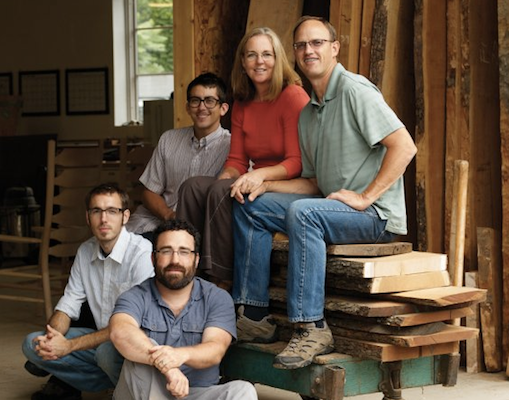
Boggs, right, with his partner, Melanie Moeller, and the Asheville members of The Boggs Collective.
The ever-inventive Brian Boggs—not satisfied with re-inventing the ladderback chair form and every tool and technique used to produce it—has turned his attention to the biggest problem of all, one that has dogged him and other professional woodworkers for decades: how to make a decent living while producing top-notch work.
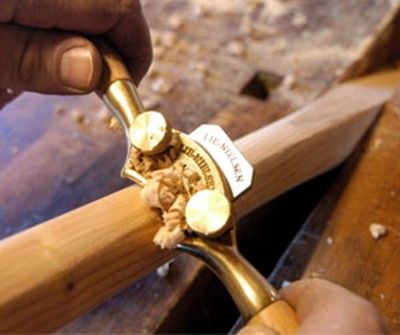
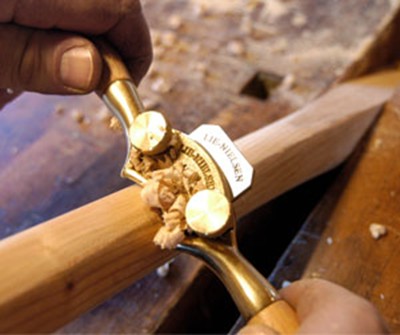 When I first met Boggs in 2001, he was in his spacious shop in Berea, Kentucky, surrounded by chair-making innovations: his Rube Goldberg contraption that sliced hickory bark into thin strips for his traditional chair seats, a huge custom steam tank, light-bulb kilns for super-drying tenons, slat-bending forms shaped like a human back, his improved version of the classic shaving horse, a sharpening method that involved diamond dust, and a host of other machines and jigs all customized for the unparalleled precision that Brian’s chairs require. And he was beginning work on a new line of spokeshaves (at left) that would fulfill the tool’s great potential. Those are sold now by Lie-Nielsen.
But when I asked this larger-than-life guy how he marketed and priced his work, he visibly deflated. He had no good answer, he said. How do you charge for a chair that was the result of 20 years of evolution in design and engineering, and the only chair that Sam Maloof bought from another maker?
Nine years later, Boggs might have the answer. He explained it at a recent seminar I attended in Kerrville, Texas, at the annual Texas Furniture Makers Show (check out some pieces from this great show). When the economy tanked in 2008 (and Boggs’ marriage ended), he saw an opportunity to start over, to change his location, reshape his career, and revolutionize his business model. “I wanted to build something bigger,” he said. He also wanted to break away from the stigma of being a ladderback chairmaker, he said.
He had outgrown the quiet hamlet of Berea, Kentucky, so he set up shop in Asheville, N.C., a growing center for fine craftsmen and a perennial draw for wealthy vacationers. But he was confronted with the same old challenges: wood sourcing, marketing, attacting skilled employees, and finding time for the design work, tool development, and joint testing that had been indispensable to his progress as an artist and maker. Plus he had new challenges: local wood sources and word-of-mouth.
Since Asheville has a strong Arts & Crafts legacy, and lots of homes in that style, Boggs began to design contemporary pieces loosely inspired by that style. But he needed to be able to have others build his designs, so he could design more pieces and evolve more quickly.
The breakthrough came when he hired business consultants to help him make a bold new strategic plan. Together they came up with The Boggs Collective.
The idea is strength in numbers, and creating an infrastructure that could support craftsman from the time they decide they want to be a woodworkers, providing training, helping them source materials, offering them designs that fit their skill set, marketing their work, giving them business guidance, etc.
The truth is that most woodworkers are not good at all of the necessary components of running a successful business, and most lack a certain level of professionalism, Brian said.
The Collective was able to hire a full-time marketer who is as good at marketing as the makers are at designing and making, Boggs said. Most woodworkers can’t afford that.
He had tried all the typical ways of selling high-end work, Boggs said. The traditional gallery is out for itself, he said, not marketing and being loyal to you. They also don’t survey the market to see what it wants from a given woodworker.
The Collective provides designs and takes a royalty when they are used. It also takes in interns and provides training. They do vet prospective members to ensure they have a certain level of talent.
Boggs says that new pros usually bite off too much. They spend their time fixing problems, rather than developing skills. So he designs pieces for them that are easy to make but still elegant. Some of these simpler designs have turned out to be better sellers than The Collective’s more complex designs, and thos elegantly simple pieces train and create better employees, Boggs said.
Then next stages are for that craftsmen to tackle Boggs’ most challenging designs, and then teach others to make them, and anytime along the way, begin to pitch his or her own designs. “He will then be designing with a fluent skill set, and with a better idea about marketing by watching what has been going on,” Boggs said. “His learning curve will be a lot faster than mine was.
“What we are trying to create is nothing less than an incubator for genius,” he said. The goal is for each member to open up his own studio, with the local ones sharing space with Brian and the others in Asheville.
Outside designers and makers are welcome, too. Peter Galbert, Curtis Buchanan, and others are already designing chairs for The Collective.
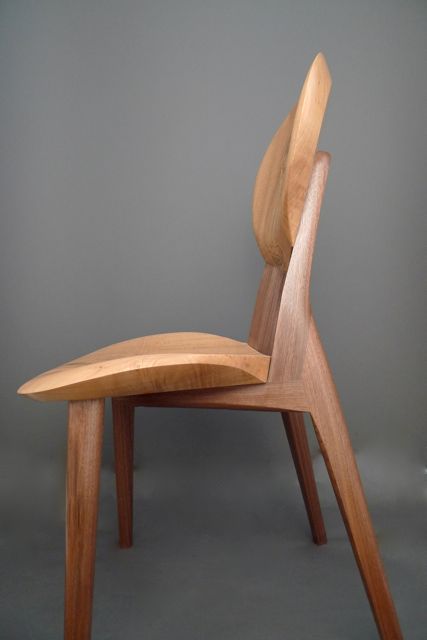
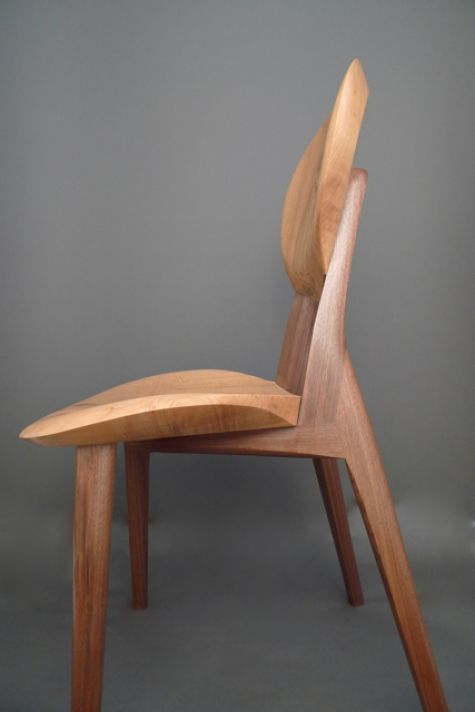 Boggs says doors are opening that never would have opened before. He recently received a $100,000 business incubator grant for The Collective. And a high-end guitar company called to get special chairs (at right) for players to be comfortable in.
Brian then gave the seminar attendees a reality check: “People have enough furniture, so what is the value that we provide?” This launched a group brainstorming session, where the answers bubbled up naturally from the group of mostly pro makers:
1. The ability to take someone’s creativity and give it a tangible form.
2. Shared passion
3. Soulful experience
4. Allowing clients to particpate in some way in the process, and give them a good story to tell others
5. Connecting to real craftsman, where they live
6. An education in quality and taste
Boggs explained that these are the principle that The Collective is founded on and will stick to, and that following them is the only way to survive. And he advised that a maker’s Web site should covey all of these value points, and also have videos of the process, joints coming together, etc., so people can share in it.
He also emphasized finding the right venues for selling, and targeting people who are educated and have money.
He donated a chair to a local chairity and then organized a cocktail party to introduce the collective to wealthy local people who run and run contribute to the charity. He also said woodworkers should direct their activities so they make for good press. For example, building the collective has been a great story.
Boggs says that organizations like The Boggs Collective can build a community of connoiseurs of furniture, just like cigars, wine, cars, guitars, etc. It’s a tall order, but wouldn’t it be wonderful if he succeeds.
-
Boggs, right, with his partner, Melanie Moeller, and the Asheville members of The Boggs Collective.
-
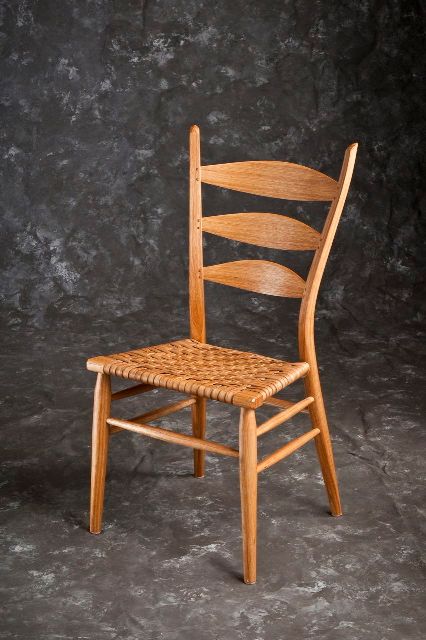
This is the ladderback dining chair that made Boggs famous in woodworking circles.
-
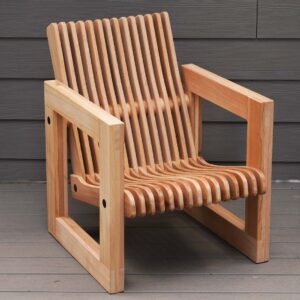
Dream Guitars of Weaverville, N.C., recently hired The Collective to design and produce a chair for guitar players. This is the result, designed to be comfortable for someone in the playing position. Boggs also developed a new joint, seen at the back of the seat, for this chair.
-
Boggs also designs his own tools. His line of spokeshaves is manufactured by Lie-Nielsen.




Comments
This is brilliant! Every other industry uses think tanks and other professionals to supplement the shortcomings of an individual. (i.e. a marketing pro, an accountant, an employment lawyer) As handy as us woodworkers are, we can all use the help of others. Well done Mr. Boggs.
Hi Brian ... i just read this post and click through to a couple of the links ... i would be interested in talking with you about your project. i have been making furniture professionally for over 30 years and currently run a five man shop in southwestern vermont. i really like your six goals and they are very similar to ones that have allowed me to do the work i have gotten to do over the years ... you can contact me through my website
http://www.dorsetcustomfurniture.com/
if you're interested .. good luck .. dan mosheim
Allowing clients to particpate in some way in the process, and give them a good story to tell others is a brilliant way to engage your customers - marketers now try to do this regularly no matter whether they are selling cheese or craft pieces. Selling is getting people to buy what you have, marketing is offering people what they want better and more uniquely than your competitor.
Perhaps a way to do that is to actually engage the customer in the design process so there is something about their piece that makes it a limited edition, one of a kind no one else will ever have - not only creates the connection and stories, but increases the value so the piece you as a woodworker are building is a valuable piece of functional art, not just a chair or table.
Michael
my try at a 'CHAIR"looks like the one they are sitting on the far right in the picture lol. only the best for "THE COLLECTIVE".I enjoy this web site very much. lots of info for a starter like me to get pro's advise. keep them comming.
I don't understand how this collective will help other woodworkers. Can you explain a little more in detail? Because on first read it seems that Brian Borg will be on the receiving side of this collective. Is he attempting to brand his designs? Plus nothing was said about generating sales during these economic times.
One can build a ship but if you don't have water it isn't much good.
Don B.
I agree with Michael about involving the client. That is not the process I will always use, but certainly for custom work it will be a critical part of how we create value in our work,
By making it speak the client's vision. As creative people part of what we do is tell our story through our work. If we can help the client through that process we become a vehicle for their inspiration.
In response to the comment by dboetb, there are several ways in which The collective serves the needs of area woodworkers.
Much of this is explained on our web site (www.boggscolective.com). But briefly our mission is to create the infrastructure needed to support what we do.
That includes making better wood available custom cut to suit the designs produced, training, design assistance, Marketing and business support. We offer a design program that uses designs by established craftsmen like Curtis Buchannan, Pete Galbert, Boyd Boggs, and yours truly, to help get craftsmen started. Our craftsmen then have good designs to build so they can focus on skill development and efficiency and established craftsmen can leverage their design skills and earn royalties. So we offer designs and a market for them.
We are also developing a local network that helps craftsmen connect with odd lumber sources hidden in barns and garages in the area, cooperative machine use, and technical and design assistance. Beyond that we are bringing Architects, interior designers and builders into our network to help us connect with and educate clients as to the value of what it is we do. That's marketing and then some. And it is working. Sales are way up since we began this networking.
So that's a start. Hope that answers your question. For more you can sigh up for our newsletter on the web site. We'll keep you posted on new developments.
Brian
I just re-read this blog Asa wrote and I think it is important to clarify that this is not so much a Brian Boggs venture. The collective is using my name to leverage our branding strength, but what we are doing is not something I would have fully conceived or attempted on my own. My business partner, Melanie Moeller has been the one to develop this concept to a level that it can fly. Without her 20+ years in international business consulting at the helm, This collective would not be.
It would still be just Brian Boggs Studio. Now my studio, as well as a growing number of other studios, is supported by a much more solid infrastructure.
Brian,
Are you now acting as a designer and less as a maker?
I understand that it can be difficult to do both design and building. However, do you feel that this takes you away from the core of your initial business as a chair maker and could possibly "dilute" your brand since you are less a maker and more a designer.
I like the idea you have proposed but I just can't really see it fitting into the American idea of how we buy things. Unless the stuff you make is cheap, it seems we are still all trying to reach the same audience. Those that have the money, know and understand quality, and have the ability and desire to engage people who make things for a living.
I guess that the collective is now more of a manufacturing site and place for a collection of ideas from other makers. Do the folks that work there act on their own as sub contractors to the collective. Or do you have employees who get a regular paycheck?
F.
Brian,
Thanks you for responding. When I first read Asa's blog it appeared to me that the collective was targeting woodworkers as its clients but now since you have broken it down for me I understand the concept a little better. Have you thought of franchising the collective in other parts of the country and is the collective set up as a not-for-profit or for-profit organization?
Don B.
We have no plans for franchising. Our company is clearly what is now referred to as a fourth sector business. There are three business sectors in most folks minds: public (govt). private for profit, and non-profit. There is an emerging fourth sector that we are a part of that is a for-benefit business. We are structured to generate our own money through our products and services, but our goals are based on our philosophy of service to society as a whole, not just clearly identifiable stakeholders. It was important to me and is to Melanie that we create a new model that could be replicated by others. But if it is not a model that can generate its own income it is not in and of itself serving society.
In response to Floss,
Are you now acting as a designer and less as a maker? Absolutely. That's an important part of the business design. I have more design ideas than I have time to make.
Good makers are more available than good designers. The Collective offers a way for designers to do what they do best and makers to have good design to work on. The idea is that this has the potential to elevate both quality of design
by increasing the potential income from one design idea. It also has the potential to increase efficiency of new makers who can focus on technique and process while making a higher caliber of work.
I don't think this will dilute the brand, but will certainly change it. It already is doing that in a powerfully positive way.
This is designed to precisely fit into the American way we buy things. Makers you know of like Moser and Nakashima leveraged their brand and profited by having others do the building. this is wholly different in that the craftsmen own their shops, are self employed, self directed, and can sell whatever they want, whenever they want to whomever they want. They are free do design and make whatever they want. The collective simply places orders for furniture as a client. We also offer lots of other supportive aspects of the infrastructure. But not as employees.
Clients can still engage the makers. We are a supportive agent to this kind of relationship. Our furniture is selling at the same price because it is made in the same spirit and to the same standard. It will also be more readily available as the collective grows.
We are getting a tremendously positive response from all aspects of the market. Sales are increasing and our clients are loving this model. It is a complex model designed to support the best of what we all do.
I hope this helps clarify the concept. It sounds like you value the same things that the collective is designed to incubate.
Thanks for all the great questions, folks, and thanks to Brian for fielding them all. This is much better than just my blog alone.
Log in or create an account to post a comment.
Sign up Log in