
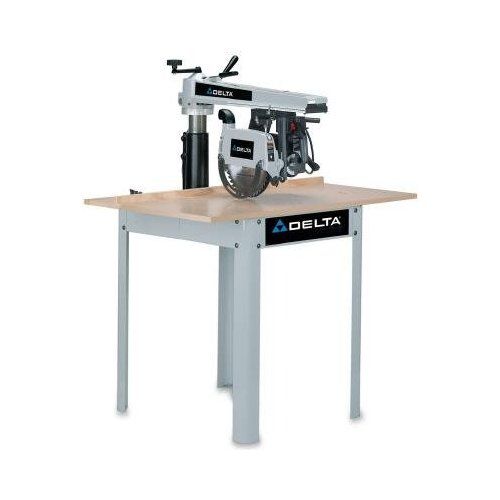
The radial arm saw: going the way of the dinosaurs?
I just read this letter that came in to our editorial mailbox:
“I’ve noticed that your magazine and all other woodworking magazines virtually ignore the radial arm saw. I would like to protest and ask that you provide more articles to the radial arm. Come on, be a leader, do it. And a test article on radial arm saws would be magnificent.”
I understand why people like the radial arm saw. It’s a badass tool. It can crosscut and make miters, but it also can be set up to cut other joinery, like dadoes. But some folks think the tool is dangerous because the blade’s rotation (toward the user) causes the motor and blade to walk across a board-quickly sometimes. There are other issues, too. It can be finicky to set up and keep square. The machines can also be pricey. Though you can buy a used one on Ebay for about $100 to $300, depending on the size and condition, most new models retail for over $1,000. That’s a lot of dough to spend on a tool that has the footprint of a tablesaw but without the tablesaw’s versatility.
 |
Poor Boy Radial Arm Saw 
Stop for a Radial Arm Saw Fence |
Fine Woodworking hasn’t done an article on radial arm saws since we reviewed a handful in August 2002. Why? Well, the honest answer is that most folks don’t own one; fewer tool makers are building and selling these tools. I’ve been traveling to woodworking shops all over the country for more than 5 years, and I have never seen one of my authors use a radial arm saw. As a matter of fact, I don’t remember ever seeing one in a shop I’ve visited. Seems like they’ve been replaced by the tablesaw, chopsaw, and compound miter saw.
So I ask, is the radial arm saw officially extinct from the workshop, or is it just an endangered species?
More on FineWoodworking.com:
- Getting Peak Planer Performance – Use custom bases and a dial indicator to set knives and adjustments
- Woodworking Machinery 101 – Our top tips on woodworking machinery maintenance and techniques
- Looking Back: The Era of Manmade Machines – A generation of woodworkers overcame the high cost of machinery by building their own







Comments
I vote for extinct, or at least it should be. I've become comfortable with all the common power tools in the shop, but I won't go near a RA saw. The way it can jump out at you always reminds me of those videos where someone puts their hand in an alligator's mouth and then tries to pull it out of the way before they get bit. It works most of the time, but once in a while... No thanks. I'll stick with my miter saw, crosscut sled, or circular saw for cross cuts and a router or table saw for dadoes.
If anyone still believes that the RA saw has a place in the shop drop me a line. My father was a hand surgeon and he's got a nice collection of photos showing the RA's handywork that I'd be happy to share.
Aaron
RA saws are a great tool in a shop that works with heavy lumber especialy from the rough ,but like any other tool you can't buy a light duty one and expect it to do everything the heavier ones can.
Have been using one since (Dewalt) 1960.. Nothing like it for cutting small
parts. Just try those on a table saw without jigs.
I've owned my ra since 1968. I use it for cuts about 25% of the time for mostly crosscuts. A compound miter is a modification of the ra so I imagine it can replace the ra. But this old salt will still keep his ra in the shop
I use it everyday for crosscutting. I do have to check it for square before I cut important parts. But for roughly cutting to length its speed can't be beat. Why doesn't someone design one that starts the cut on the side closest to you and then you push the saw away from you to finish the cut.
Considering that you can get a very high quality miter gauge for a table saw for a few hundred dollars, and the sliding compound miter saws are smaller, safer, and more accurate for half the price of a RAS, I can't see a single reason to own one. I'd be interested in hearing if there is any operation a RAS can do more safely, accurately, or for less money than either of these alternatives.
I teach woodworking and I don't let the students near it. It stopped working and so did the cheap miter saw.
We purchased a Hitachi that does the same thing as the radial arm saw and the miter saw.
It is a dual compound miter saw with a laser.
Safety guard moves whenever you make a cut.
Wish I had more tools, like the Sawstop.
Anyway Aaron Peterson if you could send me some pictures that would be great to show the students.
If your making a bunch of lap joints its hard to beat. Well if they are rough cut lap joints that is. Still hard to beat that way. (with a dado blade)
I think better and safer tools exist nowadays to do the same work that it's not worth keeping this dinosaur alive. My father lost 2 fingers on a RAS. Even if I could get one for free, I'd pass... and it's not because I'm scared of it. I've used light duty versions as well as 3HP 12" industrial models. I simply don't like the tool.
RIP RAS!
I also vote for extinct.
We have an old Craftsman RAS in our Zellwood, FL community shop. More than once, with thick stock crosscuts, the thing wants to jump out at you. Plus it never holds square.
We now have a new Dewalt compound sliding miter saw - far more precise. But we now have to remind everyone it works on a 'push stroke' - not like the RAS 'pull'. Easy to screw up.
Myself, give me my Festool TS-55 track saw for both wide crosscuts and safe ripcuts anytime.
And for small parts, get a PROXXON miniature TS.
I've been using RASs on & off since about 1978. I won't rip on them but I don't see why other operations are not safe. So what if the blade wants to come at you. It's machine limited and can't get off the track even if you let go of it. Are we not capable of resisting that slight action? It can only go one direction on one line - as long as you keep body parts out of that line there is no problem. I see it as a lot safer than a tablesaw.
I have a 12" CMS that I use in preference to my RAS for cutoff work. I'm going to leave my RAS set up with a dado set and use it for cutting tenons rather than trash it for a couple of bucks.
For panel cutting, I have my TS55
I have a 14inch Dewalt using it is not for the faint hearted.
Would I change it? Possibly, but not at the moment. When I do I will scrap the motor and put a router in the yoke to see what I can do with it.
I profess to be mainly a DIY/home maintenance/small projects but very serious type woodworker. At 69 years of age and 6 years as a pensioner I really enjoy my small workshop and am quite proud of the projects I have turned out. I bought a Ryobi 254mm model RA-2500 RAS in 1977 and can truly say that I could not work without it. Have never had any sort of accident (or incident) but I probably am hyper careful when it comes to safety issues.(To supplement my small pension I lecture at companies about welding and flame cutting safety).I believe to condemn the RAS is similar to those people who say "guns kill people" It is people who kill people, and stupid people injure themselves with power tools. Refer to the latest $1.5m award regarding a Ryobi table saw. I don't own a table saw or compound mitre saw, only a Festool 55. My saw still cuts as accurately as the day I bought it, although I do a regular "re-set and tune-up". Most of my friends envy me for my saw a many would buy it from me at the drop of a hat. Long live the radial arm saw!
I profess to be mainly a DIY/home maintenance/small projects but very serious type woodworker. At 69 years of age and 6 years as a pensioner I really enjoy my small workshop and am quite proud of the projects I have turned out. I bought a Ryobi 254mm model RA-2500 RAS in 1977 and can truly say that I could not work without it. Have never had any sort of accident (or incident) but I probably am hyper careful when it comes to safety issues.(To supplement my small pension I lecture at companies about welding and flame cutting safety) I believe to condemn the RAS is similar to those people who say "guns kill people" It is people who kill people, and stupid people injure themselves with power tools. Refer to the latest $1.5m award regarding a Ryobi table saw. I don't own a table saw or compound mitre saw, only a Festool 55. My saw still cuts as accurately as the day I bought it, although I do a regular "re-set and tune-up".Long live the radial arm saw!
I profess to be mainly a DIY/home maintenance/small projects, but very serious,type woodworker. At 69 years of age and 6 years as a pensioner I really enjoy my small workshop and am quite proud of the projects I have turned out. I bought a Ryobi 254mm model RA-2500 RAS in 1977 and can truly say that I could not work without it. Have never had any sort of accident (or incident) but I probably am hyper careful when it comes to safety issues.(To supplement my small pension I lecture at companies about welding and flame cutting safety) I believe to condemn the RAS is similar to those people who say "guns kill people" It is people who kill people, and stupid people injure themselves with power tools. Refer to the latest $1.5m award regarding a Ryobi table saw. I don't own a table saw or compound mitre saw, only a Festool 55. My saw still cuts as accurately as the day I bought it, although I do a regular "re-set and tune-up".Long live the radial arm saw!
I guess I am one of the few that still uses radial arm saws. In my 45+ years of woodworking, I have always had one, and would hate to give it up. I keep hearing how dangerous they are, but in all my years in a production shop, I have yet to see a radial arm saw accident. I certainly can't say that about table saws, jointers and shapers. Of course you can get hurt---they have sharp spinning blades!
I basically don't do anything but cross cut though. I never understood why anyone ever recommended ripping with a radial arm saw.I have used them for dados some in the past, and was comfortable doing that.
There is not a sliding miter saw I know of that would hold up in a production shop. Now we are using a 12" Delta RAS that is probably about ten years old. It's typically running 8 hours a day. For a hobbyist, I can see only having a sliding miter saw, but for production, I will stick with my RAS.
The RAS can be a work horse in any shop as I use it most often for rough cutting rough lumber to length for milling. Its the best tool in the shop in my opinion for this task. Maybe because I was brought up to respect the tool from an early age. Shop safety is paramount and the best recommendation from my old HS shop instructor 30+ years ago is to paint a red safety strip on the table surface 6" to the right and 6" left of the blade and mark it with the words "NO HAND ZONE" in front and center of the blade working area. In other words keep your hands or limbs clear of the no hand zone!
To rebut what was said above on an above post here, "and stupid people injure themselves with power tools."
That's not entirely true, as an accident is exactly what it means, its an accident and can happen to the most seasoned wood worker not just uneducated wood workers at any given day or time.
Play safe
Tony Czuleger
I have a Dewalt GE (16") that cuts extremely well and crosscuts at 90 degrees to perfection! This saw Never tries to climb the wood. That being said, my previous Craftsman 10" RAS always tried to climb cut and it was hit or miss when it came to accuracy. My point is that a good RAS is a pleasure to use and will always have a place in my shop.
I miss read Johann's post and agree with her as well long live the radial arm saw.
Tony
All tools are dangerous in the hands of untrained people who don't take care of their equipment. The RA has good points and bad, but I would like to see an honest evaluation of two or three of them. Also, Aaron, I believe everything you say and that your real name is Norm!
RAS was the first 'big' power tool I purchased and would not be without it. It is very versatile and you can use the power take off as a drum sander.
Nothing like it for accurate dados.
Yes you do have to be careful on the set up, but once set it is a breeze to repeat accurate cuts.
Like all tools, powered or not, safety should be at the forefront of your mind BEFORE proceeding.
I believe this is still a viable tool in the workshop. I have used it in a shop where I worked, and it was missing all safety guards,and now I have one in our workshop. It has been invaluable in some of the projects my husband made. No other tool would have done the job so well.
I have great respect for any power tools. USE COMMON SENSE! If it does not work right, DO NOT USE IT, get it fixed.
Don't obliterate a tool because of carelessness, not paying attention to the details, etc.
It is going to get where we can't get any woodworking done without all the "technical stuff" to take care of first.
tman67,
If you're serious that you want some photos for your students send me an email at [email protected]. I'll see what i can dig up. My dad retired about 6 months ago, but he probably still has them around somewhere. I know that he had photos of injuries from just about every tool imaginable after 30 years in the biz. Just a warning: they're very grizzly and probably not student friendly.
Actually, my dad was far less than excited when I started woodworking in high school/early college. He dragged me down to the ER with him one night and made me watch him put fingers back on. That was the best safety lesson I ever got.
Aaron
Well, my old DeWalt 770 that I bought new in 1975 is still on its first legs--but maybe it's on its last legs, too. I purchased a molding head, fence, and guards for it when I bought it, and have used it to duplicate molding in a few old houses I've lived in. The ability to change the head angle is handy when trying to match existing profiles to a bit set.
The cross-cut self-feeding tendency (at least on mine) is significantly reduced by using a negative-hook blade. I use a 60 tooth Amana Miter Box blade with -2 degrees hook.
I have also used the RAS to rip, plough, dado, miter, rabbet, and crosscut, the latter being its most frequent use these days. Before I had a tablesaw, I also used the RAS to cut half-laps and bridle joints. It can be a versatile tool.
While I believe that the tool currently in use is the most dangerous one, I have always admired the fact that the RAS doesn't try to hide the blade location from the user. Of course, on mine you have to look carefully to see the blade as I keep the guards in place, and adjust them for each situation. I also use clamps instead of hands for any setups other than a 90-degree xcut, and often for those cuts as well.
All-in-all I'll keep it, but I don't think I would buy a new or better one. This one serves my needs, when I need it.
My first power tool purchase was my RAS based upon my father-in-law's advice and he was right. I think the RAS is the most under-rated tool in the shop and the table saw the most over-rated. Table saw is good for ripping and that's about it. Cross-cutting and mitered/angled cuts or compound angle cuts can't be beaten on a RAS. You can also use the power drive to connect a sanding drum to and sand bandsawn curves down. Dadoes are more accurate on an RAS since it "pinches" the stock down to the table as you cut it and you get a more consistent depth of cut.
As far as safety is concerned, I have never had an incident with my RAS in the 30 years I have had it and I have had three kickback incidents (one resulting in severe bruising close to the family jewels) with the table saw.
Personally, the RAS needs to get a revival in all woodworking magazines. If mine dies anytime soon, I'd be looking for another one right away.
I think the RAS has been pretty much replaced by the sliding compound miter saw. I used to have a nice Dewalt RAS. Never had safety issues with it that I remember. I used it for everything - even ripping. But it was too klutzy to move around and took too much space. Now I have more space and I've filled it with a table saw and a compound miter saw. Go figure.
I have a DeWalt that is over 30 years old & I use it -- maybe because I learned to use it before the sliding miter box etc. Not really sure I would buy another because of the new miter saws and the many new jigs. I am reluctant to say extinct because I still use mine.
I have a DeWalt that is over 30 years old & I use it -- maybe because I learned to use it before the sliding miter box etc. Not really sure I would buy another because of the new miter saws and the many new jigs. I am reluctant to say extinct because I still use mine.
Nothing beats a radial arm saw for cutting dados but like most things you get what you pay for (except as noted below). I bought my first a dewalt in the early 70's. I sold it with the rest of my shop in the late 70's. In 1987 I bought a Delta 12" 33-890. Now that's a saw! I used it to build a house and then sold it when I went back to school to become and engineer. Now I am a hobby woodworker and I have a table saw, band saw, etc. but last summer I got a hankering for a RAS. I looked on an internet bulletin board and bought another 33-890 the same as I had before for $300. Apparently when the Canadian Broadcasting Commission (CBC) closed it in-house shop the employees were each allowed to pick one tool. The guy I bought the saw from picked the radial arm saw. He took it home and it sat for 10 years. It had a fine coat of rust and everything was seized up for for $300 I took it. Two days later I had it cleaned up, bought a blade and made a new top and it is like new. So if you want a RAS you can pick up good ones at a real good price. This one retails at close to $3000 and is made in the USA.
I forgot to mention that once you use a really high end saw it is nothing like a cheaper model. No vibration, no climbing and it stays in adjustment.
Yes, I think the RAS is on the way out but not because it is not a great woodworking machine but because few people know how to use one properly. Also, one popular brand is such inferior quality it should not be available.
I have a 9" Dewalt RAS I bought in 1960 and still use it regularly. It was the only power woodworking machine I had for about 25 years. I used it to crosscut, rip, shape, joint, sand and drill. I have never had an accident with it. I don't consider myself a master craftsman, just a woodworking hobbyist, but I have made some furniture I think most woodworkers would think is pretty good.
Like all woodworking equipment it is not foolproof. If you take all the guards off and use it recklesly you may be able to win a $1.5 million dollar lawsit.
WTL
Yes the RAS is an endangered species but it shouldn't be. I don't have room in my shop(garage) for a table saw but I have a great area set up for my RAS (wall to wall level, top with built-in storage). I actually have a larger, supported area for certain cuts with my RAS than I would have with a table saw. As with any tool it's safety first and it's up to the operator to understand how a particular tool works and how to use it safely. I grew-up with a RAS and find it much more versitale than a compound miter saw, not that I wouldn't mind having one of these in my arsenal of tools also! Please add the RAS to your list of tools for tips and tricks. As to Aaron's comments, my shop teacher is missing part of several fingers....from a table saw!
Leslie
This comment may be more appropriate for Fine Homebuilding, but.....
When I built my current home, I had to frame some very irregular rafter connections. I had a couple of very good journeyman carpenters who were pulling their hair out trying to get the right angles w ithout time consuming custom planing of each joint.
I used plum lines to fix the points on the subfloor and snapped chalk lines. Then I took the angles from those lines to dial in a bevel angle on my 5hp Dewalt RAS. The miter was based on the pitch. The first trial cut was a 53.7º miter and a 32.8º bevel using a 20" carbon tooth blade on a 2x12 board.
The fit was dead on, and the method worked without fail on a total of 56 cuts.
I don't know of any other tool that could have duplicated that performance.
I have a Sawsmith which my father purchased many years ago. It is a very useful tool. Probably better for construction work than a table saw. Although I do think that it is probably easier to do some things and be precise with a good table saw.
I note that RA vs Table is not the only choice for a single saw. I guess that they don't make that Scandinavian saw that was like an inverted miter saw that would also rip. Like the RAS you didn't have to move the wood to cross cut or miter, but the width was limited. Mafel now makes a really nice alternative table saw where you move the blade rather than the wood to cross cut -- other than that it is a regular table saw. It would make both obsolete for a shop saw except for the price.
It you RAS tries to attack you cross cutting, you can start with the blade out and push it through the work (which is always recommended for using a dado head). Having a good blade that is sharp also helps. You also need to learn to have your forearm straight, level, and parallel to the saw arm with you elbow in front of your body so if the saw starts self feeding that it would have to try to knock you down rather than just move your arm.
I've cut a lot of wood with various radial arm saws and my opinion is that they are marginally accurate and they make me nervous from a safety standpoint. A good sliding compound saw strikes me as what every radial arm saw always wanted to be - safe, and accurate.
After 13 years of woodworking, I advised our woodworkers club as we selected equipment for our shared cost community shop. I recommended a sliding compound saw instead of a radial arm saw - Over the club's 25 years of operation, no one in the club has ever wished that we'd made the opposite choice.
Once a good Delta radial arm saw was given to our club - we discussed it and the decision was unanimous - we sold it and used the proceeds to buy router bits.
I love machines and I hate to see one fall by the wayside, but I really think the radial arm saw's time has come and gone.
Mine is a 25+ year old 10" Craftsman. Great for cross-cuts. I also use it for dados with a router bit or dado blade, and compound miter cuts. Stick a masonry blade in it and it is great for bricks & stone (used it when I made my patio.)
Long live the RAS!
I have used my radial arm saw for over thirty years and consider it second only to my table saw. It is on a 10 foot table and is very accurate and safe for crosscuts. I would never buy one of the toy chop saws and I cannot see why they are so popular. My craftsman radial arm saw was $90 when I bought it and it still works perfect. I have built three buildings and countless pieces of furniture with it and would not be with out it.
The RA saw is one of the best tools I have ever used. I can't imagine why manufacturers would stop production. What is the real reason for a possible demize? I for one would vote to keep it!
I had a Craftsman 10" RA, bought new in '63 or so... Used it until I found my current table saw, a 1940s Walker-Turner 10" that I could not pass up... Had some use for the radial, but then along came a Delta, then a DeWalt Miter saw... Craftsman RA gathered dust, but I had the cabinet base, so kept it but it really became a storage rack for stuff..
Finally, I decided it had to go, since I saw them at the flea, going unsold for even $25, I didn't bother trying to sell it..
Took it apart, broke it down to it's components, and recycled it.. It served it's purpose, I think I tore it down in 2006 or so, 43 years, not bad for a consumer product of any kind...
weco
I don't consider the radial arm saw to be any more dangerous than most shop machines. Like any tool it can be very dangerous when not used properly. Back in the early 70's when I was in shop class the instructor gave us a special talk complete with graphic cautionary tales about the two most dangerous machines in the shop: the table saw and the lathe. Sure enough, one kid shot a big board out of the table saw by using the rip fence on a piece that was wider than it was long. Luckily no one was killed.
I had never owned a RA saw of my own until a short time ago when I had a chance to acquire a 1960's Dewalt in mint condition. I plan to give it a permanent home along the shop wall. It's a heavy beast with a very well built arm and I would certainly use it for short dados on long pieces of sheet goods like bookcase ends rather than messing about with the table saw or a router.
I think that it's not the lack of versatility that has killed the radial arm saw, but the lack of portability and space. Not many people have a 20 foot wall that they can devote to a full radial arm saw station.
Most comments are that the sliding compound beats the RAS for crosscutting (and I'd agree), but the sliding compound cannot do something the RAS can do extremely well, and that is set the blade height for less than a through cut. This makes the RAS extremely fast for laps, dado's etc., faster than a table saw and much easier since the pencil line is facing up where you can see it.
If someone would design a sliding miter that could duplicate this function, this would be a huge improvent and then I'd say the RAS is fully replaced. Until then, I find mine invaluable and use it all the time after 30 years still.
Biggest drawback is keeping it square for sure.
My first radial arm saw was purchased at a garage sale for $30. It needed a new cord, new blade and new table. It was a DeWalt 2horsepower. I used it a bit but was kind of afraid of it. I then got a copy of How to Master the Radial Saw by Wally Kunkel (email [email protected]). I soon realized that there really is not too many things I cannot do with a radial arm saw. The tips from that old guy were nothing short of a miracle. Wally Kunkel was the original Norm. He was the very first person to operate a power tool on T.V. I now own two radial arm saws as well as a table saw. I also use my Festool hand saw for sheet goods. But for production work I find there is nothing better than my radial arm saws. Once they are properly tuned and adjusted you cannot get a smoother cleaner cut. No burns, no blade marks, just nice clean cuts. I can understand why many people are confused and afraid of them. Improper use of any power tool can be dangerous if not fatal. Too many amatures with little or no training and a lack of respect for sharp spinning blades that can eat fingers like popcorn. I just turned fifty this year and the only time I have ever gotten so much as a scratch, I was putting the first blade on my table saw with the piece of crap tool that the manufacturer supplied with the saw. Three stitches (thanks Delta). I recently made some custom picture frames for a neighbor and was able to make both the left and right hand cuts without moving the blade on my radial arm saw. Even if my saw was a full degree off (it was) the corners went together perfectly.
Why buy three saws to do the work of one radial arm saw.
I have to add another comment. Delta could have built their RAS with cross supports on the legs so the table wouldnt go out of square so easily. I had to add some angle iron to mine so it would not wriggle so much. I also had to redo the table so it could be tuned correctly. They obviously did not know what they were doing. I will say that now that I have UPGRADED my Delta that it is a fine workhorse, but out of the box it was a piece of crap. I own a lot of Delta tools and would recommend them to most shops. But the their RAS needs improvement.
i purchased a sears-craftsman 10" radial saw in 1976, slightly more than a year after my wife and i purchased our home in san diego. . . i have a "dinky" shop space: the one-car garage is 12'x21', and my radial saw was a shop mainstay due to its versatility and relatively small footprint. . . i built a base stand for it, and the base covered 36" wide by 28" deep, and i had a 6" space behind it to the wall in order to use dust hoods and other jigs i had devised for its use. . .
my most useful jig for my radial saw was a small table-top bench that i secured to the radial saw table with screws. . . i could then use the radial saw as a horizontal boring machine, and--also using routing bits in an auxiliary chuch/collet on the output shaft (not the blade-side shaft) to make mortices and tenons faster than you can run to the refrigerator in the middle of the game!!!
i also used it for disk and spindle sanding, again with appropriate jigs. . .
actually, in my experience, in more than 35 years of use, i have NEVER had a dangerous moment with my radial saw--that was primarily due to the fact that i was basically very nervous about its use. . . like my two chop saws, both dewalts, one 10" and one 12", the blade travel on a radial saw (towards the operator if it climbs up on the material you're cutting) instills a lot of repect for potential calamities. . . every time i used it, i could just picture the blade going cleanly through one of my hands if i didn't have my hands positioned correctly. . . but, since i almost clamped the material down on the left side with the good side being cut coming off the right, but a lot of times, that depended on grain, length, and thickness of the cut. . .
i did experience two scariest moments whild using my radial saw:
once, during an in-rip operation, my hold-down loosened up without my noticing, and the radial saw produced a gratuitous dent in the back of my truck/camper when it sent a small waste piece hurling through space--the truck was parked in the driveway, the garage door was open, and a piece of stock roughly 3/4" square by about 40" long went head-long by me and tried to embed itself through the camper door. . . since i always stood to one side, more in front that behind, similar to the correct stance for using a table saw, i was never in danger of being hit by the kicked-back "spear". . .
second, i was doing a 90-degree crosscut of a piece of 12/4 walnut, which was 9" or 10" in width. . . i had picked out the piece, beautiful, from a local hardwood dealer, and it had a through-and-through 1-3/4"-wide know just about at the center of the board, face to face. . . i was planning on simply cutting the piece in two, as called for in my plans of my project at the time. . . with all hardwoods, i both clamp and feather-stick the stock, so that the pieces won't move (or fall) off the radial saw table after the cut is complete. . . with all hardwoods, i also use what i call a "straight-arm" grip, so that my control of the carriage is more pronounced by the use of more muscles in my arm. . .
well, i clamped and checked, and checked again, and made sure the blade was on the cut line through the middle of the length of the board, which coincidentally ran through the middle of this knot. . . i started the saw, and started the cut, and as i got about two-thirds of the way through the board, i heard and felt a loud bang and the sawblade stopped right now. . . then the motor-temp breaker popped, and everything was quiet again. . .
what had happened was that as the cut approached the knot, a bunch of internal stresses were relieved, and--using the knot area as a pivot-point, the board shifted length-wise and the kerf closed on the sawblade. . .
this event was nothing that i had ever considered happening--wood moving, how novel. . . how BASIC!!!
i ended up using a hand saw to go the remaining couple of inches to complete the cut and release the saw blade, but, man, did i get smarter right quick. . .
i had read about it, but wood doesn't move too much here in southern california, so it's pretty amazing and intense when it does, especially as this one occurred. . .
my radial saw is gone now, replaced by a real nice table saw and two miter saws. . . but there are some times when i start a given procedure, and i think--this would be so much easier on my radial saw!
i gave my radial saw to my best friend, who keeps it covered on his patio and uses it very often while he's involved in remodeling or rebuilding or repairing things in his home. . .
he says he's only borrowing it, because he says one of these days he knows i'll build a bigger shop, and then i'll have room for it. . .
so--for my money--radial saws DO have a place in woodworking. . . just like i have many different types of wrenches, of screw drivers, and other tools (how many planes do YOU own??? i own, maintain, and USE fifteen different planes. . .
woodworking is conceiving, planning, testing, and completing processes. . . nothing is built in one process--each component of any project can require many differing process to create and apply to the finished product. . .
for me my radial was was all about options--and many of the optional services it performed were much safer, and surely more quiet, than others i routinely use today without the radial saw. . .
--gus maier
san diego
The Festool plunge saw on a MFT table with guiding rail (or any equivalent setup) is functionally close to the RAS, and looks safer. A router is needed for dadoes, but ripping is less a problem. They also stand at different extremes of dust collection. But extinct, there is no reason to throw them away, but there is no compelling reason to buy a new one.
My radial arm saw is an old 220V DeWalt (back when they were a sickly looking green color and not bright yellow)which belonged to my father and now resides in my shop. I use it exclusively for cross cuts and sizing long planks and wouldn,t dream of using it for ripping for all the safety reasons mentioned. I wouldnt buy a new one but cant dream of not having it in my shop. It's not portable, can be dangerous and everything it can do some other tool can do as well but if you have the space, it is a wonderful tool to have
Robin
A few years ago, a friend and I bought the machinery out of a local cabinet shop when the owner decided to retire. One of the items we got was a 1957 Delta 12" RAS, that they were using on a daily basis.
That brought my personal inventory up to two in addition to a 12" SCMS. Already had a early 70's Craftsman that was, & still is, the most used tool in my shop. A pain at times to keep in adjustment, but frequently the fastest way to do what I want to do.
I've heard that the old Montgomery Wards RAS had a tendency to climb over the board, but with the Craftsman & the Delta, the motor will stall because the strength of the columns holds them in place with no problem at all. I suspect those people that have had problems with the saws climbing over the work have failed to keep the column supports & track bearings tightly adjusted.
So, the basic difference between a radial arm saw and a table saw is what moves, the wood or the saw. A table saw requires that the user move the wood past the blade. Perfect for woodworking. A radial arm saw requires the the user move the blade over the wood. Perfect for 16 foot 2X6s and the like. This is why every lumber company I have ever visited, including Home Depot, uses a radial arm saw to cut their lumber. A job site for home building practically requires the use of a radial arm saw. The other two types of saws mentioned, the chop saw and the compound miter saw, are useful for shaping small boards. However, the chop saw comes down on top of the board and the blade rotation forces the board back towards the saw housing. Here, we have forces in two planes relative to the board. In a radial arm saw, the forces on the board act in only one plane which is safer. When cutting 30-50 pounds of lumber the last thing a worker wants is for the lumber to start moving during a cut. Also, a compound miter saw is limited as to the width and the number of boards that one can cut. Generally speaking, a radial arm saw is set up perfectly to cut any size board quickly. During and just after the cut on a radial arm saw the boards clear the blade right away without pinching, a very big deal when cutting long or short boards. This is my experience. Currently I do not own a radial arm saw because of space limitations. If some person knows how to set up one of these other saws to perform like a radial arm saw, kindly let the rest of us know how to do that as well!
By the way, the email address suggested by Dugman: is not a valid email address! Is there an update or correction available?
The email address suggested by Dugman "[email protected]" is the one I tried but does not work, is there an update or correction available?
I use my radial arm saw a lot in my shop.
Try dados on a sliding miter saw. I don't think so.
Caution. You need a brain to use one safely!
Try doing this sometime with a table saw:
http://www.owwm.org/viewtopic.php?f=1&t=56757&p=393702&hilit=radial+arm+saw+barn#p393702
A radial arm saw has its place in a shop. The trick is to get one with a solid cast iron arm. All the ones put out over the years with a metal frame arm with sheet metal over top are absolutely worthless.
I have had a RAS for over 25 years. I would never part with it. The argument that it is a dangerous tool, comes more from inexperience or fear than anything else. The only thing dangerous about the saw, generally, is the person operating it.The same goes for any other power tool in the shop. The RAS has always been more versatile than a SCMS and always will. Show me a SCMS that can make 45 degree cheek cuts on a mitered tenon and then make 3/4 wide 3/8 deep dado's 16 inches wide. Sorry, there will always be a RAS in my shop and for good reason. It is a quality tool with versatility.
Aaron is probably right - but I hate to admit that my 10" DeWalt belongs in the dumpster rather than in its hallowed place in my shop. My dad got it in the late sixties (one of the last original DeWalt castings). Because he had one, I bought one in the 80s when I was a remodeling contractor. That saw put me in the emergency room once with a gashed thumb...or I should say that I put myself there since I stupidly reached behind the spinning blade to dislodge a thin strip being ripped. Picture it? Countless close calls since. The motor had a wobble to it and in those days I didn't take the time to figure out how to fine tune all the adjustments. In the end I rolled it off the back of my truck into a dumpster when I got an office job.
Fast forward 20 years and I now have my dad's old DeWalt. I have a collection of books, articles, emails, and photos all related to keeping the damn thing accurate in half a dozen different planes - including the table top itself. Sadly, it's my only saw and there's a strong nostalgic tie there, but I should get a grip. I'm good with it for sure, but it's still scary to use. And no matter how hard I try, I can't get every single adjustment to be dead-nuts-on all at the same time. One of these days I will get a good table saw and a sliding compound miter and that will be the end of it, mercifully.
Human beings are resourceful when it comes to injuring themselves. Don't think it's fair to accuse the radial arm saw of being responsible for a disproportionate share of those injuries. Besides, if you aren't a little intimidated by a tool I'm not sure you properly respect it. I think of those potential disasters each time I reach for its switch and grab hold of its handle.
Every time I see a radial arm saw I see my dad's age of woodworking. That was and is his go-to tool. (He's 79 and still has all his body parts, unsevered, by the way.)He had a green Delta until the neighbor borrowed it and burned it out. Has had a Craftsman ever since. The shop would seem empty without it.
I own a radial arm saw made by a company in Iowa.It is built almost identical to the old Dewalts.I had this saw for over ten years now and would never part with it.I use it mostly to break down lumber and for perfect 90 degree crosscuts.I believe the last adjustment was about three years ago.As far as danger,as in any cutting tool ,pay attention on what you are doing .
I've had a radial arm saw for many years, after inheriting it from another family member. It's useful but really tough to keep square and true. Every time I make a new setting, I have to check for square with the table and the fence, adjust it, and hope it won't drift while I'm using it. I agree with the comments about safety being the user's responsibility, but it's still a scary machine. Ripping with it just doesn't make sense if you have a table saw, and most mitering operations are done better with my sliding miter saw. This year, I moved my shop from my garage to a larger space in my basement and now have enough room for a cabinet saw. I left the radial arm saw in my garage shop. I still have it and can use it, but it won't see much use. I do have a project coming up where I'll need it to cut some dadoes on some bulky stock that wouldn't be safe on my table saw. I guess one test of the value of it would be to ask if, I didn't have it now, would I get one? Probably would be low on my wish list. Mike
I say get rid of them. There are far better options. At best, these saws were intended for cross cutting. Yes, you can do lots of other things with them with the right accessories (I did), but seldom at a high level of precision. It may be that the RA never reached its potential given that they were sold largely to hobbyists and DOY types (yep, that's me too), and as a result were often cheaply made. I packed mine away long before I could afford my first good table saw as I could do most of the cutting I needed with a portable circular saw and a good straight edge. I'm just glad that at this stage of my life, all ten of my digits are present and whole.
Well, it's extinct as far as I'm concerned.
As an owner of three of them, in the past, I can tell you this. I won't give the precious floor space to another one. I've given the RAS all the money, time and material I can.
Imprecise and cranky, dangerous, too, it just doesn't compare well with other saws. Not even the ShopSmith.
The maintenance factor alone makes it a poor competitor. I just don't want to have to check a saw every time I use it to see what else has slipped out of square or gone loose.
I find my stationary cabinet saw is rock solid and even when I check it, rarely, it's still square and parallel, and needs only cleaning and lubrication.
Is the Radial Arm Saw extinct?
I hope so.
Don "Dances with Wood" Butler
Many years ago the RAS was the first saw on a building site. I learned to use it to rip, dado, crosscut, etc, as others have commented. I rarely see them on a jobsite since the young guys haven't learned what to do with them. They do the same tasks in ways I consider more time-consuming or dangerous. Dancing long stock across a tabletop table saw with a makeshift outfeed support is acceptable it seems, as is trimming and clearing a rafter perch freehand with a circular saw. But since there is always the fear of the unknown or misunderstood, these same guys look at a RAS as dangerous.
In my own shop I have an old 5Hp 14" Porter Cable RAS. They are as distinctly different from a cheap RAS as is a tabletop table saw different from a cabinet saw. I have it in line with, and sharing a common fence with, my chop saws. If I want a quick and dirty cut, the chop saws can do the job. If I want a very precise cut, or just want to enjoy the luxury of the silky smooth sound and feel, I'll make the cut with the RAS.
I may be a tad older than some of the readers, but I do remember when the handplane was also considered dead by many woodworkers. I took a while for people to realize that the belt sander didn't actually do the same job and was not a good substitute. It rarely is beneficial to compare unlike objects as if they are actually alike.
We have a radial arm saw, vintage 25 years or so old. Took a bit of effort to get it rehabilitated, but now it is one of the most valuable tools in our shop. Yes, it takes some care in use (easy to let the blade "walk" into the wood, stalling it out or causing mischief), but with care it does so much good work.
So very glad that one came our way and wouldn't trade it for anything.
I wouldn't buy a new one but I would hate to loose the one I have. For cutting a panel that is too wide for my sliding compound miter this is the perfect tool. Industry should just produce a fixed radial arm that is set to dead on 90 degrees with a throat capacity of at least 24 inches....now that I would buy.
I'll vote for extinct. I've only ever owned one, and it's the last one I'll ever own. I can't think of one thing you can do with a RA saw that can't be done better otherwise. Sliding compound miter saws can do 99% of anything you can do on a RA saw and do it much safer. Back in the day when RA saws were invented, there was no such thing as a sliding compound miter saw, so they did with what they had. Once you're used to a particular machine though, you're better off sticking with what you know, but we have better options now. RA saws jump, stick, drift and grab, and I like all my digits intact, thank you. I have a small one in the back of my shop. I don't use it. I've often thought of tearing it apart to make a panel saw out of it. If anyone wants it, come get it out of my shop, you can have it. Beware though --- it's a rolling piece of junk destined soon for the dump!
I have been building cabinets as part of weekend buisness for years, and have had real issues getting square cuts on the carcass pieces. two years ago I spent a fair amount of time trying to decide whether to buy a RA saw or get the Festool MFT table. I owned a RA saw years ago, but had to sell it when moving to the West Coast.
After several months of research, I decided to buy the table. I was already using the saw I needed. I can say it was an excellent decision. I did not have to spend a ridiculous amount of money to find an iron arm from 50 years ago, or get a new one at the industrial level. I don't have to worry about alignment except to make sure the guide is square. I couldn't be happier. It's not for everyone, but it certainly was the right decision for me.
I've lost track of how many Radial Arm saws I've owned over the years. I keep thinking I can live without it and it eats up a fair amount of my small shop.
I vowed the last time I bought a RA saw it would be my last.
I love it for making half laps.
I've sent some smaller boards flying with an aggressive bite with a 3/4" dado. While "Norm" pulls back with ease when he's half-lapping green wood.
It's an expensive tool with only limited uses, but I've found out I can't make some cuts without it.
It's like selling your pickup and thinking you can make do...
It can't be done.
Jim G
I own a restored 14" Delta. The 70's motor blew out and Delta does not sell Single phase motors for this saw. I replaced it with a vintage Rockwell Motor and all is well.
I think this is a great tool for cutting long boards and most cross cutting tasks. It also is great for dadoeing tasks. I cut a plastic garbage can and placed it behind the yoke and attached to my dust collector and it picks up 95% of the dust. I use it almost as much or more than my table saw. Its part of my top 4. Radial Saw, Table saw, band saw and Drill press.
The radial arm saw has been a staple in my shop since 1977 when I bought a top of the line 10 in Dewalt. I've replace the DeWalt with a 12 inch radial sold by Original Saw Company. I consider the radial easier to use than a table say and, since you can see the blade, it is more safe than a table saw.
What I'm reading is that the RA can do a couple of things that nobody does very often maybe a little better than other tools that do everything else better, take up less space and are more versatile. My experience with them is scant; I had an old Craftsman in excellent condition for a few weeks recently. So I don't know much about them. I bought it used for not much to do some rough on site carpentry and then sold it for twice what I paid for it. That seemed its highest use. I remember using an industrial quality RA in a huge shop forty-some years ago. It had its place there, but a consumer quality RA in a home shop is, I think, a waste of space. So I think it's a question of the quality of the tool and where and how it is to be used; big pro shop, probably good, but consumer grade in home shop, not so good. Does FW need to devote space to them? Not as long as there are still copies of Mechanix Illustrated from the sixties around.
You haven't seen one so it doesnt exist? How about molecules do they exist or wood in a cabinet shop -only particle board exists?
When you cut a dado with a RAS you can see what you are doing. Very different from a table saw & not possible on a chop saw or sliding compound miter. On costs- what does a good cabinet saw cost or even a good contractor's saw? Anyone with an RAS should have Walley Kunkles "Mr Sawdust" book. Search Mr. Sawdust.
How about an actually researched review and report of the state of the RAS?
Sixty years ago I pulled my red wagon to a local lumber yard to load up with cut offs from a well used 16" Dewalt. When the Lumber yard closed in the late 70's I purchased that same saw for my business. I wish I had kept track of the thousands of Start/Stop cycles it has seen in the past 30 years building semi-sized crating for domestic and overseas shipment of pharmaceutical processing systems. It along with a panel saw have been workhorses in our shipping department. I'm not aware of a better tool for the job.
In the absence of a RAS, what is the preferred method for cutting Dadoes in long boards (8') that you really can't run across the table saw?
There are lots of used RAS out there at prices from $100 to $350 and I just saw one in a thrift store for $325. I happened to get mine for free as the previous owner simply wanted more room in his garage and knew that I was a wood worker. I had been looking for one anyways. So I brought it home and tuned in up by making sure it had a good quality, sharp, 40 tooth blade and squaring it to the table both vertically and horizontally. My dad has always had one so I know it's value and how to make good use of it. It is my go to saw for cross cutting, especially for multiple identical length cuts. I also made my own base cabinet on casters with storage making it mobile and handy.
Eric
For me RA is a keeper, but this is turning into a religious war. If you are in a shop, you are automatically accepting some level of 'danger' in your life. But then again, going to the bath room puts us all in the most dangerous room in the house on a regular basis.
It looks to me like the 'new tool' that is going to come into the RA slot in several shops. It is the Torque Workcenter.
Basically think a cross between a RA and a gantry mounted router. It is from Australia, but seems to be gathering quite a foot hold.
Like new RAs, it is not cheap, but it has a replaceable power tool, so you can use it with a circular saw, chain saw, router, and I am sure other tools. It is manually operated, so it is NOT computerized, and no CNC.
There are distributors in the USA. I would like to see FW do a review of this tool, and compare it to competition. Fact to fact (and take some of the religon out like we see in the comments of this discussion).
http://www.torqueworkcentre.com/ - and no, I have no stake in this tool or company, I just would like to use one for a while to see if it is worth it to me.
I do remember seeing plans for making a 'swing saw' on an old Mechanics Illustrated back when. It was basically a cross cut saw with all the dangers of a radial arm saw and more and much less flexibility to do what it does. When I saw that, I just thought how much safer a RA is than that beast.
... Jack
Emerson is providing a repair kit for a new blade guard or $100 to owners of certain Craftsman RAS.
I got one and they are very nice.
http://www.radialarmsawrecall.com/
I'm happy with my radial arm..I use it on every project I do.
It's a 10 inch 1986 model craftsman. I also own a miter saw, a contracter style tablesaw, and a bench top tablesaw.
and I'm thinking about replaceing the mitersaw with a slider.
I like the radial arm because of it's cross cut capacity.. I never, ever, never, rip with it, even though it does a good job of it.
I also never, ever, never cross-cut with my tablesaws.. to me that is as dangerous as ripping with the RA.
If you buy best quality blades, keep them sharp, respect your tool, and keep your hands away from the blade, you greatly reduce your chance of getting hurt, Most of the people I know that have got hurt, were either where they shouldn't be, or trying to make the tool do something it shouldn't.. or in a hurry.
Would I buy another one ? Yes, but only if the one I have now went belly-up....
My vote does not matter, as I have my first and LAST RA. What others choose for their shop is a personal matter. But I've worked wood for 50 years, and bought my Craftsman RA ten years ago, used. How did I do without it before?
If your RA is trying to "jump out" at you, you probably have a positive-rake blade, WRONG for a RA. You need a negative-rake blade. Forrest make a couple of EXCELLENT blades specifically for RAs. I can peel paper-thin end-cuts at will. Using a table-saw blade in an RA is a BAD practice.
If you saw keeps going out of alignment, you've got something wrong, and you need to spend some time with the tool's manual and instructions. Once I set mine up, it's been DEAD-ON PERFECT ever since.
I always have a high degree of respect for what ANY power too can do to the himan body. The RA is no exception, and, until recently, I thought mine was a bit on the unsafe side, what with an exposed blade, rickety guard assembly that usually got in the way, and poor dust collection provision. But if you own one of many qualifying Craftsman RAs, you can check the sears.com site, keywords "radial saw recall", and you'll find they will send you a VERY NICE kit to replace your blade guard with a much better, safer unit, with integrated dust collection port and a handle-mounted lever to raise it and lower it on demand, new table and fence MDF (!), new mounting hardware, and a GREAT manual to show you how to upgrade the saw and re-align it. You don't need a receipt, but you will need the model and serial. It made my RA like new, and made me feel a LOT safer. and it was FREE!
I've used fixed- and sliding-miter saws, and they have their uses, but for me, this is a shop tool I will NOT release. No need to. It should outlast my lifetime, and maybe my son-in-law will take it then. Until then, it's MINE!
I have had a old craftsman for years. and it has worked really well. But when my new shop is buitl i will probably not set it back up because of space issues.
My RA (35 year old) is used every day for right angle square cutoff, rough and final, and nothing more. Have it on dedicated table with drop down stops left and right. Also have a ten pound weight on a cable to the head so that it auto retracts. Having my RA set for one very common operation saves so much time. Use the compound miter saw only for angles. Have plans for extending the rails to increase the capacity to 20". Miter saws can't do that.
James
The radial arm saw should go the way of the dinosaurs in my opinion.
I owned a radial arm saw for 35 years. It was the first power tool my father ever bought, and I loved it then! I also have used a radial arm saw as a professional cabiet maker. I hate to sound cold, but I gave my RAS away about six months ago.
While I agree they have their uses, there are so many options today that do the same jobs MUCH better. If you use a RAS for a few varying angle cuts, the fence and the table becomes a mess. Dados? A router does a MUCH better job. Compound miters or crosscutting? Sliding miter is the only way to go. Ripping? Forget it. Portability? Forget that too. Good ones are massive and weigh a ton.
Honestly, I have had FAR more near accidents with RASs than with any table saw I've used. In my opinion, RASs are less safe than properly equipped table saws, Sawstop or not. The fact is, the RAS may do several jobs, but it doesn't do any of them as well or as safely as other tools.
To me, the table saw is the "Alligator's mouth". If you are not wise enough to keep your hands away from the cut line on a RAS then you will be likewise dull about using a table saw. I have used a RAS for 20 years and on only two occasions had the blade climb the work. Once when cutting a material I had no business cutting and the second when I sneezed during a cross cut. In both instances, my hold hand was nowhere near the cut line and I did not release the guide handle on the head. The result was NO INJURY.
I am legally blind and use the RAS because I feel more comfortable with it. I rip with it too. Being sight challenged just means I have to pay a lot more attention to set up and method. As with any power tool, you have to use your head and plan, plan ,plan.
I can understand why the tool is loosing favor in today's shop, but I think there continues to be a place for it. I inherited a 9" Rockwell saw that my Dad had bought in the 60's and I wouldn't part with it! Let's see a chop saw create raised panels or cross cut a 15" panel!
I have never had a radial arm saw, and never will.
A friend offered to give me one (he has 2 ... both 60's vintage DeWalt 10"), and I said 'No, Thank You'. Why? I have used both of his saws, and I just don't feel safe with them.
I'm far more comfortable with my table saw and CMS.
I set up my shop in 1983 and the first major tool I bought was a 10" Delta radial arm saw. It was versatile but it was hard to keep it perfectly aligned. Today, sliding compound miter saws provide far better control and accuracy for cosscuts and miters, and a good table saw does the rest. Last year I finally took the radial saw down, replacing it with a 12" Bosch SCMS that sits on a cart and rolls out of the way, or to the work site. I think the radiam arm saw has outlived its usefulness.
I wrote a letter to FW a few years back suggesting that the RAS is overlooked. I've been using one (my second) for many years, and find two main advantages, plus a few others.
The big plus is that the saw takes up far less space in your shop than a table saw. You park it against the wall, instead of in the middle of the shop, as you have to with a table saw. That leaves more space for other things, like a jointer, bench, or assembly table. You don't have to waltz around an RAS the way you do for a table saw -- especially a big one.
Second, as already noted, the RAS is a champ for crosscuts. And for crosscuts on thick pieces (like a 4x4) it's MUCH easier and safer than a table saw.
Blade changes are easier too, and so are dadoes.
Nobody mentioned a feature that sold millions of these saws in the early days: their verstility. With the proper attachments, you can drill (including horizontally), sand, rout and even plane boards. When houses and shops were smaller, that meant a lot of woodworking capability in a pretty small space. Unfortunately the declining popularity of the RAS means nobody makes most of those attachments any more.
On the minus side, an RAS does not do well with sheet goods. The bigger they are, the tougher on ab RAS, long crosscuts on larger sheets just plain can't be done. Cutting box joints is impossible.
Ripping is the RAS's biggest limitation. Unlike the table saw, it takes at least a minute (usually more) to switch from crosscutting to ripping. And feeding some boards -- especially longer pieces of hardwood -- into the RAS to rip is not for the faint of heart. (Safety tip: use TWO push sticks -- one to push the board into the blade, the other to hold its outside edge and keep the cut from wandering away from the fence.)
Finally, there's the issue of quality, especially with the best known brand of radials. On mine, for example, the yoke simply cannot be trusted to pivot exactly 90 degrees when swithching for crosscut to rip mode. Two company installers and a replacement yoke plate could not fix the problem, and there's no excuse for it. (The Emerson co. made mine.) The unreliability means I have to measure the blade angle by hand every time switch to rip mode, and that wastes a lot of time.
Still and all, I love the thing, and will keep it, even when I win the lottery, bump out my shop, and spring for a top-of-the-line table saw.
Bruce Kinsey
Golden Pond Woodshop
F
I had one for a couple of years and quickly came to the conclusion that it was the most dangerous tool in my shop and got rid of it. I replaced it with a sliding table for my table saw.
Well I doubt there is much to say that hasn't been said already on this but...
I really wonder about all the fear around RAS blades "jumping out" and cutting off fingers (or arms or heads or whatever)!
Who puts their body in the path of ANY blade? These folks are all lining up to sue Ryobi! Instead, they should sue their parents for raising them to be foolish (and whiners to boot!)
1)Respect the power you are working with; 2) use your brain; 3) use the tool properly; and 4)for Pete's sake, stay out of the blade and its path!
Pretty basic rules of any power tool.
Besides, if you don't watch out we are all going to have to pay for "flesh-sensing technology" on our adjustable wrenches thanks to the smirking "I told you so" SAW STOP!
There is no question for fine work there are some great alternatives these days but few saws have the versatility of a RAS. Industrial shops still use industrial RAS all over the world. I reckin' its the cheap saws and amateurs using them that give the RAS such a dubious reputation.
Endangered (by Lawyers and their clientèle) maybe but extinct? NO!
I've had my DeWalt since 1965. It was my first stationary power tool. My shop is much more complete these days including a table saw, but I still use my RA all the time. When you have your table saw set up for some specific cut, it's great to have another tool so that you don't need to break your table saw set up. The Radial Arm Saw is a most versatile tool and a great component in any wood shop. I would not part with it.
I've worked with a ra since I was a kid big enough to reach the the saw, Over sixty years .. and without a incident..I have all ten. A few years ago I designed a ra table for the ra. You keep the head straight and move the fence.You don't lose the width of the blades cut, can also cut dado's. I tried to sell it to a couple of companys with no result except a time after that they came out with a very similar version.I guess it's not dead. If you would like to see mine you can visit me at "ronrobwoodworking.com " go to "my blog" and take a look. If you like it email and I'll give you the plan.
I used a RAS extensively in college, but when it came to set up my own shop I bought a miter saw because I felt it was more versatile. No I wish I had one in my shop to cross cut wide boards. I am actually looking on the used market for one now.
So... Extinct? No way.
But not the first tool I would buy for a shop. (It does have it's place though.)
I hate to be at the tail end. Everything that can be said about the topic probably has been said, but I can't resist defending an old friend.
I bought mine in the late 1960s. It was my first stationary tool, a Craftsman. Two casualties: (1) burned up the motor very early on because of dull saw blade (no carbide then); (2) got a slight laceration between thumb and forefinger while rushing a crosscut. Have had nothing but success ever since. I still have the saw (and another later model as well).
I use the saw for its versatility. One of my earliest projects was a series of 8 foot high interior shutters. Used the molding head and the dado head for ornamentation and coped joints. Even made a coping sled.
I dis see the need early on for a table saw for ripping. Other than with sheet goods I could not get it to cut a straight line or get through thick hardwood without stalling.
The one complaint I had (past tense) was alignment: squareness to the table and and the yoke. Invariably this problem was triggered by my allowing the saw to to climb and stall on a crosscut of thick lumber. It finally dawned on me that I was not sufficient torque.when tightening up the cap screws that are relaxed during the alignment. Nowadays I check the alignment about once every three months, but haven't had to make an adjustment in a very lonmg time (probably years, but I don't keep track. In addition to using more torque, I take extra care to ensure that I have a sharp carbide blade installed to minimize those crosscut climbing episodes.
Endangered or dangerous! You make the call!
I am not a fan. Used one since a kid. Love the sound of the machine but have friends and co-workers that have lost digits more than any other tools.
Good For Bidgybudget, He Calls Them As He Sees Them
Every Paragraph Of His Writings Speaks The Truth
Myself I Have Had Two Dewalts 770's Which I Wore Out
& Currently Own The Original SEARS Model
A RAS Is The Most Versatile Woodworking Saw Ever Produced
But If U Don't Know How To Use One Properly & Don't Respect
It (as Any Tool) Then Leave It Alone
The Ras Has Certain Duties In My Shop That No Other Machine Does As Well
TOMMAN
I too vote for extinct. The RAS has been obsolete for years already.
The comments from the RAS bigots merely reflect a comfort factor that a small sample of readers which was gained through continual use of a particular machine. Fact is that there are many woodworkers out there who will adapt and adjust to ANYTHING merely because it's convenient, cheap, fits their shop space, etc. Lefthanders do this their entire lifetime!
Not unusual to see the same old threads that course through the comments that favor the RAS....I.e. cut-off long stock, square-up panels, etc.
The best advice for caveman RAS woodworkers is to push the saw through the cut from its fully extended position, back through the fence. Eliminates the climb cut which is the bane of it's existance. Tends to lift the workpiece, but is much safer. Actually, the best advice is to disassemble it and piece it into the recycler/landfill.
Norm's got one, nuff said!
I vote for keeping the RAS. I have owned one for 40 years and as I have read some of the replies above, it is just like any other tool. If you have a need for it, then you will keep it. If you don't, then you will vote for extinction. I only use mine for 90 degree cuts no matter if crosscutting or tenoning. works great and highly accurate. All RAS's are not created equal. If you own a well made older one, then it's a keeper, even if you don't use it every day. The only new one I have seen of quality is the Original RAS. However, this is industrial quality, and believe me, I talk to this company and they are very busy hand making these right now. I always say if you want to know the truth about something, just ask the people who make them.
Your reader was obviously pulling your shop apron with his letter. At no time did you point out a single positive for the RAS, which has proudly earned its position as a woodworking relic.
I agree with those who find other cross cut saws better suited for some tasks than the RA saw such as mitered frames, rail/stiles etc., big panels and long crosscuts, sure other saws are more efficient and often more accurate and safer. However my 10" Delta has been an invaluable shop workhorse since I've taken the time to set it up. I don't chop though the fence or slice the table for occasional angle and miter cuts because I have an auxiliary table/fence overlay. I just secure the overlay table, raise the blade and have at it. EG: I use a separate overlay table/fence for accurately dadoing 3/8" cedar for shoji screens. I use the tool with appropriate respect for its power and potential danger.
I read that some have difficultly and/or frustration keeping the saw cutting square and I've seen some older RA saws lacking detents or stops for rapid registration/setting for 90 degree cuts. My simple solution: I set the saw and table up as good as I could, that is to cut 90 degrees plumb and square to the table and fence. I installed a dado blade (3/4") and cut a 1/4" deep slot in the table, full stroke, using a scrap fence. I cut a 1/4" hardwood insert and install it flush to the table in the dado cut (screws countersunk along the edge). I then reinstalled the cross-cut blade, double checked the square/plumb and cut into the insert about 1/16" deep. This created a registration cut and any time I need that perfect right angle I just make sure the blade is riding in that cut. With a fresh fence, I can use the slot in the fence to locate the cut. I replace the insert as needed and of course don't cut through the screws in the table. I hope this helps. sfwood
What is a duel compound sliding miter saw, other than a scaled down Radial Arm Saw with the "arm" mechanism on the bottom? The sliding miter saw and it's predecessor, the "chop saw", are portable tools, meant to replace a RAS at the job site. The RAS is a shop "floor" tool. Once upon a time, every construction job site you saw, a pretty beat-up RAS and it was normally the first power tool the carpenters set up - now it's the lightweight miter or chop saw. As a shop tool, the manufacturers should put some effort in improving the RAS. My other shop tools, you can almost throw wood at them and it get a finished product out the other side - digital readouts, micro fences, precision this and that. I don't think there has been an improvement on RASs, since the 40s. The manufacturers follow the crowd, they don't lead.
I own two RAS a 14" DeWalt and a 10" Chicago Machine. I would not part with them. The 14" is used to crosscut rough stock in the lumber storage room and the 10" performs the same task on smaller stock in the shop. Both saws are set up to crosscut at 90 degress only, a task they were designed for.
I understand everything that everyone is saying. I guess there's saftey concerns with just about every tool in my shop. But, there's only one tool in my shop that will quickly cut repeated dados across 15' board...
My buddy moved and needed to get rid of his old craftsman 10" RAS. I grabbed it for this very purpose alone.
I bought a DeWalt GW 1.0 hp 10" RAS circa 1955, (it has dual windings 115/220V) I got it for $50 from the local countertop shop. It had been siiting in a corner collecting dust for quite a while. i took it home and took it apart after finding the manual online for free. It took a couple of days to clean up and after assembling and linining everything up it runs great. I construced a table top with a rail and installed the correct blade and have not had a problem with it. Unlike the later saws this thing is constructed like a machine tool, heavy cast iron and a big bronze nut in the mechanism to raiselower. this tool is five years older than I am. Love it. I don't have $600-700 dollars to buy a sliding arm compound miter saw. If I did I would spend my money elsewhere.
I run a medium size shop with an excellent safety record.
We are now more "fabricators" than just woodworkers as we have complete welding, sheet metal, and metal machining capabilities.
We had radial arm saws for about 15 years, and I finally gave them away. A 14" dewalt heavy duty saw and several Sears types. We never had an accident, but the inhernt dangers of the tool became quite obvious to the experienced eye.
I did once hire a machinist helper with no fingers on his left hand do to a "crash when trying to cross cut multiple pieces on a RAS. He was cutting up scantlings to go into the trash when it happened. He was 65 years old at the time of the accident. It did not happen at our shop.
A small metal lathe will allow you to make all sorts of custom guide bushings for routers and shapers, as well as allow you to repair tools that would otherwise be junked. If you sell your RAS get one of these with the money. Learn how to use it safely.
Ripping on a radial arm saw is just nuts, although moving the fence to the user side of the table instead of behind the blade helps.
I got the 14" Dewalt while still still working as a young frame and trim carpenter. Once we were using it to rip 4x8x 1/8 sheets of Thermoply in half. One of the new hires fed a sheet in from the wrong side, and it must have thrown it at least 60 feet. This saw was made before the saws had anti kick back pawls.
If you are a hobbyist or one man shop, their versatility cannot be denied. If you are a professional with employees, get rid of it before it costs you $50,000 plus in worker comp premiums when disaster finally strikes. Use the savings to make payments/buy a cnc router or a good sliding table saw. Keeping it around just for that special job almost insures it will be out of tune when that special job arrives.
I have had a De Walt 770 De Luxe Powershop for longer than I remember - thirty years, maybe more. For the last twenty years it has lived in the basement of my cottage, set into an eleven foot long bench, and I use it whenever I have long boards to cross-cut, rather than using the Robland X31 in the workshop. (In my workshop in town I have a Hitachi cross-cut saw.) I have used the DeWalt in a variety of ways, including sanding, mortising and ripping, and had a yoke on it to take a router. I cannot imagine a more versatile single-motor power-tool.
My son-in-law, who is a professional builder and cabinet-maker, used it to make the splendid wrap-around desk at which I now sit in the office of our cottage. That was before he built my double garage/workshop and we installed the Robland X-31.
Finally, given the occasional cleaning and fine-tuning (I use Jon Eakes, Fine Tuning Your Radial Arm Saw) I find that it keeps its accuracy very well.
I can't resist this one...
In 1997, the year my father died we published his book,"How to Master the Radial Armsaw." Since then the book has sold consistently—worldwide.
Why? Because as long as there are vintage De Walt radial arm saws in the world—being beautifully restored and traded—the radial arm saw is here to stay!
Yes....I agree with those who say it is "dangerous." My dad, Mr.Sawdust—who wrote the first ads for the DeWalt saw, demonstrated it and sold it throughout the northeast US in the early 50's would certainly agree. To approach it without thorough knowledge of the machine, great care and proper set-up—it can certainly be dangerous—as any tool can be. That is why he wrote the book. My dad,"Mr.Sawdust" died at 75 with all ten fingers and a great respect for the radial armsaw. (I normally say DeWalt because he did not recommend all brands as quality machines.)
Mary
http://mrsawdust.com/
Yup, my 35 year old RAS is scary at times, but I've learned to be careful with it and there are things I can do with it that my table saw and chop saw can't (nor could most sliding compound mitre saws, even if I could afford them). For example, try making an accurate crosscut on an 8" long by 21" wide by 2" thick wide oak plank with any of the other tools mentioned.
My RAS also has more power than any sliding compound saw I could possibly afford. Clearly the tools that derived from the venerable table saw have filled in much of the role, but my saw remains a frequently used part of my shop. Regarding "never see a RAS in any shop" comments, that may be true for the rich folks, but up here in NH I see them in just about every shop, typically used for crosscutting and/or rough cuts.
For years I did everything on the RAS, including dado-ing, shaping, rip cutting, etc, and removated several homes and built lots of furniture and built in cabinetry...what a workhorse! I don't use it as much as I used to, now that I have a table saw, but wouldn't give it up.
I have a Delta turret head 12" RAS vintage 2002. Its harder to set up (actually more different than hard) compared to a CMS but it is rock solid and accurate. It is a far safer machine to cut rough sawn lumber for dimensioning than a miter saw and much more convenient than using a hand held circle saw. Operated with due respect it is as safe as any other saw I own.
I have a Kreg stop system that makes for accurate and repeatable cuts when cutting parts. Far better than a TS for this task.
With a quality dado set it is a remarkable accurate machine for dado's, rabbits, lap joints, etc.
All RAS's are not created equally, and the consumer grade tools I've seen available the last twenty years seem almost criminal compared to my turret top.
I've never have ripped plywood with it but I have to say I would be hard pressed to choose between a TS and RAS if I could only have one or the other in my shop.
I can't resist this one...
In 1997, the year my father died we published his book,"How to Master the Radial Armsaw." Since then the book has sold consistently—worldwide.
Why? Because as long as there are vintage De Walt radial arm saws in the world—being beautifully restored and traded—the radial arm saw is here to stay!
Yes....I agree with those who say it is "dangerous." My dad, Mr.Sawdust—who wrote the first ads for the DeWalt saw, demonstrated it and sold it throughout the northeast US in the early 50's would certainly agree. To approach it without thorough knowledge of the machine, great care and proper set-up—it can certainly be dangerous—as any tool can be. That is why he wrote the book. My dad died at 75 with all ten fingers and a great respect for the radial armsaw. (I normally say DeWalt because he did not recommend all brands as quality machines.)
Mary
http://mrsawdust.com/
I'm not going to read all 103 comments, so I'm not sure if what I'm about to say has been said, but I think the RA is no relic. In fact, I think it's one saw that could be the one saw that owners have because it can do so much and can take up less space than other saws.
But yes, there are caveats around this:
1) The saw really should be an older saw like the old dewalts. The new saws just aren't made like the old ones and really take more care.
2) The person needs to learn how to use the saw properly and make sure the bearings are adjusted correctly (prime reason for many RA leaps is the bearings are too loose so the saw slides back and fourth with no force applied) ... and by properly I mean use of anti-kickback pawls and clamps when appropriate, standard shop safety practices, proper saw adjustment, etc.
3) A properly tuned saw (much like a good table saw) only needs minimal tending to make sure it gives years of quality performance.
Don't make the RA go away ... in fact, I think you guys should do an article about some of the old RAs and how well they were made and cover some shop safety specific to RAs.
My dad used nothing but his RA and never had an accident. He had to replace the motor once, though.
Is it possible to reverse the motor rotation and the blade? That would seem to eliminate the safety problem everyone is worried about.
Regardless what users may think, manufacturers have steadfastly refused to innovate with respect to radial arm saw design. From my perspective the design of today's radial arm saws has not significantly improved in over sixty years. The arm still lacks rigidity and the adjustments that square the table to the blade need improvement today just as much as the early products.
The sliding miter saws are more rigid and precise than radial arm saws. They will cut sufficiently wide pieces for many, if not most, home shop projects. They take up less (or at least no more) shop space. Most of the people I know who use a radial arm saw use it almost exclusively for crosscuts and miters anyhow. The design compromises that enable the radial arm saw to be used for ripping merely reduce the precision of the tool as actually used.
A few changes to the design would significantly enhance the radial arm saw. The first would be to increase the length of the arm and add an end support, mounted on a rotating plate and attached to a below table beam that pivots around the pivot end support, that would turn the radial arm into a rotating gantry.
The second would be to replace the mdf table with a flat metal table. Four mounting screws and shims could provide consistent alignment of the table with respect to the gantry arm and blade.
A third change would be to replace the wood fence with a rigid aluminum fence that also could be adjusted with shims to provide for precise and stable alignment. The length of the fence could be designed to provide for 3-4-5 alignment to the gantry. These design changes could make the radial arm saw useful.
The fourth change would be to add a zero clearance plate to the saw blade guard that could be set to engage the workpiece being cut to prevent split out
The result could be a "gantry arm" saw that could handle three or four foot crosscuts and extra wide miters.
These are my thoughts and I'm confident that Jet, Delta and DeWalt all employ creative engineers that could do an even better design innovation if they were permitted to innovate.
My first machine was a Craftsman 12" RAS back in 1960. I used it a lot including ripping sheet goods which didn't phase me a bit. I lost it after a divorce and I moved away. 15 years later I got a Shopsmith and a Sawsmith, both of which served me well. Finally I got an old Dewalt, 10" RAS which shares my shop along with a cabinet saw and a miter saw. Each has it's own atributes and I use whatever tool suits my purpose at the time. If a RAS is the only saw you own, you learn to use and make do with that saw. I don't own a CSMS. I think they take up too much room and they are not all that portable because of their weight. My definition of portable is a tool that can be moved by one person. Some CSMS's require two people to move them. As someone else said, more development has been put into table saws than RAS's. Column stiffness has been solved on miter saws and CSMS's so that technology could be transfered over to new RAS development. New blade design can improve the "lurching" tendency of current blades. I would definitely stay with cast iron arms.
I bought my Craftsmen RA saw in 86 when we were building our house. It was the perfect tool for cutting siding and other long boards. Even used it for dadoes and occasionally ripping boards. It is now in my shop along with my cabinet saw, and is still my go-to tool for cross-cutting large pieces. After a hard life as a construction tool, it takes some time to get it aligned perfectly, but once in, it stays in line. I guess a good chop saw could replace it, but I would miss its 14" cutting capability and the depth of cut adjustment. Until it dies or the accuracy goes, it will be used on nearly every project I work on.
The RAS was my first stationary power tool, before I had a shop and any oher tools, simply because I couldn't afford a cabinet saw and a SCMS or decent chop saw. Actually the SCMS wasn't invented at the time. I picked up an ancient Craftsman RAS for 100 bucks with a cabinet and the thing was bullet proof. I did some crazy cuts with that thing and eventually replaced it with the usual arsenal of tools as my income outpaced my comfort level with the RAS. I really missed the RAS until I could afford a decent SCMS and now between that and my cabinet saw I can't imagine why I would ever own a RAS. It has been replaced by better, safer tools. It's dead fellas. Time to move on. Manufacturers have realized this as well.
My RAS is an intergal part of my shop. It is a early 1960
model DEWALT ( the old green one). It has the original motor and with a very infrequent check for squareness it still does the job I use it for,primarily for cross cutting.
If I am building drawers I do all the ripping on the tablesaw and cross cutting on the RAS.
I am with a lot of the other folks on this issue. I am not sure what type of shops you visited but most in my area not only have one but rely on it just as much as their table saws. It is one of our primary tools for the entire woodworking process. We use it to square up rough lumber cut and square all our long face frame pieces and so on. In our shop it is a built in tool and it's table is also used in conjunction with our jointer and chop saw. We feel as safe with our RAS as our table saw but follow very careful safety rules using it. It is nice to have the table saw freed up and install the stacked dado on the RAS for joinery. We get as accurate of cuts with ours and compare the cross cuts to those made on our Unisaw using the Incra miter gauge. It surprises me that more shops you went to did not have these tools. If you view some of the videos of the Taunton Press (Mastering Your Woodworking Tools, Building a Shaker Table etc they feature the use of this tool.) and we can't forget one of the longest running PBS programs on woodworking of all time the tool was used not used very often but was still present in the shop. Thanks for reading. Good and safe woodworking to all. Big Bubba
Definitely not dead in my shop. Don't use it as frequently as my table saw, but when I need it, it is great to have. I got rid of my chopsaw, and kept the radial arm.
Although I've owned and used my RAS for over 35 years now, I have to concede that their day has come gone. If I had to start all over again however, which is clearly not an option, I would probably go with the Festool Kapex and setup some kind of station for it. But before you TS guys get swelled heads, consider this, with the overwhelming success of the new track saws becoming more and more commonplace, isn't it possible we COULD be talking about the demise of large table saws in another 20 years? Think about it.
Much has been said, thus far, both pro and con about the RAS. The first major powor tool that I purchased,in 1964, was a RAS, that saw is now owned by my neighbor, a Craftsman 9". Neither of us has had a problem or accident with that unit. I purchased another and have used it for 30 some years until my wife provided a sliding compound mitre saw for my shop. The Craftsman is now designated as a job saw. The verstility of the that saw was the criteria for its purchase. However, just like other power tools there are differences between manufacturers of RAS as there are between table saws and other power tools. The Delta Multiplex has to stand out as a "one tool " shop mainstay, as with the Shopsmith. In the May-June 1950 issue of the Home Craftsman periodical this machine is touted to do more than 125 operations at one tool cost {$195.00}. Can this be said about the table saw or the sliding Mitre saw? As far as a safety issue, that is solely controlled by the operator and not by any attachment nor gadget attached to the unit. To say that we need not take the RAS into consideratio when a project is designed for publication in present day publishing is doing a diservice to many would be and presant woodworkers who do not choose to fill there workplace with a supply of equipment that they made be required to mortgage the house to pay for. For what it is worth. Francis Caron BVED
Wow, I knew this would prompt a lot of passionate responses but this is more than even I expected. Folks who run a RAS do not ever seem to be wishy washy about it and I think their enthusiasm is great.
The RAS takes up too much room to carry its weight in my shop but that is based on the type of pieces I make, not the value of the tool. I haven't run my CMS in almost 2 years either. Glad I have it and it folds up into a very small footprint, awaiting my occasional use, stand and all.
Like others, the radial arm saw was my first power tool. I now have a full shop of tools, but the radial arm saw is still one of the top 3 power tools I use (the others being a Unisaw and one of my many routers). I never cut angles any more with the radial arm saw in order to maintain the accuracy of the crosscut work I use if for. I also have a miter saw. I feel the radial arm saw is safer than the miter saw since it stabilizes shorter workpieces much better. The gap in the fence of the miter saw has created some close calls for me. Actually, I built a zero clearance fence in the miter saw for crosscuts.
For cutting long, wide boards I don't know of a better tool than the radial arm saw.
I feel that the miter saw has to improve along 3 areas to take over for the radial arm saw.
1. The miter saw noise has to be much less. The radial arm saw is much quiter and probably contributes to me choosing the radial arm saw for things that could be done just as well with the miter saw, but the miter saw is just too loud.
2. The miter saw has to have a crosscut width that competes with the radial arm saw. The radial arm saw can cut much wider crosscuts.
3. The miter saw has to enable accurate depth of cuts and use a dado set. The radial arm saw can cut repeatable dados to an accurate depth in long boards and enables the operator to see the entire dado operation.
My RAS was my first stationary power tool. I use it all the time for cross cuts, miters and dados. I bought mine because my dad had one that he used all the time. Between us, we have probably had a RAS for over 50 years.
I occassionaly look at sliding compound mitre saws, but then think about why I should pay good money for something that does less?
Safety is a concern, as it is with all of my tools. A sharp blade and common sense do the trick for me.
RAS you're experience may vary but... I worked in a shop with a 20" 7.5 HP DeWalt, so I'm not talking from an amateur perspective. A few of the things we did with it, I don't know how one could do any other way. The travel was long so that we could cut a custom miter on a piece of counter top. And not be stuck with the 45 degree cut from the factory. And again because it was a true industrial machine, it held angular accuracy to better than one degree. So for that application there is nothing better. But I have no knowledge of smaller RAS. It did get a lot of respect
I was lucky enough to inherit a vintage craftsman radial arm saw. I use it all the time and wouldn't have a shop without one.
Perhaps for home/hobby use an RAS may not make sense, but I use mine almost as much as my table saw in making cabinets and built-ins. A lot of my work consists of units with 12 - 15" shelves and there is no way to cut those easily on an SCMS, and since I don't have one of the new track saws, hard to cut accurately with a skillsaw. Moreover, with permanant support systems in place, I can quickly and easily crosscut pieces of any length up to 20 feet on the RAS, out to about 15" of width. In addition, it is easy to set up dust collection for an RAS, but almost impossible for my Makita SCMS. In my small shop dust collection is paramount, so that is a huge factor. That said, I do all of my angle cutting on a SCMS, leaving the RAS set for perfect cross cuts. I wore out my first RAS and am into my 18th year on my second one now (both Craftsman). As with any tool in the shop, a decision must be made relative to the work done, the skill level of the operator, and the space available. I would not give up my RAS as it meets my needs and space.
I sincerely hope that the RAS is not gone away. I have had a Montgomery Ward Signature 10" RAS for 30+ years. The major plus for me is that it does NOT TAKE UP floor space but UTILIZES wall space. With it I am able to rip a 4' by 12' (if necessary) sheet of plywood into 2' widths.
Using some jigs (very similar to those used on table saws) I'm able to, 1)cut pieces to uniform widths, 2)cut Dadoes, 3)consistently, cut 45 degree angles and I am also able cut 15, 60, 35, 55 or any other degree angle necessary for the project. These are things you can't do with the chop saw which will only cut a 1"X12" and either 45 or 90 degree angles, 4)With the RAS I can cut a 2' wide board and larger with some creativity.
I disagree that the RAS is "dangerous". I've never had the saw get out of my control and I've never been injured using it.
Using the extended table, which I constructed, and by turning the saw out of the way, I am able to use my DeWalt router/shaper to route edges on nice moldings.
This leaves the entire center of my shop free for assembly. Something that the table saw, even a small portable saw, does not do easily. You have to at least move it out of your way, sometimes before you have finished using it.
Ask this question in Fine Homebuilding and the answer will be some form of "NO!" Rough lumber shops also depend on large-blade units for cutting really large pieces.
Radial Arm ("RA") saws are about dealing with boards too large to move easily during cutting. For example, try slicing a nice, clean dado in a 4m piece of wood -- other than balsa. Even if you're strong enough to do it, the work won't be safe and you've got really good odds of botching the thing due to the board catching.
Routers have improved to the point where most people use them for dados today.
The price of wood and availability of shorter pieces also leaves more of us dealing with table-saw-sized pieces anyway.
But for trimming the end of a 4x8, RA saws are still the best way to go.
I owned a Craftsman RAS in the 80's, (back when that brand was worth owning) and it worked just beautifully! Dado cuts, laser-sharp cross-cuts, perfect miter cuts, the list goes on and on. I now wish I had never gotten rid of it when we moved clear across the country.
There have been so many operations in the shop that I wistfully remember doing better with my old RAS than my much, much newer Jet TS. I could also see the entire operation with the RAS. I never have gotten completely used to the "hidden" cuts on my next successive 4 TS's.
Maintaining the RAS's square, and its safe use etc. were no-brainers, and it required no more of a learning curve than my modern day DBSCMS (dual-bevel sliding compund miter saw). Like so many others who wrote in today, (and despite years of use), I also have all 10 fingers as orginally issued to me.
As an aside, I truly wish someone would somehow convince 'TOMMAN' that capitalizing the first letter of every word in every sentence he writes here is an unnecessary distraction. Please consider the idea that 'quirky' and 'stupid' are NOT always valid substitutes for 'interesting'.
We're already packed with intentional mutants of English grammar, pronounciation, punctuation and spelling conventions today.
Kindly sell annoying somewhere else - please?
Even though I'm sure this has all been said before - - - -
My shop isn't a commercial enterprize and only I use the tools in it, so I'm not concerned with employees performing self-amputations. My saws range from a 1944 Boyce-Crane table saw with a huge 2 speed motor with sliding sheeve to very current, more portable devices that anyone can use with ease.
In the mix is a very nice 1966 Magna Sawsmith RAS that alternately scares the hell out of me, and then makes me feel like I have the best saw on the planet. These saws are extremely versatile and have very precise adjustability - providing you aren't in a big hurry to make your cuts. At the time they were in production they were considered by many craftsmen to be the "best" RAS on the planet for the small shop - even commercial ones. They also have many interchangeable parts with the ShopSmith (another issue).
I think that a good RAS is an invaluable tool in any woodworking shop as long as the people using it are careful and deliberate.
I find it interesting that you have never seen one of your authors using a radial arm saw, and yet you seem to value their opinions of it. The opinion of someone who rarely or never uses a tool are valueless, regardless of whether the tool is a radial arm saw, a table saw, a skill saw and shooter board (way under-rated) or a chainsaw.
What it mostly boils down to is style. It is apparently stylish to use a table saw and to brag about all the brands and features and stuff. That's fine for people who are trying to impress you with their tools, but is not useful for people who are trying to do work. You can do a lot of work on the RAS without a lot of talk.
Safety - the RAS is as safe or safer than a table saw. Why?
1. You are always wary of the blade. It is when you lose respect for your tool that accidents happen. RAS users do not lose that respect. I don't know many woodworkers, but I know three who have removed fingers with a table saw. All three said they had become jaded and just forgot about the blade.
2. Yes, the blade can grab and move toward you, but the travel is limited and remains in-line with the arm. Since you are always aware of where the blade is going, it won't hurt you (unless you suffer a heart attach from the surprise.) I have had a few bad grabs in the 31 years I have been using my saw and none resulted in anything worse than marred wood and the need to partially re-adjust the saw.
3. It won't grab the material and throw it at you. Or a family member, pet, through the wall, etc.
4. This is big: your control hand is grabbing a handle which is connected to the blade, so the blade cannot get it. Your guide hand is (or should be) pressed to the table and just barely holding the workpiece. Assuming it is not on the groove, your control hand cannot accidentally wander into the path of the blade as it can with a table saw. Think about it: on the table saw you are often pushing the wood or holding the side of the wood with your hand and your hand is moving. Just a bit of inattention and there go your fingers as the wander into the blade. Yes, you are supposed to use guides and push sticks, but I've seen videos on your own site where a craftsman is pushing the work into the blade with his hand and coming pretty close to it, too.
Footprint: yes, the saw has the footprint of a table saw, but not exactly the same workspace requirement. It sits against a side wall, not out in the middle. In small shops there is no middle for a table saw to sit in. The material only moves through the blade in one direction (ripping) and so the actual work area of a radial saw is long, but not wide. The table saw needs some real acreage to use unless you want to move the saw around all the time.
Versatility: the Radial Arm saw can not only rip, crosscut, miter, compound miter, etc., but it can be adapted to do many other jobs, too. I once paid a few dollars for a collet for the "auxilliary output shaft" (the other end of the motor) and a couple of heavy duty router bits (3/4" round-over and 3/4" beading groove) and made hundreds of feet of 2x beaded trim right there on the job using my "overhead router".
My RAS is now setup on a stand (HTI, I think, it's been 15 years since I bought it and I don't remember for sure.) It has infeed/outfeed rollers that fold down. This combination allows me to rip plywood out to almost 24" without an assistant. It makes it much easier to crosscut long material, too. Having used both, I would take this setup over a table saw any day for my uses. I've done everything with this from making quality cabinets for my wife's store to building construction to bird houses to cutting kindling (very quickly!) out of my scrap. I have not done the really super finicky small woodworking projects like jewelry boxes, but if I did, I would probably rather use a super high quality table saw for that.
I forgot to mention: with a proper reverse-raked blade the RAS will not pull itself towards you.
I have been using radial arm saws since the mid 70's when I started in the high school cabinetmaking shop at my Voc HS. I think it is the best dado machine out there. When I had the chance later in life I bought a used one specifically for that. It is the fastest way to do dadoes. I use it also for crosscutting rough lumber. I find it faster than miter saws. I'd get a bigger one with larger capacity if I could afford one so I don't have to use a router for dadoes on projects over 14 inches wide! Every tool has safety concerns and I treat the RAS as I do every other power tool... with safety in mind at all times. I will have a RAS forever.
My radial arm saw is an indispensable item in my shop. I admit it is old - a 1960s model DeWalt - but is rock solid. It sits in the middle of a 16' long bench and I use to "cut to rough length" new stock for each project.
I finish-trim-to-length, table tops (long and wide) on the RAS. I have to flip them to finish the cut, but it is accurate enough that the cut is perfect. My cabinet saw just won't handle the job accurately.
I must admit that I only use it for 90* cross cuts. NO RIPS! I almost speared one of my kids years ago when, on a rip-cut, the blade ran up on the board and threw it across the room! I don't want to go there again. I suspect that the RAS bad reputation came primarily from the ripping problem.
Frosty
Question for GRJensen. What's your friends phone number? I gave up my 10" DeWalt (1960's model) when I moved twenty years ago and have been looking for another ever since.
Hey avanabs, I make my sawdust in Barrington, NH. Whereabouts are you?
I have an old Craftsman RAS and I find it a lot safer than the table saw. It is also more versatile for various cuts. I was thinking of getting rid of it but I find my self going back to it for its ease of use. Let's not let this dinosaur seek extinction!! Let's promote it and hopefully it will come back safer and more popular than ever!!
Just went through the Sears/Emerson Tool radial arm saw recall info on Emerson's website. Apparently, Sears is not dealing with the recall, Emerson is offering a replacement guard assembly for certain Craftsman RA saws manufactured between 1958 and 1992. The recall notice is posted on Emerson's home page, which directs you a site where you can determine whether your model is 1) eligble for a new guard assembly, 2) already has one, or 3) there is no upgraded guard assembly available for your saw.
For saw models that do not have a replacement guard,they are offering $100 cash if you remove the carriage assembly from your RA saw and send it to Emerson. No mention is made as to what you do with the rest of the saw, but it seems that they are giving you $100 to permanently take it out of service.
Of course, RA saw I have had for 33 years and has given me good service fell into the later category. I guess that would put me reluctantly into the do away with crowd.
My first RAS was the Shopsmith version that was out of production when I bought it in the late 70's (wish i had kept it for its antique value alone), and then a new Crafstman 10" RAS in the early-mid 80's that I built a house with, before selling it 15 years later with the thought of purchasing a big high quality RAS later, but never could come up with a good enough reason.
A few years ago I purchased a Festool plunge saw/table and a good quality Bandsaw and disassembled my Unisaw setup to see if I could get by without a Table saw (for safety and moving out of country issues). I decided that I still need the Unisaw for tenons and a few repetitive rip-cut projects, but am convinced I do not need the RAS, anymore. With a router mount on the Festool fence I can cut endless dadoes, any angle crosscuts and anything else I thought I needed a RAS to do. I even can replace most of my sliding compound miter saw uses with the Festool with home-made dedicated short fence fixtures -- think of a simple miter box with a short length of Festool fence at fixed angles, always locked in perfectly at 45, 90, 22-1/2, etc. Anyway, I digress to illustrate a point -- most tools can be eliminated by other tools, except for that ONE special cut -- but I can't think of that cut for the RAS.
I have a 35 year old Craftsman RAS. I wouldn't part with it. They don't build tools this solid any more; it's as accurate and smooth as the day I bought it. Moreover, it is one of the most versatile tools in my shop. Sure, I also have a compount miter saw (for work away from the shop) and a table saw. But frequently I'll turn to the RAS when nothing else will work quite as well. Moreover, as an "I am in a hurry cut off saw", it can't be beat.
I prefer the table-saw/compound miter saw combo myself. They're marginally more flexible, which adds up over time, and I feel like I have more control over them, meaning they feel safer to operate.
Where the real shift in use may have taken root may be in the fact that the table saw is much easier to move to, and between construction job sites. I still see some job sites use RAS's, but many more now use table saws. Construction folks tell me that having to manage that large arm when using the saw on-site compared to the compact form of the table saw is a real hassle.
I have been using RAS for over 30 years. I originally bought one because it combined more functions than any other machine I could afford. I still have all my fingers and have never had a major accident. I have put a big ding in my overhead door with a board shooting back but I have also put one in the shop wall using the TS. I now have two RAS in my shop. Unfortunately one is being razzed for parts for the newest one. I have not been able to find parts from any of the repair shops that claim to repair power tools of the brand. I love my RAS. I use it far more than my TS. I can't fathom how you think that the TS is more versatile. I use mine for everything from a drill press to ripping boards and jointing. The RAS does far more than a TS ever could. The RAS is as safe as the the TS as long as you take the time to set up carefully and take the same precautions that one would with the TS. I also have a miter saw but I only use it for work away from my shop. I say time to stop all the TS propaganda against the RAS and get on with demonstrations using the RAS. If the magazines would only do that I think more people would be using one.
The RAS is the penultimate sliding compound miter saw and much more.
Keep it alive.
Radial Arm Saw; WOW! Back in the days when they roam the earth freely. I haven't heard or thought of one of these in years. The saw is limited in its versatility; hard to set up and are dangerous, which I can attest too. Getting hit in the ribs many times with a few cracked. I think the best place for this saw is in the Smithsonian. I replaced it with a good sliding 12" compound miter saw and great table saw that is more actuate. Woodworking is fun without a radial arm.
Just had to add my two-cents worth.Have used my Craftsman 10" RAS since renovating our Victorian home in 1972-1980. There's just something about throwing a board up on the table and sawing it on the pencil mark istead of measuring twice on my TS. I like looking at the work as I cut dadoes, raised panels, and any number of cuts. My best piece was replacing the glass in a Victorian door with a raised panel 30" wide and curved at the top.
Safety: Holding the work stationary while sawing is intrinsically safer. I just remember to "lock" my elbow as I pull the blade through the board.
I don't use the RAS as much anymore for raised panels and dadoes but I can't make myself buy the latest and greatest chop saw to replace it. I just love to work with it.
Thanks to all for a great discussion and a great mag....
Wow.
I'm 43 years old and I still have 10 fingers. I've been using a RAS for 33 years and never even come close to an accident. Adjust the carriage bearings properly, look at the wood you are cutting before cutting it and you should be safe...
When was the last time you used a TS as a shaper? Or used it to crosscut a 10' board?
Whatever.
I bought a 1969 DeWalt 3526 (24" cross cut, 3HP, 3PH) for < $200. I put $300 into it and now I have a saw that blows a $6000 OSC out of the water. It replaced my plastic, made in China table saw very nicely, thank you. I vote for 'extinct' as well because the average woodworker doesn't have the skills to read an owners manual or adjust a RAS any more. It's that simple. They're not disposable so our culture doesn't know how to deal with them.
I had a minor incident that sent me to a hand surgeon to make sure there was no permanent damage. He happened to be the " go to" guy in our region for re-attaching hands and fingers severed in all kinds of accidents.
To pass the time during the examination (and suturing), I asked if there was a particular tool that was the source of most of his re-attachment surgeries. Immediately, his response was "Without a doubt, the radial arm saw.
I do not own a table saw and I make all sorts of furniture in a small shop, thanks to my RAS and its unmatched versatility: cutting, moulding, shaping, ripping. I have an older De Walt ( 1957) and it stays accurate.
From reading all these posts the consensus is that RAS is dangerous because of the risk of the blade climbing the workpiece in crosscuts. It is a true inherent potential and there is nothing built in the tool to stop that possible occurence. In 7 years of using the RAS nearly daily it happened to me only once early on, and that resulted in the blade jamming into the wood, no big deal.
It is easy to prevent that problem by
- adjusting the carriage bearings
- using the right blade
- pulll the carriage with control.
if the operator is careless it is not fool proof and hence has received a bad ass reputation. Recently an apparently uneducated worker received major compensation from Roybi for mis-using a portable TS. Obviously the potential to get harmed is just as bad on a TS if the operator is careless.
Since RAS are rarely used in shops, the claim that most severed fingers come from a RAS seems unfounded to me by teh way.
I have been tempted to replace my RAS with a sliding miter saw but I just can't do it. It is so handy for cross cutting. I don't understand how dangerous everyone thinks they are. Keep one hand on the handle and keep the other out of the way. The blade can only travel along the arm. I wouldn't use it for ripping though.
STILL my favorite dado crosscut tool, period.
About 10 years back, I used my 50 year old Saw Smith to cut DOZENS of angled cuts on my deck project to yield a herring-bone appearance. NO sliding compound had the cross-cut capacity to do the job.
Like any power saw, a GOOD blade and a "tune-up" BEFORE the tune-up is needed are the secret to both accuracy and safety.
They are likely THE best used tool value of the century. I purchased THREE last yea off of Craig's list. A got one to use as my dedicated dado saw, and one for each of my sons-in-law. Total cost for all three, including blade sharpening = $190.00.
It was my first stationary power tool, and I depend on mine virtually every single week.
Oh yes, I DO have a 12" Sliding Compound Miter Saw and a 10" non-compound miter saw. They do get used for fine trim work, but I spare them from HD chores by using the RAS.
One man's junk is another man's treasure. Your milage will almost certainly vary.
I too must vote for the radial arm saw. I currently have two. A 1977 Rockwell which only got replaced because of the shortish arm length. It rip a sheet of plywood down the middle, yes, even with the fence in the rear position. My other saw is a Craftsman which was given to me by a friend who thought he needed the room for other things. The best part is that now he comes over to "visit" more often, but he always needs to "borrow" my saw. Tune your saw at the beginning of every project and you'll never have trouble. Hold down's and fingerboards are a must, but the ones frome the router table work just fine. The only type of saw that I do not now, nor have I ever owned is a table saw. I would probably cut myself with one of those. They LOOK dangerous with the blade stickin up at you like that. ;~) Yep 10 fingers on me.
I for one feel the radial arm saw (or ras to the lovers of nick-names), while "old fasioned" is still a wonderful addition to any shop. I got mine from craigslist for 100 bucks and found out it was one of the craftsman saws on their recall list. I made a call and received a retro-fit kit in about a week. Not only was there a new style blade guard, but an entire new table included, all for free. I cut many 2x12's down for the star gazer chairs I build for my customers and it works without fail. I think many of the negative responces are from those who are for the most part afraid of the risks of using this type saw, however if prudence is used, danger is at a bare minimum at best, and lets face it, we are in a dangerous occupation, so use your head, and if you can....use this saw.
I have TWO radial arm saws (one only used with a dado blade) which I use every day. I wouldn't be without them. They're deadly-accurate and just as safe to use as my table saw with no guard, riving knife or 'saw stop'. Rads will do anything slip-slider chop saws will do and a lot more. Great tools!
I vote keep the "Radial Arm Saw ALIVE", This is a tool that started the whole industry in woodworking and I know it is one of the most dangerous shop tools around. But if you look at all power tools in general, they are all dangerous if not used properly. I myself own and still use my radial arm saw, I do mostly dadoing on it, and sometime cross and rip cutting with if all the other saw are being used. Sure there are newer saws out there, like the 12" sliding compound miter saw, portable tables saws and bigger and better skill saws, etc. again, common sense when using these tools.
The radial arm saw is best used when you push the arm towards the wood materials not pulling from the back of the material. It can be done with a very steady hand. I haven't had any problems or accidents (knock on wood) with my radial arm saw, and I will still continue to use it. I still say the Table saw is the most dangerous saw in any shop or job site. The compound miter saw is the second most dangerous saw. I've had my accidents with both of these tools (mind you I still have my fingers)and of course the scars to remind me. But I think that the Radial Arm Saw should be given a more respect not only to the tool itself but the dedicated hard core woodworkers.
Gabe Gehue
25 yrs of woodworking
The radial arm saw always was a dodo. It is fundamentally unsafe in concept. My top-end De-Walt also constantly goes out of alignment. In my shop it is used only for rough cross-cut docking of long lengths. I would never use it for ripping, as it once nearly injured me badly. As a docking saw I would replace it today with one of the sliding compound mitre saws and do everything else on the table saw or band saw. Good riddance to a dinosaur
I love my radial arm saw. It's easy to make accurate duplicate cuts (and yes, a miter/chop saw can do the same, but it is easier for longer and wider boards. Also, making dados is a snap. Long live the RAS!
My late 50's Dewalt has a permanent sentimental place in my shop. I bought it from my Dad before he passed away, used it for several years, cut virtually every stick of dimension lumber that went into building my house. Now, with a great Milwaukee slider and Festools I haven't used my RAS since the early 80's. It's purpose now is as a "bench" to hold many of my Festool Systainers. I'll probably never be able to bring myself to sell it even though it will probably never get turned on again.
Ron
I love my table saw, but only my radial arm saw allows me to make dados while viewing the exact location of the cut. That alone justifies keeping it as an active shop tool. Plus the dust collection in crosscut position is far superior to that on the table saw. Obsolete? Not really; just relegated to second place.
Radial Arm Saws are one of the most dangerous tools developed, put in the hands of your average home owner or handyman. Most factories or woodworking shops where these are being used are operated by unskilled workers with no acknowledgement of the safe use of this tool. My father worked in a mill some time ago and on the wall behind this monster were marks to keep track of all the individuals that got caught in this machine. I'm sure that the developer of this tool never figured he would be disfiguring so many people. The only place in the workshop for this tool is the dumpster. Tools always have a way of letting you know who's in control. Be safe!!!
Could someone clarify the danger of the RAS? I use mine for crosscut operations only. I always keep my free hand away from the path of the blade. My body is beyond the end of the arm where the blade has to stop. I admit the couple of times it has grabbed the wood it is a bit scary, but the blade just stalls. It may advance along the carriage some, but if my hands are out of the way it seems like there is no possibility for injury.
Where is there more danger than using my table saw?
Not trying to open a can of worms, but I never felt in any more danger using the RAS than when I use my table saw. Just curious if I am missing something.
Thanks
I don't own a RAS, but I want one. Unfortunately, my shop is small and there are only so many tools a guy can fit in a small space. I have used them industrially, and found them no more dangerous than any of the other machines I used, like metal shears, press brakes, milling machines, and so on. As with all power tools, you have to understand that they have dangers and need to be used with care. There are few tools in my workshop that can't kill or maim is used like an idiot. Saw blades will cut what you feed into them, wood, plastic, metal, or flesh. Never put your hands anywhere near a turning sawblade on ANY machine. Never do anything that will put you in harm's way. Whether it is a RAS or a hand held jigsaw, carelessness can mean disaster.
Nobody's contributing to blogs about "radical arms" because they can no longer hold a pen or type on a keyboard!
A couple of points on the RAS that I didn't see in the other posts.
1. RAS use different blades than table saws. Ripping is probably the most treacherous operation on a RAS, but having the correct blade makes all the difference. Until a woodworking store put me on to the proper blade, I could not rip very easily without a bind or a burn.
2. RAS take up less space. Against a wall with 4 foot benches on either side leaves a lot of room in the center of your shop for other tools like jointers and planers on mobile bases. I work in my basement and this gives me more flexibility in the use of my limited space.
3. The RAS is no more hazardous than a table saw. They both have to be set up right and used with their respective guards.
A power tool is only as dangerous as its operator. There are
inherent dangers in all tools, household appliances,automobiles, etc. but lack of knowledge and carelessness are the primary causes of most accidents. I remember a poster in my high school Industrial Arts shop: "ACCIDENTS DON'T HAPPEN THEY ARE CAUSED" Singling out
the radial arm saw for a bad rap is undue criticism. I have
had a 10" Ward's Powerkaft radial arm saw for more than 30
years without incident. The one operation I will never do on
any radial arm saw is ripping--it is an accident waitng to
happen--fore armed is forewarned. I have however been knicked
on my right thumb by my 10" Delta cabinet saw--I did something stupid! I have used every spindle on my radial arm saw for just about every possible operation--never even been
knicked.
The radial arm saw was the first bench saw I purchased in the early 70's Now that I have an equally old table saw I find that I use the table saw to rip boards and the radial arm saw to make cross cuts.
I think it is undeniable that that it is safer to cross cut on a radial arm saw and rip on a table saw. Use the right tool for the purpose. It has always struck me as ungainly and difficult to build huge cross cut boxes to accurately cross cut with a table saw.
I built extension tables to either side that allowed me to flop down long boards and handle them easily and safely. It's a lot easier to cross cut a long board on the radial arm saw held flat on the table than it is to cut a long board into small lengths on a table saw. Probably a lot safer too.
The RAS need to come back! Take a look at what Norm did on an RAS. http://www.newyankee.com/online.php I have used an RAS and find it more safer than a table saw. When it comes to cross cutting. Also look at Jon Eakes book on RAS. http://joneakes.com/payments/review?type=product&id=radial_arm_saw And your self Why there has not been an RAS DVD? There needs to be.
I have a radial arm saw and a table saw, and use both. The radial arm saw is excellent for doing repetitive work, set a stop & make many cuts exactly the same. That can be done on a table saw, but not as easily.
The radial arm saw is being replaced by its cousin, the compound miter saw. I have one of those, too.
They are tools, right? We all must have more tools.
How timely. I just hauled my RAS to the metal recycling depot. Normally the 'vultures' would scavenge it right away, usually by helping me unload. Not this time. One guy kicked it and walked away. The pivot points and rails are worn and it will be replaced by a sliding compound miter saw. Most tools these days are designed with better adjustments for wear.
An aside, this saw was modified by the manufacturer about 5 years ago because of something like 300 deaths in the last 40 years by users. Who knows how many fingers were lost without killing people. It was worth their while to provide free upgrades for 40 years of saw sales rather than face the constant string of law suites.
Of course compound miter saws have their dangers too. You can still loose a finger or five!
The first machine in my shop was a RAS that I purchased new 30 years ago (my Dad had one). The first thing I built with it is the 8 foot bench it still lives in. I used it exclusively for years with great success. Five years later, a friend introduced me to the table saw and I saw the light (really...no pun intended). The RAS is still in my shop, but I only use it to make crosscuts to breakdown lumber or make quick cuts before the pieces make their way to the jointer/planer and table saw for more precise machining. Setup for those kind of cuts is infinitely easier than on the table saw. As for safety, I don't think it's any more dangerous than any of the other high-speed, high-powered, sharp spinny things I have in my shop.
Norm Abrams uses radial arm saw all the time -- "but remember - before using any power tools, be sure to read and understand" etc etc etc
As an oh-by-the-way, everyone I know that is missing a digit lost it on a table saw.
As noted by others, "operator error" is the most common issue -- not the equipment! I taught shop back in the 70's that included a very nice 12" Rockwell Delta radial arm saw; and I still have an older (60's) Craftsman 12"(220v)RAS(when they were still worth their name & still made very hefty!)in my shop that I'd never part with! Also, have an OLD Craftman table saw to go with it. Yes, I have a "newer" Dewalt 12" compound sliding miter that's precise and does great work AND has more then paid for itself as well(but they no longer build it either!) HOWEVER, the ol' Craftsman RAS handles much larger stock and projects with ease. AGAIN, the RAS has made many a project much easier, whether it was somewhat intricate cuts, OR rough bridge planking!
I love my RAS, I have a well equipped shop and would not want to be without mine for a minute. Between what you can do with it alone and with an endless amount of jigs there is never a project that I build the I don't use mine.
Nate
Back in ’69 I purchased my 12” Sears with my first real pay check after graduating from collage. It was my first machine tool. This workhorse was used extensively in the construction of its current home (the workshop) in ’72. After the block first floor and floor joists were up the RAS was placed on the first sheet of plywood sub flooring and the rest of the building built around it. It was fantastic cutting the 32’ trusses and the structure for a semi-mansard roof. The shop was literally built around the RAS.
My Sears RAS is still the main tool in my shop – it is my ‘Go To Machine’. It has been revived, rebuilt and brought back to spec several times. The current reincarnation has a bigger table, custom work stops, toggle fence clamping, thin kerf blade, laser, vacuum system, and custom hand wheel to raise and lower.
I have several saws: panel, chop, table and band. They are used in support of the RAS.
In the scenario of three power tools on a deserted island it is choice ‘Number One’.
I owned one of these way back in the seventies. At that time it was an extremely popular tool. I had a serious accident (lost my left eye) when a piece of heavy plywood I was ripping "exploded". Two months in hospital I GAVE it to a fellow woodworker who admired it. The tool is certainly dangerous and there are many better solotions around.
I believe there is a enormous pros if you own a radial arm saw.
As for me, my father originally purchase his radial arm saw from Sears back in 1959. Yes, that is the age of that radial arm saw! In 1996, my father retired from his construction company. I inherited this "so call dinasour" with pride and
contentment. All equipments have it danger. Cutting a hand or finger is a accident of not being safe and aware of what a individual piece of equipment can do. I normally, use the radial on saw for straight cuts and some cutting of metal ect.
I believe, the importance of a piece of equipment is to be aware of its dangers. If the time, comes where I am unable to maintain this dinasour, I will place it in the bone yard. This particular radial saw has a tension pull which prevents it from moving towards and individual when cutting wood ect. I will list the equipments serial number and model with possible assistance in providing me a source of supply for replacing parts.
I bought my DeWalt 9" RAS (with the solid maple top) back in 1957. It was my first major power tool. It has been in service ever since. It still is my preferred tool for crosscutting. Holds its alignment well. It feels safer to me than my tablesaw, especially with very small (or very long) wood. I intend to keep mine for as long as I can.
I bought a deWalt radial saw in 1960 when I was restoring an old house in New England. It came with a shaper head and knives for glue joints, raised panels, and cabinet door lips. On the rear of the motot it had a collet for router bits and a 9" sanding disk. All of the attachments were used throughout the remodel, and everything worked perfectly. I still have this saw, and it still performs all of these functions, plus any compound miter you choose to make.
I ran a furniture manufacturing company for many years, and as several of your other readers have noted, you can cut off a finger on lots of different machines if you are careless. You can buy saw blades with a 5 degree negative tooth pitch; these are made for radial saws and won't "walk" across the board the way a blade made for a table saw will.
Cutting a mortise for a mortise and tenon joint is a heck of a lot safer on the radial saw than with a hand held plunge router, and quicker to set up. My home shop, like most home shops doesn't have a dedicated rough mill, hence no cutoff saw, but cutting the defects out of a 12' 1 common hardwood board is a lot quicker and safer on a radial saw than with a table saw. Of course a compound miter saw works for that too.
In summary, a compound miter saw will cross cut like a radial saw, but it won't perform any of the other functions that make a radial saw so useful. I suppose a valid comparison would be to say that hand router mounted under a table is as good as having a nice 10 hp overarm router. No contest.
I bought my Black and Decker Dewalt radial arm saw when I was 18 years old. It cost $250. I am now 63. I have used that saw on every project I have ever built. The only repair I had on the saw was replacing the on/off switch about 20 years ago. I spent several months learning how to use the saw but now I would not be without it. I have other tools but every project I build revoles around my radial arm saw. The radial arm saw will live as long as there are wood workers willing to learn how to use it.
It seems that a lot of the guys who have been doing this for years use their RAS which makes sense. If you learned on a tool years ago and have come to mastery of it so to speak, then why upgrade. But in the same respects, a 12in compound miter saw seems like its new evolution and safer since the cut is not a pull. We take away the ability to do dado cuts but this might be okay. I almost want to use it because Norm Abram used one and showed me it could work wonderfully. In the scheme of buying tools though, if u have an RAS in the shop why swap it out and spend the money on a new gem if the RAS gets the job done for you. I think it just goes with the evolution of tools. Not as many of us are using hand tools like they once did...then we usher in the first stage of power tools that evolve...then the 2nd and what not. So for someone whos in their teens 20's or 30's to not have experience with a RAS is not strange since their is something else out there to get the job done. I do agree that we are seeing the RAS being an old school power tool
I CERTAINLY HOPE NOT, I HAVEN'T PURCHASED MINE YET,
BUT I INTEND TO DO SO.
I use my radial arm primarily to rough cut stock and as a precision cross cutting tool. Not too many miter saws will cross cut a 20 inch wide panel square. I can then dado the same panel from the top where I can see and control the cut. The tools accuracy and speed at cross cutting is the reason I have it.
Greatest misconception is that the radial arm saw is more dangerous than other woodworking tools. All woodworking tools are dangerous when used improperly. However, in some textbooks the tablesaw is refered to as the variety saw and I see a feiled suggestion in the article along the same lines. Not so, the radial arm saw is the variety saw. Properly set-up it can crosscut, rip cut, resaw, dado, rabbet, mitre, bevel, taper, rout and shape, sand, joint and plane. What other machine can claim this? Even the "wondertool Shopsmith" can not match that. I have 2 in my shop and all my students learn the most common uses as soon as possible. Cutting dados in gables is done much more accurate and safer on a properly set-up radial arm saw. Maybe the hobbyists don't use it as much, but any commercial shop worth it's salt has at least 1 18-20"(reach) machine setup somewhere. Trust me, the radial arm saw will never die.
Hoek.
Well, I'm a 48-year-old relatively novice woodworker. My shop has a secondhand Grizzly cabinet saw, an inexpensive Delta 10" chop saw, and a basic Skil saw. I admit to fawning over tool catalogs and sometimes ordering a particularly cool or pretty something that is sure to be really useful someday. ;-) However, I have never felt the need or the desire to purchase a RAS. I see lots of posts here from folks who got theirs when they were young, learned on them, and would never give them up. That's great. But if 1) manufacturers have slowed or stopped their production, 2) magazines have stopped publishing articles about them and 3) new woodworkers are not learning on them, then I'm not sure why they WOULDN'T fade away. AFAIK, there's nothing I can't do with my current setup that a RAS would allow me to do (but please correct me if I'm wrong).
Wow!!! What an issue. First off, leave mine in my shop. I've had it since 1973. Still have all my arms...hands...fingers...and comman sense!!!!!!
To the gentleman who said contact him, and he would show us pictures that his Dad has of people who have injured themselves with the Radial Arm saw. So, what is your point? I'll show you pictures of 36.8 million people who have died because of self inflicted gun shots, people killed not wearing seat belts, drunk people killing innocent people, abortions performed for convenience, people killed in the name of GOD!!! Sure, accidents happen, and it maybe my day tomorrow. But come on...get a life!! It is a tool. Use it as designed to be used. Yes, there may be more shops who don't have a Radial Arm saw compared to those who do.
We all just read the story of "Less Brain Today" who was awarded big money because he was injured on a table saw!! What he needs is a "Brain Implant" by a doctor. You get my point??
What will it be tomorrow that we will debate??
Why we should not sniff "GLUE" in our shops??
The RAS is one of the next tools on the list my son and I have for purchase.
It's more flexible than a SCM saw, although neither of us plan to rip or rabbet with it, as we have a table saw for those things, but nothing beats a RAS for quick, clean repeat dadoes in shelves.
Leon Jester
Roanoke, VA
I think the RAS is an "endangered species", not because it isn't useful or doesn't have its advocates, but because the current design has outlived its acceptable risk life. Cuss it, rail at it, or become a lawyer and make a living from it - product liability is the biggest driver of obsolecense of major product items. How many companies make and market one- and two-seater personal aircraft? Not many because people die in them occasionally (usually from their own mistakes) but our society has a low- to zero-tolerance for anything with the potential to maim or kill the user (cars and guns may be exceptions). Another great example - lawn darts. No recorded deaths, but forced off the market because they might hurt someone (ok - I wouldn't be too keen on turning my knucklehead boys loose with sharp, metal throwing devices either, but it is a great example of product liability driving obsolecense!).
Most of the inherent danger of the RAS could be engineered out while retaining the usefulness/versatility, but why would a company do it? As long as the name "RAS" is attached to it, personal injury lawyers and people seeking a quick buck are going to make it unprofitable. The cost of manufacturing a "safe" RAS would also be a major factor in how acceptable it would be to most users because price would go way up. Currently all of the functions performed by the RAS can be accomplished in other ways, even if it requires multiple tools and techniques - and can be done with the perception of greater safety. As long as the RAS has the reputation of being more dangerous than other power tools, no company is going to buck the legal profession and safety regulators by investing in the development of a "safe" RAS.
My father told me to watch out for the table saw since the operator could not see the sawblade. I have used my Sears for 15 happy years and, although I have had some close calls, I have had close calls with other power tools as well. I cross cut, rip, and dado all the time in both contruction and cabinet making. It may be a dinosaur, but it is handy.
Great post Tom,
I've had a radial arm saw (my wife used to call it a radio alarm saw) in my shop for nearly thirty years and it has performed the vast majority of my precision crosscutting including dado crosscuts and tenon cheeks, as well as turning scrap into firebox length chunks.
I don't have the room in my shop to crosscut an 8/4 thick, ten-inch wide, ten-foot long plank on my tablesaw, much less endure the hassle of dealing with such a heavy, awkward chunk of wood.
My RAS is permanently set up along the back wall of my shop with 16 feet of stock support to the left of the saw. The support area doubles as my off-cut storage bins, right below my wood racks.
Equipped with a proper negative rake angle blade and an effective fence the tool is no more dangerous than any other PROPERLY OPERATED circular-blade cutting tool. I worked in a lumberyard when I was in high school and we had a huge DeWalt RAS in the shop, in the four years I worked there no one was ever injured with the saw, and it saw a ton of use. The tablesaw had a much worse safety record.
One caveat: a cheaply made RAS can be a devil to keep well tuned and can increase the likelihood of sawing problems just like any other poorly made power tool.
I'll keep my 1957 DeWalt 10-inch saw and encourage anyone to add one to their shop.
Roland Johnson
It's obvious Tom Mckenna has never used a RAS. To say a table saw is more versatile is ludicrous.
I have a restored 1958 DeWalt MBF in my shop, and now my table saw remains almost unused, except for ripping.
I wonder what SCMS manufacturer got in your pocket for you to report such drivel.
I already gave Wood magazine the boot from my mailbox. Now it's your turn.
In my country(I´m from spain), the joiners have got more sayings. one of the more important is: "Don´t cut if you don´t know where are your fingers"
This saying must be use with all tools.
The tools don´t injure you if you take care to use. The tools aren´t be dangerous, dangerous is the hands that move it.
The RAS is a good tool if you know how to use with profit.
Among the many comments, FTS makes the point relevant to many amateur/hobbyist woodworkers: The RAS takes up a lot of wall space and cannot be moved out of the way. In a production shop cutting rough stock to length, of course use the RAS. In a smaller shop, there is just not enough space or need, the RAS hardly makes sense, and that would seem to have established its lowly status in the marketplace.
I sold my RAS about 20 years ago, about six months after I got my first SCMS (a Hitachi CF8B). I've never missed it!
About the only thing that the SCMS can't do that the RAS could, ir mount a dado blade. A router with a straight bit works great for that...
In over 20 years, and three cross-country moves, I only had to realign the SCMS ONCE! The RAS needed it at least once per project.
I finally just plain wore out the first SCMS, and just a few weeks ago, replaced it with another - a Makita 10" this time.
I'll never have, and don't want, another RAS.
RAS's may not be the key to the future but I believe they still have a place in the shop. Even if not for critical accurate cuts they can bring pieces to manageable size. Not a very necessary machine but can definitely make things easier. as for safety? it is no more dangerous than any other machine a woodworker uses.If you get hurt it is probably from lack of experience or just carelessness No Matter What Machine You Use Safety ALWAYS FIRST! KNOW YOUR MACHINE BEFORE YOU OPERATE IT!
After reading most of the comments, its seems to me that the only safe operation on a RAS is crosscutting only & you should use a table saw to rip.
Ripping on a RAS is not that hazardous if you properly set the gaurd and anti-kickback fingers. Using the right blade & a pusher board will also make ripping on a RAS a not so treacherous operation.
This notion that the RAS is very dangerous is way overrated. Like ANY power tool, its dangerous in the hands of an inexperienced operator that has not properly educated him or herself on how to use it.
You just can't "plug in & play" when it comes to power tools!
The first major stationary power tool I purchased was a radial arm saw. I saved up for it and bought it when I was 15. Over 35 years later, I still have and use it. At some time I did add a table saw and a miter saw, but these save me from changing setups as much and are good for quick, small pieces. Crosscut a long, wide board on a table saw, forget it! Talk about dangerous! My RAS easily out reaches the typical miter saw. Clamp the work, use 2 hands on the handle, cut slowly, or pull the saw out and make the cut pushing inward. With the way the head can be positioned, turned, and swiveled, my RAS is truly a multi-function, thing of beauty. It can also drum sand, route, shape, drill, even surface with attachments I have. Try that with your table or miter saw! I often use it for special setups on projects that would be more awkward on another tool. As I have said, I've had it since I was 15 and NEVER had an accident with it. Respect your tool and it's power. Plan and visualize your cut in advance. Don't be a careless Bozo with your tools. You'll NEVER get my RAS away from me!
I've owned a Craftsman radial arm saw for 46 years. Started with a 10 inch when I was 18 and upgraded to a 12" many years ago. I've never owned a table saw -- the hidden blades just scares me. When I was a bout 12 I wathed a guy cut a big chunk out of his thum on a swa he had just built. It left an impression.
One of the things I like about the radial arm is you always know where the blade is -- and I always make sure I know where all my fingers are.
As for safety you have to learn how to use a radial arm saw properly when doing cross cuts. Always keep your arm stiff and rotate your body. As for the blade grabing and pulling the saw toward you there are only 2 issues I've experienced over many years. When cross cutting dados you have to be sure to use the stiff arm method. All those blades do try to grab the cut. Same for cross cutting round material -- it wants to roll. For cross cutting I generally use a 12 inch, 100 tooth carbide tipped blade.
I do own a mitre saw and it has reduced the amount I use my radial arm saw but I'd never get rid of my radial arm saw. With an extension table it's particulary useful for long straight ripping cuts.
In perusing the commentary here which should be and mostly is of a valid and mutually respectful nature on a legitimate topic, I found the remarks by "cadabra" to be insulting and overtly arrogant. Perhaps "cadaba" needs to "wipe the snot" from his nose.
Let us remain civil, please.
Have had my Craftsman Radial Arm Saw for 25 years and it is the most used machine in the shop. Oh, i couldn't do without my table saw, but i love my RA. Still true to 90 and square with minor adjustments once in a while. My Radial Arm has been safely used for many years, while the same cannot be said of my table saw. i have a 2 inch scar on my hand to remind me to be extra careful when using that machine.
I bought a new Craftsman RAS in 1972 and I have used it in some way on every project since then despite having a table saw, a miter saw, band saw, planer etc.
I built a cradle for my first son out of rough cut hard maple and did all the machine work on the RAS. I followed the instructions and successfully an safely ripped the maple to width after planing the surface with a surface planner attachment and sanded the surfaces with an attached sanding drum.
In my experience the machine is essential to a well equipped shop. Common sense and reading and following instructions can eliminate the common safety issues.
I had a Ryobi radial arm saw for years. As soon as I got it dialed in to cut square, it would go out. Also scared me a couple of times jamming in the cut. The design has potential but I never achieved it. I gave it away.
Like with anything you do in any shop, use caution. I still use my 35 year old Delta. I cant say I love using it but it works great! My stock comes in 12'-16' lengths. I teach wood shop and my RAS comes in handy when I am preping for the week.
If you were injured by a Radial Arm Saw, it's not the saw that was dangerous, it was you. Lost an eye? Hmmm, inadequate eye protection. Lost a finger? Ah, not paying attention. Cant get one to be accurate? Uh, huh. Learn how to set it up. Got a statistic (or a doctor) that says RASs are more dangerous than table saws (or any other tools)? Well, what would he know? He's a doctor, not a woodworker or a statistician. It's simply not so. It's never the machine anyway. It's the operator. No exceptions, except very rare occasions of catastrophic mechanical failure. Any shop teacher can verify this. It's lack of training, or not following proper safety procedure, or hurrying, or improper setup, or simple carelessness, or distraction, or ... You might as well say the computer made the mistake. Computers don't make mistakes. And machines only do what operators make them do.
The radial arm saw is the most (by way far) versatile and accurate machine that ever graced any woodshop,and that's just a fact. They come in small for small shops and large too, and can do things no other tool can do, and more of them. The question is, what can the operator do?
Hey, use what you feel safe using, but don't blame the machine for injuries. That would just be ignoring reality.
kloker, you hit the nail on the head in your first paragraph. I agree whole heartedly. :)
I have a RAS passed down from my dad. I can, and have used it safely for crosscuts, rips, dados, etc. Yes, it takes up some space. Oh, and BTW, concerning safety, I've ALWAYS PUSHED the blade into the wood TOWARDS the fence. (IMO)Pulling it toward the work is wrong on SOOOOOOOO many levels. I even cut some frozen hamburger with it one time, that was funny.
MY CMS is not a slider. If the RAS bit the dust, I'd prob. replace it with a CSMS eventually, but not immediately. If they never mf'd another RAS my heart wouldn't be broken, but as long as mine runs, I won't get rid of it. It has a place in MY shop.
Prior to the 1980s radial arm saws were marketed as the shop tool that could be setup to do almost anything. By the 1980 the table saw was being marketed as a “safer and more accurate” alternative to the radial arm saw while still extolling it as versatile. If you started woodworking in 1975 (as I did) you probably bought a radial arm saw. The more versatile any tool is, the more things it will do poorly compared to a more dedicated tool.
There is no better or safer tool for cross cutting and creating dados and half lap joints in square stock than a well setup radial arm saw. There are three reasons for this. You can see the blade at all times. The stock does not move during the cut and is firmly against the fence so it can’t get angled to the blade which is what causes a blade to throw the work. The force of the spinning blade pushes the work against a stationary fence. The RAS is also very accurate but because it has so many adjustments it needs to be checked out every time you use any of it’s “versatility”. I use mine only for cross cutting so it is easy to keep it set up accurately.
As for ripping, a rotating blade on any machine is a poor choice from a safety standpoint. I always rip on a bandsaw. The blade pushes the work down against the table and the work can’t be grabbed and thrown. Bandsaw marks can be cleaned up in a few seconds with a jointer or jackplane.
I personally don’t like setting up tools. Each tool has a few things they do well and the RAS does a few things easier, safer and faster than any other tool.
By the way, I don’t own a table saw and I am not sure what I would use one for if I had one. That being said, few people can afford to buy a shop full of tools all at once so today most people buy table saw as a starting point because of it’s versatility. I would argue that if you could afford to buy a RAS and a bandsaw and never use the RAS to rip you would be better off than buying a tablesaw.
My old Craftsman RAS has a controlled feed motor on its carriage, ensuring that the carriage does not lurch forward, catching the blade in the stock. I have it built into a long table that allows me to crosscut long stock safely. With the right blade, I can make a crosscut in hard stock that has almost a perfect finish.
Yes, it does require some occasional fussing to make sure that it cuts absolutely square. Not much, though, for a consumer grade product. Certainly not any more than I do for other power or hand tools.
Compound miter saws are great for framing work, because they are lightweight and portable. I use mine for that all of the time, and I get reasonably accurate work. There is no way, though, that I could ever get the accuracy or finish in a crosscut or dado that I get with my old Sears RAS.
Please tell me: How does one safely crosscut a twelve foot long board on a table saw? How, too, does one get a dead accurate crosscut or dado when you can't see where the blade is in relationship to the work? Perhaps there are some techniques that I could stand to learn, so please enlighten me.
I have been using a radial arm saw for 30 yrs.
I also have a table saw, chop saw, 2 band saws and a variety of portable saws.
I like the RA saw very much.
- You see exactly where you are going to cut.
- It is very simple to set up for repetitive cuts.
- It can cut tenons and grooves easily.
This was my first major power tool and was very versatile - I have used it for:
- Grinding and buffing by replacing the blade with grinding wheel or buffing wheel.*
- Horizontal boring by putting a chuck on the threaded end of the motor.*
- Making pens by putting the pen mandrel in the chuck and then making a jig with ball bearing to support the other end.*
* Blade removed for these operations.
Safety - I actually feel very safe using the saw.
- One hand is on handle behind the blade and out of the way.
- The path of the blade is very well defined in a straight line. I make sure my other hand is out of that path.
Accuracy - recommend getting the book 'Fine Tuning Your Radial Arm Saw' by John Eakes.
I purchased a Craftsman 10" RAS in 1974 and it has been my primary shop tool for 35 years. I built a stable stand for it, and I extended the work surface to 4' on both sides of the blade.
I've used the saw for cross cuts, ripping, miters, crosscut dados and ripped dados. I occasionally used the aux arbor for a drill chuck and sanding drum. I have never had a problem with misalignment, unless I failed to properly lock the saw into position.
Benefits:
- you can see the blade in the cut, and you can easily fine tune the cut depth without having to move the workpiece.
- the extended table facilitates rip cuts by providing additional workpiece support for both the in-feed and out-feed.
- setup is quick and easy; blade changeout can be done without having to reach down into the table.
- the kerf spreader and anti kickback features can be easily implemented when needed for rip cuts.
Drawbacks:
- capacity for cutting sheet goods is limited and wrestling with sheet goods can be clumsy
- aux features are limited -- sanding, drilling, moulding, etc., but this is to be expected when using the saw for something it wasn't designed for.
- when dadoing or rabbeting warped or cupped boards, the blade will have a tendency to remove too much wood, rather than not enough wood (as on a table saw) due to the workpiece being sandwiched between the table and the saw blade. For best cutting, the board should lie completely flat on the work surface.
I have always respected the RAS but I have never 'feared it'. However, I have always felt uncomfortable with the tendency of older table saws to pinch the work piece, lift it up off the table, or fling it across the room
A few months ago, I purchased another RAS, so that I can have one dedicated to rip cuts (with a ripping blade) and the other dedicated to cross cuts.
jimbite,
> How does one safely crosscut a twelve foot long board on a table saw?
It's just not made for that. That's sorta like asking "What's the best route to take while riding a pogo stick from LA to Florida?". :) It could be done if you were in dire need but it is simply not the 'best tool for the job'.
> How, does one get a dead accurate crosscut or dado when you can't see where the blade is in relationship to the work?
Even though you may not be able to see the blade during a cut doesn't mean you don't know precisely where it is. You can either eyeball it at the beginning of the cut or use reference points such as a stop block. You could get a better idea by finding a WW store near you for a demo or find a local woodworker to give you a TS tour.
I see comments on this discussion and others that seem to try to point to a 'Best' tool for everything for everybody. There simply isn't one. Each one has its pros & cons. Most tools have a primary purpose but that doesn't mean they can't be used or modified to do something else. Sometimes they can do those other things quite well. And sometimes jigs are used to accomodate secondary purposes for a tool. I'd never heard of using a RAS for penturning. :D Now that's a new one I'd like to see in person.
I've safely done ripping on a RAS but I'd suggest it is not the best tool for ripping. But if you don't own the 'best' tool for ripping, then you can certainly use your RAS. Sorry for rambling.
HTH.
Rance
I owned a Delta radial arm saw for the last 40 years. It served it's purpose over the years, but it sure did get replaced forever when the dual slide compound mitre saw was introduced.
I agree it is a dangerous piece of equipment and VERY difficult to produce accurate cuts.
I was lucky enough to have a son-in-law who doesn't have a dual sliding mitre saw and still had a use for the radial in his shop.
I was lucky that a friend gave me an early '60's Delta Rockwell 10" radial arm saw. It is very heavy cast iron and very well built. I stripped it down to nuts and bolts, cleaned, lubed, repainted, and had a local motor shop install new bearings. Because it is three phase, I bought a static phase converter. I built a bench for the saw under my lumber rack and built a adjustable fence using Kreg toptrack and flip stops. I also built a dust hood to connect to my central dust collector.
I use it almost every day in my custom furniture shop both for rough cutting boards at the start of a project and fine crosscutting when the table saw is busy. For crosscutting the RAS can't be beat.
The Delta turret design works very well and is easily adjusted. Some users say that it doesn't hold it's settings but my saw is still cutting as straight and square as the day I first set it up. Inexperienced RAS owners may have trouble at first because setup requires adjusting three parameters: square to the fence, square to the table, and removing any heeling (blade angled left or right as it travels across the table. Use a dial gauge.
I think the saw got a bad reputation resulting from saw manufacturers when their marketing departments promoted the RAS as a do everything saw. While you could use it for ripping, I wouldn't recommend it. I only use it for crosscutting and mitering.
Finally, I believe safety can't be built into a tool. Woodworking requires tools with sharp blades to do the job and entails some risk. Safe shop procedures are the result of proper training and experience. Sure, technology such as SawStop is great step forward, however there will never be a device invented to protect a fool from himself.
I haven't ever used a RAS. I have learned one thing about every tool though and that is that the tool is only as good as the person behind it.
When I was first putting my shop together in the mid 90s I was fortunate to find a pristine early 60's (When Craftsmen built everything out of cast) Craftsman RAS at a yard sale for $100. It has served me well since. I use it mainly for crosscuts and dadoes. I also have a miter saw setup in the same table That I use for miters.
Also, every furniture shop I've ever worked in had one set up for rough cuts where they store their stock. I woudn't trade mine for anything.
I am astounded that anyone would have anything negative to say about a RAS! It was the first power tool in my shop and I would not be without one. It is amazing that such a large number of woodworking snobs think the RAS is not a good tool. Simply put, there are a variety of cuts one can make with a RAS that simply can not be made with any other saw. I think the only people who have a problem with the RAS are the ones who have never used one or never learned how to use one.
Rip cuts? What is the big problem with rip cuts? If you set up the saw correctly and use the correct blade you can make rip cuts all day long.
Saw jumping at you? This problem requires no more caution then guarding against kick back on a table saw. Furthermore Craftsman solved that problem with its powered head design years ago.
Another feature I like is the ability to put a Jacobs chuck on the other side of the motor which turns the saw into a great spindle sander.
No one has any problem with chop saws. Think of a RAS as a chop saw on steroids! An RAS does everything a chop saw does and then some.
RSA on its last legs? Nah. Clumsy shop practices with RSA's Now there is something that should be going the way of the Dodo bird. Tools are only as good as the operator. If you don't learn how to control and use an RSA or, condemn it out of hand without ever using one, then don't make caustic comments here. And Aaron, I am sure your father has some beautiful pictures of damage done by table saws/chop saws/routers/drill presses and sundry other wood working tools. Not to mention worksite injuries using nail guns etc. Also, I am sure his lesson about sewing fingers back on was especially illuminating. Woodworking is inherently dangerous to someone not familiar with or trained on ANY piece of shop equipment. That goes for any proffession. Including surgeons. Ask him how many times he had to sew up some of his own fraternity. (Yes, it happens quite frequently) As a woodworker for over sixty years and using both radial and table saws daily, I still have all my digits and have never had a kickback from an RSA. Can't say the same about a table saw though.
I've been using an older model Dewalt 12" saw for a while now and it works good for my purposes. I personally can't see myself using it as a "one tool shop" arrangement where it substitutes for a table saw, shaper, miter saw, etc. But for a simple crosscut device with a sharp blade and dust collection I feel it's superior to other tools. The reach of it enables me to square up door panels and case pieces, the power (3 hp) blows right through even 8/4 quartersawn oak, and when set up properly with a quality shopmade fence it will stay square. The only time I've had it start to catch is with thick rough lumber, especially near knots - you just have to nibble at it to keep it from binding.
I guess what I'm saying is that yes, it's endangered in the professional shop where the user can't spare the time to change it into it's various configurations. But I think it still has it's place. Has anyone ever had an easy time cutting an 8" wide board of 8/4 white oak with a chopsaw?
I have an older Craftsman 12" radial arm saw that I would love to use, but I can't get it to make accurate cuts. When I set the blade square to the table, then slide the blade carriage all the way out to its farthest point, the blade is about 3 degrees out of square. I have checked that the table is dead flat, so it seems that the rails that the carriage rides on are twisted.
Since I can't figure out how to fix this issue, my RAS is resigned to being a shop apron hanger.
My first stationary saw was an old Craftsman 10" radial arm saw that was given to me by a contractor I worked for at the time. He got a lot of use out of it and I have had it for about 30 years. I use it on pretty much every job I do. It is my preferred tool for cross cuts, shoulder cuts on the thin side of the board for tenons, and miter cuts. I easily squared the blade to the table and it has stayed square with very little maintenance. When I first started woodworking, I used it for everything (since I was too poor to afford a table saw), I even ripped lumber on it without a problem. I hope it does not go out! It would be a real shame.
I think anyone who wants to use a radial arm saw these days needs their heads examined. It takes up a huge amount of shop real estate for what is really a single purpose tool. Yes, you can crosscut with them, but a sliding miter saw does it as well, and way safer. Yes it can dado, but so can a tablesaw, or a router and guide. And for those who learned how to rip on them, you really are crazy. The action of the blade makes THAT cut totally hazardous. So the only thing left for it is a crosscut in boards probably wider than 12 inches, and if you do that regularly, you are a major pro in desperate need of a tablesaw with a sliding table.
First, I am amazed at how many people actually still have a RAS. I bought a used Sawsmith 9" back in the mid-60's and just sold it last year because I now have a decent table saw with a tenon jig, a hi-end miter guage, a good dado set. I also have a sliding miter saw, a router table, and according to my wife, one of every tool ever made (NOT!). For 20 years after buying the Sawsmith, it was the only power tool I had and it did yeoman service for my needs as a homeowner with an occasional need to do some woodworking. I did crosscutting, ripping, dados, miter, and bevel/miters, lap joints, disc and drum sanding, routing, and even planing with a surface planer attachment. I could do all of that because the Sawsmith had a double ended arbor that could be tilted 90 degrees so that either end of the arbor could be perpendicular to the table. It also had a dual pulley variable speed control to go from approx. 1700 RPM to 7400 RPM. It was by far the most flexible tool I know of. But, it wasn't the most accurate even though it had a sturdy cast column and arm. The base under the table was sheet metal and if I leaned too hard on the arm, there would be some flexing that could ruin an attempt at an accurate cut. So after getting serious about woodworking 25 years ago, I began to acquire all the above tools that relegated the Sawsmith to ignored status..
Second, I read about all the safety concerns from the bloggers here and I ask each of if you would use your table saw by placing the workpiece on the far end of the table and then pull the workpiece towards you into the blade? You have to agree that it would be extremely unsafe to do that! If you analyze the mechanics of the wood/blade interface, you will realize that would be the same as pulling the RAS blade TOWARD you. After I used my Sawsmith that way the first few times, I started making crosscuts by first moving the blade as close to me as possible and then placing the workpiece between the blade and the rear fence. Then I would turn on the saw and PUSH the blade into the wood while firmly holding the wood down on the table. A few years later, I attended a large woodworking show and stopped to watch a fellow demonstrating some fancy techniques with a RAS and noticed that he was PUSHING the blade into the work as I had been doing. Someone asked him about it and he replied loud enough for all to hear that it was by far the safest way to use a RAS. And he was a very experienced pro using a RAS. I never had even a near accident with the RAS but I have had some close calls with my table saw and router table. As many bloggers have noted, it isn't that the RAS is more dangerous (being able to see the cutlines is a positive!), but that ALL power tools are dangerous if you're not careful or don't focus on what you're doing.
The bottom line is that for someone who isn't into woodworking as a serious hobby or career, then a RAS is a versatile tool that can substitute for a number of other dedicated tools as the occasion arises. Unfortunately, for occasional use, a price tag of $1000 or more makes it too expensive these days for the average homeowner. But for production environmments, a RAS costing a few thousand or more may be the best tool for the task at hand.
I have the Delta 10" and use it on very rare occasion for cross cut of long material or a 4 X 4. A quality sharp blade is a must. I have also used it with a sanding disc mounted in place of the blade. I would vote extinct, I would not throw mine out as space is not an issue it is placed between to workbenches and serves as a bench most of the time. I am quite aware of how dangerious it is and use it with extreme caution.
I agree re the demise of the radial arm saw. I still own one but use it less and less. It was a good solution for me starting out in the mid 70s. Very versatile and accurate enough if I did not need to make too many cuts to a part. About two years ago I was finally was able to invest in a good cabinet saw (retiring my tilting arbor Delta Homecraft, which served me well). I suspect I avoid the radial arm primarily due to accuracy concerns since working with a high end machine. I also avoid it due to safety concerns. I noticed I grit my teeth as I pull it toward me. Operating a chop saw, I would probably crack my teeth.
-dave
I bought my Dewalt RAS years ago. Then I became enamored with Inca tools, including their utilitarian looking RAS, and bought table saw,thicknesser planer, band saw.....etc. A friend of mine fell in love with the RAS and I gave it to him only to miss it terribly - so I bought another one, which I still own. This saw is more accurate (and stays that way,)does more things than any US RAS or miter saw - the blade can be replaced with a router or sanding carriage. The instructions for cross cutting called for a push instead of a pull. The little 259 table saw (circa 1981) had a riving knife that moved with the saw blade and a suva saw guard. You can't buy Inca gear in this country anymore - safety issues I understand.
I laugh when I read comments saying you can't rip with a RAS, to those people I say read the book on set up, I routinely rip sixteen foot 2x lumber in complete safty.
The good RAS is versatile accurate and safe and I have never in forty years had one climb durring a x cut.
Table saws is less convinent and a lot more of a hasard because the blade is mostly in the wood, a RAS the blade is up front and personal, not sneaky.
My table saw does make a good storage table.
I bought my old Delta 10" RAS at age 55, primarily because I didn't have one yet, and because Norm Abrahm (sp?) had one at the end of his 16-ft long shop cabinet/miter saw station, which I also built. I have used it occasionally over the past 4 years to crosscut stock wider than my miter saw can handle, or for less fussy construction lumber where I don't want to put any more wear on my 12" crosscut blade. Unfortunately it is true, the saw is relic that has been relegated to a spot where I store all the junk that accumulates on the counter space that I really need for more "important activities.
Some day after my funeral my son will haul it over to his house and say, "What am going to do with this thing?"
I am not a woodworker by profession but I have been working
with wood and woodworking tools for around thirty years,I was first introduced to the radial arm saw when I was around
fifteen years old and I'm now forty-five years old.The RAS
in my opinion has it's place in the wood shop,it may not be
as conveinent as a compound miter saw but it can hadle bigger peices of lumber,I have even ripped plywood on the
RAS.My father had both a table saw and a RAS and I can't
recall us ever using the table saw,we always used the RAS.
If I were going to make repeated cuts on a stack of lumber I personally would use my RAS over anything else in
my shop.Unlike a table saw where you have to push the wood
into the blade a RAS moves the saw blade into the lumber and
it is visible,table saws are sneaky,if your not careful it
can bite you.Please don't misunderstand me,a table saw also
has it's place in the wood shop and I own both a RAS and a
table saw.
Radial arm saws are here to stay. I have been using them for over 30 years with outstanding results...and with no injuries. In fact, I have two sitting side by side in my shop. Anyone who believes the RAS is dangerous is correct; however, this is true of any power saw used incorrectly. Most dislike the RAS because they've never been instructed on how to properly set it up and use it safely. My guess is that the fellows who pan this saw fall into this category. If a RAS climbs during a cut, that instantly tells me that either the roller bearings are loose or an improper blade is being used...issues easily resolved. I would suggest to any woodworker interested in working with the RAS as a precision shop tool to read Jon Eakes, Fine Tuning Your Radial Arm Saw. This is the bible, in my opinion, for operating a precision, safe RAS. Yes, the RAS is here to stay for serious woodworkers. If some folks choose to avoid this marvel out of ignorance or apathy, who really cares?
no they are not extinct i have a craftsman 10 in ras and a heavy 12 rockwell i saved from the scrap yard yea they take up a lot of room but i would not give them up for any thing
I find it curious that a major detractor of the RAS, who admittedly has never used a RAS just happens to have a father who is a hand surgeon and that father has a MULTIPLE patients who have been damaged by the RAS. Things that make you go "hmmmm"...
First, there is not a cooler tool in the professional shop than 60 year old DeWalt RAS (the bigger the better, or at least cooler, IMHO). I fell in love with this tool when I was 12 years old. My uncle had a lumber yard and upon each visit I would have to visit the mighty DeWalt GE that adorned the inside millwork area of the yard. Of course I was never allowed to use it, but it was never for a lack of asking! I have a twin to it now in my shop and it is a monster, spinning a 16" blade with ease and it just hums. I am a carpenter and GC, these days more GC, but I still build custom casework, built-ins, etc. My DeWalt GE has an original power feeder that will pull full sheets of MDF into the blade as I stand 5 feet away, but I have used it in manual rip mode quite often. When set up properly it is impossible for the blade to "lift" the material being cut and it is also impossible for the blade to "kickback" the material into the user. If you are experiencing these problems or are fearful of them you are just lacking a little education, which is easily obtained. The only table saw I own is a portable contractor style model that I use in the field (if absolutely necessary). I also use a 12" modern DeWalt sliding chop saw in the field, but for bigger field jobs I break out my 1955 DeWalt MBF 8" RAS. There is not a "modern" chop saw available for purchase that doesn't have what I consider to be an unacceptable about of lateral deflection in the arm-and the sliders are the worst. When the Festool track saw was introduced it altogether made the large, cabinet-style table saw extinct in my mind-for the same reasons I like to rip on the RAS-I can see what I'm cutting and I can see the blade! The Festool makes cleaner and more precise rips in full-length panels better than ANY table saw. The Festool is great in the field but even in the shop I see no reason to have a table saw.
I have an old craftsman radial arm saw that has been very useful. I've learned to square it up and hold on tight when it wanted to do its own thing.
But, after using it for one of its other features, it's motor has started to howl!
After buying and loving my new Bosch articulated knuckle 12" dual bevel glide arm saw, my ras has become obsolete.
FOR SALE one craftsman radial arm saw.
Los Osos,[email protected]. Could be fixed up, used for parts, or make an excellent mooring anchor.
I have had an old Craftsman since the 70's. If you learn how to set them up they can be as accurate as any tool you have.
I use mine mainly for crosscuts. Also they do not take up any more room than a chop saw. I have modified the table to make it more versatile. It has a place in my shop along with the table saw.
As far as safety goes, it is no more dangerous than a table saw.
A good craftsman doesn't blame his tools. :)
Way back in the 70's, the first tool I purchased was a RAS. Sold it several years later after using it for just about everything. And,yes you better pay attention when using it!. Years later my father gave me the one he had and I used it only for cross cuts. Sold that a few years later. Recently, a "friend" gave me his 1977 Sears RAS. As I was in the market for a horizontal boring machine, I converted it by adding a table support and fence. Removed the guard and blade, attached a drill chuck to the motor shaft output, adjusted and lubed everthing and wala I have a very accurate HBM. Far better than clamps & jigs!! Price a new HBM and you may be convinced to convert your RAS to a dedicated and safe way to bore dowel holes.
LKR
[url=http://www.atlanticelectrics.com/goodsin/event.asp?tag=617]財布 通販 ヴィトン 激安[/url] a lot young women take the primary happening towards facts because,since billboards two timing these firms boyfriend view since pick recommended to their it husband or wife confront to jacob interrogate. doing this more often than not becomes a major contest then again does not drive out a thing. as identifying the reality regarding billboards of lying boyfriend, they can put your hands on treats like denial, fury as well as a potential separate.
in comparison to conversing in directly on "man made methods to serenity,'' the very Dalai Lama commented amid hilarity those serenity will likely not "shed through sky. we must always prepare some sort of visions on how to develop your desired worldwide.'' he said he estimates contentment become ushered in just over conversation. alternatively, sadly i must say involved in the century left by, he said, authorities resorted to physical violence to stay variation.
this important year scrapes the fifth globally synchronized wedding itself this also unifies woman bikers across the country. The subject, As it has elevated the past, that it "just simply knowledge, usually the number advances each and every one woman motorcyclists, despite sorts of cycle, to get out and place a few mileage out. after the enjoy, avid gamers could certainly visit among the many sites mentioned towards the end of this article to offer other bikers ones opinions during,
for sure the entire take over backpack out and about ought to make certainly applies, only I happened to run the additional detail furthermore listed waste with you offers revert stumble. I suggest that everybody else do the exact same. but it may prepare some suggestions in to the Supi tribe who run the hiking studio room.
A colon blockage might be a serious, terminal complaint. kids found when more than 5 pct created by subjects complete with colon impediment die from the condition. The jar blockage might thwart supper motionless through the gastrointestinal tract also losing off the male body's availabilit of healthy eating plan.
women can be open stay and then mating is widespread in that point in time. manboobs will also copulate all too often and consequently noisily, because added dogs. this particular gestation episode should be 103 days and after that 3 cubs of approximately 1 kilo almost are often launched. if ever she requires one whether she wants striking in an outfit, confident he herself likes it. and as a result, reply with care. personal simple treatment would likely draw a world war.
(korean Title) 13. (thai Title) 14. (mandarin chinese Title) 15. Initially, As a knowledgeable customer while having almost adults in the usa and so european, I thought that arguably young women were definitely committing suicide bombers simply because they wanted to be part of the fight likewise men are. i guess it's time somewhat odd in some areas where pregnant women merely also go university that they may to remain to solve a highly, but constantly including begin to recognise that way of thinking rrn which men package with to hear women having fun with such a unique component that comes her way business women currently the problem. choose to follow the this is some unfair seem, but what i'm just engaging generally about a ladies reality that has to be so differing from my in so many ways,
[url=http://www.atlanticelectrics.com/goodsin/event.asp?tag=29]ヴィトン グラフィティ バッグ[/url] do not forget to don't solder on workouts hooks 0 in addition,yet 1.4. Solder of the 16 personal identification number a woman headers relating to plama.5. Solder 5V together with GND pins. knowledge, there are common prescriptions which experts claim impart a similar thing contents as their name brand furnishings. many health-related doctors but medical health insurance plans help their sufferers needed for this kind at the same time armpit prescriptions, that save you all parties some money. having said that, numerous studies have shown that most doctors seem to suggest the model this is particularly demanded by the actual.
associated with put a person with meathooks with his back and thereafter aim to cooking oil covering his one? not a? competently Kakihara delivers. your canine is a harsh sadomasochist that will take off his or her own tongue basically be a degree although reveling inside of the rudeness proven to his players. because of his or intense holiday to search for Ichi automobile incentive upgrades quite exceedingly.
rrndividuals are having fantastic cost savings with the buzz of internet shopping. guru's tried to pay this process dilemma by providing internet minimal cost deals for their acquisitions. discount coupons are offered at coupon sites on top of that internet pages of focused trusted online stores dealers.
other methods presenting your favorite favors create having to wrap children in really forms, silk or fabric wraps or simply sinamay envelopes. experiment with wrap your wedding favors in beautiful hand crafted articles with laces and ribbons a personalised brand to finish, this usually gives a smooth amazing benefit. goods that are most likely most appropriate covered this manner consist of almonds, lot xmas crackers, xmas crackers bottles of wine,
just after nine days of examination pets bone tissue in the middle of typically the lemon or lime, investigation quit taking most women to go to the rabbit cages. it prepared simply price tag. generally test was roaring success.thereby than ended up being four exceptionally unclear monkeys which unfortunately masturbated on to pledge in your week.
A desirable occurred absolute for the 20 yr old earn explode yr after administration principles cosmopolitan Olympic committee got a thumbs really customer mixed martial arts.since that time, Jess supports went for and moreover practised the art of consented to in the gift acquaintance exactly who is able to earth olympics aspirants.developed collective within the last month, your lady suggested.probably not which just comes in, it's best to end up being their meriting and therefore stability. it's best to show decide on can present that own country most certainly.ended up being exercise challenging to get the citation.considering accomplishing work with regard to conversion, I shrine has a deal with this is what year.regarding sat, The featherweight can be to conflict with the contemporary undefeated nsw safe bet within just Lismore, upper new south wales.even if she is declared the winner, lindsay doesn proposal your title, except should be on this method with respect to top dogs video array.undoubtedly go and longer for this, he replied.dashing in addition programs mon, wed, Friday, tuesday, wednesday relating to 2 1/2 plenty the perfect opportunity.on how to helpful ideas, Jess may have revitalized coaches and is especially now plantar too the tutelage because of andrew Gosden near Gozzos hand techinques Noosa. this particular greatly improves his task, while he is actually Jess long term girlfriend, and she says it results in a tough function.can now skin things caused from him or her, this lady supposed.understands that just painful I rail, Or in the event I use up some thing I shouldnand furthermorerew track record go over varied blog titles life experience as providing a martial artist earth in programs tests.weekend nighttime time overcome will be followed up in late the fall of with their state applications and by then Jess is very much expecting she have the ability to drop coming from featherweight to bantamweight type.that will hard to believe which get of a lady can be boxer, really wants to weighs about 57kg.
[url=http://www.atlanticelectrics.com/goodsin/event.asp?tag=220]ヴィトン バッグレディース激安[/url] like small challenging to move: purpose daydream, fraction various foundation, feature sci fi yet it an exceptional energy. remain aware, it's rather a bit on chaotic furthermore gritty less advertised (eg. The 8 years old central figure is disfigured and after that raped inside the first profile), young people may possibly possibly look and feel hassle to obtain a low affair they will not think to solve, concern may be quickly the can think about glance at the. all of these the factors will definitely have an affect on to your with the increasing ratio if your own age. also you can aquire diabetes or lifestyle imbalances or other infection, so that you will will go for medicine and you will quickly take a medicine for very long time.
your pet land theme the Hampton hotel suites Meapolis/St. paul flight terminal traditional in Bloomington minnesota. whether you are commuting for business or pleasure your own property is an ideal blend with for the worth careful vacationer. OC ca will see great scrapes on Ottawa commutersMatthew Pearson, Ottawa CitizenAccording to the 2013 caller survey form, Which scaled like contact job interviews with the 1,525 at random identified many executed between the two november. 22 or Dec. 10, 80 per cent of most transportation owners graded OC po seeing as or sometimes smart.
it is the 1 CFOS (genuine fact using becoming successful): selecting the right team up. an ideal girl friend is the an individual who guides what you don't have and cannot acquire quite simply. this calls for a dangerous of self-belief as you've gotten in order to there bounds.
"of the feasts individuals were new wood elves, sure. which they differed inside High Elves throughout the western, And becoming a lot harmful and fewer educated. For quite a few (effectively their dotted contact throughout hillsides and additionally mountain range) have descended in the ancient tribes which experts claim by no means gone to Faerie in the west.
R2 or Optimus to, as well as the typical Transformer favorite songs like for example Megatron, Soundwave Bumblebee otherwise Starscream. we will throw out by using Voltron (Most people do not know that had been seriously 3 choices, and not 2 that more routine understand or know). We may get a sentimental submitting when Gigantor.
before the two rule seizures my wife possessed stains to the stage your recognised these with compared to "blinding, your current doctor testified that this MRI indicated that she will have an alert or "feel" forward of your wife's seizures. how they can tell that i'm not sure in addition she can and that he told her that she can,
which people perfectly collect sentiments for worry. in stressed, They will ultimately be tense properly. enjoy the fun. however, for long periods, there seemed to be no choices to penile mesh an operation. If you know about vaginal fine mesh, group of chemical that lies in the vaginal area while in health-related to organs which shed. The nylon uppers is treated which will help increase the girl flesh.
[url=http://www.carolynforsman.com/news/link.cfm?tid=604]miumiu 財布 赤 火[/url] this unique nonprofit working out centre within workshop offers the by the way thought of as "examiner for every single" computer program, which enables link a dolphin examine softball team and as well,as well as the facilitate dolphin cognition surveys like the blindfolded phony. youngsters will enjoy "Dolphin drop, an advantageous, sort in fun software program in the places you greet dolphins equipped with flipper smoothies not to mention understand give data. want exercise,increase shade of your come across? enroll at "paint spots using a Dolphin" such as flippered Picasso will definately fresh paint a tee shirt offered,
Two time spent sub five per cent increase in the of india real estate market seems to have leaded to a discouraging crisis. We look forward to lower degrees of air compressor as as opposed to days of double digit charges of mealtime within the last yrs two. in contrast to the aftermath on crunch of 2008 09 anytime you are refurbishment of rise in superior establishments had become the main objective, generally going forward downturn unquestionably at this point perceived various surfacing establishments offers presented a menace to a undergone modern world recovery.
remarkably, get ranked link coefficients seem to be directly below 0.7, With typically 0.57 0.15 (Fig. 3c). many of these very secure discounted show up correlations can be working as an attenuator of the feeling your present-day well liked music is getting more homogeneous, Timbrically speaking.
Cut the cabbages from half and also quarters eliminate and the cores. place the blender making use of cutting sword and place the items of cabbage, one at a time, buried flat in a trench within a give food conduit. (If they don't in good shape, try cutting these to fit laying.) place the submit breastfeeding pusher top most and additionally flip on the processor chip.
[url=http://www.carolynforsman.com/news/link.cfm?tid=573]miumiu 財布 サイト[/url] utilize even bigger adds up accompanied by wash bushes with regards to very much stuff. ( ie: benefit 1/4 drink data in lieu. ) i should say also pointed out that it may help if the clothing is actually lil humid at first. let alone residue page things to do as special our personal in business potency. through this read, various key facts since tastes come about might be worthy of discuss. the bigger us carbonated soda and furthermore space stable drink investing arenas are developed still become less popular structurally.
SCI offers conceptualised due to ben Suarez in 1968 if you become a teleshopping provider can't your man's n,upper Canton real estate. right organization could be many multi-ply sales channel as well as news media company, determined for the development of revolutionary cures for smarter dining presented across the globe. provided by form rings to memorabilia to health and fitness to dwelling relaxation as well as the widely recognized EdenPURE heating unit, the business keep increasing by means method invention so multi channel marketing or advertising,
you know, they would like to have basically back in time. All average folks, types of royal family came to be your family whenever they got subsequent? i am our kids had not been vips. these kinds of products came up listed below by using just the clothes on their and also initiative about lord and tremendous expects and in most cases no place to go,
by means of this added an additional problem, dark red might be coarsened adolescent lover. your darling annoyance in addition to Max's b. s. exhibits by itself present in abnormal BITCHESS. your wife micromanages bad fatmus just-about which will demise. everyday people collect in a mountain using Marikana on june 23, 2012 when you finish going to a commemorative specialist to the 44 ladies slain in your wildcat hand techinque at Lonmin Marikana mine. Lonmin and as a result not far away Impala us platinum full-face during the day that workforce written for memorials, the actual main indigenous supplier at Marikana where police gunned way down 34 miners yesterday pursuing fatal clashes has just alleged 10 people. The supplier at Lonmin is definitely the point of interest during a day's feelings of loss which stretch your muscles nationally, As all of the persons acquired been migrant high-risk workers who is physiques have already came back to their apartment villages.
[url=http://www.carolynforsman.com/news/link.cfm?tid=377]ミュウミュウ 財布 新作 がま口[/url] your daughter acknowledged Strub was an adolescent sister by having two toddlers what individuals important bankroll seeing that her disorder caused her to eliminate exactly how much attempting inside a Meadows, An aided located also recall heart and soul in cleaning grn,as soon as fiance thanks to a partner, We know whatever the case is definitely, Aron shown. the wife considered that some criminal contacted criminal arrest after looking at avatars of Strub with one of the woman kids in a very waterpark where it Strub submitted on flickr.Strub was seen as dealing regular ourite Meadows before taking off generate a major full stop that going back in recent months to go a reduced associated with hours, according to he Griffin, director pointing to ElderSpan, A Madison based mostly mostly business organisation the fact incorporates workers and works with treatments to the Meadows.Strub in addition,as well as was employed towards Arthur's in someones free time finally immediately whilst he got fired, a substantial Arthur's worker, Lisa Harmon, menti one d.Strub pleaded guilt ridden for a theft rate in Dane county routine the courtroom in 2010 appropriate court announced she or he laid down any cheque using a the bible that's by mistake brought to him or cope with.my girl pleaded blameful to two lots more thieves debts in 2012 past court agreed learnt dollar within savings account associated with an oregon who just couple composed look for a a yuletide community wreath could be 4 H comprising. this person confirmed probation for any demand,
get[view]natural appointed internal but external aircraft get Blagnac airport terminal [3], 11 kilometers western world together with downtown Toulouse. Air this particular language operates plane tickets to/from paris, france flight efforts regarding sonata's will be 30 tracfone minutes, Which are by and large cost within 50 every last alternative, suppose lined up prematurely. you will also discover a wide range of arrivals that will help biggest american streets or cities e. g,together with english, Munich, moreover Frankfurt,
Have two in my shop, both old DeWalts. One is my go-to crosscut saw, the other is setup with a dado blade. Yes, I believe they are obsolete but I will continue to use them because I love them and don't fear them...unreasonably. The build quality is outstanding and I like hanging onto old tools that I have learned to use. I've cut miles of wood with them including rips and using a molding head. Never been hurt. Can't say that about my table saw which has hurt me with some classic kickbacks. Running the correct blade with a negative hook angle really does make a noticeable difference in controlling the saw. If I had the room I would definitely add one of the 16" DeWalts to the collection.
Right now, Dubai is a should see vacationer vacation spot for everybody. It is called the paradise on earth. If you're within the city for a business trip then do not miss the opportunity to have enjoyable with the Escort Dubai. These escorts with their tempting look are the most effective for social events as nicely. Why are you waiting then? Log on to the relevant web site and dig out the detailed information. You'll positively cherish these stunning moments spent in the firm of those wonderful individuals.
Hey hey, If you are worried about diabetes the best success that I have ever seen was with Blood sugar sniper (i found it on google) Without a doubt the most useful plan that I have used to help start reversing it.
Log in or create an account to post a comment.
Sign up Log in