Setting Up Shop: Which Machine First?
Woodworker Rob Porcaro explains why a portable thickness planer is his number-one choice. Jul 28, 2009
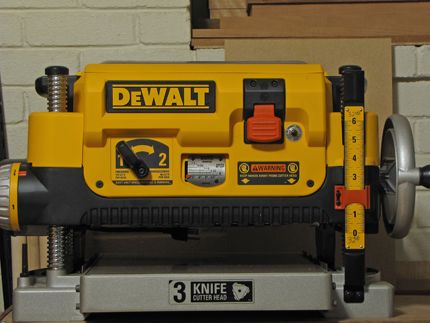
New woodworkers setting up their first shops may wonder which major machines should be purchased first, second, and so forth.
The suggestions in this post apply to the type of woodworking that is done by many readers: building mostly furniture and accessories, such as tables, chests, jewelry boxes, bookcases, and maybe a chair, using mostly straight but also some curved and sculptural elements, and employing a combination of machines and hand tools. It is assumed that money, time, and shop space are limited.
Quality woodworking is a very personal endeavor so the right choices depend upon each woodworker’s methods and skills. Similar issues confront experienced craftsmen looking to upgrade their machine arsenals.
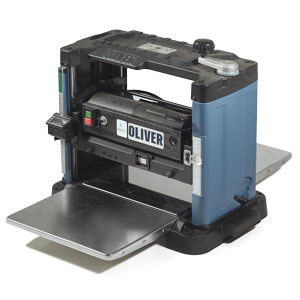
My suggested first major power tool is the portable thickness planer. Why? It accomplishes very well a difficult, essential task with relatively little expense and shop space.
$350 to $650 buys a machine that will perform its job at a very high level. Most woodworking projects start with flat boards of uniform thickness. So why not buy a jointer first? Here are two good reasons: a jointer with the analogous quality and versatility as a portable thickness planer would cost far more, and its tasks are far easier to do by hand than is thicknessing.
A flat surface prepared by hand, preceding thicknessing, can be done reasonably quickly and does not have to be pretty. It may even contain residual furrows from a scrub plane and tearout, so long as it does not contain cup, bow, or twist. Thus it can register properly against the bed of the thicknesser for the other side to be planed, then the board is flipped, and so forth.
Spending much more money on a good jointer, or worse, buying a cheap or narrow jointer destined for early obsolescence, will produce a flat face but the arduous task of hand thicknessing remains. The portable thickness planer quickly frees the woodworker from two of the most limiting habits in woodworking – using pre-dressed wood and defaulting to 3/4″ stock.
I like my DeWalt DW735. I use it with a dust collector but its blower allows use without one, making it easier to start up a shop.
Machine number two? Hint: it’s not the table saw.
See these other great, related articles about portable or benchtop planers:
- You might want to build an infeed/outfeed table for your portable planer
- We tested 11 benchtop planers in this Tool Test
- Essential Milling Machines
More in this series
• Machine Number Two: The Bandsaw










Comments
Yes a thickness planer should be high up on list of must have tools. It would, however, be second on any list. The first major tool purchase has to be a table saw; can't do much with planed woood without a good table saw.
I always felt this argument was a waste of time. There is no one tool you should buy first, because in order to make woodworking fun and effective, you will need more than one tool. Tablesaw first? You'll spend a fortune buying dressed lumber. Planer first? Have fun cutting and ripping those smooth boards by hand. If you want to get started woodworking you will need a few good tools like a table saw, jointer and planer, cordless drill, and hopefully you'll be able to fit a router in there as well. You'll be able to build just about everything from furniture to cabinets with those basics.
table saw first, you can learn some of your chops on cheaper sheet goods. You can make a usable face frame with a table saw, sandpaper and screws. When I look around now, I'm glad I kept all that stuff in the shop and didn't bring anything into the house till I had progressed a little bit. On the other hand once I had planer, jointer etc. I had to forget what I thought I knew and learn how to make a piece of wood foursquare. Also what I'm seeing is that all the good hardwoods act a little differently than mdf or plywood when machined. There is way more than a lifetime of learning to do
regardless of which machine you buy first.
If you want a power saw first and want to work in solid woods, I'd go with the bandsaw because it can safely cut unsquared wood. Ultimately, I agree with msdr, you need a few machines to really get started and enjoy the process.
I'm with blueberry on the bandsaw. I find that it cuts that planed wood just fine.
I own a full slate of woodworking machines, but when I relocated to Connecticut, I was without 220 power for a while. This rendered my tablesaw, jointer and planer useless. All that was left to me was my trusty 14-inch bandsaw. With that and a collection of handtools I was still able to make furniture, albeit a bit more slowly than in the past. It was a great way to re-learn the craft and I developed a new-found appreciation for the flat, square stock I used to take for granted. Even though it took longer to make a piece, I have to say that I had more fun making it. Since then, I still let the power tools do the grunt work, but I switch to hand tools as soon as I can.
I think it gets down to what you want to make or work on in your shop. Looking back on my purchases, I waited too long to get a table saw, which I find indispensable for any kind of sheet or wide board cutting, and for truing up edges/widths of boards. I like my benchtop planer, but managed without for a long time. I wasn't starting with rough lumber on projects either, or doing alot of work demanding true thicknesses. My vote: Table-saw, followed by sliding compound miter saw, drill press, thickness planer. Now, all that being said, my current top list would be my lathe and then my bandsaw!
I looked at all the stationary tools in my shop and thought about the amount of use each one got. A big number one is the table saw. I would say the next group would receive equal use; sliding compound mitersaw, thickness planer, jointer, bandsaw, drill press. In my shop the rest of the machines are used much more infrequently. By the way, if you make a u-shaped jig and a sled, you can thickness wood with a router, instead of a planer. And then you have the router for all the other things it is capable of.
As much as I agree that a planer is a very important tool, most woodworkers will agree that beginning with straight, flat and properly dimensioned material is crucial to achieving a quality end result. A (thickness) planer is not terribly useful if you do not have a flat reference side to plane from. Running twisted or cupped material through the planer will result in a twisted or cupped piece that is quite uniform in thickness. Woodworking begins and ends with the cut. If the cut is not perfect the piece won't fit properly. Just a few of those and your project comes out,,, well let's just say less than what you imagined in your mind's eye. How many of those have we turned out over the years? Flat surfaces result in straight, clean and SAFE cuts. Any way you look at it, the simple fact is that irregular reference sides result in irregular cuts. It is also extremely dangerous do run cupped or twisted material through a table saw. Binding and kickback is not a fun experience.
For the purpose of this discussion, my thought is that any way you look at it, your first machine is actually three machines, jointer, planer, table saw. This to me is the foundation of every project. With the big three, virtually any commercially available material can be properly dimensioned. Any one without the other presents issues which need to be overcome and will likely minimize the resulting quality of the final project. After 50 years of making sawdust my words to the beginner are, start your shop off the right way and love what you do. Cut corners and spend most of your time trying to work around the mistake. If you need to save money, find good used machines rather than new, expensive ones. In these times there are plenty of deals to be found.
Just one guy's opinion.
There is not likely to be one good answer to these questions because woodworking is a creative, personal pursuit. Woodworkers, new and experienced, have the opportunity to make more thoughtful, informed decisions, resulting in better woodworking, when presented with a variety of viewpoints.
The following may clarify my rationale for suggesting the planer as the first machine purchase. As an example, I would rather hand rip and crosscut an 8" x 36" board than reduce its thickness from a rough 4/4 to 3/4" or from a presurfaced 3/4" to say, 5/8". The same goes for making 1 5/8" table leg blanks from 8/4 stock. I feel that a new woodworker can quickly improve his range of design by not being restricted to the thicknesses of predressed stock.
I am not suggesting that anyone send a board into a planer without one flat surface to register against the planer’s bed. I believe it is easier to achieve that flat surface by hand, starting with either rough or presurfaced stock (both are almost never flat when purchased), especially since it does not need to be smooth to properly register on the planer bed, than it would be to thickness the board by hand. After one surface is machined flat and smooth, the board is flipped to cut the hand-prepared surface. Thus, I suggest buying an economical, high quality planer as a first purchase to go along with hand tools.
It’s great to accumulate a full set of woodworking machinery, but I hope the various opinions in FW's TWL blog will help new woodworkers decide where to start.
msdr: this argument IS a waste of time, but that is what forums like this are for, right?
I think the answer to this question largely depends on what you want to make. Even if you are mainly interested in furniture, you may want a different machine if you're making mostly straight, square craftsman style furniture vs. ornate Victorian furniture.
A portable thickness planer was the second to last major piece of equipment I purchased (I still do not own a jointer!), and I think that was the right decision. Sure, it has made things easier to own the planer, but I did plenty of nice work without it, and I never once used a hand plane. I am sure I'll be able to say the same about the jointer, someday.
Here are the ways in which I worked (safely) without a planer or jointer:
-Be very picky about the lumber you buy. It is relatively easy to select boards that are straight, and which have no cupping or warping. You may have to hit the lumber pile at your local home store or lumber supplier multiple times, but you can do it.
-Buy the lumber the right thickness to begin with. I found a one-man local hardwood supplier that usually rough cut stock to 4/4 to 6/4 thickness. He was always more than happy to run it through his thickness planer to get it the right thickness for me. I would guess you could find a place like this in most parts of the country. If not, keep in mind that you can do quite a bit with standard 3/4 stock from a home center. It may take a little creativity, but that's part of the joy of woodworking.
-I created a "jointer fence" for my table saw, based on instructions in a table saw book I own. This consists of a piece of MDF shelving that attaches to my regular saw fence, with a piece of 1/16" thick, peel-and-stick vinyl tile attached to the MDF behind the blade (using only the tile adhesive), cut in a curve at the front to fit closely behind the blade. I position my fence so that the blade's left edge is in line with the left edge of the linoleum, turn the saw on, and raise the blade up into the MDF. Then I can run the rough edge of the lumber along this fence as many times as needed to straighten it. Essentially, it is a jointer, rotated 90°. I have never used it for the faces of a board (since my stock was usually jointed and thicknessed by the lumber dealer), but I imagine it would work for something up to the maximum blade height. There are lots of other jigs that have been described in various books and magazines that allow you to turn your table saw into a jointer.
My first stationary tool was a relatively cheap, 9" Craftsman bandsaw, (a gift from my woodworking grandfather), and I was able to do quite a few nice projects with only that bandsaw and some hand tools. If I had to start from scratch now, though, knowing what I know now, I would definitely go with a table saw, given the flexibility and accuracy of a good table saw.
However, I would also submit that a handheld router, with all of the clever, shopmade jigs one sees in FWW and elsewhere, can do almost anything that a jointer and planer can do. Add a circular saw, cordless drill, jigsaw, and chisel, and you could make almost any project out there, while spending less than you would on a nice portable planer.
All this having been said, the best tool to start with is the one you can afford. I have seen some surprisingly nice projects created with nothing more than a hand saw, a drill, and some sandpaper.
My first machine was a router but I wasn't able to build the cabinetry I wanted until I got a tablesaw. Until I was able to acquire a shop full of tools, I built a lot of things with those two machines and the basic hand tools. If I had to choose one tool only? - I'd definitely go with a tablesaw.
First, I enjoy these discussions. I can remember a time when the answer would have been" a Radial Arm Saw", no questions asked.
Second, I cheated and went with a 1950's Shopsmith for my first "tool".
5 tools in 1 machine and it even came with a bandsaw and a jigsaw.
Before the Shopsmith I built some nice furniture like a crib with the basic hand tools, circular saw, jig saw, cordless drill and some sandpaper but the addition of the Shopsmith and the portable planer has taken the possibilities to new levels.
Shelves cut from different boards are now planed to matching thicknesses and I save money by buying rough lumber.
I'm not going to saw much wood with a hand saw but I will take advantage of the planer and the benefits associated with its use. I can see where the author is pointing us in this discussion, toward a tool that would seldom be considered for the first tool but packs some serious time and money savings into its ROI.
i guess i will comment on this topic, since "my first machine" thoughts and ponders are still fresh in my mind.i have been in and around wood working my entire life, but i just started creating my first "true work shop", and after about 2 months of weighing pros and cons on whats to come first..... i decided on a "band saw" since my space is limited during the house hunting days i went with a 10" craftsman bench top band saw...the way i look at it is, if a cross cut is deeper than the throat of my B.Saw, then i still have my trusty miter box and hand saw, but now instead of having to size my projects to the "mill standard stock cut sizes" i can re-saw my stock down to custom sizes, and start making things the size "I" want them. i am now able to make cuts in 2 minutes that would normally take me 30 minutes to set up and creat "squared supports" to ensure my cuts are perfectly true...like say "tenon's" and mortises (if i want to dowel and glue everything back together...lol).... so in my view i made the "hands down" best decision (for my needs at least) by choosing a "Band Saw" sometimes i wish i bought a little larger one, but then when i am using that little extra space, i once again realize, i got what i need.
anyone have thoughts or ideas that i may have missed in my decision making process? i welcome any and all, and respect the experience.
i would like to thank you all in advance, and thank all those who have come before me...
SEMPER FI
Nah !!!
Table saw, table saw, table saw . . . . . .
The best you can afford ( DELTA )( regardless of what SHE says ).
I have an 8" jointer, and a 15" thicknesser ( planer ), but I still have to go and and use my brother-in-law's table saw !!
I need that Unisaw !!
Of course the first machine you get depends on what you want to do. However, for general wood working, I vote for the table saw. There are two big reasons. First, most of what you must do to convert lumber to components of a project is rip it to width and cut it to length. The table saw is tops at ripping and very good at cross cutting (beaten by the chop saw or miter saw). Second, the table saw is extremely versatile. It can cut boards to thickness provided their width is less than twice the maximum depth of cut of the saw. Fitted with a good miter guage, the table saw does a fine job of cutting miters. With its blade tilted, it will miter a board's thickness. It can cut tapers with a taper jig. With a molding head and set of molding cutters it will cut moldings. It is slower at that than a router table because it turns slower than a router, but it does the job. With a dado cutter it will cut dadoes. With a tenon jig it will cut tenons. Obviously it will cut grooves for a tongue and groove joint. If you make a sliding table, the saw can cut heavy boards or very long boards with ease. It can cut large pieces of plywood, with the maximum size depending on the size of the saw's table and the availability of infeed and outfeed rollers. You can make dedicated special sliding tables to cut odd angles repeatedly, such as when making pieces for a segmented bowl. You can make a simple jig to allow you to produce circular disks. The number of jigs one can make for the table saw are almost endless and allow you to do a great many things with one tool.
There are no right or wrong answers here, but it is an important question that many woodworkers face in their lives.
I have worked with a lot of major power tools over the last 45 years. The one that I used the most and that became the centerpiece of my own shops is the table saw.
In my first shop, I started with a contractor's saw, which I tuned up to run like a top. However, I noted a tremendous improvement in accuracy and capacity when I started using an old Rockford table saw with a new Biesemeyer fence. (The Rockford saw is an earlier version of what we now call the Delta Unisaw, generally speaking).
If I had it all to do over again, I would start with a Unisaw, or equivalent, with table extensions because I had to build them anyway -- and I wouldn't forget a top-quality table-saw fence and miter guage because they make a great difference every time one uses the saw.
A Delta 14" band saw with a 6" riser block and a DeWalt 3-cutter-head planer are also at the center of my shop because I always begin with rough planks from a mill. But the table saw is the heart of my shop, just as it was in my dad's cabinet-making shop. He used his Delta table-saw for 50 years to make his living; my older brother still uses it. We treated all the major power tools in my father's shop as family heirlooms and made sure they went to the oldest son. (Old school, I know.) The power tool we were most concerned about getting to the right person was -- you guessed it -- dad's table saw.
My last observation has to do with price. A person does not need the best of everything. Many medium-priced tools will work very well in most circumstances. But when it comes to major power tools, I have to say that value is more important than price. If you are serious about wood working, then pay the higher price up front for a good quality table saw -- or whatever else you buy as your first major power tool. Good quality power tools are cheaper in the long run. They are more accurate, durable and powerful, and they are safer to use because they have the capacity to do the most demanding jobs. This cannot be said of many less-expensive tools. This, I think, is especially true with respect to most good table saws compared to most contractor's saws or bench-top saws.
If you go with a low-cost alternative and you maintain your interest in woodworking, you will surely have to spend that money all over again. If, on the other hand, you buy good quality power tools and lose your interest in woodworking, you will have no trouble selling your power tools for a decent price. Other woodworkers recognize value, too, and they are often on the look-out for good used tools. (New woodworkers can start with used tools, too, but they might need an experienced person to help pick them out.)
Anyway, that is my two-cents worth based on my experience. The experiences and needs of others might differ.
I'm currently setting up my shop, it's been a labor of love for 3 years and it'll probably be another 10 or so before I'm happy (thank goodness for an understanding wife).
I agree that saws need to come first. My first project was built w/ two borrowed tools: my father-in-law's table saw and my brother's router. The bunk beds and dressers turned out great so I bought those two tools first.
A good bench top saw won't kill the budget and is the center piece of my shop. I'm currently building a table to put it in that will give me the workspace of a stand alone unit.
A router is an essential second pick because it is such a versatile tool. (The table above has a home for the router on one end helping to save some space in the shop.)
While I'm saving my pennies for the same planer as above, I've found that every mill I've gone to is more than willing to give me the exact thickness I need. The rough lumber costs the same whether I plane it or not.
For now I'm still borrowing some tools and working on my brother's band saw and jointer. It's a little inconvenient hauling my lumber up to his place but it's great spending time in the shop with him.
If one has to depend on using handtools for most of the work and can afford only one machine in the beginning, I would have to say that a toolgrinder of some kind is the most important machine to have first. It is definitely no fun at all to have to recondition edge tool bevels by hand with nothing but a whetstone or some sandpaper. Even if it's only an old-fashioned treadle-powered sandstone or a handcranked benchtop grinder, it will save scads of time and make it much more likely that all those fine edge tools one plans to depend on are properly sharpened. Hand tools will do a great deal of work when sharp, but dull ones are the b**ch of misery.
That said, there is no reason at all that a toolgrinding device has to be ONLY that. Several woodworking machines can be made to grind tools. Even a cheap woodlathe can be fitted with a grindstone, and a good woodlathe with homemade attachments can be made to do alot more than just turn wood - think along the lines of a Shopsmith. Table saws can be fitted with either a sanding plate or a stone for grinding tools, as can radial arm saws. Even a 12 or 14 inch bandsaw can take a sanding belt and be rigged to grind tools - or fitted with a sanding disk on the outboard end of its main shaft.
I think the question comes down to what sort of materials one plans on working with. If it's sheet goods, then buy a good table saw. I've worked plywood without a table saw, even to the point of handplaning the edges for smoothness or joinery. It isn't any picnic - a table saw would have saved me a great deal of time. If most of what one works with is solid wood, then buy a decent bandsaw - at least a 14 inch model - and keep it well-tuned. It can rip much heavier stock than most table saws and do so much more safely, and if fitted with a miter gauge (and a SHARP blade), it can crosscut.
A good bandsaw will also resaw face-jointed or hand-planed wood to thickness, and at one time I had to depend on milling rough-sawn stock that way. I'd flatten the face on a jointer and saw the board to thickness on the bandsaw; then joint the sawn side. I did alot of that and I was doing it commercially; I learned all about resawing, but even a small table-top thickness planer would have made the operation more profitable. 'Course, in those days there wasn't anything but fairly expensive floor model planers.
I still have no tablesaw and see no time in the future when I would get one. Tablesaws take up a ton of space and have eaten too many fingers. Bandsaws are smaller and more versatile. By the time you want a stationary machine you will already have a router and a circular saw which will cover anything you would do on a table saw that you couldn't on a bandsaw.
Without getting wordy or boring, a great table saw is the most useful tool in the shop. Do not waste time on cheap table tops, and in most cases contractors saws such as the cheaper rigid. I am no knocking rigid tools, but table saws are not there strong suit. I buy my tools based on experience, performance, and reliability ( sustained accuracy), and not to color coordinate my shop. If I could afford all Powermatic tools, then maybe my shop would be gold and black :-)
My father started his shop with a TableSaw he inherited from his father. My budget was very small as I started my shop. The first tool I got was a sabre saw, then a clamp on fence to guide it. With that combination, I am able to make accurate cuts on top of a piece of insulation. A basic router came next, allowing me to shape edges and make dadoes. Then I started trolling the pawn shops in the area. A jointer then joined the group, followed shortly by a table saw. Home Depot recently had a "display" model of the DeWalt planer the author of this thread recommneds and it has made me start a project where the thickness of the product was critical. Everything I have made to date has been made from dimensional lumber from the home stores. I am still in the process of getting an open space in my shop big enough to handle a full sheet of plywood, so I find myself breaking sheets down with the sabre saw and the guide on the sheet of insulation...
No doubt about it, the TS is the heart and soul of my shop, and the most frequently used tool. I can rip, crosscut, bevel, dado, cut grooves, edge joint, and can even buy profiles for molder head with it. It also provides a large reference surface. Perhaps more importantly, it's the tool I most enjoy using.
A BS is good for curves and resawing, but leaves significant saw marks that are at least 10x larger than those left by a good TS blade, and they need to be planed out or face jointed afterward. I like my BS, but there's no way I'd give up my TS in favor of one...not for the projects I build anyway.
Now, if I were forced to own only one tool...I'd have to contemplate long and hard about the router, the most versatile tool in the shop. With it I can rip, crosscut, dado, groove, profile, create molding, curve, slot, dovetail, finger joint, plunge, edge joint, face joint, write, draw, sand, play gin rummy, and mangle people who try to force me to own only one tool! Well...you get the idea.
Funny this came up today. I just finished a related story for my Guild newsletter titled "How do you answer the question?" The premisewas a question that was asked "What are the 3 most important tools in your shop?" I was talking about 3 instead of the first but my position is the same. It depends on what yoou intend to do with them. My immediate thought was the same as many of the people responding to this question and get a good table saw. Then I realized that this would be a bad choice if goal of the person asking the question wanted to make wooden pens, do scroll saw work,or turn a bowls. When people ask our opinions,we need to stop for a minute and ensure we understand the context of the question. If you'd like to see the full article, the following link is to the current newsletter for my guild. http://www.lswoodguild.com/newsletters/2009_08.pdf
My vote for a first stationary machine would be a bandsaw.
The initial purchase cost is one of the lowest for "larger" machines. The footprint is small, they are relatively quiet, produce little waste and are inherently the safest large machine to start on because of the very low potential for kick back. Starting out woodworkers in all likeliood would use commercially available 4S stock until their skill levels increased and the need for more economical, self planed/jointed material became paramount. The tablesaw is indeed very versatile however there are more compact, economical and safer options available for beginning woodworkers. For example a good quality sliding compound mitre saw could be used for cross-cutting. The bandsaw of course would do the ripping on most boards and a good quality handheld circular saw/guide used for dividing panels.
Currently a 3HP cabinet saw is the center piece of my shop and I couldn't work without it with the way I now work. It is in it's third incarnation. Naturally I took losses on it's predecessors as I upgraded.
The bandsaw I use on a regular basis is the original one I purchased years ago.
TS hands down.
Why?
Because its also the first shop bench you will have. Think about when you started, you built things on that solid surface. Where are you going to put a thickness planer? On the garage floor?
No, the TS is the tool used to start the shop, and all the building you will do, long before you get the proper bench and the rest.
A few C clamps, a few bar clamps, some glue, and when you start with pine, learning to use a hand plane is OK. Have a TS, well, you can rip straight edges with a cheater board even on wavy stock, then cut a second straight rip edge, then you can cut to size, clear off the top and construct the rest. Build a torsion box, do it on the TS top.
Try that on a planer.
Hi there, I have enjoyed reading all the postings and finally thought I would throw my two-sence in, I sat back and thougth about the first projects I ever buildt long before I became a finish carpenter The first tool I ever worked with was the table saw, I still remember using my dad's old table saw, which at the time was at least three times my age. It was very old but also very accurate and dependable,infact so much so that I actually just got rid of that saw about 5 years ago after using it for a good thirty plus years my self after getting it from my dad. The table saw is the most versitle and usefull tool in the shop, sure the planner is nice so is the band saw and the router and the jointer and so on, but so were power windows in cars when I was young but you didn't need them you still used the hand cranks, point, all those other tools are luxuries, if you can swing it, fine but to get started the table saw is the way to go, you can do all the above with it with a little practice and a few extra attachments, I still have the first vanities I made using my old table saw complete with raised panel doors with shaped stiles and rails which are still great, I have to say after 40 years, ,I have all those other tools in fact I even have all the portable ones to take to job sites, but the tool I always come back to is my table saw, the first and best tool to get started with good luck to all you young wood workers have fun and be careful using any tool you get. Good luck Bob
My first stationary power tool was a bandsaw, because my first projects were canoe paddles. A jointer and planer came next, and a table saw was my last purchase. My answer to the "which power tool first" question is whichever tool will most increase your efficiency and enjoyment of the kind of woodworking you do, or best allow you to try woodworking projects that are beyond your current hand-tool skills. The first machine in a shop should probably be a really good dust collector: all those power tools you're about to buy will kick up lots of sawdust, which can cause emphysema and lung cancer when breathed. Better safe than sorry...
Just starting? Table saw seems to be a big favorite but I am surprised that no one has advocated SAWSTOP. Produce your project with an outstanding quality tool AND save your fingers too. What a combination. Especially if you except to use that tool repeatedly for the next 30 or so years. That's a lot of opportunity for an accident (meaning it didn't happen on purpose) to occur. Check it out before you make a purchase commitment. Go to SAWSTOP.COM and watch them try and slice a hot dog. By the way, show your wife before you tell her the price.
Anybody that doesn't agree that a table saw is the first and most important machine needed to set up a shop is out of their minds. I am a general contractor, who builds custom homes in the San Diego area. I am now on my third cabinet shop. I build cabinets, furniture, entry doors, and stairs in my shop. My father (who is also a general contractor) ran the mills for Dixieline lumber co. in San Diego. I have learned all I know from him. He had a cabinet shop when I was growing up, and I spent a lot of time there.
Having a shop with a lot of machines is great, but you could build custom cabinets with just a table saw. It is so versatile, if you know what your doing. In a standard kitchen, you could in theory use the table saw to...
1)Cut all the plywood, or melamine for the cabinet cases.
2)Rip all the hardwood for the face frames.
3)Cross cut all the face frame stock to length with the miter gauge.
4)Put a sanding blade on the table saw, and run the hardwood through to clean up the saw kerf marks (this way eliminating the need for an edge sander, or planer.)
5)Rip the style and rails for the doors.
6)Cut the mortises and tenons on the styles and rails for the cabinet doors.
7)Straighten out hardwood to glue up for door panels.
8)tilt the arbor to 22 degrees to raise the panels on edge for the doors.
9)You can even make crown molding by clamping a fence on an angle, and raising blade a little bit at a time.
And there you have it, an entire kitchen built with a table saw. I have done all of this with a table saw over the years. Sure it is nice to have shapers, sanders, edge banders, chop boxes, line boring machines, hinge insertion machines, ect. They make life a whole lot easier, and faster. But it could all be done with just a table saw. I joke with my wife all the time, that if it came down to it, and I had to down size, I would only need three machines. A table saw, an edge bander, and a line boring machine. And I could still make a living at building cabinets.
As to what table saw to get... That all depends on space and budget. I have owned over ten various cabinet and contractor saws. While the Powermatic 66 and the Delta Unisaw are the most popular amongst wood workers, they don't even compare to an Oliver, Tanewittz, or a Yates American. These three machines where manufactured from the early twenties up until the early eighties. They make the Delta's and Powermatic's look like tin cans. They are tougher to find, and usually require three phase power, but they are a much superior machine. Every piece is made out of cast iron. There is no wobble or run out. They have 7.5hp direct drive motors, that could rip a wet log. Plus the two that I own (an Oliver 88D, and a Tannewitz XJ,) have the capacity to use an 18", and a 20" blade. It makes it nice when that rare occasion pups up and you need to rip something over 6" thick.
Anyway, that's my take.
Fortunately, being out of one's mind does not preclude building fine furniture.
I retired 2 years ago after working in cabinet shops for 45 years. The last 4 years I worked on a CNC router. You can make almost anything on a CNC but every once in a while, I would still need to use a table saw. You need a table saw. If I had the room and money, I would buy a CNC 2nd.
There's a new poll about this on the Tom's Workbench blog. Looks like the "Tablesaw" vote is currently ahead:
http://tomsworkbench.com/2009/08/16/quick-poll-84/
When the discussion comes to that first tool the opinions and justifications are as varied as the individual users. While my preference leans heavily towards a tablesaw, the best you can afford, that addresses what I build. The primary question that each needs to answer for themselves is; What do I intend to make? If you are intending to make small, marquetry emblazoned jewelry boxes, or specialize in turning pens for example, a large, expensive table saw would not be of much value. However, plan and building a full set of custome kitchen cabinets, the decision process will lead you down a different path.
Consider also how much space you have to dedicate to any tool choice as well as projected growth potential in not only projects, but space and skill building as well. I center my shop around my 3hp Jet table saw with large table extensions because I work with a lot of full-size sheet material, and over the years (with a loving, understanding wife) my shop has expanded considerably. Though I fondly recall the cramped existence of a one-car garage of condo living so many years ago.
Rob,
Really enjoyed your two posts on the first tools to buy in setting up a woodworking shop. Whenever someone says something which is nontraditional, people seem to come out of the woodwork to point out that they are nontraditional. Gina pointed out a survey which shows that the table saw is still number one. What would anyone expect? Sure it is the most common choice but that doesn't make it the best one. That is the problem with surveys. They are the last way of finding out "interesting" ideas - ideas which make you think.
I have thought about your choice of the thickness planer as number one and the bandsaw as number two. The first is a provocative idea. I need to think more about it. To me, the bandsaw is FAR more versatile and useful than a tablesaw. I am moving more toward handtools, so I am using my tablesaw less and less, but I can't get away from the use of my bandsaw.
To me, one cannot start a woodshop with one tool. One needs a bunch of them. Here is my recommend for the first bunch of tools that a person should acquire to start his own woodshop.
- circular saw
- jig saw
- router
- belt sander
- electric drill
- sandpaper, hammer, screwdrivers, Red Devil scraper, etc.
All of these can be bought at Sears or at Home Depot new for not much money, or can be bought used cheaply. With this set of tools, one can build wonderful furniture - very complex, sophisticated furniture with advanced joinery if that is what you want. You are just stuck with using dimensioned lumber from the local stores. BUT THAT AIN"T SO BAD if you are just starting out.
After you move past the use of this first set of tools, you should keep them as you buy your bandsaw, jointer, thickness planer, table saw, etc. They will come in handy. By the way, I would buy a jointer before buying a thickness planer. A thickness planer only reduces thickness, it doesn't flatten, unless you make an appropriate sled.
I enjoyed and profited from your posts. Thanks for making me think. Have fun.
Mel
To clarify, the question I raised was which major machine to buy first. Judging from the interest generated, this clearly seems worthy of discussion. I feel it’s great to hear opinions from passionate fellow woodworkers. In agreement with many of the comments, the answer surely depends on the types of projects a woodworker intends to make. This, along with personal preferences in working style and other factors, precludes a definitive answer. The main point is that new woodworkers can hopefully benefit from the many opinions offered.
Regarding the roles of the jointer and planer, I suggested in my post that the necessary flattening of one side of a board can be done by hand reasonably quickly and more easily than thicknessing a board by hand. The latter task still remains for hand work to achieve the desired thickness if you have a jointer but lack a planer (unless certain rigs are attached to the jointer which I feel are awkward).
My suggestion for machine number two, the bandsaw, is also a subjective choice, based largely on the versatility and creativity capable with this machine, even by novice woodworkers.
For the record, I happily use my Saw Stop cabinet table saw, jointer, and routers. I like them almost as much as I like my hand tools!
I set my shop up just a few years ago though I had been dabbling off and on for years. I had a portable table saw my dad gave me and I got rid of it a few years before I set up my shop. When I set up my shop I went with what I read in most of the forums and users group...table saw first. As a fairly inexperienced woodworker at that time (a 2 on a scale of 1 to 5, 5 being a top notch pro)I was uncomfortable using the table saw. Though I had take a few classes I still felt threatened by it. Not a bad thing really but indecisiveness in using a tool can get you into trouble. I barely used it because I was frankly, afraid of it. Now that I have nearly all the cool stuff my recommendation based on my experience would be band saw. A 14" BS to be specific. Rough cutting lumber can be done with a circular saw and then you can do the refinement cuts on the band saw either for ripping or cross cutting. It's much less threatening and you also get the benefit of being able to do curves. I use my bandsaw more than any other large machine in my shop. At this point the only thing I use my table saw for is cross cutting with a sled but I COULD accomplish what I need to without it. In fact due to space limitations I've mulled over even getting rid of it but it is true that it comes in handy at times and is quicker for certain things. I'm no longer afraid of it though I will always respect it as one should. The addition of the crosscut sled makes it much safer. So..just my humble opinion.
BJ
By the way I forgot to mention that I got a jointer/planer combo just recently and would now say it should have been my #3 tool. My order based on my current experience and mode of work would be:
Bandsaw
Router
Jointer/Planer or if separate Planer then Jointer
Table Saw
And as someone pointed out...much of this depends on what you are doing and what you are willing to do by hand. I'm also assuming you can afford to get some of the smaller hand tools that allow you to do some of these things by hand to make up for not having the "major" tools. ie. a random orbit sander will get you by until you can afford a band sander, a circular saw will get you by until you can afford the table saw, the router isn't really replaceable by anything in my mind but they also aren't that expensive so they should be high on the list, you can do a lot with a router to make up for not having a table saw etc etc..and for me the jointer planer was a last choice originally because I bought all dimensioned lumber and just did my best with it and with hand tools. BJ
The first large power tool I got for the small shop I had was the radial arm saw. I know most people shy away from the radial arm saw these days, but it was a great choice. Rip, cross-cut, dado, shape, etc. It takes some careful thought because of a little extra set-up time, and a special attention to safety. I put a 10" bed on which doubled as my workbench, and made ripping much easier than using a small table saw. I highly recommend the radial arm saw to anyone with a limited budget, and limited space. You can find a wide selection of used saws for very little money (sometimes as low as $50).
I gave away my power tools to Habitat For Humanity when moving to a retirement home. Now it is back to basics using hand tools and with good hand saws, high end planes, Japanese chisels and a great dovetail saw. With a good workbench, I find myself enjoying woodworking much better than with all the big power tools. There is no greater joy than using a fine tuned plane on a piece of wood. Music to my ears. It really is personal preference and woodworking goals.
I feel it is essential to learn hand tool skills first and then augment with power tools as skills improvement. A top notch bandsaw would be my first purchase. For cutting plywood and accuracy I would buy a Festool saw with a complete table and guides sufficient to reduce a 4' X 8' sheet of plywood to desired size.
If buying any power tool, buy the best you can afford. They will last a lifetime.
My first shop tool was a bandsaw. No regrets. Handplanes ( not Lie-Nielsen's, Veritas, Bedrocks, etc.) properly tuned,i.e., "fettled" can makes surfacing and thicknessing go quickly plus it is a good workout, and you feel that you are working wood. Old Stanley planes can be found on e-bay for reasonable prices. I started with Stanley but in the past few years I've been seeking Sargent planes which pretty much duplicate Stanley's range of models. They have a heavier body casting which means you have to do less pressing down and more pushing. Since most modern benches are higher than the old days, this is an advantage. Nothing helps you escape yourself like a session with sharp chisels, gouges, saws and planes. And the aroma of fresh shavings can't be topped. If you earn your livelihood doing woodworking, machines are the way to go.
Loved the “heart clapsy bangle” DIY session, it is just special! I myself is not someone who is a fan of fancy and expensive stuffs, this bangle looks very easy to make and can match any clothes. Thanks for the sharing!
Turning Woodworking From Hobby to Business
Woodworking is an art/craft, depending on how you look at it, that can see you earn quite substantial amounts. There are people who love woodworking, but just do it as a hobby. The good news is that if you have interest in the subject than transforming it from a hobby to business is quite easy and this article is just going to show you how.
Have tools that you will use for your woodworking. The kind of tools that you will need for your projects will depend on the vastness of your business. If you want to start small, then having simple hand tools will prove to be adequate. You need to buy high quality tools like a hand drill, a timber saw, measurement tools and more. On the other hand, if you want to have large scale production then you will need heavy machinery like a power saw and more. Make sure that the space that you plan to use is adequate.
You need to have clearly marked out your niche. Woodworking is a broad subject that can see you produce anything from a simple birdhouse all the way to production of office and home furniture. You need to copyright your products to avoid cases where people can steal your ideas for their own benefit.
Make sure you advertise. Know that you are no longer doing your woodworking for the fun of it. There are many ways that you can advertise your products. You can use the internet. Using the internet will need you to put up a website. You can have a variety of sample pictures on the website. You also need to know all the ways of putting up a good website if you want to get enough traffic. You need to use the internet to not only advertise, but also to sell. With the website you will be able to tap into potential market that cuts across country boundaries.
Still on the above, you can also make use of word of mouth. Inform your friends and neighbors of your business this is a very inexpensive way of getting your word out there.
Use the internet to get new ideas for your woodworking. There are many plans that are available on the internet of which some are free. You need to use the plans that are available here to improve on your skills. You can always get to learn new ideas using the available plans.
http://woodprofitfromhome.com
This woodworking blog are very good. I have some knowledge on this blog. So, if you interested to know more go through this below link. https://tinyurl.com/yckxlfwb
Log in or create an account to post a comment.
Sign up Log in