
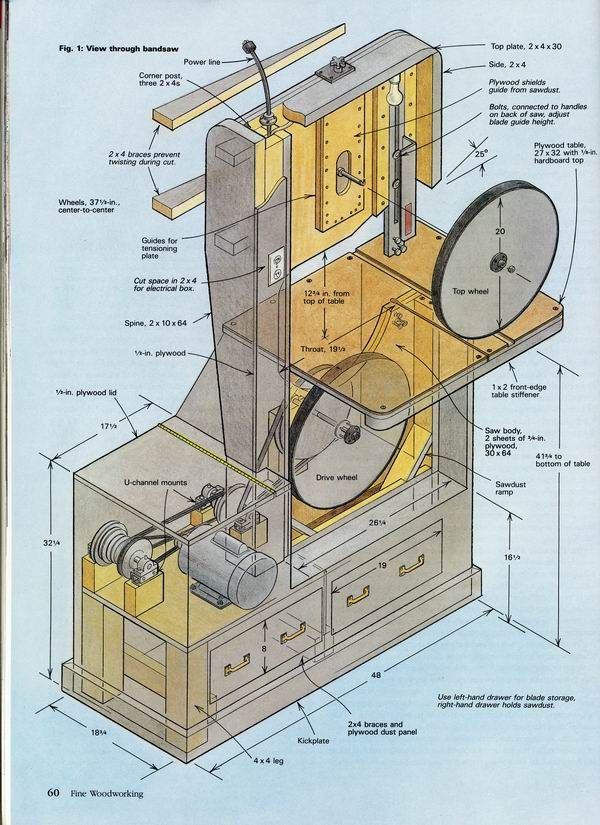
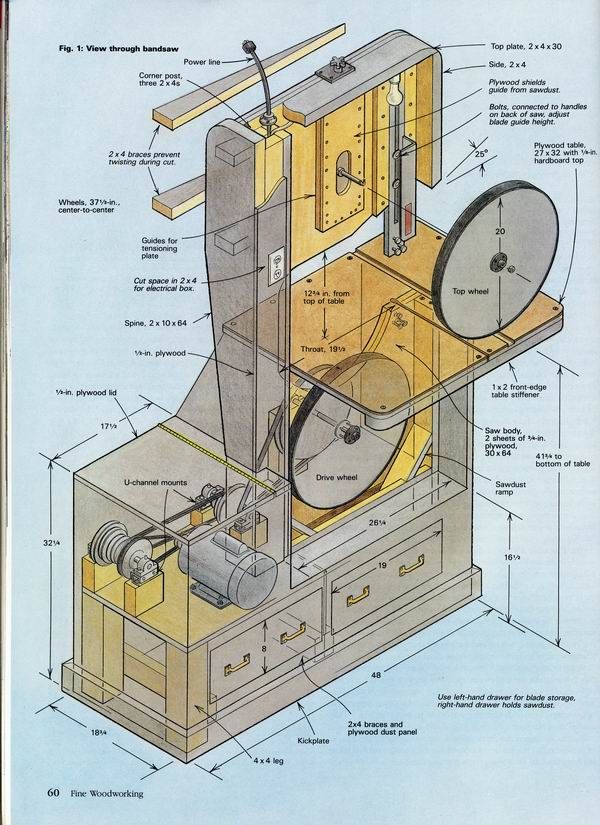
I was thumbing through (figuratively, of course) the most recent DVD archive of Fine Woodworking, which includes just about every article and advertisement hofrom issues #1 – #208. I came across an article William Corneil that I’d seen before but never read: “Shopmade Bandsaw,” FWW #65, pp. 60-63. (I was looking for an article on the Roubo bench that was published in the same issue, on p. 66.) The saw has 20 in. wheels, is made of plywood and solid lumber, sports a 1/2-HP motor, and has around 12 in. of resaw capacity. Best of all, it cost Mr. Corneil all of $72 to make it.
Of course, that was back in 1987. Reading that article got me to thinking. I knew that there were similar articles published during the years (a shopmade tablesaw immediately came to mind), so I decided to track them down. If nothing else, I thought, I could write an interesting blog post about all the woodworking machines we’ve shown you how to make. And there are quite a few!
UPDATE – April 28: For a concise listing of six of our most popular vintage articles covering the construction of homegrown tools, visit Matt’s latest blog post.
The shopmade shop
In fact, you could equip a shop with all the machines you need based on these articles. I’ve listed them below, with a few words describing every one. Unfortunately, none of them are available on our website. I’ll post a PDF of Mr. Corneil’s bandsaw article soon. And where possible, I’ve posted a photo or drawing of the machine. For the rest, you’ll have to get your hands on the archive DVD (plug, plug, plug).
Tablesaw and jointer
Galen Winchip figured out how to make two of the shop workhorses, the tablesaw and jointer. The tablesaw, which appears in FWW #41, has a sliding table. The arbor doesn’t tilt, but the saw is made for crosscuts, so it’s not that big of a deal. If Mr. Winchip did need to make a cut with the blade tilted, he could just use one of the two tilt-arbor tablesaws that he made. The saw cost about $300 to make in 1983.
His 6 in. jointer (FWW # 28) is just as impressive. Before I opened this article, I was expecting to see a handplane. I was mistaken. This is an industrial jointer, made from plywood and beech, powered by a 1 1/2-HP motor. It cost Mr. Winchip $350 to make, which, at the time, was about $1000 less than a 6 in. jointer made by a tool company. Now-a-days you can get a very good 6 in. jointer from a number of tool companies for about that price. And I got a great old Delta 6 in. jointer for much less. Nonetheless, you have to admire the audacity and skill needed to make it. (Unfortunately we don’t have the correct rights to the photos, so I can’t post them here.)
Shopmade planer
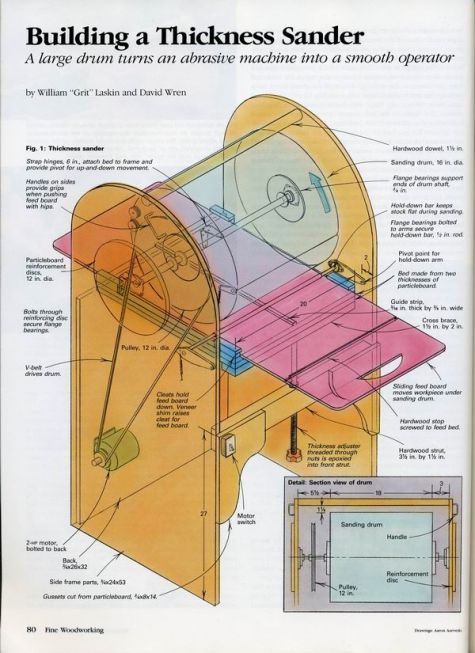
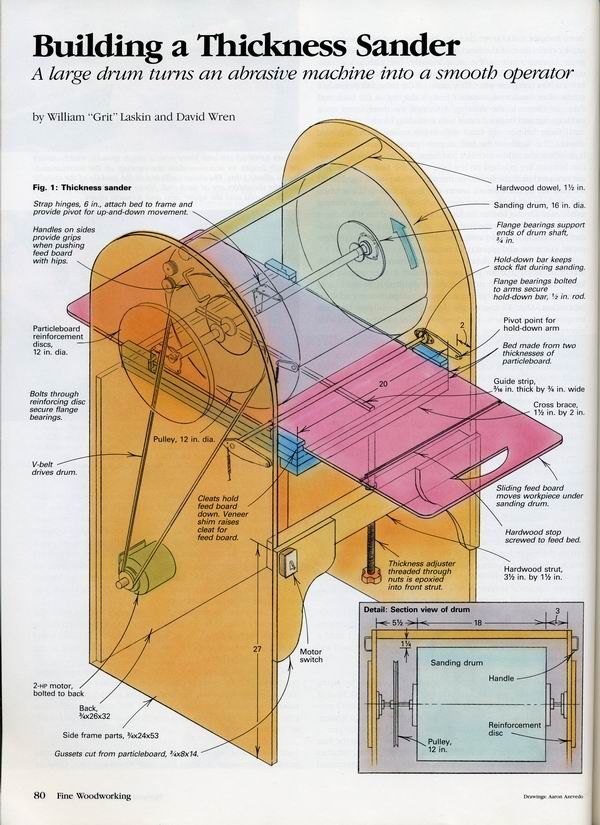
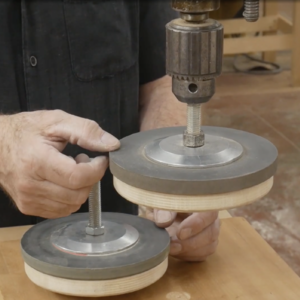
Next up, you would need some way to thickness boards. William “Grit” Laskin & David Wren showed how to make a thickness drum sander in FWW #85. No, it’s not a planer, but it would get the job done. The drum has a 16 in. diameter and is made from a bunch of particle board discs.
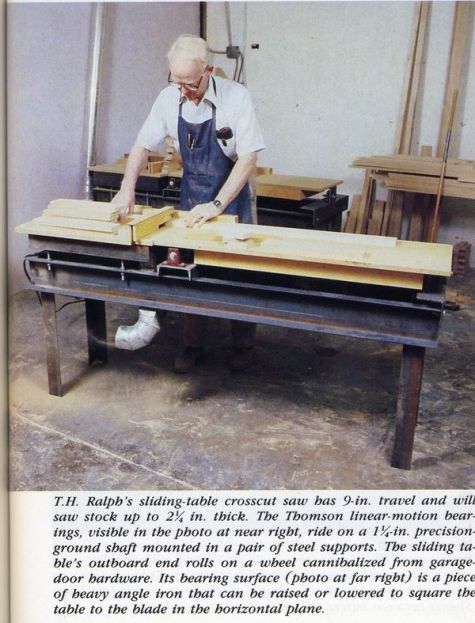
A sliding table saw just for crosscuts
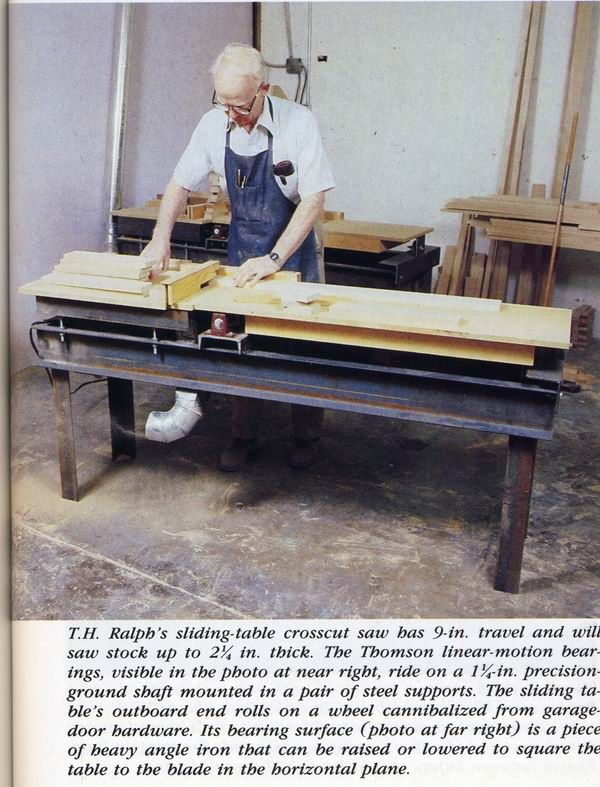
If you didn’t want to build the sliding tablesaw by Mr. Winchip, you could always opt for the crosscut saw with sliding table by T. H. Ralph in FWW #59. Honestly, I’m tempted to make this one. Basically, it is a tablesaw that does nothing but crosscut. Front to back, the table is quite shallow, but it is very wide. The sliding table has 9 in. of travel. I think I’d like about 12 in. – 18 in. of travel. Nothing does crosscuts better than a true sliding tablesaw, and this is one. But, I know I’ll never make this one. I’m saving up for a something like a Felder. And if I win the lottery, I’ll get a Martin.
Make your own bandsaw
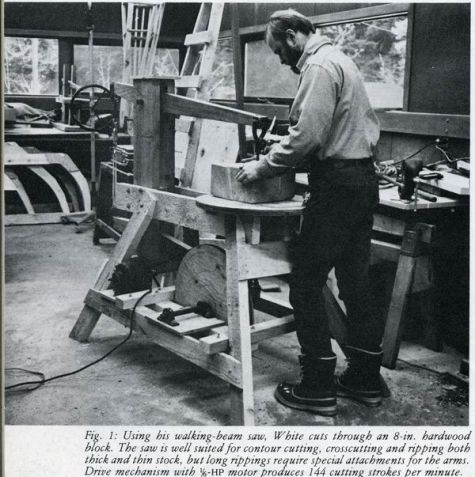
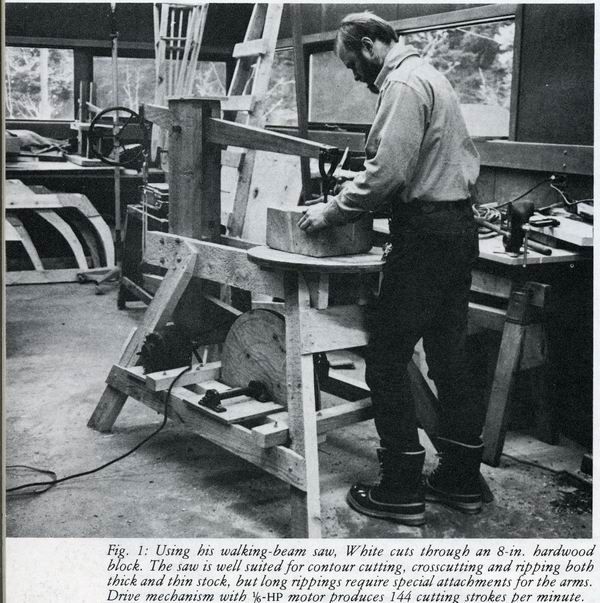
I use a bandsaw on just about every piece I make. I’m addicted to bookmatched boards and curves. FWW has shown readers how to make more than one bandsaw through the years. Before Mr. Corneil’s impressive 20 in. bandsaw, there was the walking beam saw by Mark White in FWW #24. It’s is closer to being a oversize (humongous, to be exact) scroll saw than a bandsaw.
Three ways to make a lathe
We’ve done at least three lathes through the years. There’s the treadle lathe by Chester Knight (the article is written by Jim Ritchey, editor and illustrator of “Methods of Work”) in FWW #15. The lathe, made of ash, has beautiful wishbone legs. Only the headstock and tailstock spindles and the flywheel shaft and crank are metal. In the same issue is a foot powered lathe by Richard Starr in FWW #15. Starr’s lathe works something like a spring pole lathe, but uses a bicycle freewheel so that the spindles always turn in the same direction. He uses a bicycle chain in place of the rope, and a metal spring in place of the pole. Then there is the bowl lathe by Donald C. Bjorkman in FWW 31. It has a 74 in. outboard swing. It can also be used as a standard lathe, with a 17 in. swing over the bed.
Build a stroke sander
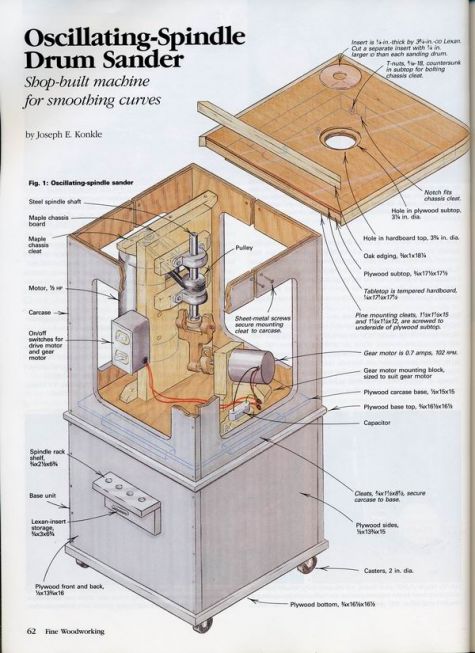
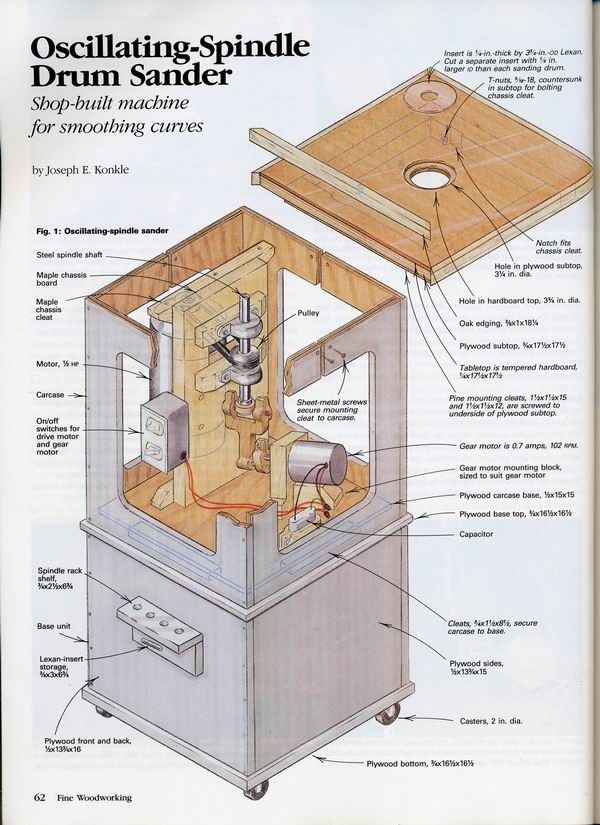
Of course, you’ve got to prep your projects for finishing, but a drum sander can’t do everything. So, you might to build the stroke sander by A. W. Marlow in FWW #29. Most hobbyist don’t even think about owning a stroke sander, which is really a huge belt sander. They can be very expensive. I’d bet you could still make one for much less than you could buy one. For curved parts, you’d need an oscillating spindle sander, like the one built by Joseph E. Konkle in FWW #87. It’s a nice design with good execution.
Dress a drum sander to the nines
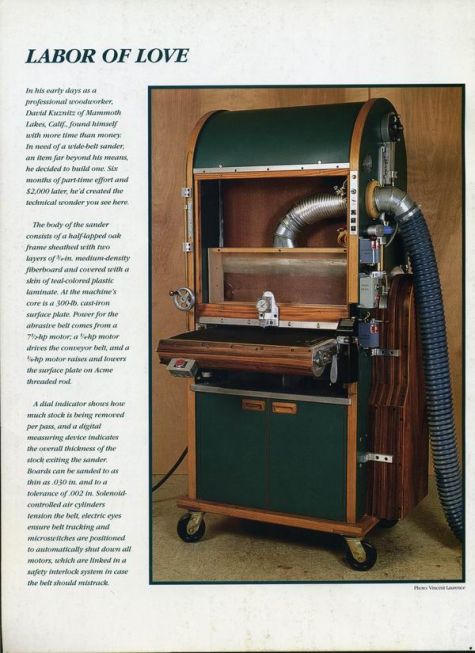
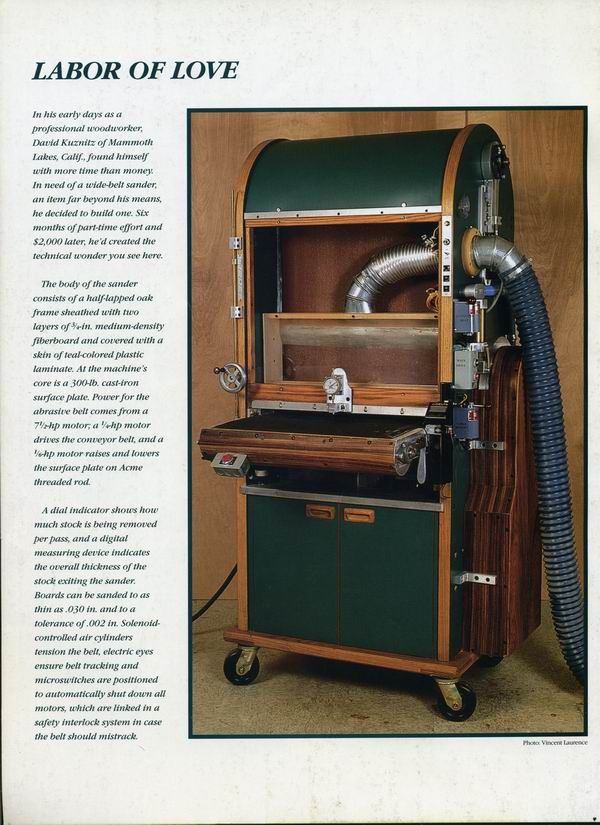
The back cover of Fine Woodworking has always been a place to display the spectacular. The back cover of FWW #105 is no exception. That’s were you’ll find David Kuznitz’s shopmade drum sander. It has it all. There’s the 300 lb. cast iron table, a 7 1/2-HP motor for the drum, a 1/4-HP motor for the belt that moves the stock, and 1/6-HP motor to raise and lower the table (how else would move a 300 lb. plate of iron up and down?), and some kind of digital measuring device that tells you the thickness of your workpiece as it leaves the sander. Kuznitz says that it cost $2000 to build the sander (in 1994). (Thanks to Dean7 for pointing this one out.)
I know that most of these machines now can be had for a reasonable price. But even if you wouldn’t even think of building one, you’ve got to admire the moxy these woodworkers showed. I know I do. I’ve made several handtools and it can be tough. Making a woodworking machine is a serious engineering and construction challenge. Bully for them for getting it done.
If you’ve made a woodworking machine, tell us about below.




Comments
This is starting to sound like ShopNotes magazine...
-Steve
I picked up a few used FWW magazines last week. On the back of the cover of FWW #105 (April 1994) there is one of the nicest home made sanders I've seen. The title of the short article is called "Labor of Love". The maker is David Kuznitz of Mammoth Lakes, Calif.
It's a wide belt sander but the article doesn't say how wide. It does show a standard metal electrical outlet box on the front of the machine, so a little measuring, and knowing how long one of these boxes are would tell you how wide. It cost David $2,000 to build. It has 3 motors with the main motor being 7 1/2 horsepower. It has other bells & whistles also. I won't say anymore than that, but maybe Matthew could post the picture and the article here for others to see and read. It's a very short article since it's on the back page and the picture takes up most of the page.
Thanks for the great article Matthew!
- Dean
Dean,
I'd never seen that back cover before. That is one astounding piece of home-built machinery. I'll scan the cover next week and add it to the post above.
Matt
Matthias Wandel recently posted a series of articles about building a shopmade bandsaw. Quite impressive!
http://woodgears.ca/bandsaw/build.html
Hobbyist - one who practices a hobby
Hobbiest - the most hobbi member of a group of three or more.
I like the David Gingery approach myself, although I've yet to attempt it.
Gina, thanks for correcting that spelling mistake. You know the old saying: Every editor needs an editor. And, at least in this case, a sharp-eyed reader.
Matt
Recently I posted in the Jigs Gallery the spindle sander I made.
Check it out at:
https://www.finewoodworking.com/item/26412/shopmade-spindle-sander
Also available on my website at:
http://atelierdubricoleur.spaces.live.com/blog/cns!2ED8F7A23848B4AE!279.entry
Best,
Serge
http://www.atelierdubricoleur.spaces.live.com
When my wife's grandfather passed away, I was given a book he had entitled "Forty Power Tools You Can Make", published by Popular Mechanics Company in 1943. I'm guessing many of these plans date back much earlier. The ingenuity in these is amazing. The first plan is "Homemade Bandsaw from Pipe Fittings and Auto Parts". Auto parts are a common thread in many of the plans, a rear axle is cut off just outside the center section, mounted vertically, and an electric motor turns the wheel rim by friction drive to make a large vertical drum sander. There are several drill presses, a drill press speed reducer, a 22 in scroll saw, a portable belt sander powered by a vacuum sweeper motor. and on and on. Many of the auto parts are from Model T's and Model A's. A wood lathe headstock turns on Model T connecting rod supports. There are several machines that are still not available to individuals and maybe even available to industry.
If you can find a copy of this book it is very interesting reading and you may be able to update the plans to parts that are available today.
Check out "Gilliombuilders" at Yahoo! Groups. Nice homemade wood working machines are there.
I have made an 18" thickness sander with a motorized conveyor feed based on the work detailed in http://www.rockslide.org/drum%20sander.html, August, 2005 ShopNotes and Edwin Hackelman's gear motor improvement (http://woodworkstuff.net/EDTSander.html). The frame is rock maple based on the design from C:Documents and SettingsDominicMy DocumentsWoodworkingsander1.pdf. The conveyor is based on the Shopsmith design also built from rock maple.The sander is powered by a 1.5 hp Leeson TEFC motor at 3450 rpm. The shaft and sanding cylinder are from my Woodmaster 18" moulder sanding attachment. Their use of velcro on the cylinder greatly facilitates ease of use and sandpaper changes. The conveyor is powered by a 90v Bodine 1/12 hp gear motor (87 rpm, 43 in-lb) controlled with a KBLC-120 variable speed controller, yielding 0 - 20 fpm feed rate. The conveyor is a belt from a Delta 18" thickness sander.
I use this sander routinely and don't know how I worked without it! Another plus in building your own is that you'll always know how to fix it! I'll post pix if anyone's interested.
Hi
I`ve built a combination wide-belt sander with a inline planer and a 3 axis CNC router for my shop.
http://www.woodsolutions.com/diywoodmachines.html
Log in or create an account to post a comment.
Sign up Log in