
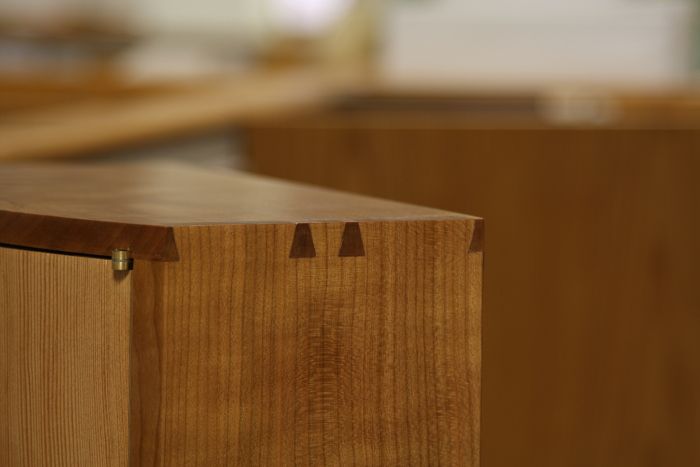
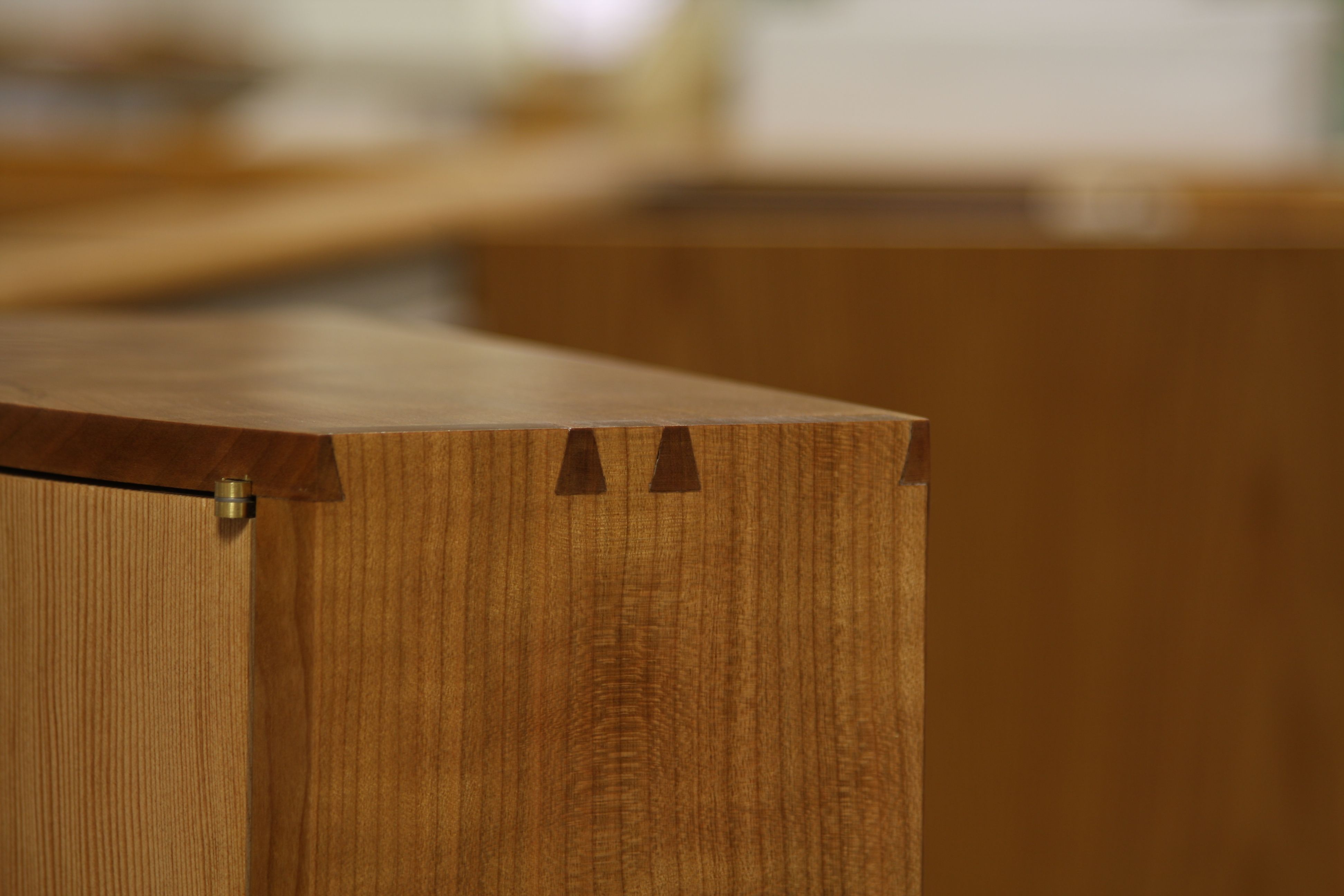
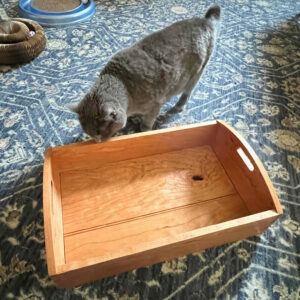
This is a beautiful joint. Does it matter how I cut it? I think not.
Before you go any farther with this blog post, take a moment and look at the photo of some dovetails I cut for a bow front wall cabinet I made in the fall. How do you think I cut them? Do you even care? Would your opinion of them (and the cabinet) change if you knew that I had cut them with machines? Completely by hand? By some combination of the two?
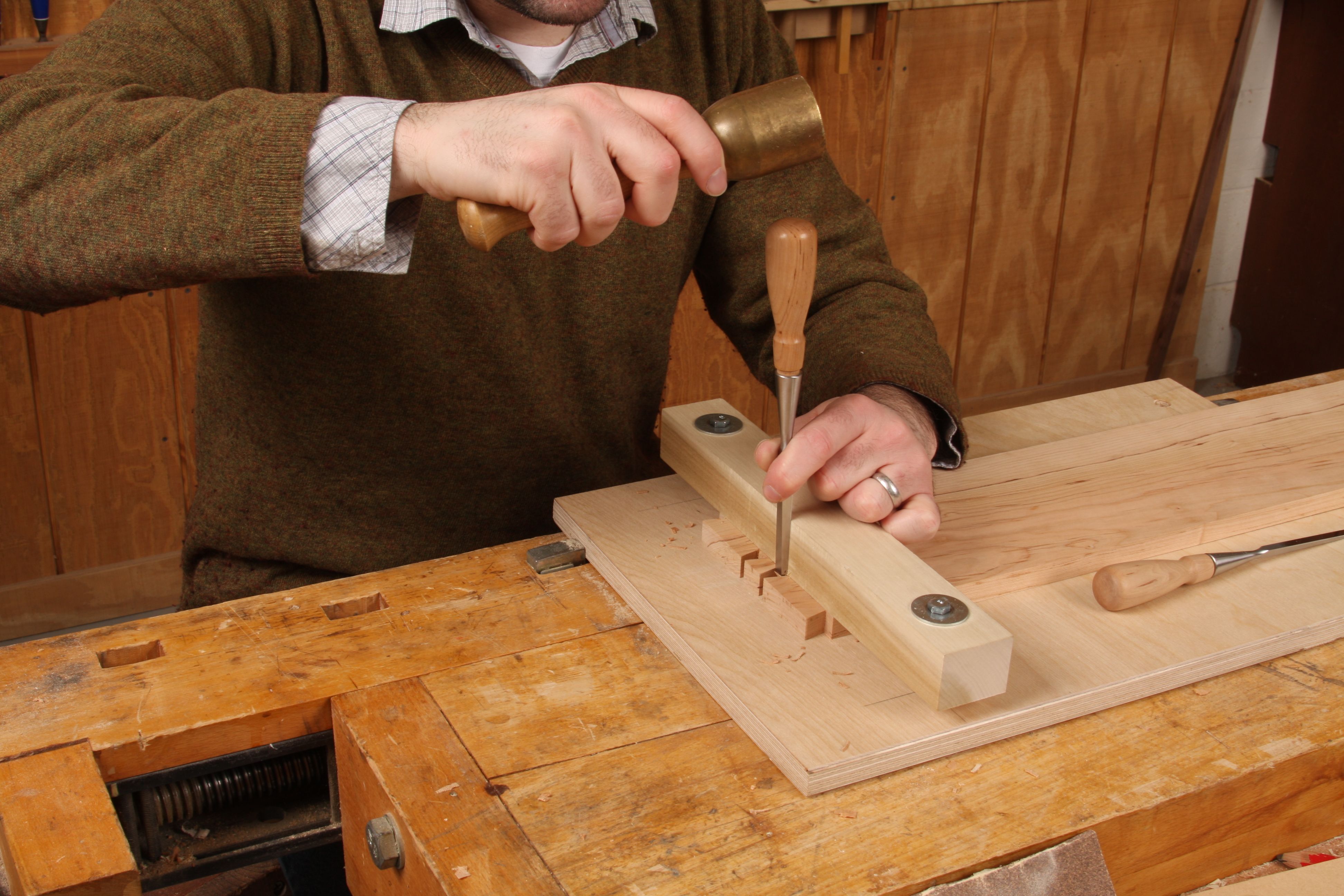
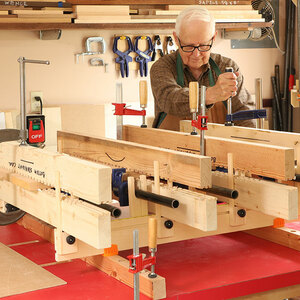
Here’s why I’m asking these questions. This past weekend, I attended a Lie-Nielsen Hand Tool Event in Brooklyn, NY, talking to fellow handtool freaks, handing out copies of the magazine, and demonstrating how I use handtools in my work. At one point on Saturday I was cleaning out the waste between some tails. The board was clamped into the jig you see in the second photo above. The fence on the jig holds the board in place and also aligns with the joint’s baseline. So, it does double duty as a paring guide. It guarantees a baseline that’s straight across the board, square to the edge, and also square to the face of the board. While I’m paring away, another woodworker walks up and says, “That’s cheating.” And I responded, “No. It’s not.” There wasn’t much more of an exchange, but when he had walked away, I turned to the other folks standing around and said, “There’s no such thing as cheating in woodworking. And don’t let anyone tell you there is.”
We’ve all heard that “argument” before: If you use some kind of jig or aid to improve your joinery (especially if it’s a dovetail), then you’re somehow taking an unfair shortcut. By extension, it’s implied that you’re not as good or authentic a woodworker as those who don’t rely on the jig. That line of thinking is complete hogwash. Here’s why.
What matters when you’re making furniture is the furniture. When all the tools are put away and the finish is dry, have you made a beautiful piece of furniture that you and other folks find beautiful and useful? If so, then nothing else matters. So, do whatever it takes to make the furniture you love, even if that means using a router, tablesaw, or a chisel guide to cut dovetails. Heck, do it even if it means leaving behind traditional furniture making techniques and joints (like the dovetail). Try as many techiques as you can and find the one that works best for you (efficient and produces great results). And don’t worry about whether or not the technique is cheating, just worry about whether or not the furniture you make is beautiful.
One last point. I didn’t write this blog because my feelings were hurt. They weren’t. I’m writing it because I wanted to counter a poisonous attitude that can belittle and defeat those of us who are just starting out and trying to l learn the craft. We need to encourage those folks, not deter them.
-
This is a beautiful joint. Does it matter how I cut it? I think not.
-
Is this jig a cheat? I don't think so, but then again all I really care about is whether or not the resulting joint is beautiful.



Comments
This is a great post, Matt. I couldn't agree more.
In your opinion it's a beautiful joint. In my opinion it looks out of place and the woodworker is just showing his skill and not thinking about the piece as whole. That being said, no, it does not matter how it was made.
The only place I could legitimately see where "cheating" can be a legitimate issue is in period reproductions. Even then, my personal opinion is that if the final result is identical, the methods shouldn't make any difference. I know some woodworkers who could possibly tell the difference, but then we're really splitting hairs. In reality, I most frequently hear "cheating" from hobbiests. And if you're just in this as a hobby, how can you be cheating anyway?
For some people, woodworking is a competitive sport that requires critical commentary on every aspect of the craft, down to the size of one's micro-bevel.
Thanks for sharing your thoughts on this. Matt.
When I started woodworking just a couple of years ago, I wish I had heard this. What I heard more ofter is: you have to do it this way (read- my way) or you're not doing it the right way. Matt - thanks for freeing us to learn and enjoy the craft without all the baggage that some feel the need to heap on it.
Cheating may be a crude term and I would concede that in contemporary woodworking, a jig is yet another tool. Yet the questions that you preface your post with suggest you have lost the vision of why we need skill and craftsmanship to make things! Do you honestly believe that the readers of FWW don't care and should have the right to a view on the quality and integrity of how something was made?
I might be as provocative as you Matt by suggesting your post is hubris, you were indeed hurt by that pejorative term! Whilst you might be a journeyman in your own right, that unsupported challenge was a crude insult. Do I think you are a cheat, No! But I think a more critical response that recognises the aims and objectives of any modern journeyman, should confront their own personal integrity when learning new skills. Oh and there is more to making, than just concerning oneself with beauty! Unless you are just yanking our chain?
Thank you for a reasoned approach to woodworking. As a hobbits with little time, I can be traditional and never get anything finished, all machines which I think limits the forms somewhat, or "hybrid" which allows me to get projects completed but give them that "special touch" that makes them unique.
If using machines and a dovetail guide were good enough for James Krenov, than the're good enough for me.
Rusty Miller
I never thought about using a jig for a dovetail! Thanks for the tip!
No, it is not cheating,
I am a woodworker and photographer. Some years ago I made the switch from film to digital. I received the same accusations from photographers who still shoot film saying that using Photoshop to even adjust the lighting is cheating! What do they do in the darkroom?
In furniture, as with photography, the end result is what matters, not how you got there.
Woodworking is a personal pursuit and what ever you feel is right, is right.
I use the same set up to cut my dovetails. Not cheating at all.
I do consider the use of CNC machinery to be cheating.
Wharton Esherick should ring a bell. ... tools he used were less important than the results he produced: "I'll use my teeth if I have to." ...
Was Wharton Esherick a cheat? I think not...
When does a tool become a "cheater"? Would a purest prefer a rock found in the yard over a hammer?...
It depends on whether you see your woodworking as an art, a craft or just a functional pursuit. I watched a TV programme recently where a guy was turning bowls from log offcuts. He first used an axe to rough out the basic shape then used a foot-peddle lathe which was driven by a branch of a tree with a piece of rope attached between it and the lathe pulleys. His foot peddle was just a length of rough wood which bent and released the branch to give the spring to drive the lathe. His bowls were just beautiful - a real work of art. They could more easily have been made on an expensive lathe - but anybody can do that! He is a real artist and his work is appreciated for the way that it is made.
I do not feel it is cheating to use a jig or any other tool to get to an end product that is beautiful and pleasing. We woodworkers range from hand tool only to full machine to mixtures of the two (as I am). Who cares and who is to say what is right?! IF we didn't "cheat" with tools starting 1000s of years ago we would still be living in caves, ya heard!
I work both with machine and handtools. Both are a means to an end which is to produce an article that I use or admir. The tools themselves are not the items of addoration. Sure I get a thrill when using a handtool to get a perfect result, but so do machined items. Mostly the machine tool are used for roughing out the work and handtools to do the finishing. However I do not particularly care whether my dovetails are perfect with handtools ro by machine. But I do care how the finished itemd looks and its usefulness.
Then one could make the argument that a tablesaw is cheating as opposed to a hand saw. should I be knawing my dovetails with my teath? I think it takes time and creativity to make jigs and fixtures to aid in getting a good looking and accurate result.
Matt I agree. The result and quality are what count, along with the personal efforts we put into a project. The specific means to get there are personal choices and they don't matter in the end. There is more than one way to skin a cat.
Thank you for this post! Right now I use everything from a Kreg jig to a Leigh dovetail jig to get projects done. It helps me get things done in a timely manner. My family and friends think my work is great. I try to enjoy the craft while also holding down a full time job. However, I look forward to exploring and honing my hand tool skills when I retire, and I have nothing but time to do this! Until that day I will use whatever I can to get quality furniture out of my shop.
Mat I enjoyed the post, and I fully agree with you.
I am sure that the "Old Masters", if they had todays technology, both materials and tools they would also be using them.
As for the "New Masters" I am sure that they all use the technology available today, whatever form it may take.
How many of you buy your lumber from shops or lumber yards, they are certain not have hand saw the trees and been down a saw pit to saw them into planks, and I bet they also kiln dried the wood - so is this also cheating?
Come guys each to there own methodology of working - the important thing is that you enjoy what you do and you make a piece that is to your satisfaction - There is no think such as a purist these days.
I use power tools and make many jigs and fixtures in my woodworking shop.
After decades of making photographs with film and chemicals, I now use a DSLR.
Drawing, painting and printing fine art images has been my passion for many years, yet I now use my computer to make artistic images.
My wife is a professional knitter who also sells and teaches the use of knitting machines.
Not a few times we have heard the comment, "That's cheating". So, I like to put it this way:
Is it cheating when my wife uses a sewing machine instead of stitching by hand?
Is it cheating if she uses a vacuum cleaner instead of a broom?
Is it cheating if she uses our kitchen range instead of a bonfire in the back yard?
I know many artists who draw or paint looking at a photograph instead of sitting outside in whatever weather exists at the time.
The remark that using tools to get things done, whether they are mundane or Art (uppercase intentional), exhibits a restricted view of things. Surely there are many ways to do things and hewing to rigid rules limits what we may do.
Thanks for resurrecting the subject, Matt. It may not convince the naysayers, but it exposes how narrow views can inhibit the work we do.
Don Butler
The Romans, Egypt's, Maya's, were using jigs and very clever tools, so now we like to discuss if this is correct or not? What a USA way of thinking, the famous ignorance at top level
Cheating is only if you misrepresent your methods. If you say produced with period hand tools and use a router--cheating. If you say produced with hand tools and use the table saw to make a jig to keep the hand tools on track-disingenuous
I agree with Berni41 - it is only cheating (or lying) if you misrepresent your methods.
I have not encountered anyone using the word cheating in woodworking (at least not in many years) and no one on this blog seems to feel this is an issue.
Cheating is a terrible word - stealing answers on a test, undermining the rules of a game, taking steroids in sports - how do you use the word cheating in woodworking? You undermine the concept of "cheating" when you use it in this context with woodworking.
Is it cheating? No, of course not. But is it equivalent? I don't think so. If we take your argument to it's logical conclusion, we'd all be buying our furniture from someone else rather than making it ourselves (what could be more "efficient" than that!)
There are two separate "gold standards” in question here: The first, as you point out, is the quality of the furniture you produce, regardless of the methods used. But I suggest that furtherance of the craft is as important if not more so than piece itself. If we lose sight of the latter, we will, in time, undoubtedly lose the former.
Matt,
Far be it from me to critique anyone's process or results as I am still relatively new to trying to learn this craft. My view is that the truth is spread around in many of the above comments. If we focus on the ends and say no matter to the means - do we lose something in the value of the journey? Isn't that what YoungElm was getting at ?- his wording was difficult for me....but his comments struck a chord. Considering not only results, but also process and how the application of the process serves to define for each of us individually how we conduct ourselves on the path -to whatever it is that is our goal.
For myself - I am indeed very gratified when glue lines become invisible and glue ups come together without scaring my dog but for me, the craft is more spiritual. I consider something else is working through me trying to reveal little mysteries along the way - I demand high standards for the finished result -then, the process redefines itself little by little each time i start a new piece.
When engaged in any craft, It is up to the individual as to how it will be done. Just don't misrepresent how you did it. There are many ways to get to the destination, do what it takes to enjoy the journey.
Dan
I've found over the years that a lot of folk like the idea of having a hand made piece of furniture in their home and would boast that it was hand made for them, but are not prepared to pay for the time it takes to produce the item, therefore it makes sense to use machines, isn't this what we call progress?
As for making a jig....why not...jigs were not invented in recent years......they should be looked upon as an aid as indeed they are.
I served my apprenticeship with some very fine carpenters, joiners and cabinet makers, we restored antiques as well. We were encouraged to think of ways to make the job easier and quicker without loosing quality.
I'm all for using routers, chop saws, dove tail router jigs and battery drills and screwdrivers, air piners etc.
I'm in my 70's now and make model R/C boats.....I hate to think how many jigs I've made over the years....or how many more I'll make before I pop off.
Did anybody consider that the guy might have been joking?
I mean I could say that FW has to keep all those expensive power tool advertisers happy when you say,"So, do whatever it takes to make the furniture you love, even if that means using a router, tablesaw, or a chisel guide to cut dovetails," but I'd be joking of course.
This is a great topic to exercise the grey matter we all have upstairs, sometimes the thought and accuracy that goes into making a jig far outweighs the beauty of the joint created by the jig.
I think whatever helps create the envisioned item is fair game.
Depending on viewpoint, is a sharp blade cheating, if rocks were used thousands of years ago? Is using a straight edge cheating, if some folks can draw a very straight line? Is anything beyond a whittling knife cheating?
Hopefully, the guy was joking...
If not, hopefully, as he travels a path to better understanding of the craft, he'll gain enough experience to understand.
Several years back I "contracted" with myself to produce four identical cherry bedside tables in time for Christmas, just a few weeks away, all with through tenon construction (I like mission style, but I also love working with cherry wood as opposed to oak, which makes me sneeze}. After destroying several nice pieces of wood trying to handcut through mortices I came up with a better method.
I ripped the center of the legs on the front face, used a dado blade to cut the mortices, then glued the legs back together. Voila! Invisible saw lines, beautifully perfect mortices, and only the tenons to go.
So I cut tenons on the side rails usng the traditional methods, and was dissatisfied with the fit. Back to the drawing board. I milled slats of wood the proper length, fitted exactly into the mortices, as my tenons. Then, on the theory that a good glue joint was as strong as the wood, I cut 1/4 inch thick pieces of wood to serve as the "sides" of the stile, each one designed to fit exactly between the legs, and with a quarter inch lip extending downward, and glued them in place at the same time I glued up the mortice-tenon joints. NO black lines, I was able to use secondary wood for the inside parts of the stiles, and the side panels just dropped into place when I was ready for final construction of the chest sides! My wife and kids loved the chests, and I was able to arrange them around the Christmas tree on Christmas eve.
Is that cheating? I achieved quality results, it is impossible to tell that the stiles are glued together unless you look inside to see the secondary wood. One can argue that I am not honing my skills, but the other side of that coin is that I have time to make something else, and I didn't waste a lot of wood learning. I worked what I hope is smarter.
I also learned a valuable personal lesson. Four was the absolute limit for me in terms of how much repetition I wanted to do. Beyond that I would have felt as though I were a factory rat.
The guy who said you were cheating is the true culprit---he was the cheater-- used a car or bus or taxi to get to your show instead of walking!! Every little jig or fixture I make or use really helps me complete my project as my vision isn't exactly perfect.
Who cares what you use as long as you as are happyand proud of your own handy work.
We’re all cheatingthen if you take that statement to heart. Did you make the tools that you use to do woodworking? No!
You Cheater! LOL
I was making my own Jigs before I knew that’s what they were called a “JIG”. My shop is full of them, some as simple as a stop gauge and others far more complex.
I pride myself on “Handmade” woodworking, which means, I “made” them with my “Hands”. My hands guided the tools, to make the cut, to connect the joint, squeeze the glue bottle, tighten the clamp, sand to perfection and apply the finish. I didn’t make the saw, clamps, glue, sandpaper or stain. I use my skills and talents to use these items to produce an end product the best my ability allows me to.
My good friend who’s a painting contractor, ask to use my shop and tools to make a bunch of circle templates out of Masonite.
He charged forwarded using a compass to draw the circles and a jigsaw to cut them out while I stood back. After finishing my coffee and watching him hack up several caveman shaped discs, I suggested using my radius jigs (handmade) that attaches to my band saw. I rough cut a few squares from the sheet, set up the jig and completed 2 perfect discs in a rather short period of time.
After watching how quick, simple and accurate it was, he said “Ya, But that’s cheating”!
I was dumbfounded. Cheating? How the hell is that even a factor to consider? To cheat would imply that rules were broken. What are the “Rules”? Who’s the judge?
Since being considered a "Cheat" I gave him the option to complete the remaining discs his way.....he quick declined.
When I’m charged with a task(s) to complete an objective, I go about it with intelligence, knowledge and know-how to complete in the most accurate, efficient and timely manner as possible. The very first thing I do, look for a jig that’ll work. Or make one that will!
I dont believe there is cheating in woodworking until you get into using CNC machines to remove human error. As long as the woodworker is making and taking the risk of mistakes in their work, they will be accountable for the outcome. Machines, jig, handtools, it doesnt matter, they still need to be setup correctly and used with care and skill.
To the "Ivory Tower" traditionalist, I welcome you to my place anytime to teach me your craft, otherwise I'm home alone with books and magazines chipping away with the tools at hand. To the other "Ivory Tower" folks unwilling hand down the craft, "Drop the steel and cleave a stone. Take traditional woodworking back to the basics."
I agree. There are in reality only two tools used to work wood, a sharp edge and a striker. All the rest are jigs. As an example, sandpaper is lots of sharp edges glued to a peice of paper.
Matt. In every craft there are dogmatic (close minded) and spiritual (open minded) approaches ... You can't reason with dogmatic folks.
Every jig is a tool. Is it cheating to use a bench vise as opposed to holding your work between you legs. Woodworking purists are generally a pain in the ass. They are like reformed smokers or drinkers. Since they don't do it it can't be right. And they feel a need to give unsolicited and often unwanted opinions about how non-traditional woodworking is not the "Real" thing. Compare high quality work using both methods and you will not be able to tell the difference.
Amen. Whatever method gets you were you want to go and provides the most pleasure and satisfaction along the way is the "right" method! Any time spent being petty and critical about how someone else is doing their thing is at best a waste.
I love watching other people do what they do. I almost always learn something from them, and I put what I learn into practice if I like it. About the only time I will jump in and tell someone about a different way of doing things is if I think I know a more effective way to get where they are going, and then I'm completely cool with them either accepting or rejecting my suggestion.
Love the process? Love the results? It's all good.
The other side of the argument in favor of using a jig and not considering it "cheating" is efficiency. After spending years assuming power tools are the most efficient way to do my work, I am learning that in many cases hand tools are more efficient. Often that efficiency is generated by less setup time. Developing and applying a jig to the hand tool work I do means I can square the end of a board more accurately and more efficiently using a jack plane and a shooting board then double checking my miter saw's fence and blade squareness or checking to make sure the miter gauge on my table saw has no slop in it, hooking up my dust extractor, getting my breathing protection, hearing protection in place. But the key is the shooting board. Is a shooting board a form of cheating? It certainly seems to me to be a "jig", which I consider to be a shop made tool that has been developed to allow consistent and familiar results. Familiar here means that I have developed it to fit my own particular way of working. I am sure that your critic wouldn't consider a shooting board cheating, but it is nearly the same tool as your chisel guide.
My initial thought was that if this was cheating then there would have to be some sense of competition implied. I have never viewed woodworking that way. As a woodworker who started out 30 years ago as a hack at best I continued to constantly improve the quality of work I produced with better tools, better jigs, but more importantly, increased knowledge. I'd like to believe that the project I do today is of better quality than the one I did yesterday and not as good as the one I build tomorrow. How I choose to improve is up to me. It should be that way for every woodworker without any sense of guilt as to how they achieve improvement. Unfortunately if I tried to freehand dovetails without a jig or tool I wood have a lot of firewood.
I read most of the comments to date and they all fail to point up one of the most compelling arguments for using jigs. Jigs also help woodworkers perform tasks that would otherwise be dangerous to perform. Take a simple cross cut sled for example. Some of the tasks one performs with this device are safer to perform and at the same time give us a more accurate cut. Another vote here for jigs.
I think cheating is too strong of a word to use. I think a better way to say it is less of a challenge.
I attended a boat building school which, as an initial project, everyone was to complete a shipwright's toolbox with dovetail joinery. The instructor demonstrated chopping dovetails with no jigs and let the students go at it. One student decided to use the clamped board technique you describe as he was familiar with it prior to coming to school. It caught on with a few other students. The instructor saw what was happening, and was rather disappointed that students were using the jig, but none-the-less, reassembled the class and talked about jigs. His point was that although the jig was helpful, he wanted us to learn without one and not go to the jig until we could do it accurately freehand.
Did the old masters of the 17th – 19th century ”cheat”? Did they use jigs or even machines?
I am totally convinced you will be truly amazed when you learn what they were capable of. Unfortunately it is not possible to post pictures here. They used jigs for drilling straight so complex you could call it a manual drill press. They used foot powered saw jigs to saw straight. Both these from 1816.
I have fantastic pictures of foot and hand powered lathes used for wood and ivory capable of work not possible on a modern wood lathe. They were so complex you did not think it possible at that time – 1670-ies!
Oval turning – no problem. Turning cross sections more complex and irregular than a gear wheel – no problem. Apparatus for cutting threads on the lathe – no problem. Today’s furniture makers stand on the shoulders of these fantastic guys now long gone.
Manually driven planes capable of fantastic irregular profiles looking like waves. I have never seen such work even in Fine Woodworking, All done during the same time period (1600-hundreds) and possibly earlier than that. Not seen in the woodworking of today. Could the technique be used today and give it a modern twist? Possibly.
I am no skilled wood-worker but love using hand tools and machines when that makes sense. A true armature in every sense of the word. Trough my professional work I have come in contact with these fantastic jigs and machines. Today we can see the pieces produced with these jigs and machines in museums and we admire them and think they were only made with simple hand tools. Much of the work was of cause but it is amazing to see the jigs and machines used for some details.
It must be possible to do woodworking just the way you personally enjoy and respect and admire the work of others no matter what road they took.
Someone earlier said it's not cheating until you start using a CNC. Have you ever used a CNC? You still need the skill of an architect to draw the piece. You need to know how to set up the correct cutter. How to read the grain of the piece you are machining etc.
Is using a marking-gage from the 1800's cheating or do you mark everything freehand with a pencil.
When I look at a turned leg, I don't wonder if it was made with a pole lathe or a power lathe. I just admire the fine design and looks of the piece.
I don't care if you made a dovetail with a machine or by primitive hand tools, I just care about the end results.
What a bunch of SNOBS on this site. (Not everyone).
Just enjoy working with wood, it is FUN and should be simple.
Matt;
The jerk probably wasn't even a woodworker to start with. If it were cheating we would all be guilty. I think it would be a fair statement to say that at one time or another we've ALL come up with our own way of doing something, does that make it cheating?? BTW Who was he to set the standard of what is and isn't.
The end product is all that counts and boys if you want to lie about how you got there, that's between you and your workbench. The only "misrepresentation" would be if you bought it and passed it off as yours. That is cheating!
People have probably quit reading by now but I remember reading in Fine Wood about 20 years ago an article on the master Pye who said something to the effect that there was:
The craftsmanship of certainty and the craftsmanship of risk.
Neither one negating the other.
I have bought into this ever since.
Cheating is what the wives are doing when the husbands are all out cutting joints.
Three years ago, at the craftsman conference in west VA., a speaker noted (on this topic) that when Stickley was criticize (by "purists"), for extensively using powered tools in his factory, his response was "let the tool do what the tool does best and, let the craftsman do what the craftsman does best".
I don't get the concern . . I will use skill heave hand tools whenever it is best for the final product, not because I need to " prove" something to myself . . It is about the product.
I worked construction for almost 40 years. I put in a lot of thought into make my job easier. Occasionally someone would walk by and see me doing something the easy way and tell me I was cheating. That usually meant they wished they had been using the same methods instead of knocking themselves out to accomplish the same thing.
Quality is quality. Good workmanship is good workmanship. Perfection is perfection. It isn't how you achieve that goal that matters, it's achieving that goal that matters.
it is not cheating! it showed the use of higher intelligence to know better methods of work skills and applications to incorporate other tools, jigs and fixtures to make it into a precision interfaced joinery. It is only your lack of imagination that can limit your skills. Just remember to keep your cutting tools sharpened and your mind sharper than them.
I,m sure that the artisans of the 18th century we considered cheaters by their masters because of the technology advancements that they used instead of the antiquated tools that their masters used. If you don't take advantage of technological advances offered to you I feel you are just cheating yourself. Who has the right to to tell you what cheating is or isn't?
I feel this ideology is being driven by the hand tool manufacturers for their own wellbeing. Are they manufacturing all their tools just like they were manufactured in the 17th century or are they cheating????
The purist in any endeavor is the deluded one who envisions a world that operates only upon his principles.
Short of CNC programed machine, I would not care how the joints were made
Wow, this has been an interesting, albeit long, discussion to read. I teach how to make dovetail joints and show using your method but ---- I've only used a single clamp to hold the guide. Well, I tell students that this is a way they can do it but I've found it's more of a hassle setting it all up and the guide tends to move with the single clamp so discourage it. I tell them they may be better practicing until they can get the shoulders square by hand and you know how difficult that can be. Guess what I'm going to try next? Yep, two bolts and a guide block. I guess I too am now "cheating" because I didn't think of that.
I say whatever makes the finished product look the best.. so be it,, Cheating or not...
To me it is all about achieving what you set out to do. I'm surely not going to rip lumber with a hand saw when a table saw is available. I could go with other numerous examples as well to illustrate that point. I get great pride in making a jig that allows me to get through a process that would otherwise take much longer. I'm in agreement with another poster that said a person who says you're cheating is most likely a little jealous that they didn't come up with the idea/jig/tool themselves. Let's all keep making sawdust and enjoy what we do!!!
We distinguish ourselves, and apes, as higher order creatures by (among other things) the ability to create and use tools.
Creating a jig is no different than the creation of the screwdriver, hammer, chisel, etc etc etc. Using a jig is no more cheating than is using a ladder to clean your gutters, or a ruler to draw a straight line.
Thanks for the post. The idea of cheating at craft work is fiction. Its all about the results. I think we all have our own version of this fiction, based around why we engage in the craft and what our skills are.
I am on the jigs and power tools side of this. The skill developed from designing your own jigs in conjunction with power tools leads to much broader possibilities for the future, and higher productivity. That means more time to design, maybe even more time to learn the ole fashioned hand tool way a doin things. If you try both, you will find that the thinking behind them is fairly universal.
Well this has sure been an interesting read. Personally, I love fine tuning my joinery with hand tools to get the perfect fit. I will however use machinery to hog out the bulk of the waste. I don't believe this is "cheating!" Love what you do, or it's not worth it!
That body on your hand plane is a jig to hold the blade steady and at a specific angle. If purests want to do away with "jigs" they will have to get rid of that cut off guide and rip fence on the table saw, and free hand it. Oh, and that straight edge and square are jigs too. Even Colonial craftsmen used "jigs" of one sort or another. When it comes to precision, duplication, AND safety, jigs are a wonderful thing.
Cheating? Are you kidding me? There is no cheating in woodworking. Whether you're just getting started or you're running a cabinet shop there is NO cheating. There is only ingenuity. Look at the Egyptians. (We're still trying to figure how they built the pyramids.) In my shop nothing gives me a bigger smile than when someone says, "How did you do that?" I don't point to all the jigs and different I tools used, new and old, to get to the final and pleasurable result.
Great post Matt. A jig is a tool. Maybe the guy that called it cheating doesn't believe in using tools or maybe he was just jealous that he hadn't thought of using a jig like that. I just tried my first thru mortises when making the shaker step stool from a previous FWW and wished I had used that type of jig. I always seem to learn something new from each project I do, which is a good thing and I am having fun!!
Potato - Pataahdo. The end result is pretty much the judge. I’ve built three kitchens for houses I’ve owned and pretty much everything was cut on a table saw, band saw, joined with machine cut mortise and tenons (face frames), biscuits, screws/glue, Leigh dovetails for the drawers……. but every visible surface was finished by hand with planes and scrapers, I just preferred the look and feel of that surface. I’m the only one who knew that in the end.
I now build one off furniture and guitars moving mostly to guitars. I re-saw exotics on my band saw. I square critical reference surfaces on my jointer (I use a digital gauge to set the 90 degree fences). I built a machine to cut binding channels because I would hate to have 200 hours of work marred by a sloppy binding job (binding channels can be very difficult, although I do cut by hand sometimes just because I feel like it).
The sound board plates, back and side plates I bring to thickness with a host of hand planes and scrapers, I do not use a drum sander for a number of reasons. All joints are cut and fit by hand. Every surface is planed, scraped or pared by hand. I build free form without moulds because I like the design freedom afforded by this method.
Anyway, use what works for you. There is no “cheating” in woodworking, although there is misrepresentation. I rely on my machines for some things and love my hand tools for the way they look, feel and perform. I build a lot of jigs and tools because that’s part of the craft. If I know enough to build and use a tool and/or a jig (or “machine") to get me where I want to be, then I am a better woodworker for it.
Matt -
Whether or not your antagonist knew it, he hit the nail squarely on the head!
You see, woodworking, like many other crafts, has its roots in workmanship that is totally dependent on the use of tools with hand/eye coordination of a man's muscles and bones. And much like anything that relies on the human condition, repetition is the key to skill and perfection.
Experts generally accept that if you repeat anything about 10 thousand times, you will have mastered it, completely. Most skill-sets require a lot fewer repetitions.
To the extent that jigs, fences, fixtures, attachments, specialized cutters, machines, and other appliances are used, the repetitions needed are never in-play, therefore the "skill" is never acquired, and cheating (in the pure sense) completely substitutes for skilled craftsmanship in the modern era.
Given that modern man has neither the time nor the patience to perfect skills like that, the results of an ingenious machine or specialized tool-set have become acceptable. Viola!
I hope you appreciate that crisp edges that are straight to a line-of-sight; parts that fit together with vanishingly tight joints; curves that smoothly transition between flat surfaces; straight/flat tenons with delicately undercut shoulders that slip gently but firmly into clean-sided mortises; tapered dowels that fit perfectly into their matched sockets; and on, and on, and on...........are the hallmarks of a true journeyman's handwork. His eyes and his touch know when things are just right. And we can see it!
Another observation is that "cheating" with modern devices to achieve results the fast & easy way is seldom done by the best-of-the-best fine woodworkers. And instead of making a box full of kindling wood with each project during multiple set-ups of machines and specialized jigs, the journeymen know how to take time with deliberate patience to "sneak-up" on good fits and good cuts by hand. An entirely different mind-set of work.
So.........if the concept of 'results is all that matters' is in full force with you, fine! Get your furniture at IKEA.
Just don't equate those results with craftsmanship and skill.
It's a pretty slippery slope once one draws the line on where "pure" stops and "cheating" begins in any artistic field. Is the accuser who precipitated the cheating discussion with his "That's cheating" comment cheating when he uses a chisel he bought rather than one he made? If he makes his chisels, is he cheating if he didn't smelt the ore and forge the iron/steel? Is he smelts and forges the ore, is he cheating if he didn't mine it? Are we all cheating if we didn't plant, nurture, or fell the tree from which material we all work comes? It's an interesting discussion but at some point, it devolves into navel gazing.
Do today's bakers and cooks still grind their flour in a grist mill?
Do pharmacists still use a mortar and pestle? I do hear that some doctors are using leeches and maggots again.
No thanks, I'll take the modern approach.
If you can't bear the thought of machines then do it all by hand but don't bore us with your sanctimonious crap!
One issue which I haven't noticed in these comments, is that some people are disabled, or injured. The unsteady hand of a person, neural changes such as Parkinson's, peripheral neuropathies...and many more. Is it fair/unfair to judge such changes in a person's life to prohibit the use of such jigs? I think not, considering how many elder workworkers enjoy such hobbies and craftmanship work.
Wow, Matt. Think you struck a nerve?
Nice post.
I love Matt Kinney's balanced attitude, but he has written "I'm not a handtool nut" in last months article and "fellow handtool freaks" in this blog post. I am not sure if I am supposed to feel offended, or feel kinship... ;)
Cadabra, You know, you sound like the arrogant artists in most guilds..... One here in my town considers china painting as CRAFTER work, not art.....Yet when the crafter put the same design on canvas, she was an ARTIST.... The same applies to you and your snubbing nose... The woodworker that learns to use all of the tools at his disposal, whether powered or not, is as much of a craftsman as you think you are...... I can bet that were you to have to dig a ditch 100 ft long, 10" wide and 18" deep, you damn well wouldn't use a shovel,spade, pickax or a hoe...... Hell, no, you would go rent a DitchWitch... Yet these tools were once considered to be tools of a "crafsman"...... I have examined FINE WOOD items made using only hand tools and I found the following: scribe marks from a marking tool, torn wood from a dull chisel, miscut dovetails- both pins and tails, and scraper marks.... But it had a modern day famous(?) name on it....The person that learns to use all of his tools, including jigs, and produces a great looking piece is a craftsman..... As a suggestion, perhaps you should follow the advice given me by my Dad 65 years ago- never steal, borrow or buy, axes hoes rakes, shovels, wheelbarrows, etc.. When I asked why, he said "they are the working tools of the ignorant".. Now I am not implying that because you use handmade chisels, wooden smoothing,jointing and jack planes, own 2 1860 era Disston handsaws, all your moldings are made with old wooden Stanley molding planes, your nails are square cut, you hunt (with a club) your own rabbits to make your special "handcrafted glue", you gather walnuts off the ground to use the hulls to make your own stain, travel to Thailand to harvest your own resin from the lac bug and distill your own alcohol to make your own shellac, and perhaps skin and animal to get the finest bristles to make your own brushes...... Failure to do or use any of the above REMOVES you from the category "best-of the best woodworker". Your attitude is a crock of crap......After the first 30 years Of Fine Woodworking Magazine, I found your attitude had permeated it so badly that I dropped it... An example was from Krenoff- (a snob) there is no place in a woodshop for file... A Craftsman that masters all of his tools, REGARDLESS of what they are is a CRAFTSMAN.... So,Cadabra, don't bang your head while looking down your nose at the rest of us.......
Throughout history, woodworkers have been prone to use the best available technology of their time. Commercial woodworkers should only use the tools that provide the most productivity that is consistent with their approach to the business model they pursue. Hobbiest may chose whatever approach they prefer.
Accordingly, do what ever turns you crank, just love what you do!
Most of my customers are not interested in how their piece was made. Their only concern is how the final product looks and performs in their home. I am always interested in exploring time saving methods and tools as long as the quality of the result is not diminished. Two or three drawers of a smaller piece can be hand-cut with no great effort. But a wall unit with 24 drawers would be too expensive for the client if I were to hand-cut them all.
Is it "cheating" to use machine-cut dovetails? No. But it is cheating to apply score marks to the tail boards after machine cutting.
Wasn't there a Far Side cartoon that had a caveman attempting to start a fire with some flint and the caveman standing next to him said "You're cheating"?
Anyway, it seems that technique has now become an end in and of itself. It's used as a platform for the purist to showcase a type of expertise that never needs to produce anything substantial. Demonstrating one's skill as a craftsman is simply a matter of producing clean and tight dovetails on an anonymous piece of wood or producing a cutting edge that results in wispy thin shavings that float in the air. I'm probably overstating the case, but it would be nice if some of our collective obsession with technique were balanced out with more focus on design.
Is using your thumb to line up that first cut with a handsaw
cheating? Is using a square to mark the line of your cut
cheating. I think these are the same as using any jig. It is not cheating...it is improving on the use of the tool.
Great article Matt.
Good post Matt, but are you sure the guy wasn't just pulling your leg? I can't tell you how many times I have found myself trying to do something "the hard way" , only to have someone come along show me a head slapping, simple way to achieve the same task - My common reply - "But that's cheating".
John Economaki, the owner of Bridge City Tools calls those who make accusations of cheating "The Woodworking Taliban."
He tells a story of just such an accusation when he was demonstrating how to cut dovetails on his JointMaker, a machine that he himself designed and built. Economaki asked his accuser how he thought it should be done and the indignant reply was that he should use a handsaw.
John handed the man a dozuki and asked him to show him. "I can't do that! That saw doesn't have a back." Came the reply.
"But that's cheating!" Economaki replied.
His adversary left in a huff.
I like the article and post very much, kind of reminds me of my days as an apprentice toolmaker.
Now i'm probably going to tick most y'all off but, yes it's cheating. If you're passing your work of as hand made, old-world, true period piece done with ancient craftsmanship it's cheating. There is also nothing wrong with it.
When i was learning tooling i made all kinds of simple set ups that would help me get my job done. Sure it would take longer for me but i was making less than the guys that could get twice the work done in half the time, some times within a quarter of the time. But i learned.
When i made two or three set ups to accomplish the same work another toolmaker was doing, i'd walk by his dungeon and glance at his set up. Next thing you'd hear from the journeyman would be a bunch of swearing and accusations of cheating and copying his work. I didn't care though, I was learning to be more efficient at my job with better results. Later on i'd gained more responsibility, status and pay i asked the old Germans why they had treated me in such a way. they replied, "We just wanted to make sure you wanted to be a toolmaker, not a shoemaker."
I use machined jigs of my own making, machinery of my own design and tools to make projects easier for me to accomplish. So yes i cheat, and i don't really care if it's cheating or not. I got over what people said about me long ago.
ePop
I love the comparison to the Taliban.
I am forty years a professional cabinetmaker and a student of the history and business of the craft. I, like most in the history of our trade craft, will bring any technology to bear that will expedite to production of the object. For hobbyists, perhaps process is key. For practicianers of tradecraft and producers of design objects, expedition of execution is key.
The effects of the latter approach can be reviewed at my website: http://www.gwatsondesigns.com.
Hmm, I always understood jig making was an integral part of the craft, and has been so for generations.
I've done several workshops with the "masters" and their instruction always emphasizes jig making as a means of optimizing the quality of your work, especially where details require exactitude. To say the use of jigs is 'cheating' would go a long way toward disqualifying the use of many tools. A simple example would be the use of a bearing-guided router bit, or even the use of any machine when building a project. Why would any aid used to assist handwork be considered cheating? Are there rules in woodworking which say a given work is authentic only if produced solely freehand? I'd have to agree there is no such thing as cheating in woodworking when it comes to turning out finely crafted, qualitative work.
After reading all the comments I hesitate in opiniating about Matt's writing.
Anyway:
To start, one has to define what is cheating - I think that cheating is to misrepresent the truth, to lie to others or to oneself. In this context, cheating would be to lie how one arrived at the end product, if it is an original design or a reproduction, if it has been made using hand or machine tools etc. If there is no lie there is no cheating.
As far as using exclusively hand tools or a mix of hand and machines, it's fine, if the person is happy with it.
Depending if one does woodworking as a way of puting food on the table or for pleasure, the use of jigs and machines becomes more relevant.
I can't speak for others, but for me what gives me pleasure is not only the way a piece comes out, but also the process of how making it, and I use hand and machine tools. Passing a hand on a surface planned by hand, how tight a joint is, how the overall piece has ended, and so on, gives me pleasure, and that's what counts, in my opinion.
More than 40 years ago I did a 4year woodworking diploma course, and I remenber how hard it was to spend a full year doing everything by hand whilest the 3rd and 4th year students were using machines, but I learned a lot with the curriculum.
In summary, cheating is lying, and using or not a particular method of working is not cheating.
Thanks Matt for fomenting this discussion.
I agree with the guy who wrote this article.
If the challenge was to create a piece with hand tools and show his skills in terms of precision of carving, cutting, ... wood, without any precision tool using only hands, his eyes and hand tools to cut, then maybe.
A person like that I might call it a sculptor.
if you look through that perspective, even a square would be cheating.
To do a mitre cut in wood the individual would have to mark it with the pencil the 90 degrees angle just using his eyes and hand and then cut with a hand tool.
I don't think that's what we are looking for, here. We want to work the wood (woodworking) in a precise way and we use the tools that we need and know or even invent, to do the job.
Saying that. I would like to say that, If you challenge your self to just use hand tools, your hand skills will improve, that's for sure,.
But if you go the other way and you are very inventive using the materials and tools that you have in your hands, the sky is the limit, you learn to overcame obstacles and push the boundaries how to do things and shape wood where is not possible in a holistic way.
There are many ways to do any task. The way you choose to do it is up to you. It does not make any difference if you use power tools of hand tools, jigs or no jigs.
If you are doing woodworking for your own pleasure like most of us it is not important how you get the task done it is that you do it.
Anyone who sticks their nose in the air about your methods is a snob. Besides designing a jig is a fun and sometimes more difficult task.
WOW! It's truly amazing how carried away people like usafchief can get. Go pop another Prozac and relax, boy!
I never said 'cheating' was bad, I merely defined it in many ways.
I never said I don't 'cheat'. I merely said I can appreciate the difference.
I never said cheating doesn't give acceptable results, I merely said that if results are the only thing that counts, you don't appreciate craftsmanship like I do!
Is it cheating if a potter forgoes throwing them on a wheel and uses pre-cast bowls instead?
Sure, but the bowls are O.K. when they're done, and the difference is almost unnoticeable.
Is it cheating if a painter uses masking tape?
Sure, but the beautiful straight lines are great when they're done, and the difference is almost unnoticeable.
Is it cheating if a mechanic swaps out a transmission for a re-build instead of finding that little problem part down inside and fixing it?
Sure, and both get you down the road when they're done, but it usually makes better sense to do the swap, and the difference is almost unnoticeable.
Is it cheating if you re-heat last night's pizza in the microwave instead of in the oven?
Sure, both are delightful, and the difference is almost unnoticeable.
Is it cheating if you use a corn cob instead of the Charmin'?
Sure, both get the job done, but the difference is..........................
Wow, all this time I thought I was cheating because I Wasn't using all these more modern machines and and jig setups.
Wow, that's a lot of comments. When I started working wood many years ago in England I did a three year cabinet making course at the London College of Furniture. There we started from scratch, we were taught about wood and tools. I can now take a piece of rough timber and turn it into a straight, flat, square edged plank with only the use of hand tools. I can make any type of joint you care to mention with only hand tools. Learning all these skills is an essential step in becoming a woodworker, in my opinion. However, I very rarely use these methods when making furniture, it just takes too long. I use table saws, band saws, routers, shapers, planer/thicknessers, and any jigs or other aids that can be bought, borrowed or built. Cheating? No, no such thing.
If cheating in woodworking is a mistake, I will not come around.
Matt, I have been singing this song for a long time. If I would have devoted the time needed to obtain the same quality of workmanship using handtools, I would never have been able
to complete the numerous projects I jhave completed with mostly machine tools. There is much more that goes into making a piece of furniture: design, attentions to details, assembly and most important, finishing. It would only be a handtool purest who would look at at piece of furniture and say, 'That's not craftsmanship, those aren't handcut dovetails'.
Henry
Cadabra, your words from your first post : "So.........if the concept of 'results is all that matters' is in full force with you, fine! Get your furniture at IKEA."
Just don't equate those results with craftsmanship and skill." are loaded with your exact thoughts.
Prozac not needed....... a large bottle of TUMS perhaps.... Your insinuation that those of us that don't want to be a PURIST will only produce mediocre work and shouldn't build our own furniture because better quality is available at IKEA...... That is a pretty elitist statement and anybody can go back 30 plus years and read FWW articles and letters to the editor etc and find virtually carbon copies of your thoughts..........
Those of you that don't own all of the old hands only tools, don't sweat it, become an expert with your power tools, make your joints tight, and make your router cut dovetails fit perfectly... Your grand daughter won't give a damn that her blanket chest wasn't made with 18th century tools.
I'd have to agree with the majority of the posts here. I don't think it's cheating. If a simple work holding mechanism and guide is cheating, then you might as well say using your workbench with vise is cheating. Or your table saw with a rip fence, or a saw hook on your bench. The list goes on. If the client and builder of the piece are happy with the way it turns out then so be it. I've read some of the posts about purists and spirtualization of the craft, etc. but you know most of us work in our shops alone, so really what difference does it make whether we use a router to cut dovetails or if a simple guide and clamp system for the chisels is used? As a hobbyist, I can say I just enjoy being in my wood shop whether it's with the noise of my planer and dust collector or fitting a joint with my hand tools. I'm glad for the time I get in my shop and I'm going to make the project as I see fit. As long as I don't turn around and lie about how I made it. That would be where the real "cheat:" would come in.
In this day and age, any way you can make it, if it’s wood it’s good.
Jigs are used in all manner of fabrication, why should woodworking be any different.
Don’t you think jigs were used five hundred years ago?
I find the whole idea of cheating at woodworking to be laughable. It's ok to study history but you don't have to re-live it. Woodworking should be fun and satisfying. If you are happy with your work that's all that matters! As a retired machinist, I spent 5 decades creating close tolerance parts on precision machines Any machinist knows hand work can't match the accuracy of precision machining. So why would anyone want to use a mallet and chisel or ancient layout techniques in the 21st century? I create beautiful furniture in my shop and I don't even own a hand plane or a marking knife!
L. Bowman
I really dont belong in this blog, I am mostly into guitar and instrument building but have built my share oscustom entertainment centers complete with speaker systems and a whole slew of custom speaker designs andwith minimal help from the more professional grade machinery. With that said, if the jigs and machines are cheating fine I dream of being a cheater because it takes me 2 days to put 2 stinking pieces of wood together, and somebody Please send me a 15" planer. All you purists out there must be better men than me.
I have jigs all over the workshop. I was once a machinist and a set up man and I can tell you that jigs not only aid in precision, but can also at time be essential for safety. If I am working on a small part, There's nothing like clamping it into a jig to keep my fingers clear of a blade.
In addition, jigs are a great way to do something over and over again. I have made things that turn out so well, that other people say "hey make one of those for me!" A jig lets me make the same exact thing again and again. These things are still originals, and each is still very slightly different from each other, but the jig makes life a lot easier.
I also use jigs for assembly. It can be very difficult holding two pieces together with one hand, holding a screw with the other hand and grabbing a drill driver with your third hand. Oops, no third hand, except that jig.
Peanut butter and Jam sandwiches are good
I am most comfortable with the attitudes expressed by dags and tails1st. The remark was almost certainly made in jest, but it really placed a lot of people on the defensive. I employ power tools extensively, more so as I grow older and more feeble. My approach is to use power tools for the heavy lifting. I use hand tools (generally old ones) for fine tuning and doing things that can't be done with power tools (yes they do exist) or which are more efficiently done with hand tools. Hand tools require little or no setup time, which adds to their appeal.
Jigs are a separate issue. Many hand tools are jigs. A plane is no more than a guided chisel jig. You can fill in the rest. Old time craftsmen routinely used jigs. The most familiar are the bench hook, the shooting board and bench dogs. So jigs are not cheating. They lead to efficiency, quality and uniformity.
Finally, everyone should reflect on dags boatbuilding instructors belief that you should learn to do some basic operations by hand before you escalate to jigs or power tools. I have learned more about the materials we work with by learning to do them with hand tools.
So what is cheating? Corked baseball bats, steroids, copying on an exam, not crediting your sources, perhaps assembling furniture from kits...I hope you get it.
When you are paring dovetails with a chisel, the hand on the handle is providing the force and hand on the blade guides the cut. T
he hand on the blade is a jig.
It is like any job or process you carry out, as long as it is done safely and the end result is what you were after. A jig is a tool just as a pencil, marking gauge or any other TOOL you employ to complete a task! When you use a router to cut dovetails, is it cheating? Should they be cut by hand at all times?
Cheating?! So, I'm guessing that if using a jig to square your approach with a chisel is cheating, then using a square to mark a crosscut line would be cheating. So too, would be using a tablesaw to rip a board to width ... heck - you better grab a buddy and your double buck saw, because using that chainsaw to take down the tree would be cheating.
The real cheating is to yourself when you refuse to use ALL the tools available to you and become frustrated with woodworking. The bottom line is the end product, the beauty of the work, and the love of process.
If there are no rules, cheating isn't defined.
If it is a contest to show pure hand skills, it is cheating to use a jig that was made with powertools, if there was a rule against this.
The discussion reminds me on rock climbing. There is a so called "redpoint" climbing style, where it is forbidden to work against the gravity with technical support (e.g. iron hooks as "jigs"). Technical support is only allowed to be safe in case of fall (harness, rope, carabiner,...).
Btw: If the client pays good, use anything to make it look good and durable and to finish quickly.
Dovetails by hand give me an inner glow but the perfection of the jig impresses my friends!
Our shop is comprised of two retired engineers that manufacture a variety of wood furniture and display cases used in museums and by private collectors. The tool that is the most important in our daily chores after the table saw and the jointer is the cnc bridgeport mill. I have never seen a bridgeport in another small wood shop but it makes our products better and faster.
Cheating: A wood snobs idea of how to discount his competition.
Perhaps we should toss the sandpaper as well. That would be cheating wouldn't it?
What a strange thought: using jigs is cheating. There are many a time part of a design includes the jigs needed. Not only because I want to make my life easier, but also because the jig becomes essential to achieving a cut I am after.
A good design should both be pleasing to the eye and at the same provoke a sense of mystery as to how it was done. This second point should not dominate, but act as secondary effect to pull the viewer in. And this is where the use of jigs become integral to the design. Done right, the jigs become the scaffolding that once removed, allows to the craftsman to appear as a magician and the audience left to enjoy the riddle.
The use of jigs is integral to woodworking. Go to the Williamsburg cabinet makers shop one wall is covered with jigs. What if your dovetails had been laid out on a curve? They could have been cut by hand on a line but the line would have been scribed with a jig especially if making several was in the books. Most shops would prefer making multiple copies to reinventing the wheel at every contract.
Let the guy walk off. He probably uses filler on his dovetails. What is putty? A jig in a can!
Now that I know that it is not possible to "cheat" at woodworking, I think I'll just use butt joints for drawers, and paste on little trapezoids to simulate the pins and to cover the nail holes. ;-)
I do agree, though, that "cheating" is a relative state of mind, and the term is used too often to suggest that technique "A" is better than technique "B" when it is really the finished product that matters.
I agree with much of what Cadabra says, except for his closing comment about IKEA, and can appreciate his comment about the kindling that piles up when setting up machinery.
There are skills required to layout and chop dovetails freehand, which is certainly to be admired, partially because its impressive to see a nice clean good looking dovetail joint made freehand and partly because it is difficult to achieve freehand. It's undeserving to those that can to be snubbed as a snob. Its a skill that requires both talent, and time.
But on the other hand, for those that do posses those admirable skills it is not right to accuse those taking advantage of jigs as cheating. The word "cheating" is just not the right word here. Making joinery, such as dovetails using jigs instead of freehand, is just simply not cheating. Its a means to an end. In this case the jig, helps to obtain, a flat even baseline, that would be more time consuming, and difficult to obtain than without a jig. Using the jig is a means of accomplishing the task, but employees less skill, but one does need another set of skills to devise and utilize these jigs, which is also to be admired.
An objective of any woodworker is the best outcome of his project, it is up the individual to decide what process to take, using his/hers abilities, time, and tools in whatever way they wish to the desired outcome, and to criticize a well built project because of the method of building is just unfair.
Perhaps another objective for the woodworker (amateur or professional) wood be to develop their skills outside of the powertool realm... and if one does not to wish to, it is fine with me... but it is one of mine.
To present another analogy as many others have used their own analogies in response to this post. I would hate to teach math to our children using only calculators instead of them learning how to do the math using their heads. The same for the serious woodworker... they ought to develop the skills to work with both hand tools and power tools as an apprentice, and choose which to apply as a journeyman.
I am in agreement that you can not cheat in woodworking unless there are set guidelines that must be followed for a competition or to be part of a special group.
I do believe that the great craftsman of the past would have used the many different types of equipment that are available today to get the job done. More than likely they only used the traditional techniques because that was the only way available to build quality furniture.
Wow I find this flurry of opinions amazing, as always everyone is entitled to their's.
I look at the "purists" making comments and judging woodworkers by their methods in total disbelief.
If one believes this why are they here? Does their judgement apply to any of the contributing editors of this magazine - even those who are reknowned for furniture making?
As we are a community that I thought was about teaching a craft that few totally master - for don't we learn everyday? If a jig means that a person does an operation safely, what of it? If a person can't pursue a hobby that one loves because of infirmity why ban him if a jig makes it possible.
Jim
Jigs and fixtures are just another phase of woodworking in my opinion. They allow you do accomplish more in the time you have to devote to a project. I pity the person that can not design a jig or fixture to help with repetitive jobs.
No its not. I have a problem with my left hand and jigs helps me to keep on woodworking.
It is possible to cheat at woodworking.
I had a Junior High School woodshop teacher who won the Industrial Arts Teacher of the Year award year after year. He did it by keeping all the students at their desks while he built a student's project, which was then entered into the District then State student-project competition. Of course, his student's project always won, and he was hearlded as a super teacher.
He cheated to get the accolades, but even more important, we were cheated out of the opportunity to learn.
Other than that, I'm not sure there is a way to cheat unless you want to establish your own constraints. Getting the job done without any false pretences is what it's all about.
I read the "Hand Tool Essentials" and there are some interesting points about jigs:
1. A hand plane is just a jig for a chisel.
2. You can make dove tails with out a jig of any kind, or even any real layout tools. Just use the tail board to mark the depth of the pin board. Mark the pins any way you like and cut them. Then use your pin board to mark the depth and lay out for your tails. So while you don't have a jig, you are effectively using the workpiece as one.
So this whole "cheating" argument is ridiculous. Use whatever works well. While I am mostly a power tool guy, the concept of using a router jig to cut dovetails is utterly baffling to me, while this "no jig" hand tool method seems simple.
Use whatever techniques, tools, and jigs work for you, and have fun. For a lot of us like me, who do their woodwork in a garage, basement, or shed, hand tools have one very big advantage: They take a lot less space, make less noise, and are a lot easier to cleanup.
Jigs,power tools, hand tools are all tools of the trade. The thought process, design and the completed piece is all that matters in the end. However with the advent of the CNC machines-I believe that falls into the category of cheating.
I think the only way you can cheat at woodworking is to not tell the truth about how made something, or how you did it. If we keep it to ourselfs, woodworking as a whole will sufer. I would not be were I am today with my skills if were not for others.
Cheating is only possible when there are rules restricting operations, thus we can not be cheating when working in our shops/garages/basements/etc. Similar to some saying using motorized methods are cheating and that only hand tools are allowed. They are ignoring the fact that our "forefathers" where using the best technology at their disposal. They would be doing the same today - they were very practical as are most of us. Unless you impose rules upon yourself there can be no cheating - ENJOY !!!!
Cadabra, you're playing semantic games with your definition of "cheating." In fact you don't use it in the same sense in all of the examples you offer. So, is it really "cheating" to reheat pizza in the microwave? Well, no. If you have the time, the oven is definitely better, since the results aren't soggy and resemble the original out-of-the-oven version more closely. It IS "cheating" if you are telling yourself it has all the same pleasant qualities as oven-baked though, but you are only cheating yourself.
Matt's article makes it pretty clear that quality is a key criterion and that happens to recognize a vital historical fact about tools and tool use without syaing as much. Patterns and jigs were in use centuries ago. Arguing that such devices are "cheating" is the logical equivalent of saying that metal tools (blades, scrapers) are cheating and that the ancient Egyptian way is the only true way, or that hafts on tools are cheating and Cro Magnon man was the last true wood worker. It's silly.
In fact, I can say so from experience, a fully hand-cut joint can be a mess, if you have yet learned the methods for using the tools you employ to make the joint and that is as true for machine tools as it is for hand tools. The fence Matt shows is precisely the same conceptual application as a bench hook or a miter box, and it is used for precisely the same reason, to guide the blade and relieve the craftsman of some of the need for additional, and tiring, concentration and muscle control. You can focus on driving the chisel and the depth of cut.
I was driving to work the other day and saw a survey crew using tripods with these fancy schmancy eye piece thingamajigs. I couldn't believe it! In my day, we could survey half a county by noon with just our thumbs, a keen eye and a tree branch. What's next... GPS?
I'm a big fat cheater!
Some of us are focused on the result, others on the process of getting to the result. A process oriented woodworker will be critical of jigs as they take away levels of skill in the use of hand tools while a results oriented woodworker will point to high quality results as the most important.
The anser is going to depend on a responders position on results versus process scale.
Classic confusion among the ranks here.
It's important to distinguish between CHEATING at craftsmanship (I.e. substituting the precision of a jig/fixture/machine for that of a skilled human) and the QUALITY of the result. Quality is merely results that meet requirements, whereas cheating is misrepresenting the work of machines/jigs/fixtures for the skill and precision of the hand-of-man.
And that's what everybody tends to confuse, because each of us tends to have his own definition of requirements (a.k.a. 'quality'), yet won't admit it, whereas almost everybody cheats and readily admits it. I do!
Quality is yours to define: It can be an exquisite example of perfection in handmade fits and hand rubbed finishes from the 17th century, OR it can be a spray painted IKEA bookshelf from the 17th of the month. Both can be judged as to how they met their quality requirements. And both may be declared to be of exquisite quality. But only the IKEA product is the result of cheating.
Pfft. ALL woodworking is cheating. If you guys were better gardeners, you could just coax a tree to grow directly into the form you desire...
Seriously, though, the only cheating in woodworking is to mis-represent your efforts. Cutting dovetails with a router isn't cheating, as long as you don't say that you cut them by hand.
Woodworking isn't a contest, with rules. Woodworking is a journey, and a multitude of paths one can take. If you are satisfied with your results, and you enjoyed the route you took to get there, that's all that matters.
There is no such thing as cheating when making any kind of woodwork. The result is what matters. Is the end result according to specification, by yourself or by your customer? Are all the joints, corners, faces etc. made to a high degree of craftmanship and not sloppy. You choose the tools, the methods, the proces and what not. You are judged by the end result (and time) Arie
Boy you bring up a good subject and from all the previous posts I think you hit a nerve!
I agree with what someone said above: that its only cheating if you misrepresent to the customer how you did it. I think if you don't include the customers thoughts in the discussion were missing and important piece.
On a side note I think that with new woodworkers like myself there may be a feeling of cheating when things are not done soley by hand. That if there is a jig with a machine behind it that it isn't truly 'by hand'.
Thanks for the permission to 'cheat'!
I would be interested in a follow up post: "What constitutes 'hand made'. When can you no longer say its 'hand made'?"
I don't understand the issue. It was a hand tool event. You just happened to come up against someone who was very outspoken and opinionated. You did not sneak in a belt sander or some other power tool. What you did is not cheating...if there is such a thing in woodworking. I make my own hand planes and tools and use jigs in the same way to guide my paring chisel to finish off a critical surface. My hands are steady enough to not use a jig until I get to the last passes. I believe my tools are "hand-made".
I worked wood for 20 years and then went back to school. In the beginning when doing presentations, I would use notes. I'd actually write out verbatem what I'd say. This crutch never allowed me to become a fluid speaker. I finally tossed away my notes, and spoke freely about the topics. Much better. My advice is to hone your skills so that you don't become dependent upon them, knowing of course, you can still bring them out in a pinch.
THE REAL ISSUE:
"Hand Made" has been high-jacked just like "Organic" or "All Natural". We all live in a "buyer beware world" and always will. The phonies, fakers, and snake oil salesman will always find a way to misrepresent what they're selling and it is always contingent upon the buyer to perform the due diligence to understand what you are buying. Sam Maloof mass produced a pile of rocking chair parts in the last days of his life for his crew to complete after his passing. Genuine Sam Maloof, fraud or just splitting hairs? We're not talking mass produced CNC parts form IKEA!.
LESSER ISSUE:
From a formally trained perspective, this jig is nothing more than training wheels. Sure you can get up and look like your riding a bike but as long as the trainers are on, but most would agree you're not really riding the bike! .
ADVICE:
Get rid of the training wheels to start the lesson because falling down is how one learns to ride.
You know I think this issue strikes a chord in us all because the underlying topic is craftsmanship. There have been entire books written on the subject. A common theme describing craftsmanship is the passion of the craft in pursuit and the drive to do your best, to produce quality. Nobody whom considers themselves a craftsman and believes they are doing their best, and producing quality work takes kindly to being told they are cheating nor should they, as it is most certainly undeserved.
In my 40 years at woodworking, I began as a teenager by being taught basic woodworking hand tool skills and quickly tossed them aside for the glamorous power tools that so called to me. I loved working with power tools and for years and years my first approach on a project was to tackle all aspects of it with a power tool. I worked in an architectural millshop, where time was money, and virtually never picked up any hand tool except maybe a hammer or a screwdriver. It was a semi-production shop and things had to be done fast and cheap. Later in life I started to grow bored with power tools and my interest shifted to hand tools. I discovered that there is a great satisfaction in working with hand tools and more importantly, that hand tools were, at times a better option than power tools. I now think in my senior years, that it behoves any woodworker to have skills in both power tools and hand tools and once they have good skills using both they can make a better decision as to when to apply them instead of quickly looking to the router as a solution and building up that pile of kindling.
Regardless of where I was at any point in my 40 years of woodworking, I always thought of myself as a craftsman and took pride in my workmanship, and would most certainly would take offense if anyone pointed at me work, and said I was cheating. So I still say that “cheating” is simply a completely wrong word here. I love what Casahanson just wrote... “get rid of the training wheels!” That’s perfect! Jigs such as the one described are indeed shortcuts, but they are certainly not cheating.
When I watch Deneb Puchalski use a router plane on a tenon cheek, utilizing a second piece of wood for an additional reference surface, I see proper technique being used not training wheels. When I watch other experienced woodworkers using shooting boards, miter blocks, marking pins with cut tails, or using their knuckles on the face side of a board they're jointing with a hand plane, I see proper technique not training wheels. The techniques apply the same principle.
As mentioned earlier, our collective obsession with "proper" technique has become its own justification with little consideration for what those techniques are meant to produce. Who knows, perhaps someday we'll have galleries showcasing only joinery, no furniture just two boards joined together with exquisite hand-cut dovetails hanging on gallery walls.
As several people have already commented, jig making is part and parcel of the craft. Would the use of a shooting board be deemed as cheating? If you can cut perfectly fitting mitres straight from the the tenon saw, or pare the long mitre of a secret mitre dovetail joint without a jig, then hats off to you.
As an amateur maker from across the pond, I have always enjoyed the problem solving aspect of the craft, and jig making for me falls into this. Even using an offcut with a 45 degree face to support my chisel as I cut a tiny chamfer on each corner of a desk I recently made. If you are confident you can pull it off free hand then fine, but I guess for most of us if there is a good chance of making a pigs ear of things without a jig, then we make one. Or as others have said its practise, practise, practise. It really depends on what you want to do.
As for Matt's jig, he is not the first to use this. There is a book by Robert Ingham a very well respected British cabinet maker called "Cutting Edge Cabinet Making" GMC publications - I think Taunten might be distributing some of their books in the US. Anyway - he uses a similar jig in perspex. He also uses a mix of hand & power tools to make some amazingly intricate boxes & furniture. For those of you who want to "cheat" I recommend this book as a great read, or for more "cheating" - Making Woodwork Aids & Devices by Robert Wearing - Again GMC publications. If you are proud of what you make and it's fun then that's what it is all about as far as I am concerned. Nothing like opening a can of worms though.
Craftsmanship is the ability to master a tool… any tool for the purpose of transforming a material into something we consider to be pleasing to the eye, useful and maybe even something that possesses both those qualities. Craftsmen from decades ago used more basic tools. Others from centuries ago used even more basic tools. The issue is not the tool it is our capacity to use it well and creatively. I can cut dovetails and am proud to do so… it’s fun. I can also cut many dovetails with my Leigh jig. In both cases I had to spend quite some time improving my skill and finding creative ways to get the job done. In the end, this discussion we are having has more to do with electricity than tools. What I suspect is that if a woodwright from the 18th century had access to our electric tools, he would most likely opt to use them.
This is one of my favorite blogs and comment chains in a long time. Thanks go out to Matt for speaking his mind and making a very important point, and also to everyone else who offered a thoughtful comment.
No not cheating, because if you use that logic, any tool you use is a form of cheating, efficiency is the key. I still practice my hand cut dove tails, with little use of guides, but jigs are nice.
Whoa ! Hot topic Hot topic.
IMHO,
If your woodworking is a contest then yeah maybe its cheating if the rules dont allow jigs For most its just a way to relax and if using jigs helps you to relax and decrease frustration then gord ahead. When you cut a 45 degree haunch on a tenon some people may cut them by eye. I think it is smart to use a block that you know is 45 degrees.
While I dont think it is necc to use a block to cut dovetails (I undercut them slightly anyway) I certainly dont think the woodworking gods would dissaprove anyhow.
Woodworking is a hobby for most... a pleasure to be enjoyed. Leave the egos to the pros and just do the best you can and HAVE FUN!
I have to admit; I probably would have said the same thing, although as a jab at those who obsess over their methods and techniques. Jigs are part of the craft, always have been, always will be. Craftsmen were and are paid for their output, not their effort.
For some odd reason, woodworkers often take pride in the inefficiencies of their methods; it is probably the romantic nature of the craft and its practitioners. I have done it myself, sawing boards by hand saying it was to "keep in practice" when really it was just for fun and bragging rights.
On a more serious note though, we more experienced wood workers need to remember what we say influences those new to the craft. We do them a disservice by implying that the most difficult or challenging way is always the “right” way and that any other way is some how lesser.
The idea of a jig is to make doing the job quick and easy, that is not cheating in anyway shape or form. A jig is an aid to doing the job in question. I left school in 1969 and for three years I spent in the army I have been a Carpenter and Joiner. To me you can’t cheat in the game, a jig is just another tool that we use. To take it to another level, is using power tools tobe classed as cheating? No! They are just tools to make the job easier, jigs are no different.
The only way I could see it as cheating is if you represent a piece as being done with all hand tools & did it with power tools. If anyone thinks that the great pieces of woodwork through out history were done without jigs, they're in denial. There are different ways to do a project but there's no law that says that there is only one way. Personally I think the technique pictured above is innovative but by no means cheating.
that's not cheating that,s using your head
In many cases it takes just as much skill to make an accurate jig as it does to make an individual piece. Their real appeal is that they allow us to do consistent and repeatable actions time and again, and for many woodworkers making a living from the craft, you need that sort of edge to remain competitive with the high street giants who churn out CNC'd crap from China. Jigs aren't cheating, they're totally neccesary.
There's still a place for a totally traditional process, but its by no means the only way to do things
Hi Matt,
RE: Your video on compact routers: Is it possible to use Dewalt compact router with a Porter Cable dovetail jig?
I'm trying to use my compact router with the Porter Cable 4212 dovetail jig. I've heard it can be done by using the plunge base, which has the correct size hole for the template guide. Would be mush easier for me to handle the small router than big 3 plus horse power Triton router I use in my router table. Can't get the 1/4 inch bit to work with the metal template guide that comes with the jig. Has anyone tried this?
I agree, there is no such thing as "cheating". How you get from point A to point B is to use whatever method you want. By using the logic of the passerby at the show, a shooting board, a miter box, or even a fence on a Stanley 45 could all be considered "cheating". I will say that I used the setup Matt used to cut dovetails a couple of times and never once thought I might be cheating.
Your work is very nice, Matt.....you inspired me a couple of times. Keep up the good work!
You should have asked the guy if he uses planes. A plane is nothing more than a jig to hold a chisel. Does he use a marking gauge, same thing only it holds a different cutting device. Did he ever clamp a gauge block in his miter box???? Oh, he uses a miter box?
A Craftsman will use all available/affordable/on-hand technology to achieve the desired end product ... a quality widget that meets/exceeds the customer's need/desire while making a profit for the craftsman, be it monetary or pride.
"Cheating" was a poor choice of word. As a beginner / hobbyist, I use jigs as a means of training my muscle memory and proprioceptive skills, with the intention of reducing my reliance upon them as I improve. Like all hobbyists, the end result is only part of the reward, the rest is the journey.
Of course it matters how it is made. Maybe not to the person who is observing the finished piece, but to the one who made it. Is it not more satisfying, when you know that the dovetails were made entirely by hand?
If you are pushed for time, or just can't do it without the jig then ok. But honestly seeing that perfect line, which was hand-cut is exceptionally rewarding, so why would I take away that by using a jig?
Each person must decide what is cheating and what isn't. Each person works wood differently than anyone else. Some use certain tools/jigs. Others use more. Some use tradional and some use modern. while most it is a combination of the two. Thus no such thing as cheating
For me it depends on the project.
18 drawers for a kitchen get done with a jig.
That pair of unique end tables with a drawer gets more hand work, but still some machine work.
I do need to get paid.
I'll save the romantic quaintness for those purists with more time. And I admire and give them there due.
Having said that, when I do have time; I thouroughly enjoy the challenge of eastern joinery with hand tools.
Pick your own poison. Just don't complain when you take it!
If you simply stop and think about the evolution of woodworking, and woodworking tools, it's apparent to me that the early craftsman were interested in making each task as easy as possible. Were they truly committed to simply using hand tools we wouldn't have seen the evolution of the lathe, scroll saws, table saws, molder/planers, etc. That being said it's still a 'craft' to produce a fine piece of furniture. Granted modern machinery has enabled the mass production of furniture but it's also allowed craftsman to produce amazing 'one-of-a-kind' pieces. It's strictly a manner of personal choice as to what degree modern jigs and machinery are employed.
I take the central question of the blog post to be: does it matter how a piece of furniture is made, whether by a skilled hand, or with the aid of jigs and/or machines? To me the answer is quite obviously, yes it does matter.
To begin, Matt's argument rests on the claim that a piece of furniture is appreciated for only two reasons: its usefulness and its beauty. I would argue that many people, and certainly the most discerning connoisseurs of the craft, appreciate furniture not only for its beauty and function, but also as an impressive and valuable human achievement. It seems to me that what gives a piece of furniture value as a human achievement has everything to do with how it is made.
Very simply, a set of dovetails made by hand is, I think we can all agree, more impressive than those made on a dovetailing jig. This is true for a number of reasons. Making dovetails by hand requires more skill. There is also more risk of failure. The woodworker is also more accountable for the end product. (When using a router jig, a good deal of the accountability for the dovetails has been ceded to the manufacturer of the jig.)
This appreciation for human achievement is evident in just about every craft I can think of. Whether woodwork, pottery, metalwork, etc., if I know that a particular piece of craftwork was made in such a way that required more skill, and a greater level of difficulty, I will appreciate it more. And I imagine we all would to some degree.
Theoretically, if we stumbled upon a piece of furniture, with no clues as to how it was made, we may appreciate it simply in the terms set forth by Matt. But for those of us with an abiding interest in woodworking, I would argue that we rarely encounter furniture in such a way. We are constantly seeking out the story behind the object, and looking for clues as to how it was built. This is at least partly because the story of how it was made is inextricably linked to its value.
I want to be clear that none of this should be read as belittling those who use machines or jigs in their woodwork. As most of the comments suggest, we all engage in woodwork for somewhat different reasons, and find joy or our livelihood using different methods. Certainly we should all be encouraged to enjoy woodworking in the way that best suits our particular disposition.
That doesn't mean however, that technique and skill don't matter. They do. And I find it rather ironic that an editor of a magazine dedicated to the craft of woodworking would argue that the value of a piece of furniture has nothing to do with the way in which it was made.
Dylan
I was at a woodworking expo a few years back where Frank Klausz was demonstrating how to chop mortises by hand. He said it was a good skill to have and he was taught by his grandfather how to do it. And then he said "but, if my grandfather had a hollow chisel mortiser, he would have used it." He went on to say that he uses his mortiser probably 99% of the time. This is not cheating, It's smart. It's common sense. This is a great subject, Matt. I would hate to hear what the "anti" commenters would saw about my dovetails cut on my table and band saws. That, by the way, look just as good and are just as strong as hand cut.
Wow, this topic has elicited some serious action.
I'm in the "no such thing as cheating" camp.
One of the recent posts (dyweller) stated that "I think we can all agree" that hand cut dovetails are more impressive than machine cut, or that "we all would to some degree" appreciate one thing more than another based the level of skill that was used to produce the thing.
Sorry Dylan, I don't mean to throw you under the bus, but I take issue with how you are assuming that anyone determines value in the same fashion you do. There are only a few people posting on this topic that are opposed to Matt's article, and they all seem to assume that their judgement of value is the correct one. I also find it humorous that you are criticizing an editor of Fine Woodworking because he doesn't know how to value a piece of furniture.
In Business school, students are taught that value is determined by the consumer. If someone is selling a chair at a garage sale for $200, does that mean that it's worth $200? If nobody will pay more than $10 for it and the seller decides to take $10 rather than nothing, then it's value has been determined to be $10.
The point is that we don't all agree that hand cut dovetails are more impressive than machine cut. We don't all assign value in the same way.
Personally, I appreciate many different methods of woodworking, and I do think I'm more impressed by the finished product than how it got that way. Not that I don't appreciate hand skills, cause I very much do. In fact, I just got my first dovetail saw, and I'm really excited about developing the skill of cutting dovetails by hand. That doesn't mean I won't ever cut them on the table saw or band saw though. I also can appreciate the esoteric implications of working in wood, but unlike Krenov and Nakashima, I don't have time to let the piece define itself. I just want to finish the project I'm working on so all those hours I've spent in the garage on the weekend don't get me in trouble with my wife cause they haven't produced anything.
One of the things that I place value in is solid wood furniture. I'm not a big fan of veneer. That's not to say that veneering is bad or that people that use it or value it highly are cheaters. I still own some pieces that are veneered, and do some of my own veneering when I can't get around it to achieve the look I want, but I prefer solid wood. That's my own value, and I don't expect anyone else to care about it.
Last thing, I don't want to be a snob. I have an acquaintance who is a total wine snob (well he's just a snob in general). I could be that way about wood, but why? If I'm a skilled woodworker and craftsman, people are going to recognize it by my work and appreciate it to the capacity they can. I don't need to stick my nose in the air and say that it took me 3 years to make a chair cause I did it all by hand. I appreciate that the FWW guys aren't snobs, they're down to earth like me and just want to make great furniture.
I appreciate your comment "praestans," and I'd like to clarify a couple of things. First, I never claimed that everyone values furniture in the way I do. This is a claim that is made in Matt's post when he claims that the value of furniture is derived solely from its beauty and utility, but it is not a claim that I made. I did claim that in addition to beauty and utility, many people also care about the way in which a piece of furniture is built, and I argued that the feat of creating hand-cut dovetails is more impressive than machine-cut. I am open to an argument to the contrary, but I didn't hear one in your post. I wonder what that argument would look like. In what way would the feat of creating machined dovetails be more impressive? It seems to me that hand-cut dovetails are more difficult, require more skill to execute well, and more practice to master. Would you disagree with any of these claims? I readily accept that not everyone values furniture in the same way. But are there really no feats of craftsmanship that we can collectively deem more impressive than others?
One last point...I don't think there is anything snobbish or elitist about appreciating and placing value on something that is difficult to accomplish. Acknowledging and appreciating the skill and difficulty of working with hand tools should not in any way demean the efforts of others who choose to work with wood in another way.
Great topic, Matt.
"Cheating" in woodworking is pretending that what you made is better than what you truly know it to be, or that it meets your standard when you know it really does not.
Honest craftsmanship, at whatever level, is a result achieving an intention. There are many good roads to that end.
Getting there takes skill, no matter if your tools are a CNC machine or hand tools. To make that dovetail jig in the photo, you had to appreciate and understand what makes a good joint. You had to use a properly prepared chisel, you had to understand tolerances for aligning the jig. Maybe the face of the jig is sloped back a couple of degrees for an undercut, and so forth.
Hand tool skills are fluid, versatile, and can acheive great results, and so garner respect from fellow woodworkers. But it also takes skill to tune machines and properly apply their use. To some extent, all of our tools are jigs and setups. A handplane is, after all, a precision jig for holding a blade.
My message to woodworkers who are learning (which is all of us!): understand genuine quality, and understand, then choose, among the many skillful ways to achieve it. Forget the nonsense that some tools are "cheating."
-Rob
Well put Rob.
Dylan, I didn't make an argument because that wasn't my point. Frankly I agree with you, I also appreciate hand cut dovetails, which is why I'm looking forward to becoming proficient in that skill.
My point was that I don't think that we should all "collectively" agree, or be expected to agree on anything. I think the diversity of ideas from all of the woodworkers on this site and others is great. That's one of the things I really like about woodworking, there are a hundred ways to do any given thing and I get to choose which one is best - for me. I don't have to fit into some collective and agree that one method is more impressive than another. There are a lot of woodworkers here who have a lot of ideas and methods I've never heard of, and I want to hear their ideas. I hope people don't avoid sharing a jig or method because someone has implied that the collective believes it's less impressive than strict handwork.
Anyway, I'm not here to argue, you've got an opinion and that's great. I've got one too.
I really enjoy being part of this community, there are a lot of creative people here and I feel fortunate to consider myself one!
By the way Matt, that joint does look awesome. I really like how clean it looks without a scribe line. I think I'm gonna make one of those jigs to "cheat" with!
So it seems we all pretty much agree that tools in of themselves are essentially and fundamentally jigs. Yes?
But then is it a shop made jig or store bought? And on and on.
Oh, and I'll assume we're talking about solid "honest" wood right? Not sheet goods and the like? Else we'd be "dishonest" or impure right from the start. Wouldn't matter how that rabbit, groove or hole was achieved. And on and on again.
The underlying question seems to be more of where the line of demarcation is between "cheating" and "honest" woodworking.
Apparently, a little different for most of us. Makes for good discussion indeed.
I'll draw that line between hand vs power tools.
A pedal powered lathe would be considered an "honest" tool or jig I suppose. As would moulding planes vs router or shaper.
Don't pass off machined worked as hand work and we'll all fall into that "honest" category.
Glen
WOW I guess theres intrest in this topic. I dont really think there is anything as cheating in woodworking some ways will take more skills and can develop more skills and different skills. I find it kinda funny how there is a big battle over hand tool and machine wood workers. I could care less what people use. There is a difference and a different mind set for both. I perfer and only use hand tools even for stock prep and ripping. Others laugh but thats my choice there are important skills in hand tools that will benifit me if I choose to work machine and vice versa. As far as jigs go I dont have a problem with them again it is by choice of the maker to use what he needs. But I also never used a guide in sharping because I never wanted to rely on it I do all my sharpening free hand. Again my opinion only. I felt it is just faster and better for me. And as a hand tool worker I mat not use "jigs" but I do use patterns and keep them in case I repeat the same work again. So as far as cheating goes woodworking is an individual expression and how you choose to get there is your choice.
All is fair in love and war. Also what happens in the shop is like what happen in Las Vegas, it stays there.
There is a distinction between how I or someone else values a piece and any kind of objective truth of the valuation. I might feel great about how tightly a hand-cut dovetail fits, knowing the skill and experience required to achieve that result. I might also judge that of two dovetails that achieve the same degree of perfection, the joint that produced the result with the least time and effort is smarter for wasting less of my time. No one can tell me that either of these judgments is wrong. I value the scenery more when I take one route home from work, but I value another route because it takes less time and gas. Both are legitimate values.
This argument -- that easier is cheating -- reminds me of people who think that reading a book on a Kindle is an inferior experience to leafing through a bound copy of a book with precisely the same content. For me, I value the fact that I can have 3,000 books in a package smaller than a typical book, and that I can use the wall real estate in my house for fine art, instead of book cases -- even though I love to build book cases.
Enjoy what you enjoy. Value what you value. You have no right to make judgments about other people whose values are different. It's no skin off of your back.
By logical extension of the argument, a bench hook is cheating. In order for me not to use mine, someone will have to pry it out of my cold, dead fingers. However, if results are all that count, why not use a router dovetail jig if you like that look? I think each of us has to be about our own methods of work and not criticize someone else's.
If you are in the business of making furniture I can assure you that 99% of your customers do not give a rat's ass as to how it was made. Show a customer a dovetail and most likely they will say "hmm, that's nice" and move on.
Joinery should be considered as part of the global design, not as element to showcase the builder's skills. Because frankly, no one gives a damn about dovetails but woodworkers.
I would like to add that when folks like the person you said criticised your techneque do that they are also saying that they don't use that particular aid but if you really look closely I'll bet you will find that they arent using a piece of flint for a chisle or a rock for a mallet. It is all relative, folks. Don't use a table saw to process your stock or a commercially made finish and then tell me I'm cheating with a wooden holder....;-J
Tommy Mac (from PBS's Rough Cut) on "selling out" while working on his Bombe Secretary...
http://www.thomasjmacdonald.com/media/video.php?vid=91baf5e68
Watched this video today and was immediately reminded of this blog... had to post it.
I couldn't agree more, snobbery about technique really gets my goat - especially when practiced by "teachers". How discouraging it is to those of us trying to learn and improve when we mess up a beautiful piece of wood only to find out later that there is a better, simpler, more accurate way of doing something that could have been shared and SHOULD have been shared by our teachers who knew of it all along.
casahanson said it best!
Jigs = training wheels
remove the training wheels and you have a novice who has no real understanding until he makes mistakes and takes time to learn from them.
How you make something says everything about the piece, why you made it that way says everything about you.
It's not snobbery to say someone has no hand skill when they choose to use machinery because they are unable to do it by hand.
I don't suppose you'll sell your wares advertising they were made using a jig will you? And that's why it matters your using dishonesty to sell that piece and misleading a trusting public.
In my opinion that piece is not handmade if you used a jig!
Got my first pull saw, a dozuki, and was trying a few cuts to get used to it. Wanting to make a nice, clean shoulder cut I grabbed a small block of wood to use as a guide( a.k.a. jig). Made a beautiful cut that was straight and square. That was a few years ago.
I was pleasantly surprised while watching the Woodwright's Shop when Roy's guest, Toshio Odate, grabbed a small block of wood to establish a nice shoulder cut. This was a seasoned woodworker more concerned about the final product than the idea of 'training wheels'.
Using jigs can help increase the speed and precision of a cut, which for me means increasing my profit margin while maintaining my expectation of quality. There's a reason table saws come with a fence and a miter gauge slot.
I didn't see how long ago this was posted but wanted to say that is a genius idea. I just took a class on hand cut dovetails and the part I needed the most help with was the one your jig solves. I am going to make one. Oh and thank you for putting it out there that there is no cheating in woodworking.
Freeworking says: "...in my opinion that piece is not handmade if you used a jig!" Well... an exercise in tunnel vision critique. It's also not "hand made" if he used a saw, chisel, hammer or plane...
I don't know about all you other guys, but I train the trees to grow directly into the final shape of the furniture. Using cutting tools of any sort is cheating.
I wasn't there, so can't hear the tone of his voice, but you must consider that some people use irony in their communications. If I were to look at that and say "that's cheating", what I would really be saying is "that's ingenious!"
But just in case he really did mean "cheating" in the negative sense, I do agree that it would be foolishness to think that. We can all go down to Ikea if we just want to put together a chest of drawers. We build our own because we want to. It's a hobby for most serious woodworkers. An art or a trade for the rare few. Nobody needs a dovetailed drawer, we just want them. Since it is all basically "selfish" (not in a negative way!) then however we feel like doing it is the right way.
So no, you can't cheat. Though growing your own wood to the correct dimensions is probably the acme of the craft! :-)
This entire thread, the [original] author's meaning (and the "sense" of his meaning) and my rather "authoritative" response [on July 15th] have stuck in my mind ever since. I owe the author (and the antagonist who started this entire issue) an apology. I've finally "gotten his point", and here's what I think... In no way did the fellow at the wood show intend to disparage the idea of using tools to make wood things. That wasn't his point at all, and I missed it. Dovetails represent a very narrow, specific point in wood working "lore" it occurred to me - either one cuts truly "hand made" dovetails, or one does not. They represent a unique spot in the artistic tool box. Use all the tools, power tools, bench planes, winding sticks - whatever - that you relish and require to make your stock square, flat, true and worthy. That's fine - that's woodworking. But - creating dovetails follows none of that innovative progress in its' creation. Either you cut your dovetails BY HAND, or you did not. There's no middle ground. They hold an exclusive spot in artistic interpretation. Now I get it... that fellow in the trade show was right all along.
Great work dude! Genious
I appreciate your efforts.
Very interesting question, if you are trying to duplicate how our fore fathers of furniture makers did it, I would say that you are not. An the reason I say this is because they where trying to make a living. If they would of had the tools that we have today, then every cabinet shop in the new world would of had a sliding table saw.
Log in or create an account to post a comment.
Sign up Log in