
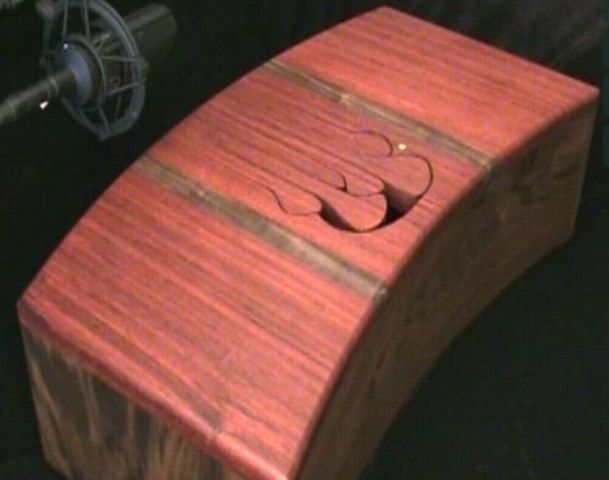
The Songa, one of the many visually and musically beautiful instruments by Charleston, S.C. musician and woodworker Adam Crowell.
Songa from Boxed Music Drums on Vimeo.
Senior editor Tom McKenna pointed me in the direction of this article in the Charleston Digitel (sic), and I’ve quickly grown very fond of these ingeniously-designed and beautifully built instruments. Charleston, S.C. resident Adam Crowell combined woodworking knowledge he picked up from his furniture-making dad together with his own musical smarts to make these fine-looking boxes. Using either mallets or your hands, you can coax out amazing melodies and rhythm. Well-thought-out design underlies these boxes’ otherwise simple-looking construction: it takes quite a bit of know-how to design the right size and shape keys for the material, since the pitches will be dictated by how much mass vibrates to produce the note. And before that, you have to determine which notes the drum will play! There is also the question of key layout: Crowell has come a clever design that is similar but not identical to metal mbiras found through much of Africa, where the note layout starts with the lowest pitch around the center position and alternate outwards left and right. His six and five note models look like graceful flower petals, and his 10- and 12-note drums have the notes facing each other, creating a mirrored symmetry that’s as pleasing to the eye as it is to the ear. A great detail is the subtle mother of pearl dot inlaid to the side of the tongues. Crowell’s hands find their way gracefully around all the drum’s surfaces, which you can see on his studio-recorded videos.
The crown of his collection, which you can behold in the gallery at boxedmusicdrums.com, is the versatile “Songa”. This instrument brings to mind a pair of “cajones” (no crass jokes, please, this is a family site) on either side of the tongue drum; a broad palette of percussive and melodic sounds emerges from one cleverly cut and assembled piece of wood. “Cajón,” by the way, is the Spanish word for “big box,” and refers specifically to an instrument used originally for flamenco music. It was originally made of thin plywood glued onto a wooden box, with a single soundhole in one side of the box. The plywood surface was struck with the hands, like the skin of a drum. The same goes for the two sides of the Songa, and frankly, all of Adam’s instruments have a more distinctive sound when played with the skin of the hands than with mallets. I’ll be getting in touch with him soon about how he builds his drums, but for now I’ll be watching the rest of his videos. Enjoy!




Comments
this is really impressive, and a musician like you Bloyu must be charmed by these beautyful and melodious pieces
Great to know about this wonderful art
Indeed, they are quite impressive. I'm looking forward to meeting the artist! Julio, don't you agree that it is a bit reminiscent of the cajón?
Well it has something from the cajon but those are luxury cajones and sound very sweet To be honest I dont like the spanish cajon very much
I played one of these in a small art gallery in Foscoe, North Carolina, near the home of woodworking author and teacher David Finck, and was blown away by the amount of sound that came from such a simple box.
Julio, that's true--the only thing these probably have in common with the cajón is the 'caja' part...@awillima, thanks for the direct feedback. I hope to try one myself at some point.
Log in or create an account to post a comment.
Sign up Log in