Can you wipe on a water-based finish?
 Dec 01, 2010

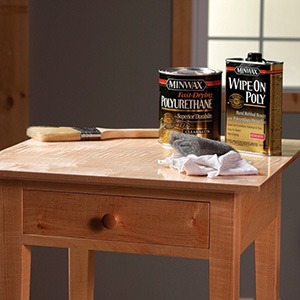
Two finishes: brush on one, wipe on the other.
Pro-finisher and Fine Woodworking author Teri Masaschi alerted me to the fact that Minwax is now selling a water-based version of their wipe-on poly. It is only available in a few states including California and Florida so I had to call Minwax and have them send me a quart. The first thing I noticed is that the application instructions are identical to those for the solvent-based Wipe-on Poly, word for word, including a recommendation to shake the container thoroughly before use. Something I’d never seen for a water-based finish where foaming is normally something to be minimized. I tested both types of poly on opposite ends of white oak and cherry boards. The first thing I noticed was that Minwax have tinted the water-based poly to warm up the wood. This avoids the gray appearance water-based finishes often give to cherry in particular, but on the other hand, this tint would be a drawback if you are trying to keep woods such as maple and birch as pale and natural looking as possible.
Following the rules, I applied three coats of each finish, sanding between coats with P220-grit sandpaper. Neither finish produced any build, but it was impossible to get an even sheen with the water-based one. The liquid just didn’t seem to like being applied with a cloth. Out of curiousity, I then brushed on a couple of coats of the water-based poly and found that not only did it build nicely but it leveled well and gave both woods an acceptable color.
Has anybody had good results wiping on a water-based finish? It would be nice not to have the solvent smell while finishing or to have to worry about the rags burning the shop down, but I’ve yet to discover this holy grail of finishing.








Comments
CrystaFin from Daly's. http://www.dalyswoodfinishes.com/ but they recommend a brush. You can get rid of the solvent, but not the brush. This is how it looks http://3.bp.blogspot.com/_1rsQtfpo2Gw/TMTrC0jhcTI/AAAAAAAAB6o/K0dAMaR-gOU/s1600/drawer_side.jpg. The last coat was satin.
I used Valspa water base poly on two floors. Both came out very well, no smell, didn't have to wait for next coat but for a couple hours. I used a lamb's skin and a rag on stairs. It looks great.
I had the same experience with the water-based wipe on poly. Some parts looked beautiful, but it was impossible to get an even finish. I had the same thought, to finish with a coat of brush on polycrylic.
I used it on a cabinet on cabinet shaker style pantry unit. I ragged on one coat of General Armr Seal then sprayed a thin 1.5-2 lb cut shellac next. This was quartered white oak and wanted to even everything out color-wise so I tinted a second spray coat of the shellac with Transtint dye.Because this was going to get moderate to heavy use I used 3 coats of the water based Minwax wipe-on, sanded between and got enough build and sheen was just what I wanted.
I was not satisfied with my color and took a shot at tinting the wipe-on poly with the Transtint, and it took it perfectly.
This stuff is also super fast dry in a heated, dry room. Love this stuff!
For water borne finishes it is hard to beat the Varathane Satin Diamond Elite. My experience has only been with a foam brush and HVLP spray applications. During the dry times of the year workpieces can be sprayed with several coats per day, they can be tinted for shading and are far more durable than shellac and lacquers. However, I have recently fallen in love with the simplicity of the wipe on solvent based Minwax Poly ,nothing seems to bring out the iridescence of figured maple like it does.
I think it is good to sand with 220P or 320P only after the first coat, then switch to Very Fine Scotchbrite pads for intercoat scuffing to remove roughness and insure good intercoat adhesion without removing most of what you just put on. The use of a paste wax on top of just 3 coats of the wipe on poly results in a great finish!
I have been using Ace Hardware's water based finish with my HVLP system and have had great results. It's available in Satin, semi and high gloss. It also comes clear or amber tint. By the way, Ace makes it's own paint and finishes and is the third largest maker of paint and finishes. Made in the USA. Clean up is a breeze and no order or fumes to worry about.
Cheers, Dean
I suggest you test the durability - particularly the water resistance - of this new stuff.
IMHO - all water-based 'finishes' for fine furniture can never equal the results of equivalent solvent-based - and I never, ever, would ruin anything I make by using them. The reason is simple: 'oil and water don't mix'.
To get them to mix, rather to get the resin to emulsify in the water carrier, manufacturer add 'surfactants' - soaps. Even if the finish cross-links when drying, these surfactants are still there. Waiting to 'do their job' - and dissolve the finish the minute water hits it.
Also, check the composition - sometimes the MSDS will tell you something - like the resin is acrylic - rather than a real urethane, phenolic, or alkyd true varnish. That is - it is soft and gummy.
Water-based latex house paint makes sense. Water-based furniture finishes do not. Their continued promotion does a disservice to all involved in making fine furniture.
I've been making a concerted effort to switch over to 100% waterborne in my shop over the last couple of years. With the economy as it is most of the commissions I've been getting have been repair/refinish rather than design/build so I've been trying out lots of different brands and products and have found a few that I have come to like very much and appreciate being able to spray them without fear of blowing myself up. I've even all but totally given up on alcohol shellac in favor of a waterborne! It has required me to re-learn a lot and pay much more attention to ambient temperature vs. humidity and even barometric pressure and how these affect the application. I now have "go to" lacquers, poly's, alkyds that are waterborne that have been yielding excellent results.....the stains and glazes are another story though but I have hope that we will one day see acceptable waterborne replacements for them too.
So, my question is-- is the wipe on poly only good for brushing?
We have a furniture repair/refinishing shop and have also been committed to minimizing our use of VOC based products. My experience with (many) waterborne products is, at best, mixed. Regarding stains, there are so many problems with commercially available water based stains, I dare not try to name them here. Suffice to say, I typically mix my own stains using water or alcohol soluble dyes or pigments. These work reliably well when coated with a sealer or de-waxed shellac. I have gotten good results with Minwax Polyacrylic topcoats, but I found that using an extender, in modest quantities, improves flow out, leveling and allows more time to "fiddle" with the finish before it begins to dry. I'll keep experimenting with new products, but to date, I would agree that traditional finishes provide superior results.
I have had good success using Fabulon (a waterborn floor finish available at Home Depot Canada). I builds very quickly and seems to penetrate the wood more like an oil-based product. In a warm shop only an hour or so between coats is sufficient. I let it cure about a week or so before rubbing down the finish. It is considerably cheaper for a gallon than similar "name brand" products too.
Note, I use a "lambs wool" applicator just as though I were finishing a floor but scaled to my piece. I apply an even thin coat - and leave it. No further wiping as it sets up quickly. Then re-apply after a light sand in an our or so.
I am traditionally in favour of wipe-on oil and oil/varnish blends - but when the situation calls for it this one is definitely worth a try.
Sorry, I found the wipe on lifeless..I had tried a number of wipe on products and
none of them gave the finish of a sprayed or brushed water based product.
A year or so ago, I used the wipe-on for the oak handrail for my basement stairs because of the ease of use. It was a situation where I wanted to get the handrail up in a hurry and found the finish to be very acceptable.
I previously used the solvent based Minwax wipe on Poly for many years. It is wonderful. Unfortunately, it is not available anymore in CA. I have since hoarded the solvent poly I have left.
Since then I have used the water based poly with good to very good results. For me, it has an extremely short open time, 30 seconds at best. Far to short to smooth the finish. My last pass is a flat rag wipe. I am going to try a foam "brush" next. Is it possible to use a latex extender like Floetrol?
I've had good luck wiping on Resisthane Plus waterborne pre-cat lacquer from Hood Finishing Products (http://www.hoodfinishing.com). I used it on Mahogany paneling and trim and the result was great, no lap marks or streaking. I used a cotton jersey rag. It can be sprayed or brushed with equally fine results.
Very simply I have a "ONE SHOT" deal, my business in normally in FL, but I am in CA doing one piece of furniture, a simple 6' long x 12" wide x 2" thick console table, MDF core with zebra wood veneer, normally in FL I would use the minwax solvent base wipe on poly (I love the finish) but solvent base products are outlawed in CA ... WHAT TO DO? use the minwax water base wipe on? or brush on? or ??? (I have no spray equipment here in LA) I want to keep this as simple as possible due to time restraints, I don't want to source products all over town, prefer to just go to home depot or local hardware store for supplies. someone help me please!
Log in or create an account to post a comment.
Sign up Log in