
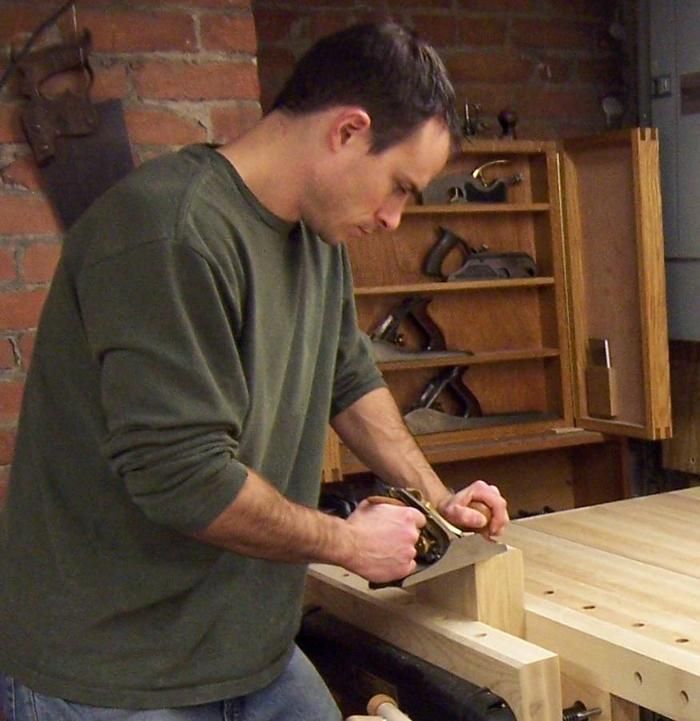
Rob Bois in his shop in Newton, MA
by Robert Bois
When CustomMade first asked me to contribute to this blog, I figured I might as well dive in head first and address a topic that never fails to spark controversy – pricing. If you wander over to almost any woodworking forum, you’ll find any number of opinions on “the right way” for woodworkers to price their wares. I myself have even gotten into a few lively debates on the topic, but over time one thing became clear to me – most people giving pricing advice never actually account for the individual business model.
In reality, no two woodworking businesses are the same. To illustrate this better, I divide the craft into two main categories: custom and production businesses. Custom woodworkers typically build one-of-a-kind pieces to the specifications of a customer, which makes this model much more of a service business. On the other hand, those who create their own designs and then sell them as finished pieces have almost purely product businesses. So when someone offers you advice on how to price without asking what kind of business you are in, kindly smile and decline.
The primary difference between the two models is that they ask the woodworker to differentiate on very different things. A good custom woodworker differentiates on craftsmanship, communication with the customer, and quality of service (on time, on budget, while exceeding expectations). Because this is a service business, the traditional method of charging time and materials often makes a lot of sense. The better you are at providing that quality of service, the higher the hourly shop rate you can fetch in the open market.
A production woodworker, on the other hand, almost always differentiates either on design or price. Most high-quality craftsmen seek to build a reputation by combining a branded design with high quality craftsmanship, rather than focusing on a low-cost model. In this case, the market value for the end product is much more disconnected from the time and labor. This model requires a keen understanding of the market to ensure that marketing, branding, and design will resonate with the right prospective buyers. The pricing should focus almost exclusively on what the market will pay, rather than the cost of materials, labor, or overhead. Cost only comes into play when determining the final profit margins.
In both cases, competitive differentiation remains the key. If a custom woodworker can regularly meet tight deadlines, apply specialized tools and techniques, or demonstrate superior craftsmanship, he or she can charge a premium shop rate. By the same token, a production craftsman that focuses on differentiated design, specialized materials, or unique production process can use that to charge higher prices or achieve better margins. The critical factor, regardless of business model, is to identify those key differentiators and validate the premium pricing they can command. Successful shops have a very good understanding of their competitive advantage and the value that target buyers place on it. So before reading another forum post, ask yourself – what are your differentiators and what are they worth?
Rob Bois lives in Newton, MA with his wife and dog. By day, Rob runs product marketing and thought leadership for a software company. By night, he is an avid designer, woodworker, and author of theboisshop.com video blog. Rob has successfully applied many of his business and marketing learnings to his woodworking craft, and regularly contributes to blogs and forums on topics related to the business of woodworking. You can view some of Rob’s work at his Newton Fine Woodworking web site.





Comments
Wait, so I must "identify those key differentiators and validate" them? (kindly smiling...)
Smith, as those two things sounds the same there is a subtle but important difference. In my experience woodworkers tend to identify competitive differentiators but never validate them with the market. The key is ensuring there is a buyer segment that puts a premium value on your unique product or service. Unfortunately, too often that second step never happens, and craftsman can't understand why people aren't willing to pay a premium for what they do. This is probably the greatest frustration woodworkers face when attempting to go pro.
FWW Editors,
I'm a little bit confused. Why would I take woodworking pricing advice from a Software Marketing guy? I'm sure Mr.Bois makes some valid points from his perspective but you couldn't find a professional woodworker with a proven track record in the business to dole out this advice?
Am I missing something?
-Paul
Paul, if you don't want to take advice from a software marketing guy...don't. Implying that Rob can't have some good insight because he doesn't fit your idea of an expert, and taking issue with the FWW editors for not finding someone that you think is more qualified, is simply unhelpful.
If you have something substantive to say about Rob's thoughts, it would enrich the thread and help others who would benefit from your experience. Comment on the content and specifics of what he said so we can get a constructive debate going.
SeanP berating someone for questioning the underlying premise of a post is shall we say 'simply unhelpful'. Typically, when someone offers 'marketing advice' laced with jargon, I "kindly smile and decline".
FWW editors,
The Pro Shop series would be more 'creditable' to me if FWW would call on professional furniture makers as blog authors other than a .com attempting to market their services.
Don B.
Don, thanks for your feedback though Rob Bois is just sharing one person’s opinion based on his vantage point. Do you sell your work? If so, how do you set your prices? Thanks for any insight you can provide. Gina
Hello - I asked Rob Bois to write about this topic because I thought he had a unique perspective. As a product marketer he works with pricing products on a daily basis, but also works as a woodworker who sells his work, so he understands some of the difficulties woodworkers face in this arena. The great thing about comment sections, though, is hearing ALL perspectives. So, I'd love to hear more about how you price your work, why, and what you think doesn't work.
Also, if you would like to contribute to The Pro Shop, I'd love to hear from you! We're looking for people who are interested in contributing.
I think what is happening here is that the detractors in the crowd are responding to the somewhat (no offense Rob) stilted writing style employed, and not the advice, which is pretty straight forward.
"Key differentiators" = How do you stand out from your competition? What makes you better than the guy down the road, and how can you sell it? Are you the best wood-turner in town? The best at veneering? Emphasize your strengths in your marketing materials. Don't ask your clients to pay twice the price of the furniture maker down the road without giving giving them a good reason.
It doesn't matter if he is a software marketer. Selling is selling. And remember, he does actually design, build and sell furniture. I for one think he's pretty qualified. And Don, I didn't read anything in his post that leads me to believe he's trying to sell me something. And so what if he is. We are all selling something.
The “.com” was referring to Custommade.com not Mr. Bois.
Don B.
For the detractors:
Mr. Bois insights and advice are generalized intellectual constructs. They need to be taken and applied to the facts and circumstances of a specific situation. They are aggregated abstractions of a wide variety of experiences. Hence these need to be analyzed and then applied relative to one's own needs, desire and capabilities.
Before denigrating a person's contribution, insure you comprehend the knowledge the contributor is providing.
It does appear that when a contribution is abstract and simultaneous, rather than concrete and linear, the invective is more apt to appear. If only these detractors would take the Mark Twain approach to commenting: Better to keep your mouth shut and appear like a fool, than to open it and remove all doubt.
I used to price my custom work by my best estimate of time and materials, and got pretty good at it. As I get older and wiser, I tend to go more quickly to "what will the market bear?" and then try to determine if that amount will cover my T & M + and little more.
I had my best luck estimating by days and parts of days, rather than trying to count every hour. By estimating days, alongside what you expect to accomplish each day, you can better know if you are on track, and if not, you can work a little longer that day to get caught up. If you are on track, there is an incentive to do a little more to get ahead of schedule and beat your estimate.
Bob K
As A part time woodworker, I don't even plan on making a real profit, I just do it for the enjoyment. I have enough pension that all I hope to do is make enough to pay for more wood, finish, and a new saw blade or occasionally a lttle toward a tool upgrade. I do a lot for friends, family and Senior citizens and neighbors. I guess I am too giving of my time, but I get a lot of satisfaction and also qppreciation.
Installed 5 windows in a house for a new neighbor, got a 25.00 gift certificate for dinner. (didn't expect it either)
Young couple that needed assistance. They have raked leaves and mowed yard for me when I needed help. Helped another roof house, told them if they paid me I would be upset. He helped me rewire part of my house and as a retired wood shop teacher has taught me most of what I know. Used to grade my projects for fun, now tells me they are all A+. He has a key to my shop and is always welcome to use whatever he wants. Enjoy your woodworking and forget profit unless you need it to survive. Sometimes I can hardly wait for another request.
I'm not quite sure what the grousing is all about; I found this to be a very useful and insightful article! Tragically short, but what can you expect from a blog post?
I am currently in process of integrating production work into my typical schedule of custom-pieces and have been having serious problems getting my pricing right. The custom work I can usually get pretty close, using my experience (read: earlier mistakes), but as is pointed out here, this formula doesn't produce good results for production pieces. I knew that there had to be a better way, but I wasn't sure what it was. This article has cleared up this confusion, which is great. Now, to just work out this new formula...
Personally, I don't really care what an author's 'other job' is. Most folks I know these days wear more than one hat and I find that the different perspectives can be very helpful. Yes, there is a fair amount of jargon in this article, but that comes with the different perspective. I think that most woodworkers (buildy-people in general, really) could use a lot more help with marketing and business operations and I will be looking here in the future to see if there is more useful info.
Thanks for writing this article Mr. Bois, it has definitely got people talking. The difference between custom and production is important to point out; as a hobbyist I have struggled with applying a pricing strategy to it.
My experience to this point includes making items for family members in which I only charge for materials and perhaps a new saw blade. I've also donated a few items for auction fundraisers where I grappled with assigning a value to them.
In the future I'd like to supplement my income by making both custom and production items but at the price my work might fetch I'd be better off looking for work at a local hardware store. After reading some of the other posts on this topic it's clear that many of us don't do it for the money alone. Indeed a great deal of satisfaction can be drawn from working with a consumer and delivering a finished project.
If you asked me right now the end my answer to the "How to price your work" question is this: 15$/hr or 4x cost of materials.
Thanks again
Mr Bois's advice is no different than any expert in sales and marketing will tell you. It is the usual template that is promoted by such types, and I have had many encounters with these people over the years of trying to coax a living out of my business. It is all true, and I think that most of us professionals or aspiring professionals know this. Unfortunately, I know of dozens of custom workshops that are struggling or just scraping by. The trouble with statements that are true is that you cannot argue with them. They are not always useful, though, as the businesses I have just mentioned prove. It is a common situation here in England and from my friends over there, I know is much the same in the USA. Many woodworking businesses struggle with viability. There is something else, some other elusive device that no-one Iv'e met has ever been able to describe. Until someone who runs a professional, full time woodworking business wants to write about how this works, then I don't find it useful just quoting jaded business paradigms.
One other thing; whilst I don't have anything against part time makers per se, I don't think their stories are useful to those who are full time professionals. The reason is this; If you have another guaranteed salary and a home workshop, setting and sticking to your price is easy. If the customer doesn't want to pay five grand for that entertainment centre then you can tell them to take it or leave it. Professionals with rented shops beat themselves down when the end of the month nears and the order book is thin. It is no longer to do with theoretical business models, but pure survival. Even prices for custom work become what the immediate market will bear and when I say immediate, I mean what the guy standing there with the cheque book wants to give you, in certain instances.
All those Pros, I wish you good luck in finding the elixir. Tell me about it when you do!
Mike.
Currently I am an unemployed project manager that enjoys making custom items with his hands. I appreciate especially Doug's and Brade's coments on practicality of advice. You need to be rewarded for time spent based on the quality of service provided. If you can provide the quality that can drive a $5,000.00 price tag on a piece of furniture, stay as close as possible to that price so you can stay in business. If you are building a basic porch swing, look on line to see what a similar product is worth and sell it for less. If there is not enough money in that particular item to make a living, either commit to becoming a better craftsman building finer or custom items or consider your work as charity and do it because you love working with wood.
Re; the price is right,
I have been a professional woodworker for the past 30 plus years. Good times, and (presently) bad times. I have built both custom interiors and custom furniture and even a bit of semi-production work.
Perhaps the problem of pricing rests on a degree of self knowledge. To the extent that a woodworker is an artist;time and materials are pretty much unimportant in pricing. This does not mean one can thrive or even survive on our work. Even artists work in a market environment and that market is pretty crazy too.
The problem I face today is not pricing, but customers; there are none! In future, I think some people will continue to sell, but the vast majority of us should not count on it.
What to do? Make things, have fun, survive some how.
A couple of things; no-one will ever build a sucessful craft buisiness by making and selling the same for less. It is foolish to think this can be done and I strongly urge anyone contemplating doing so to think again. this is, I'm afraid, one of those universal business paradigms that is true and useful in almost every case. Things are sold on points of difference; if the thing is worse it will be cheaper if better it will be dearer and if it is much the same then the price will be much the same. Making the same thing, however just means that you will be moving into a market which already has competition from established businesses and getting a foothold there will be more difficult.
Secondly, unless the business is geared up for production, small furniture businesses do not ever make production furniture. The way I describe this sort of making for small concerns is 'Batch production of limited edition furniture' or 'Semi-Bespoke'. I don't mean to be pedantic over terminology, but there is definitely a differece. At best the small business makes some economies by running batches of components saving time. This cannot be compared to the economies of scale and automation possible by mass producers in super efficient factory situations. Batch making falls between the truly custom and production items and must be viewed in these terms for them to be done sucessfully.
Mike.
I got an anonymous tip yesterday that this blog post was getting some renewed comments. Ironically, I had intended to do a regular series of articles here, but my dual life as a marketer and woodworker finally caught up to me and something had to give. That being said, I always spark controversy when I bring up pricing, as it can be a very uncomfortable topic for many. But the reality is the pricing exercise is the same regardless of what product or service you are selling (aside from commodities). For whatever reason, I've always found that woodworkers tend to think they are somehow different or exempt from traditional business rules (I could get the same controversy started if I went into business plans, marketing plans, etc.)
In the past, I even ignored my own advice and lost money as a result. Once I started pricing at what my research showed me was fair market value, I've been much happier with the projects I've been accepting, and the profits I've been making. My backlog has actually even grown as a result, even though I'm pricing myself out of more projects than I'm accepting.
I am looking for insight rather than criticm so I'm trying to pull out the intelligence in all of the comments. My experience is that I price a piece based on three different formulas;a)material x 3,4,0r 5, b) material and labour plus margin,c) comparison with production units plus?, and select a number based on complexity of design and how much the customer will bear. It's about as unscientific as it gets. When I get the job, the design usually takes longer than expected and my production time is always longer than expected. Material costs are usually accurate. I don't need my accountant to tell me I'm not making much money. So, how do I apply the principles in a very thin market?
Log in or create an account to post a comment.
Sign up Log in