
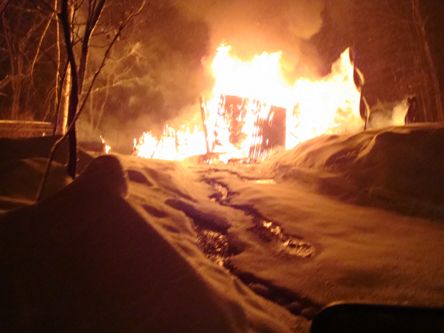
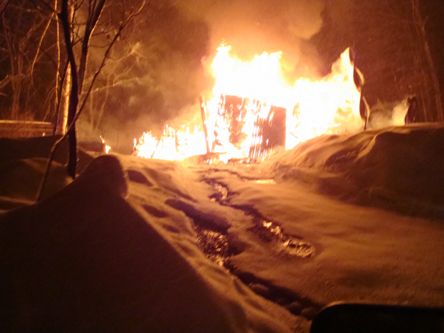
Furniture maker Jon Brooks of New Hampshire lost his workshop to a fire in January.
Shop fires seem to be everywhere: We got sad news last week that furniture maker Jon Brooks of New Hampshire lost his eclectic woodshop to fire. Last January we heard a similar refrain when furniture maker Mark Levin lost his woodshop and nine finished pieces in a shop fire. Ellis Walentine, host of Woodcentral.com, experienced a similar loss in 1999. And the list goes on… a quick Google search reveals more recent shop fires: in West Paris, Maine, Pocono township, Penn., Manilla, Ont., and so on.
Needless to say, woodworkers should pay CLOSE attention to fire dangers in the workshop.
To help with this we rounded up a list of ten safety tips–excerpted from former fire inspector Bruce Ryden’s article Fire Safety in the Shop, from issue #174.
- Sweep up sawdust: It may seem like a real chore to sweep up a pile of wood chips or shavings after a long day working in the shop, but by cleaning up, you can remove the most manageable portion of the three elements needed to start a fire.
- Don’t smoke in the shop
- Don’t use torches or welding equipment
- Fix or replace power cords that are frayed, cracked, or otherwise not in great condition
- Secure all electrical connections tightly
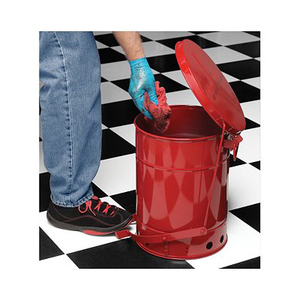
- Dispose of oily rags properly to avoid spontaneous combustion (For more, read How to Safely (and not so safely) Dispose of Oil-Soaked Rags.)
- Be cautious of other potential sources of ignition like such as water heaters, furnaces, portable heaters, and electric fans
- Buy a heat detector
- Install a sprinkler system
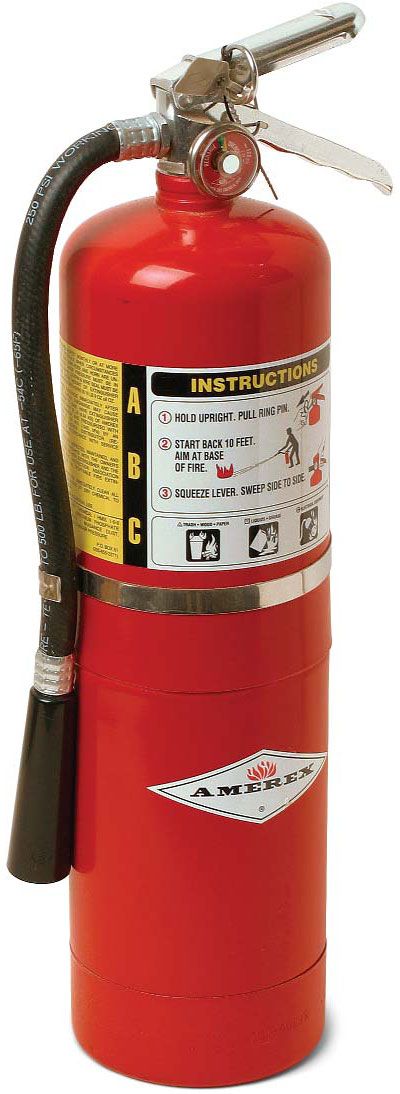
- Keep at least one well-maintained, easily accessible, portable fire extinguisher in the shop. Keep it near an exit.
Do you have any fire prevention tips? Or shop fire tales that you want to tell? Post a comment below.
-
Furniture maker Jon Brooks of New Hampshire lost his workshop to a fire in January.
-
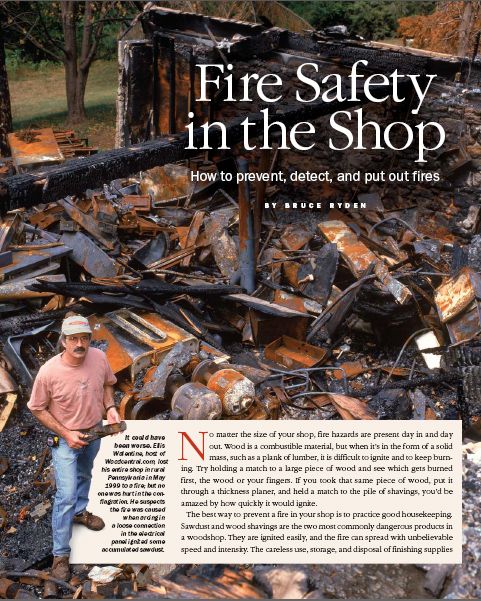
Ellis Walentine, host of Woodcentral.com, lost his entire shop in rural Pennsylvania in May 1999 to a fire; but no one was hurt in the conflagration. He suspected the fire was caused when arcing in a loose connection in the electrical panel ignited some accumulated sawdust. This photo was included on the first page of former fire inspector Bruce Ryden's article Fire Safety in the Shop, from issue #174.
-
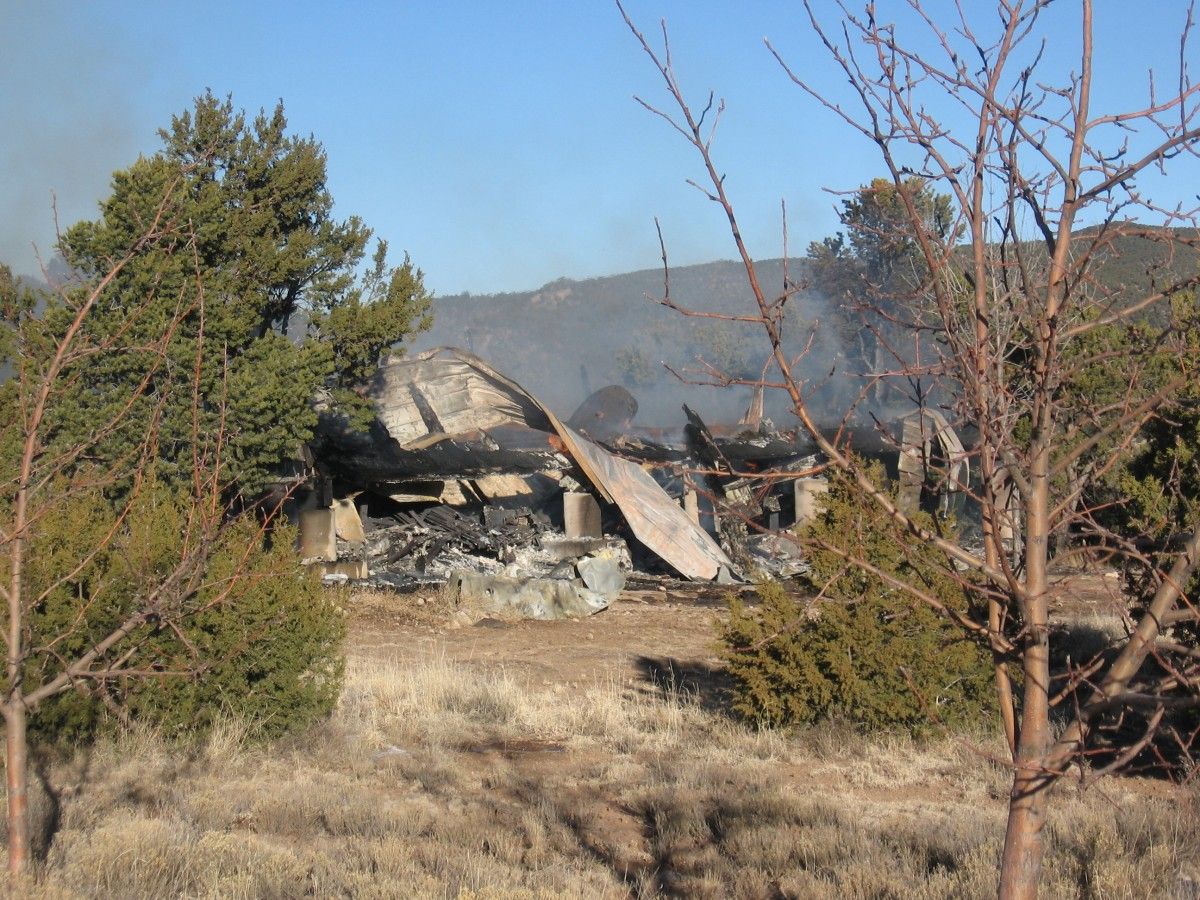
Furniture maker Mark Levin lost his workshop in New Mexico to fire in January 2009.
-
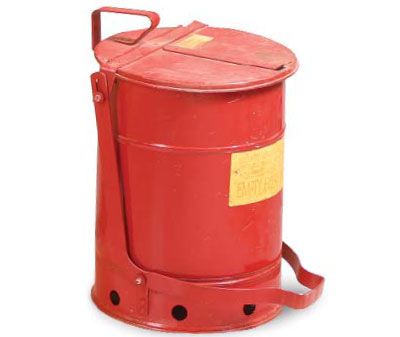
Rags soaked with flammable finishes can ignite spontaneously, so they must be disposed of properly. With its springloaded, self-closing lid, this red bucket prevents spontaneous combustion. A plastic bucket half-filled with water also will work. (For more, read How to Safely (and not so safely) Dispose of Oil-Soaked Rags.)
-
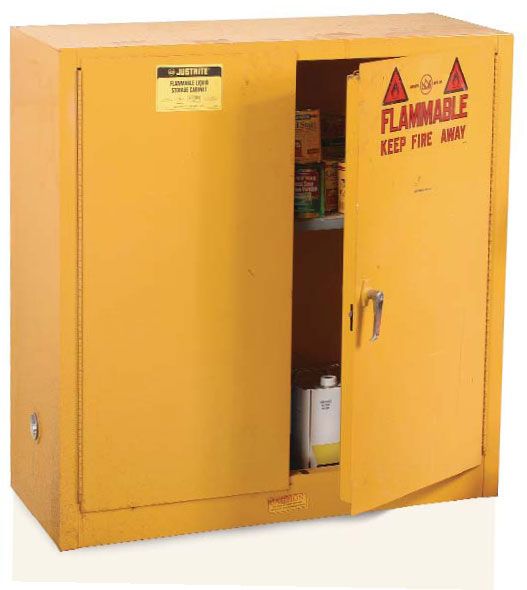
A storage cabinet for flammable liquids is meant to keep a fire from getting much worse very quickly. Whether you buy one or build your own, it should have a self-closing door and a lip on the shelves to keep spilled liquids from escaping.
-
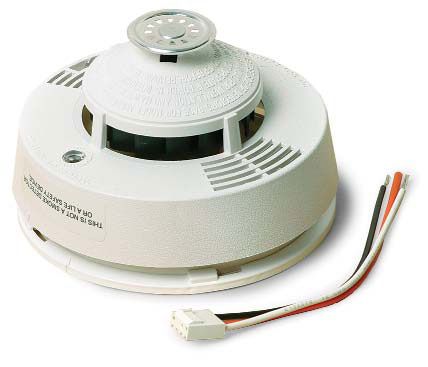
Heat detectors provide an early warning and don’t commonly suffer malfunctions in dusty environments.
-
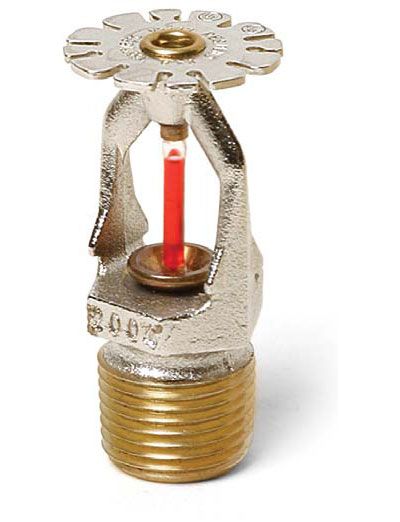
If a fire occurs, damage will be minimized if a sprinkler system has been installed.
-
A fire extinguisher can prevent a small fire from getting worse, but you should always call the fire department first.













Comments
I am a woodworking hobbyist but an insurance agent by trade. I thought this was a good article, although it is always unfortunate that a shop needs to be lost before fire saftey is reviewed. We all know how difficult it is to find a company that will insure a woodshop. And none of us want our insurance rates to increase but the fact is, insurers are reluctant to insure a woodshop because they tend to be a fire hazard and there are so many fire claims on them.
I think of my own shop and how many years it has taken me to acquire all the tools that enable me to do the work I do. I probably could not sit down and list every piece. If there was a fire in my shop, I might not be able to even remember all the pieces of equipment I have in order to make a claim.
If anything can be taken out of this fire, I am sure Jon Brooks would suggest that each one of us review our fire saftey equipment and procedures. May I also suggest to ask your insurance company for help on this. They don't wish to experience a fire any more than you do. But, because they do handle these claims from time to time, and see patterns in causes of fires, I am sure that they would be very willing to provide fire saftey suggestions that would keep you in business. The exercise of asking and implementing their recommendations may not only save your shop from a fire but will also put you in good stead with your insurer. This may result in their willingness to look for cost-saving credits to apply to your policy to reduce your rates.
If we were all to take a little time to review shop saftey and fire saftey and implement some improvements, that exercise, over time, would result in fewer insurance claims which, in turn, would result in lower rates.
Fred Webster
First, I always take rags with solvent or oil on them outside and lay them flat on the ground to dry.
Second, If the shop is attached to the house or another building, a small storage shed away from any structures is a good place to keep any combustibles. It's a small price to pay to have to go outside to get finishes or stains.
Third, having seen what a spark can do to a grain elevator, I highly recommend no open flames of any kind while there is any chance of sawdust in the air.
I am an amateur woodworker and recently retired after being a professional firefighter for over 20 years. I can't tell you how many fires I've been to that were started by spontaneous combustion in oily rags. That cause is just way too easy to avoid. I take mine outside and dry them in the sun. From there they go in the trash, never back in the shop. I keep an extinguisher, pressurized water, next to the door and plumbed a hose just outside the shop. It has to be easily accessible and on your path toward safety. An incipient fire in a wood shop will go from stoppable to total loss faster than most people can imagine. But no shop is worth getting severely burned or killed for.
I clean the shop every day and put the sawdust in my compost pile. Not only is it safer without the accumulation, but I seem to think better when the shop is clean ( and I need all the help I can get).
I agree with the previous poster, there is no way I could recall all the tools in my shop, not to mention the jigs which I spent countless hours making. It is so much better to avoid the disaster
When you leave your shop, unplug or otherwise disconnect as many power tools as is practical. An electrical device that is turned *off* but plugged in to a live circuit can catch on fire. (Same story for your kitchen toaster, coffee maker, etc.)
Example: last summer I went back to my workshop to check on something. The shop has a very low ceiling so my air filter is mounted on a roll-around cabinet rather than the ceiling. I was standing about 10 feet from the air filter (which was turned off) when I heard faint sizzling/crackling sounds coming from it. I quickly stepped over to the filter and unplugged it. The whole event took less than 10 seconds. I could smell the faint odor of burning electronics. If I hadn't had the good fortune to be standing there then, maybe my shop (and house) would have been one of the examples mentioned in this article.
The filter was made by a major company, and their customer service people responded by promptly replacing the unit, even though its warranty had just expired.
Funny how things come around . . .
This article, inspired by the fire that changed Jon Brooks life,comes to me half way 'round the world from Fine Woodworking to New Zealand where I now live. But my friend who also lives in NZ, sends me the news about Jon's fire( Jon is his stepdad). Small world . . .
When hearing of the fire, I was immediately reminded of near tragedies in my own experience in my various shops. The first one that comes to mind, was in my shop in Glens Falls, NY. It get very cold and dry there, and before we all heard about static electrical charges building up in the dust collection pipes, I came back into the shop one evening to check on the finish that was drying on a project. I smelled that telltale wood burning, only to find it coming from my dust collector bag . . . Not long after that, I ran a ground wire along the pipe to ground it.
Another close one was when I came in the shop an hour or so after using my belt sander to put an edge on a piece of steel only to find the dust collector bag of the belt sander actually on fire on my favorite work bench. The belt sander is long gone, but I still have the mark on the bench to remind me . . .
Solvents in the air finding their way to an ignition source, oily rags, heaters, bearings getting hot and melting . . . so many ways to sneak up on you. I walked the shop many a night double checking everything. I have had no shop whatsoever for the last three years after moving here, and I still go over my safety checks in my head out of habit!
My deepest sympathies for all who have lost their tools and work. Hope this forum of ideas helps to prevent others from loss.
Chris Harrington,
Auckland, NZ
I appreciate my godfather's story being used as an example to others, but feel it is important to stress that the tips mentioned here would not have prevented heavy snow from pulling the power line from his building and starting the fire.
I would add that you should make certain that the insurance policy you are signing up for really covers what you are asking to have covered. There are a lot of slippery sales people that only care about making a sale and taking your money.
Chris Mills
This is a comment on oily rags.
I was building a spec house and my painters were staining the cabinets with DuraSeal. They left their wiping rags next to a wall in the dining room on a Friday.
Fortunately, I was showing another spec I was building next door and decided to check on the first. When I open the door, the house was filled with smoke but there was no flames. I finally found the source in the dining room where the rags had been tossed. Because the house was air tight without any flow the fire burnt down through floor. It was hot enough to melt an aluminum ladder.
The painters finished the cabinets the following week and using the same stain. They tossed their rags out against a rail fence; the fence burnt down that night.
I now keep an ash can in my shop and any rag, towel or piece of paper with any combustible material goes in the can.
Take photagraphs of your tools so that in the event of an insurance claim you can list your tools jigs etc. Don't keep the photos in the woodshop!
While you are taking the photos you could look for hazards.
If you are worried about electrical fires have a master switch near the door which you can throw as you leave.
Remember - the main function of fire extinguishers is to help escape. Rarely are they adequate to put out a fire. If you think the first extinguisher will not put out the fire - GET OUT.
BTW. Don't use a linisher for wood then metal. The hot metal dust sets the wood dust on fire. I have tried the experiment.
I'm sure that it's included under item 7 dealing w/ other potential sources of ignition, but use of a grinder around saw dust probably deserves a special mention!
Electrical outlets are great places for fine dust to accumulate. If an arc is created when a power tool is plugged in, there is a potential for a fire, especially with the really fine dust. Once a year, I remove the covers from all the electrical outlets in my shop and give the insides a once over with my shop vac. I'm amazed to see how much of the really fine dust ends up inside the boxes. I tried using the sealed covers, and while it helped, I'm still finding some dust in there.
Eric Mueller
I am an electrician and woodworker. There is a common problem that many woodworkers miss. That is the accumilation of superfine dust in electrical switch, junction, and outlet boxes. Take the cover off any box and give it a quick blase with an air hose. You will be amazed at the amount of dust that comes out. Now...pull your table saw or other stationary tool switch out of its box. (after turning off the power) Position it so you can safely turn it on and off and using a flashlight turn off all the shop lights at night. After killing the flashlight, switch the tool on and off in the dark. You will be surprised by the large, bright arc/flash that occurs when switching a tool off. Easily enough to ignite that accumulated dust in an elecrrical box. Very scary ! A PSC motor, the most common in our single phase shops has a centrifical switch in the end of the motor that creates a similar arc and if your motor is packed with dust under a table saw that is also packed with dust and shavings ......... Well, it is a disaster waiting to happen. There is no easy cure but start by sealing every box with silicone as airtight as possible. Also, it is best to use ONLY TEFC (totally enclosed) motors in our shops. Lastly, remove all the outlet covers a couple of times a year and give them a shot of air. Preventative maintenance is the best precaution ! Hope this helps protect your sometimes invaluable investments.
Shawn Nystrom, Suffolk, Va.
I had an issue arise several years ago in a basement shop that seems unbelievable. It could cause a fire as well as be an shock hazard. One day when I went to unplug a tool as I disconnected the tool from the receptacle the plug sparked as we have all seen and to my amazement it ignited some cobwebs draped around the receptacle. After that the shop is kept clean floor to ceiling of dust and cobwebs. I also have heard of people loosing their shops to dust fires that could have been avoided by simply grounding their dust collectors and if you are working in a basement shop this is even more important as most homes have the heating and hot water heater in the basement and some even have the cloths dryer there as well and these not only are more risky ignition sources they dry out the chips and make them even more susceptible to ignition not to mention that in a basement shop it is like being in a below ground inferno that is difficult to escape some advance planning is necessary. Works safely Big Bubba
Good point Meesto. "I appreciate my godfather's story being used as an example to others, but feel it is important to stress that the tips mentioned here would not have prevented heavy snow from pulling the power line from his building and starting the fire."
Yes, there is no attempt here to make any judgment on the Brooks fire.
Thanks for the feedback on insurance. It's something that we haven't done any reporting/research on here at FW.
It would be a good idea to keep all flammables such as varnish, paint thinner, shellac, etc. in an approved metal container.
In addition to the photos of tools: keep receipts - even if many years old; scanned copies if possible; write on the receipt what the tool is, date purchased and store. Plus consider a narrated video of your workshop to pick up items that you may not think of.
Put the photos, receipts, etc in a safety deposit box. Or some insurance companies will keep the photos and scanned receipts for you.
And always check your insurance renewal statement to ensure your workshop is still covered. Some firms may require a special 'rider' for very expensive workshops.
I was glad to see the information on protecting your workshop from fire, an area often overlooked in home shops. I have several comments regarding this important issue.’
Concerning the disposal of oily rags, any rags containing any substance that could spontaneously combust needs to be stored properly between use and properly disposal of. While using appropriate containers will reduce the hazards the safest practice is to remove the rags from within the structure and store outside away from combustible material.
The use of a heat detector is also a great idea but unless the unit is installed so as to sound the alarm in the remainder of the home, especially sleeping areas, it may not be heard when a fire is detected. For those shops detached from the home a fire bell installed outside the structure might alert those nearby of any alarm.
Last but in no way least appropriate fire extinguishers can be valuable in extinguishing a SMALL fire. The Extinguisher shown in the article appears to be the typical ABC rated dry chemical extinguisher. Unfortunately this may not be the best choice for a fire in a wood working shop. Generally a fire extinguisher rated class ABC has a higher rating for class B, flammable liquids, but a much lower rating for class A, wood paper and trash. Anyone anticipating using any portable extinguisher to control a fire should have a clear understanding of the limits and proper use of these devices. A pressurized water or foam extinguisher may be a better choice when attempting to control a SMALL workshop fire. Never get into a position where the fire is between you and a safe exit and be very conservative in judging the size of a fire you will try to control.
I have read a number of fine comments about used rags! However the one thing that made me take a bunch of extra precautions is my dust collection system! My system is hung from the cieling in my shop to save floor space! My biggest fear was a smoldering fire that burst out "AFTER" the shop was closed for the night and we all went to bed! To make sure this shouldn't happen and if it does we get warned I did the following!
1)The system is well grounded right to an earth ground!
2) I always empty the bags when they are both half full!
3) I never ever sand,cut,grind or do any operation withmetal involved when my vac system is running in my shop! Nor do I us it to vac the floor if there is any metal shavins on the floor!
4) I installed 2 fire/smoke dtectors and 2 carbon monoxide detectors! One set is battey and local to the garage. The other set is hot wired electrically to the ones in all of our bedrooms and basement. If one goes off they all go off!
Safety and protection!
Ray Russell Sr.
What about rags from waterbased finishes? There's more than water in there. Is this a hazard?
Jim LeMay
I recently saw an advertisement for an unmanned automatic fire extinguisher at Griot's garage that I'm considering for my unheated garage.
http://www.griotsgarage.com/product/in+your+garage/garage+accessories/ceiling+mounted+unmanned+fire+extinguisher.do?search=basic&keyword=extinguisher&sortby=newArrivals&page=1
They aren't inexepensive, but if installed correctly could provide a significant reduction in the amount of damage experienced during a fire. Plus, unlike a water based system, can be used in unheated spaces.
Consider the layout of your shop when positioning fire extinguishers by the exit as recommended in tip #10. A second extinguisher may be warranted at the opposite end of the shop. I was nearly trapped by a small fire that broke out in a shop vac that was between me and the exit (and at the time the ONLY extinguisher). Fortunately all turned out well, but now there is an extinguisher at EACH end of my shop.
when I'm done using the shop I make sure tools are unplugged( habit from when my kids were small). I also regularly pull stuff away from walls and clean up the dust. I don't store any solvents in my shop either. Cleaning dust from inside machines was recommended to me after I had my dust collection machine repaired.
I think sprinklers are a good idea for a larger shop however I have seen several times the damage done by the water when a head is accidentally set off. I work in an apartment community where we have on every stove hood a dry chemical extinguisher which did put out a stove fire. If there are other extinguishers of this type it may be an alternative.
Never turn an air compressor on to 24/7. Might be handy for ready use but $200,000+ later I have mine on a timer switch.
I nearly started a fire in the dust collector of my belt sander by a spark created from a screw in the wood I was sanding. Now I am hyper-vigilant about sparks. I've heard of vacuums exploding when a spark was introduced into flammable dust. Work ouside, keep your dust collector outside, be aware of possible sparks, use your nose, and empty dust filters before leaving your workspace if there's any chance you sucked up sparks...
Couple of years ago I was using a bench grinder to shape
the end of a piece of angle iron. Didn't notice that the sparks were going pretty far. A few minutes later(after I had turned the bench grinder off) I noticed a smoky odor.
Looked around and the cloth wheel on the polisher was smoking.
Apparently the sparks from the grinder started the cloth wheel
burning. Glad I didn't leave the shop right after the grinding. Also...any fuel cans(kerosene/gas)...I keep isolated
from any other machinery.
Jim
To Ray Russel Sr. Your shop sounds almost fire proof. It sounds like you were sold a bill of goods on that EARTH Ground. Unless that Earth Ground is bonded to the main Service panel. Then it is virtually useless. This is recommended for the discharge of static electricity. This has been tried before and a Rod 8-10 feet long just doesn't to rid stray voltage. Ask once that static electricity gets to the ground rod where does it go ? It meets 25 ohms resistance, it could bleed off and eventually go to the earth or not.
Testing has shown without bonding to the service panel, that Earth ground has between 25-50 ohms resistance. And that depends on your soil and really how much rain you have had. The Earth is a terrible conductor. Primarily the Earth is used for Lightning strikes and can not function to clear a fault, a short, a partial short or even a ground fault. The purpose of a circuit breaker is to clear the fault quickly with in a 1/10 of a second to prevent fires. GFCI's and the New Arc Fault breakers are not a bad idea for a shop with a lot of wood dust The Arc fault breakers AFCI's are expensive but they can detect a parallel faults and a series fault, In other words, a line to neutral of a broken hot that is intermittently arcing or an open neutral that is carrying current that is arcing.
Ground rods by themselves, can cause a myriad of problems by them selves, and a potentia above ground i.e., shock hazards, they can cause stray voltages to be floating around on metal parts. This is why it is so important to home run a wire from the ground rod to the main Service panel. All grounds in lighting fixtures, receptacles and any other device available shall be home run to the service panel.
It was once said, we spend an awful lot of time terminating wires( the groundwire) in hopes it will never have to be used.
Since I have been into woodworking, I have found that machines wired with 120 volts, both the Hot and Neutral are both switched, I even called the manufacture on it and they blew me off, but if the neutral opens on a machine like that and you energize that machine, it could become hot to the touch. Obviously manufactures don't follow the NEC (National Electrical Code.) A lot of these machines are made in China and they follow one plan, color coding is wrong too, so one must be careful when checking connections.
Another thing is, if you have water lines and gas lines running to the shop they too should be ground/bonded to the service panel.
One last thing Electricity doesn't take the shortest path to ground it takes all paths back to the source, the transformer...not to ground.
I apologize for the length of this but there are many things related and preventing fires, and personnel safety and especially with little kids in the shop at times, safety is of prime concern.
I had a heavy duty extension cord that I was using with my table saw. It had three receptacles on the end and when using it, I noticed that it was sensitive to how the plug was put in. While I was using the router, it would shut off if I moved it and the cord in random ways. One day when i turned on the table saw i saw a puff of smoke and I turned the saw off.
I couldn't tell where it came from and for some reason, I turned the saw on again. When I did this, smoke and started shooting out of the plug. Turning the saw off had no effect. Before I thought to unplug the cord the sparks stopped and the receptacle lay there smoldering. The blades on my table saw plug were gone, they had just vaporized. The receptacle was a molten mess. This is what I learned:
1. Concrete floors are good. (keep combustible materials contained)
2. Stay away from multiple outlet extension cords. If they become defective, they can short across the jacks.
3. Make sure plugs fit tight and the connection is solid.
4. Make sure your circuit breakers are recent and still work.
Fortunately my table saw worked after replacing the plug. I hope passing on my story will help others. Keep on woodworking!
This is where Ground Fault Circuit Interrupters and Arc Fault Interrupters come in handy. Either would have opened the circuit immediately. The breaker didn't trip? Then faulty breaker, or too big for the job, or the run is too long for the wire, not allowing enough current to pass through the breaker to trip it.
Don't rely on a single ground rod to clear a fault. The grounding conductor, the bare, green must be run all the way back to the main panel,also it should be isolated in the sub-panel, from the neutral. if the one in the shop is a sub panel. Either way that ground must be tied to the Grounded Conductor (white/Neutral) at the point of Service attachment, usually at the Main Service Panel (some states allow the meter socket to be the grounding point). This is what clears the fault for any breaker in the system.
GFCI's don't even need to be grounded to work effectively. They have a comparator inside that samples the current leaving the Hot and compares the return current on the Neutral if the imbalance if greater than 4-6 miliamps the circuit will open protecting the machine but more importantly personnel and property.
The GFCI came out in 1970, only recently, last 5 years or so, has it been discovered that Lightning can wipe out the electronics in a GFCI. You can push the reset button and the power comes back on but the circuit has no protection, the electronics are toast. The good news the NEW ONES , once it takes a lightning hit, they can not be reset and must be replaced.
Also remember even if you have Air-Terminals, Lightning Portection, that is not a failsafe against Lightning strikes, it does strike trees and other wooden objects.
The trouble with electricity is, it almost always works, But when you have a fault you want it off ...NOW.
They also make GFCI's for 240 volts, great for machines and safe, one less thing to worry about.
Fire, before water being the greatest nightmare in my shop, I would like to add my tuppence. Old bakelite plugs are a no-no. They build up carbon and on a switch-on load like a thicknesser, drawing enough amperage, it has the ability to ignite the shavings I was too tired to sweep up the night before. I work barefeet mostly, so the image of me dancing on the burning sawdust was memorable. The chant was no rain-dance but a vociferous string of expletives....you all know them. The other bugger is that 0000 grade steelwool. A lone spark from the bench grinder, never mind the shower of heat from an angle-grinder, sets that mess of metal ablaze with a heat I need in my fireplace in winter. Which leads me to the following. We all have some of the most flammable mixtures in our shops. Methylated spirits, thinners, turpentine, parrafin, penetrating sprays and an array of paints that would get Michelangelo inspired. The world is held together by paint?? Of course! We know this. Plus, if any of you are like me with good intentions of building a fire-proof cupboard for the flammables only to procrastinate because your best woodworking friend came around today etcetera and so forth.
When I leave my shop to do anything, I switch off the electricity.
Safety to you all and happy shavings.
apparently some jurisdictions have a bylaw which indicates that someone must be present for at least a half hour after any grinding/welding and presumabley spark producing activities.
Not a bad idea...
many is the time I have stayed longer to empty out the ts and dust collector when I thought that there was a chance of a spark or even shavings from an overheated ripping blade.
Got too much to lose.
Eric in Calgary
Log in or create an account to post a comment.
Sign up Log in