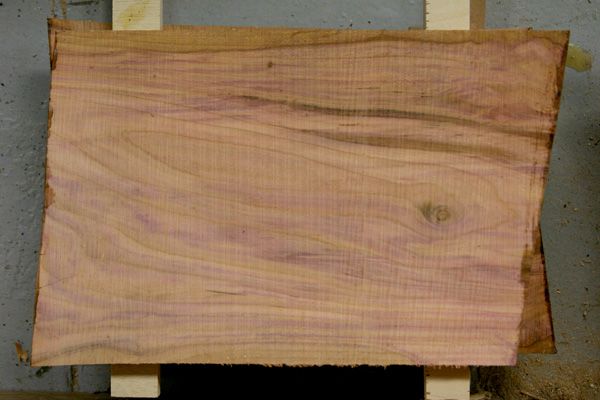
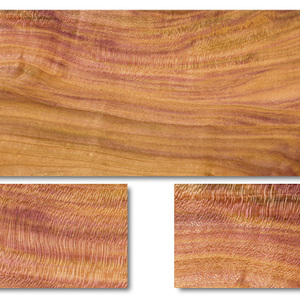
This choke cherry board is all stickered up and ready to dry.
One of my Fine Homebuilding colleagues recently cut an old Choke Cherry tree trunk into firewood and subsequently arrived at the office with a small log for me to experiment with. I promptly took it home and sawed it in half, revealing a beautiful piece of wood, loaded with swirls of varying shades of pink.
The next day, I resawed the two log halves into some small boards I hope to use for box tops at some point, sealed the end grain, stickered, and weighed them down. As of last week, the moisture readings were off the chart. They’ve already come down considerably, which has led to some checking but, I expected that and realize I’ll probaly be cutting away 25-percent of these boards as a result of rapid drying and the inherent problems that produces.
I’m curious as to whether or not anyone else out there has had experience with this species. The tonality is just stunning and I’m praying these small boards won’t cup or curl over the course of the next several months. Until then, I’m keeping all my fingers crossed.










Comments
To prevent more checking ,throw a piece of plastic over the cherry to slow the drying process.
The wood should be treated like any other fruit wood (apple pear ect. ).
Over the past eleven years I've cut many gifferent tree woods on my woodmizer,and found fruit wood the hardest to prevent from checking because it does want to dry very fast.
Good Luck
I have worked with choke cherry in the past, and the best advice was already given by blackbogtree - stick the pieces in plastic bags, seal them tightly, and wait. My pieces generally take around 6 months before I'll hazard turning them. Once they're turned, they spend another month or so in bags to finish drying.
Fruit wood can be an absolute nightmare to work with. Best of luck!
Beautiful wood! I have never played with chokecherry, and would love a follow-up to know what it works like. I have cut and tried to use just about everything that grows in this area. The chokecherry trees are scrub-sized, rarely reaching 3" diameter.
I try to cut the wood as long as I can handle, and let the logs dry as much as possible after PEGing or painting the ends. If I cut them before they dry, I will cut them thick knowing I will resaw them.
The grain in some plum trees I harvested spiralled more than 360 degreees in a 4' piece. Had I slabbed them wet, even with good stickering, the stresses would have made them useless.
I have a significant amount of choke cherry that I have dried. Much of it cups and warps quite a bit and when I have tried using it after milling it to size I found that you may want to wait a couple weeks - at least a couple days to see if it moves again. A piece that I butterflied and glued up cracked after a week. You just have to chose your the pieces that are more clear and straight grained.
Log in or create an account to post a comment.
Sign up Log in