
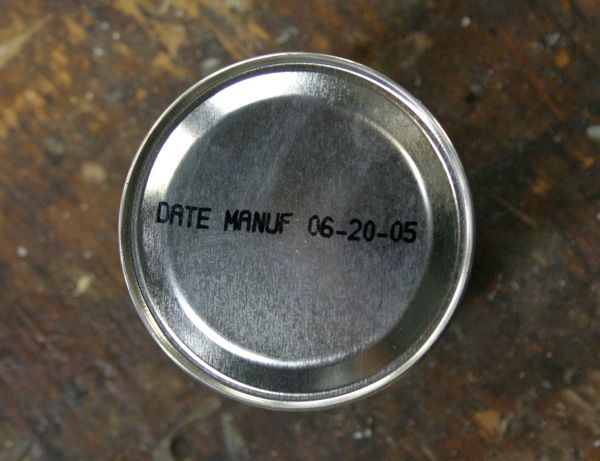
Lesson learned: always check the date of manufacture when purchasing shellac.
Remember how your mom taught you never to eat anything out of a bulging tin can? You know, the botulism warning? Turns out it goes the same for shellac as well — sort of.
This afternoon I found myself in the FWW workshop during my lunch break. My aim was to use some clear shellac purchased this morning at the local hardware store to finish some walnut and maple picture frame molding I put together last night. I set the can down on my finishing table, broke out a flathead screwdriver and proceeded to pry off the lid when, WHAM, the top shot off like a champagne cork and a shower of shellac droplets filled the air. After a short trip to the bathroom to throw out one of my now-contaminated contact lenses and use the emergency eyewash, I figured I might as well give the moldings a quick coat before setting off to purchase new lenses. Trouble was, my clear shellac was actually . . . brown!
No worries, I thought, I’m sure it’s just this particular brand. It’ll dry clear. So, now I’ve got some beautiful walnut moldings with maple stringing that’s been stained into oblivion. I’m hoping to use a small block plane to shave off the top layer and get back to clear maple but, who knows!
Oh, and the shellac can? Well, it was manufactured in June of 2005, making it well past its prime.
Has anyone out there had a similar experience with old shellac? If so, I’d be curious to hear about it in the comments section below. As for me, I’ll be cursing myself for at least as long as it takes me to plane through my stained maple so please, commiserate away! I could use the laugh.











Comments
I haven't had your experience with shellac but I have had it with nitrocellulose dope (used to paint airplanes). In that case it wasn't the finish that had deteriorated but rather the can. Seems these coated cans have a finite lifespan that is less than desireable at times and once the coating dies, the can simply rusts, turning your finish into a brown stain.
Cheers --- Larry Marshall, aka woodnbits
Hi Larry,
I haven't returned to the hardware store yet to exchange the can but before I do, I'll have a look at the condition of the inside. I'll let you know what I find.
Luckily, the stained maple came right off with a few passes of the block plane. Phew!
It hasnt happened to me, but I know my local Hardware Hank has a can of Zinser on the shelf that is dated 2005...Would be intersting to open it!
If the problem was corrosion (i.e. rusting) then it's possible the pressure came from hydrogen gas.
Afterall, it is an alcohol base and after 5 years, maybe it had started to ferment. Stranger things have happened.
Assuming that the can was not hot - say above 45 deg C, then I am convinced that the shellac was contaminated.
Alcohol does not ferment - it is a fermentation product.
Alcohol does not react with metal under any conditions which can possibly be encounterd in normal life.
Bacteria are killed by strong alcohol so the only thing left is a contaminant which reacted with the metal to produce hydrogen gas.
This could be either an acid -which would attack both the tin lining (if there is one) or the iron- or a caustic alkali which would attack the tin or possibly zinc if present.
I suggest you report this to the manufacturer.
I remember the first time I ever used shellac. I opened up my brand new can of "clear" shellac and it was a dark brown. Well, I guessed that's the way it's supposed to look. After all, my favorite beer is Pale Ale, and it isn't exactly pale by American beer standards.
So I used the whole can over a series of projects, lightening or omitting the stains to account for the darkness of the "clear" shellac. Imagine my surprise when I eventually replaced the can with a fresh one!
I actually posed the question to my father, a microbiologist, and his response was rather similar to that of "davecefai," especially that bit concerning "fermentation" which is what I originally thought might have happened. He had very little in the way of any idea as to what the heck might have caused this.
Anyhow, the frame came out nicely so, in the end, all is well.
Thanks all, for your comments and suggestions.
Cheers,
Ed
YES, ABOUT EIGHT MONTHS AGO I HAD A CAN OF SHELLAC BLOW THE LID OFF IN THE MIDDLE OF THE NITE.
RENO PAUL
davcefai has the correct answer.
Shellac resin is an organic acid (mainly aleuritic and shelloic acid) and the alcohol/shellac solution is acidic. If the liner for the can is compromised which does happen now and then where the welding seam is then hydrogen gas slowly forms inside the can.
Report your experience to Wm Zinsser Co (the manufacturer) and while I'm sure they will take care of you one way or another. It's a known occurence. They will probably want some information from the can so they can backtrack to the can lot. However I will say that your date indicates a product 4 years old.
That's way I mix my own from flake. I mix what I need and that way it doesn't sit around long enough to go bad.
I had a non-explosive experience with a gallon can of SealCoat shellac. The gallon can was about half-full and getting old. I went into my storage shed one day and found half a gallon of shellac on the concrete floor. The can had developed a hole, apparently due to rust. The hole was big enough to drain most of the contents in a day or so. It may have had pressure in the can.
I have always presumed that enough moisture had gotten in with the air when the can was open,and that it had worked its way to the bottom of the can where it rusted. However, the other posts give me different ideas.
Now, I only buy quart cans of shellac and check the dates carefully, both when I buy and when I use the product. My floor still has a heavy shellac coating.
Zinnser shellac is treated to extend the shelf life to "3 years". Your shellac was pretty old even if the stuff hadn't exploded. It might look OK but the ability to resist water damage and resist scratching would likely be subpar.
If I was using shellac on a real project, I'd test the stuff first, or more likely just mix some fresh from flakes so I knew what I had. It dissolves pretty quickly if you grind it up in a coffee grinder first (I wouldn't do that with the "rawer" type of flakes, though; I wouldn't know if I ever got all the bug parts out).
I am getting ready to use shellac for the first time on a project, with a can I have had sitting for at least 3-years unopened. This is perfect timing for me. I did not realize the shelf life issue, and would have assumed that it was supposed to be brown. Thank you all for the invaluable info.
Well, lets see. An alcohol plus an acid makes an ester which can be very volatile. Maybe that's what happened. If it was hydrogen, then I would expect that there was enough other organic stuff in the shellac to have absorbed the free hydrogen, but then maybe not. If it was hydrogen build up, then it was lucky there wasn't a flame nearby.
Where were your safety glasses?????
Safety first!!!
These comments may explain why I ended up with a puddle of shellac underneath a two-year old can of Zinser dewaxed sealer shellac this past summer.... top was tightly sealed, can was 4/5 empty but somehow had leaked out through the lid (to judge from the drip down the side of the can). No discoloration of the shellac, though, and no deterioration of the can itself. Never had that happen before, and I've been using shellac (mix my own and Zinser) for 15 years as a sealer for pine and other softwoods.
Thanks for the insights.
Don't sweat planing the wood. Scrapers are one of the most helpful of all woodworking tools - as long as they are sharp. FWW has had numerous past articles on sharpening various scrapers. They will remove an astonishingly thin shaving when sharp and do so without "picking up" (grain tearout) while affording a great deal of CONTROL in an otherwise difficult situation!
So what would happen if the shellac was transferred to a glass jar upon purchase? Would any of these problems be present anyway, or would the glass eliminate all these problems?
I had used most of the can let set outside in AZ...opened it about 3 months later it had turned brown...I looked down as the side of the can was sticky...it had leaked out...threw it away. Now I purchase a small can that I know I will use.
I have a can that's been sitting on my shelf for several years. One time recently when I was in the shop I heard a pop. It was the lid blowing off the can. I put it back on. It happened again.
Rather than plane away the mess, why not glove up and take some maroon scotchbrite and denatured alcohol to the shellac and it should remove it without taking the chance of shaving away part of the profile
I store shellac cans in Ziploc bags. If the top blows, the contents at least will be contained within the bags, and not make a huge mess. Make sure the bag has enough headroom for expansion in case the can does blow.
The reaction of an alcohol and an acid to form an ester results in water as the by product. I suspect corrosion of the metal can is the culprit. But the formation of brown color is indicative of a polymerization process of the shellac itself. It is worth reporting to the manufacturer although they put a manufacturing date on the can for a reason.
AEW's response about forming an ester is one I've heard several times and I suspect there is some truth to it. Not to worry, as I'm in contact with a couple of manufacturers and hope to have an answer for you all quite soon.
Many thanks for all the interesting theories, suggestions and tips. This is exactly what the blog community was meant to provide.
Cheers,
-Ed
Oh, and I'll be sure to post a quick photo of the now completed picture frames. They're quite nice - a simple, clean design.
The problem here is that canned shellac is an inferior product.
Get some shellac flakes and a gallon of alcohol and simply mix your own as needed. It's easy, cost effective and you'll have the choice of several grades to achieve different colors.
marzetti,
I tend to disagree. I've used both - premixed and flakes - and to be honest, I've been quite happy with the final product acheived using both products. Of course in the end, this is all subjective.
Cheers,
-Ed
I had the same thing happen with a quart can of SealCoat a few months ago. Leaked all over, but I could not see where on the can it was leaking from. Not sure how old it was, but I'm pretty sure I had purchased it within the last 2 years. Just checked the can I have now. Date code 03/09/09, so I should be OK for a while.
AEW -
Here's the rub with the "ester" theory. Even if the alcohol and acid combined to form and esther, it doesn't explain the buildup of pressure in the can.
When I returned to the hardware store to clue in the shopkeeper, I took him over to a few of the other cans he had in there - all of which had bulging lids. That's a considerable amount of pressure. What is producing all that gas??
Still waiting on a couple of manufacturer explanations. No doubt folks are checking with attorneys, worrying about God knows what. I did of course make it clear that this wasn't their fault. These cans had bene sitting on the shelf for YEARS.
Cheers,
Ed
I have been useing flakes for at least 25 years and have not had a problem,with the finish not drying,the color clear not brown.I use blond and orange with good results. Try It from Hock tools.
I'm with the flakey Shellac guys, I even grind mine in an old coffee bean grinder. Fresh shellac done that way takes maybe 15 minutes to create, in whatever quantity and cut that you desire. Grind it, mix it, set it in a sunny spot for a couple minutes. If you have any left over use it to coat something in your shop. I use http://www.shellacshack.com and end up paying pennies to shellac something. I also store mine in ziplocks in the freezer - driest container you'll ever find.
I work in a paint store so I checked our cans of shellac.
Sure enough the cans of clear shellac were bulging and they
looked like they were ready to blow. They were dated 4/05.
Needless to say, I immediately yanked them from the shelf.
The cans of amber shellac were fine.
PhastEddie,
Were the cans of amber shellac just as old as the clears?
I had a light bulb go off when I read your article. I had a can of shellac that I used earlier this year and forgot behind the door in my office. I came home a couple weeks ago to a very strong alcohol smell in my house. The shellac can had a 1/4" puddle of shellac pooled under it. I couldn't imagine what had caused the leak. So glad to read abut why it happened and will go the flake route from now on.
Had the same thing happen with a can of polyurethane that was a couple of years old and partially used. Assumed it was some type of slow oxidization of the chemicals. Don't know why that would cause pressurization since there would be no heat involved.
About 7 months ago, I walked into my finishing room and over to my storage cabinet and noticed that the tops had exploded off of 3 shellac cans. The shellac was brown inside. I am sure they had been in the cabinet for at least 2 years. The tops were off, but none of the shellac had come out of the can, so there was no mess to clean up. I figured due to age that pressure had built up. I will have to watch my expiration dates more closely. Sorry about your contact lense. I wear them also.
Simply, a few things going on in combination can cause the problem to occur. While certain reactions can cause expansion and corrosion to occur the major issue is the lack of a vent. A sealed can does not have a vent… when you open a can the pressure inside will, of course, release in a shower of the contents. The major drive is the temperature of the solvent, in this case alcohol, at the time that it was packaged. This does not mean the ambient temperature of the room but the temperature of the solvent at the time of packaging. Generally, the lower the flashpoint, the more critical the fill volume becomes. If the manufacture overfilled the container (meaning above the normal acceptable fill volume - this should be a known safety standard set by the manufacture for every item they package) and the solvent was at a lower than acceptable temperature, the results are disastrous. Easy experiment… fill a tanker to the top with alcohol (8k gallons or so) in Minnesota around March, plug the vent, and drive south to Huston, TX. Depending on the day you problem will not make it out of Kansas before the experiment comes to an end. How to open a bulging container safely… put on safety equipment (glasses, gloves, and the like), shutoff all sources of ignition or open outside, cool the contents, cover the container with a heavy towel, and open slowly.
As a chemist I can certify that the alcohols used to dissolve shellac cannot be dried completely. The alcohol used in South Africa (and probably also in the USA) typically contain a minimum of 5 - 10% water. This can cause rusting of metal cans containing the shellac solution, fast. slow or slow depending on the can can coating used in the manufacture of the can.
Discolouration of the shellac solution is typical of polymerisation or oxidation of the shellac in the can. Discoloured shellac will not have the same properties as freshly dissolved shellac and the deeper the brown tint, the worse the properties are likely to be. Commercially made pre-dissolved shellac contains a stabiliser (anti-oxidant)which extends the shelf life considerably, but not indefinitely.
The best answer is to use only shellac which not discoloured not cloudy, or which has a sludge settled at the bottom of the can. Or to use a freshly made solution.
I never enter my workshop without my safety glasses (with side-shields) on my eyes no matter what I'm doing. Have had similar, non-shellac events happen and I was glad to be wearing them.
In response to the question,the cans of amber shellac did not have dates on the bottom. They looked different and if memory serves, I believe they are a couple years newer.
Same thing happened to me only with oil stain made by Deft. Popped the top off and that was it, stain all over the finish room and some of me. It was an old can and the stain was no longer any good at all.
Yup, found SealCoat had pooled over everything. Had purchased it a year prior. The lid was still on and I couldn't find a hole. I think it expanded just enough to break the seam seal. Called Zinsser, they said they never heard of their product expanding like that.
Riiiight!
Ed -
I'm so glad you didn't suffer any permanent eye damage.
Thank God you were wearing glasses to help diffuse the chemical's destructive capabilities.
A few years ago, I experienced a less-intense issue. The explosion was minimal, however the end result was still a sticky mess, resulting in hours of tedious cleanup.
Since that time, I developed a solution that works for me - at least for store-bought shellac. I transfer the shellac, amber and clear, to a heavy plastic clear quart container. The clarity of the container allows color monitoring of the content, along with viewing any trace of contaminants. Just remember to wipe off the screw top and container after use, with a rag dampened with denatured alcohol. This helps to ensure easy top removal at the next use. I store the container, away from flame, in a cool and dark place to minimize light exposure.
These screw top helpers can be purchased reasonably at stores like Walmart - usually located in the seasonal section that displays beverage containers.
Another reason for my transferring the product is that on some occasions, I have noted that there was no date stamp anywhere on the cans or labels -- on none of the cans in the store's shelf display. A recent purchase of brand name shellac at a local hardware store, revealed that this is still an issue.
I've successfully stored shellac in this manner for up to 2 years, even after several uses. I usually discard unused shellac after that period, and rinse the container in denatured alcohol, soap and water. After drying thoroughly, the container can be re--used. For whatever reason, the shellac does not have any damaging effects to the plastic.
I wish to add that this storage method has also been successful with oil-based stains. However, I would NEVER attempt it with pure solvents because of several possible safety issues.
Several commenters mentioned the water content of the alcohol. Keep in mind that ethanol with low percentages of water (<10%) will actually absorb water from the air. I don't recall (55 years since my organic chemistry) where the breaking point is but certainly 90% ethanol will do so. Not mentioned is that today's cans are made so cheaply that the tin plating is just a hint of color, rather than as a protective layer; tin also reacts readily with an acid, so what little is there is certainly capable of being destroyed.
I can't say how many cans of latex based paint have rusted the can and rendered the contents unusable. We moved into a new house last year and I wanted to make sure the leftover paint would be usable if touch ups are needed. I purchased Home Depot's plastic 1/2 gal buckets with a snap lid and transferred all the paint to them. Just a thought.
Log in or create an account to post a comment.
Sign up Log in