
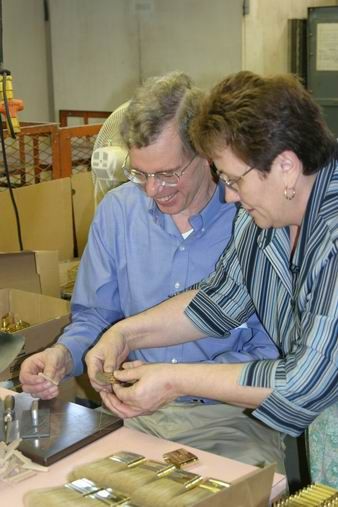
I’d always wondered what made a high-quality paint brush so special (and so expensive) so when I was offered the chance to tour a paint brush factory I jumped at it. Elder & Jenks have been making brushes since 1793, starting off in Philadelphia, and now among the oil storage tanks in Bayonne, New Jersey. The company makes all kinds of brushes but the ones I was most interested in were those designed to apply varnish. It is the bristles where qualtiy and price vary the most. Hog bristle, also known as China bristle, costs around $10 per pound, goat hair is about $20/lb, ox hair $80/lb, and badger hair close to $400/lb. Unless you paid a whole lot for that “badger hair blend” brush, the odds are that it doesn’t contain too many badger hairs.
The best brushes are still assembled by hand, and a skilled brush maker still takes 6-8 years to master all the steps. While watching a woman weight the bristles, insert them into the metal ferrule, add the wooden plug at the back of the bristles, shape the tip and then comb out the bristles, Mike Norton, the VP of the company asked if I’d like to try. Lets just say that it was a whole lot harder than it looked with bristles spilling everywhere and my paint brush looking as if it was having a seriously bad hair day.
After seeing what goes into a brush they seem quite a bargain. You can learn more about the company and their products at www.elderandjenks.com

Comments
I was hoping for a video, but none the less interesting. A quality brush will give you a quality finish whether varnish, poly or paint, a cheap brush, cheap results. Pay a little extra, take care of the brush and you will become best friends.
Log in or create an account to post a comment.
Sign up Log in