-
How to Cut Sliding Dovetail Joints -
3 Steps to Great Glue-Ups: Sliding Dovetail Joints -
Upgrade Your Jointer with a Segmented Cutterhead -
Five Minute Guide: Glue-Ups -
Box Making Tips and Tricks -
Dedicated Sled Delivers Perfect Finger Joints -
Router Jig for Perfectly Aligned Dadoes -
Tablesaw Tapering Jig is Safer and Faster -
How to Make a Simple Jig for Offset Knife Hinges -
T-Track is a Smart Workbench Accessory -
Fixing Woodworking Mistakes -
Buying and Using Trim Routers -
How to Drill Windsor Chair Mortises -
How to Apply an Aerosol Finish -
Best Tabletop Finish -
How to Sharpen a Card Scraper -
Five Minute Guide: How to Use a Tablesaw
Reader's Gallery
FWW Magazine Gallery, member
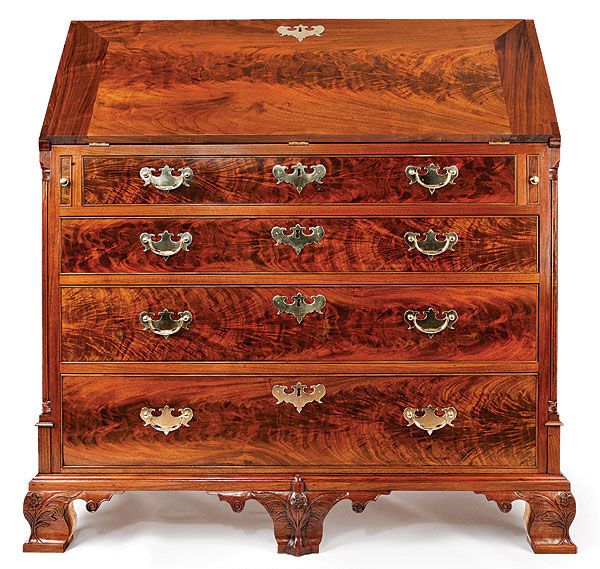
Each year, Ben Hobbs and his three sons, Calvin, Matthew, and Ernie, get together to work in Ben’s shop in what they call “sons’ week.” Ben, the 2011 recipient of the Society of American Period Furniture’s Cartouche Award for excellence in period furniture making, has been making 18th-centurystyle furniture for over 30 years. He and his sons started these desks, which are reproductions of an original by Thomas White (1765) during sons’ week, then took them home to complete the job. The desks (21-in. deep by 39-1⁄2-in. wide by 42-in. tall) are black walnut with bald cypress as the secondary wood. The finish is aniline dye, shellac, and wax. They took between 300 and 450 hours to complete (Ben was the fastest, they say, and Ernie is still working on his). Photo: Jeremy Groves
Design or Plan used: Not specified
posted in: Reader's Gallery, shellac, wax, black walnut, Bald cypress, Anniline dye
18th-Century Desk
comments (1) October 24th, 2012 in Reader's Gallery
Each year, Ben Hobbs and his three sons, Calvin, Matthew, and Ernie, get together to work in Ben’s shop in what they call “sons’ week.” Ben, the 2011 recipient of the Society of American Period Furniture’s Cartouche Award for excellence in period furniture making, has been making 18th-centurystyle furniture for over 30 years. He and his sons started these desks, which are reproductions of an original by Thomas White (1765) during sons’ week, then took them home to complete the job. The desks (21-in. deep by 39-1⁄2-in. wide by 42-in. tall) are black walnut with bald cypress as the secondary wood. The finish is aniline dye, shellac, and wax. They took between 300 and 450 hours to complete (Ben was the fastest, they say, and Ernie is still working on his). Photo: Jeremy Groves
Design or Plan used: Not specified
posted in: Reader's Gallery, shellac, wax, black walnut, Bald cypress, Anniline dye


Comments (1)
Posted: 7:41 am on October 25th
You must be logged in to post comments. Log in.