Huge advances in woodworking technology
 Sep 09, 2011
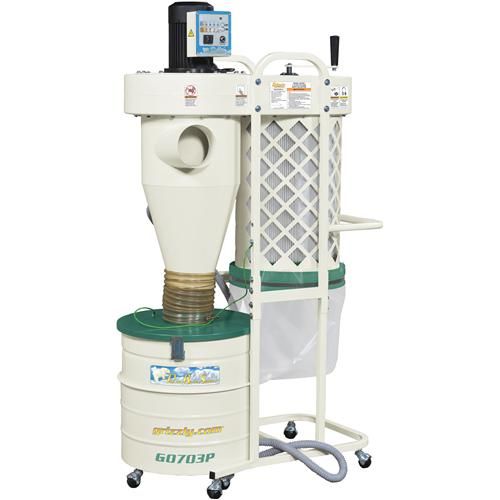
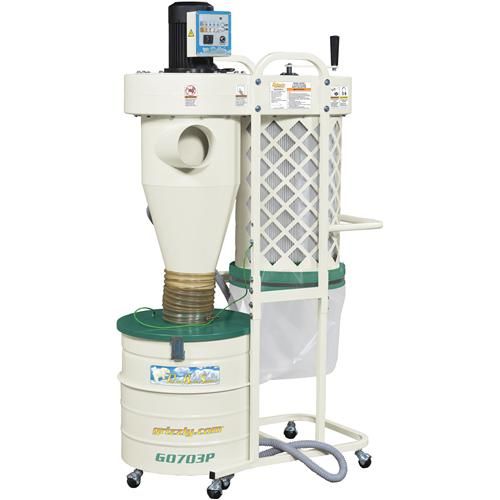
The cyclone is the best way to collect dust, and a new breed of compact models, like this $800, 1-1/2-hp Grizzly with state-of-the-art filtration, brings this unmatched technology to hobbyist budgets.
Not much actually changes in woodworking, which is both reassuring and, if you are a woodworking journalist, a bit frustrating. SawStop’s blade-braking technology was one of those rare sea changes a few years back, forcing the rest of the industry to add better safety equipment to their tablesaws.
But if you look closely, you’ll recognize two other revolutions going on, both inherited from the industry at large and finally adapted for the small-shop woodworker. FWW offers full reports on both of them in our next annual Tools & Shops issue, on newsstands around Nov. 1.
Better cutterheads
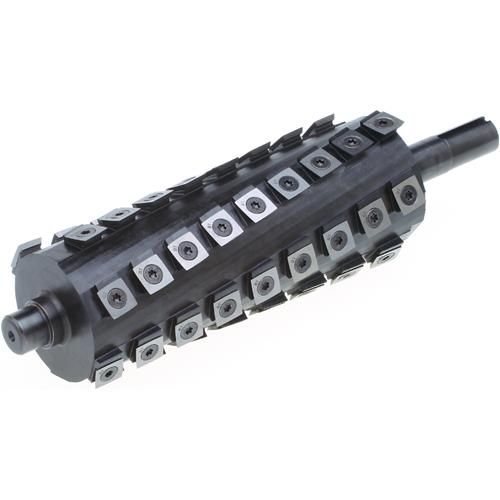
The first blockbuster story for small-shop woodworkers is segmented cutterheads. Available as an option for all types of new planers, jointers, and combo machines, and as retrofits for existing machines, these spiral arrays of small carbide cutters spell the end for nicks, tearout, and frequent blade changes.
We’ve all struggled through the process of removing steel knives, sending them out for sharpening or buying a whole new set, and then attempting to put them back in place perfectly, at the exact same level, only to see them get nicked by the third or fourth board we mill, leaving tracks until the next blade change. And we’ve all left dull, tearout-prone knives in place for far too long, just to avoid the changeover process.
Enter the segmented cutterhead. The best of these have four-sided carbide teeth, all indexed precisely into place, so you can loosen each one with an Allen wrench, give it a twist, and watch it drop precisely back into place. But you won’t have to do that for years in some cases, since carbide holds up dozens of times longer than steel. And there are four sharp edges on every tooth!
But there are a number of variations on the segmented cuttehrhead, as machinery manufacturers scramble to jump into the game. Our torture test in the next issue tells you which variations are leading the way, which new machines have them, and how to retrofit them onto the machines you already have.
Dust collection grows up
Since the government declared wood dust to be a known carcinogen, our little corner of the woodworking industry has struggled to upgrade their outdated equipment. Those old dust collectors with pourous 30-micron bags were probably worse than having nothing at all, since they acted more like fine-dust delivery systems, blowing out a cloud of the most dangerous particles at head height! Manufacturers finally discovered pleated filters, which pack in much more surface area for much finer filtration without killing airflow and suction. But those were only a first step.
Today’s compact cyclones, aftermarket filters for everything from shop vacuums on up, and new dust separators that keep those fine filters clean and free-flowing, are big news for woodworkers at every budget level. Our new report in the Tools & Shops issue tells the truth about filtration and cfm numbers; shows which dust separators keep filters the cleanest; and identifies the best products for keeping your shop air, and your precious airways, clean and happy.
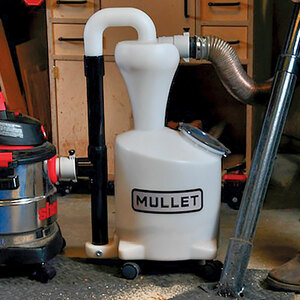
And check out my recent blog about the cart I made to turn my Dust Deputy and shop vaccum into one compact, maneuverable unit.
-
The cyclone is the best way to collect dust, and a new breed of compact models, like this $800, 1-1/2-hp Grizzly with state-of-the-art filtration, brings this unmatched technology to hobbyist budgets.
-
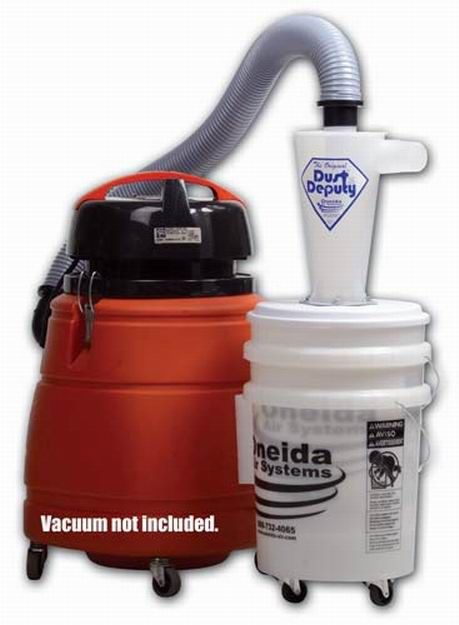
HEPA filters (the best there is) have long been available for all types of shop vacuums, but until now they have clogged quickly, killing suction. Enter the dust separator. Oneida's new Dust Deputy is one of the latest, and is remarkably effective at trapping dust and keeping the filter clean.
-
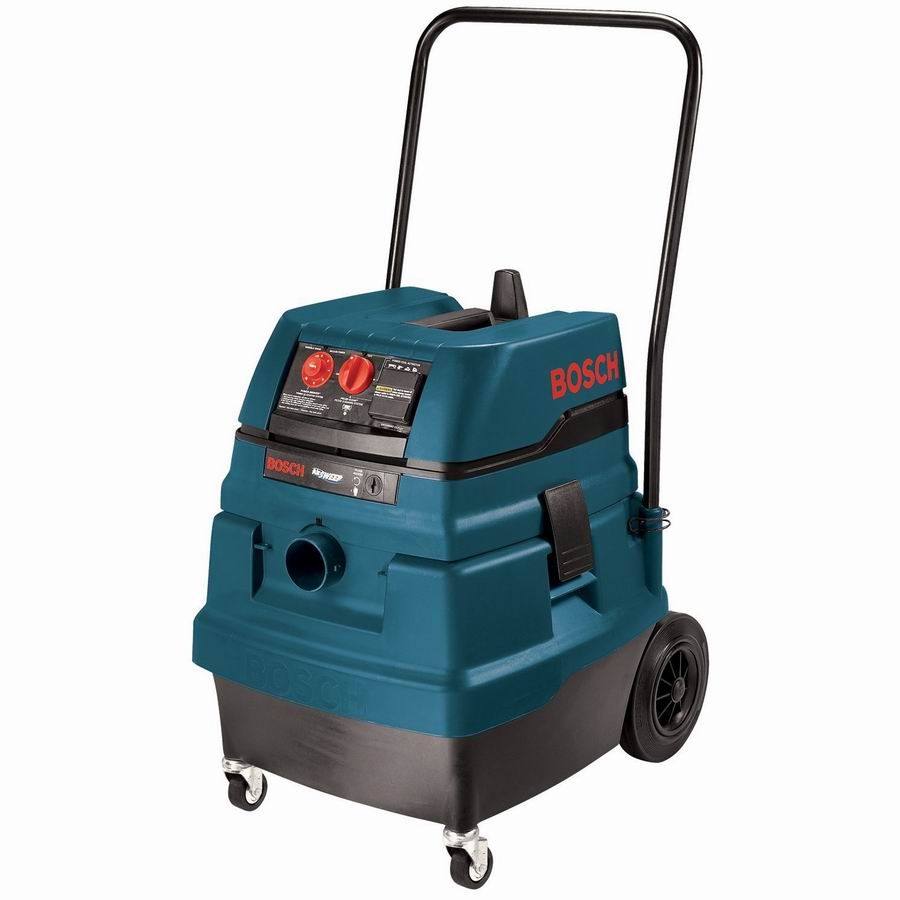
If you are in the market for a new shop vacuum, consider the Bosch Airsweep. You can order it with a HEPA filter, and it has a built-in filter shaker so you don't have to add a dust separator to keep the suction strong.
-
Byrd's shear-cutting Shelix is one of a growing array of segmented cutterheads available for new and old jointers and planers. The carbide edges will last 20 or 30 times longer than your steel knives, and there are four edges on each tooth! Plus they are a cinch to rotate and reposition.



Comments
Asa,
You state "The carbide edges will last 20 or 30 times longer than your steel knives"
What does "20 or 30 times longer" mean?
(Please put it into a mathematical formula with dimensions and factors to explain it to me.)
three examples - string, riding bicycles, and sanding
I have a string ten inches long. You have a string 37 inches long. Your string is 27 inches longer than mine. (37 inches - 10 inches = 27 inches) Your string is 3.7 times as long as mine. (10 inches x 3.7 = 37 inches
Bill and Dave ride bicycles to work. Bill rides for 26 minutes from his house to work. Dave rides for 42 minutes to work. Dave rides for 16 minutes longer to work than Bill rides to work. (42 minutes - 26 minutes = 16 minutes) Dave rides for ten minutes less than twice as long to work as Bill rides to work. (2 x 26 minutes = 52 minutes 52 minutes - 42 minutes = 10 minutes)
Jim uses a sanding block to sand 1 inch x 4 inch lumber. A piece of garnet paper will sand one side of 5 pieces 16 inches long before it is worn out. That piece of garnet paper sands 320 square inches. (4 inches x 16 inches x 5 = 320 square inches) A piece of aluminum oxide paper will sand one side of 28 pieces 16 inches long before it is worn out. That piece of aluminum oxide paper sands 1792 square inches. (4 inches x 16 inches x 28 = 1792 square inches) The aluminum oxide paper sands 1472 square inches more than the garnet paper sands. The aluminum oxide paper sands 5.6 times as many square inches as the garnet paper sands. (28 / 5 = 5.6)
Please note that the phrase "as long as" does not mean the same thing that the word "longer" means, and that the phrase "as many as" does not mean the same thing that the word "more" means.
So now, in a mathematical formula, what do you mean by "20 or 30 times longer"?
thank you
Gad, good luck with that one, Asa
Having worked in the steel industry for many years I think this is a great application of carbide. Carbide has the hardness and durability to cut steel, so applying it to wood is a no brainer.
There are too many variables to develop a formula, but suffice to say that if carbide will cut steel a few knots aren't going to nick a cutter.
Asa
Great teaser!
"Our new report in the Tools & Shops issue tells the truth about filtration and cfm numbers; shows which dust separators keep filters the cleanest; and identifies the best products for keeping your shop air, and your precious airways, clean and happy."
A link (in the article) to that item would be very helpful, but I haven't found it on my own (yet).
Allenn,
My last set of planer knives lasted 1000 BF. I expect these planer inserts to last 20,000-30,000 BF. (20,000-30,000/1000 = 20 to 30 times)
I should note that YMMV and you may have to adjust the formula to fit how many board feet you managed to get out of your last set of knives, but the formula remains the same. If by chance you find that you do not get 20 to 30 times the life out of the carbide than I am fairly certain Asa will gladly refund twice the cost of admission.
allenn, if x=steel blade lifespan, then carbide lifespan would be approximately 20x to 30x. This is the case for "as long as".
For "longer than", carbide lifespan would be approximately 21x to 31x.
When the range of approximated life given varies by as much as 10x, is 1x really a difference really worth splitting hairs over?
allann - if a train leaves Chicago heading east at 8:30 and another train leaves New York heading west....
:-0
Hi Asa,
a couple years ago I upgraded my 8" jointer from 4 knife to shelix. Cut quality is good, and certainly way quieter. However, I noticed that the cuts per inch dropped dramatically, meaning I had to feed it slower. The shelix has 5 rows, each doing a 1/2 cut, resulting in 2.5 cuts per rotation, compared with the original 4. Previously I had processed several thousand bdft (I build kitchen doors in a one man shop). I have been contemplating an upgrade on my 15" planer, but concerned about the slower feed rates for an equivalent finish.
I think in a production environment, where you are concerned with getting max depth of cuts and feed rates, a shelix cutterhead upgrade should be paired with a increased pulley size and likely larger motor (3hp --> 5hp) to yield equivalent CPI performance.
P.S. another benefit I've noticed for shelix is shorter chips being produced, resulting in less clogging in dust collection system.
Nathan
why not use TiN coated carbide bits? There is plenty of crossover tech from the metal working industry that makes woodworking so much simpler ...
I recently installed a Shellix head in my new DeWalt 735 planer. I didn't do a before cut because I wanted to sell the original knives. With the Shellix, the cut doesn't feel glass smooth but it is very smooth. A quick sanding with 220 sandpaper is all that is needed. The big advantage of the Shellix is that there are no planer marks or ridges to sand out.
I would prefer straight carbide double sided blades for my DeWalt 735. When the steel blades are new, they produce a mirror like finish. Why DeWalt does not produce such blades is an example of a company that does not listen to its customers. DeWalt makes the best portable planer but puts the worst blades in it (as far a s lifespan). By doing so, DeWalt simply opens the door for other manufacturers to produce planers just as Detroit made Honda/Toyota possible.
PS: LOL @ the comments regarding precision in meaning. I want to hear what they have to say about the language of politicians next.
I have been using an Inca jointer-planer (no longer made) since the mid '80's ---- not perfect, but among its virtues are Tersa blades. This system originated in commercial equipment. To change them, bonk the cutter head with a piece of scrap wood, to loosen, slide them out and, either turn them over and re-insert them with a new edge out, or dispose of them when both are worn. The blades are available with either HSS or carbide tips. Then, turn the machine on and they're perfectly re-set from the force of the spinning cutter head. This process takes five minutes, and the machine gives flawless cuts. My Inca uses 10" blades. I'm not up to speed with newer planers, but I've often wondered why this approach hasn't been more emulated. Maybe when FWW delivers on its promise to review jointer-planers, the reviewer will discuss this approach.
For more than 20 years my little Ryobi 10" served me fine.. I had 2 sets of spare knives, so I never had a dull set... About 4 years ago I felt the need for a wider capacity, so I bought a Rigid 13" which uses double edge throwaway blades.. I also keep 2 sets of spare blades which give me,at the least 5 changes... Draw back to both planers- number of screws that have to be loosened to change blades, so why would I buy a planer with 3 -5 times as many screws to loosen???? Granted- at no time (supposedly) is the full width of the blade in contact with the surface, but the samples I have seen have little ridges or scratches the length of the board, requiring far more sanding than I like to do.... Yes, I know that the machine is a "thickness planer", but I like a smooth surface thickness planer. Hence I would not part with any cash to own one of these.... Change does not always mean better......
Wow, lots of ego driven comments to justify low end bench top planers. Why are so many readers offended by a great improvement in wood working technology? These kinds of improvements are rare and happen infrequently. Be happy knowing that when your little bench top machine designed for portability and roughly 1000 hours of use is finally ready for the recycling pile you’ll have some great options.
I have been using a Shelix cutting head on my Master 18" planer for 3 years. It is far superior the the old blade system it replaced. Better cuts on wild grain, smoother finish surface, and best of all my ears tell me it is 70% quiter than before. $$ cost is somethig you need to consider, but it is worth ever penny.
Up date
I have been using a Shelix cutting head on my WoodMaster 18" planer for 3 years. It is far superior the the old blade system it replaced. Better cuts on wild grain, smoother finish surface, and best of all my ears tell me it is 70% quiter than before. $$ cost is somethig you need to consider, but it is worth ever penny.
To Allenn, I am retired an in my shop daily. I usually build using White Oak, Red Oak, Black Walnut, and Curly Maple. I was sharpening my 3 knife system about every 300 to 400 BF. Now I rotate the Squire Knifs about every 1000 BF. Be careful when buying a segmented cutting head. I bought one from a company that starts with a G____, that had cutters set straight although on a spiral; It gave a cut simular to a blade system, and was just as loud. When the cutter blades chop instead of shear the wood the outcome is the same.
Looks to me like some of you guys don't have enough to do!!
You should go out in the shop and get some work done and quit worrying how smart you think you are!! (allenn)
If it works for you do it...if not, do it the old way.
sawdustbkeith, or anyone else, I am in the process of setting up a 400 ft2 hobby shop for myself and I am considering buying a 15" stationary planer from a company that starts with G____. They have a helical cutterhead available, but it's not a Byrd. Is there a recommendation available from someone in the group of which planer/head combo I should buy? I'm in a residential area, so noise is a concern since I had to negotiate for the building permit already once they saw my plans for the shop. I'll eagerly await the planer reviews in the next issue too. (Wish I was retired and could focus on the hobby full time!!).
I was told there would be no math in this project !
allenn: 20-30k BF vs 1k BF. Operating hours don't enter into it, it's the amount cut (planed) that counts.
Same as HSS plane cutters vs D2, more BF per sharpening using D2 cutters.
Downside: more difficult to sharpen (presuming one were to re-sharpen the inserts.
I switched my Powermatic plainer from blades to the Selex and I will never go back. Switched my jointer also. Both machines are lots quiter and leave a better finish. They do put out more chips and dust but my dust control system handels it.
Hey Guys,
While everyone's doing "new math" to figure out whether the helix head cutters are worth it or not, keep in mind that Asa runs a magazine. Magazines are basically elaborate vehicles for companies to advertise their products in. So it's Asa's job to write about new products, especially if that company is currently paying for advertising.
Is there really anything to debate? Carbide cuts hardened steel. Nuff said, right?
A Dewalt 735 with new knives will leave just about the nicest finish you can get from a planer. But the dang thing is as loud as a jet plane. And the knives don't last too long.
Our helix head planer lasts forever before we need to rote the little square knives.
I will also note that when you rotate the knives, it is possible to have one knife not sit back in its place perfectly and it leaves tracks. It is a pain in the butt to go back, disassemble the planer and re-seat a bunch of the knives.
These heads are for business owners or serious hobbyists who plane or joint A LOT of wood. In our shop, it's not unusual to joint and plane 1000 bf of lumber in a day. Otherwise unless you're retired and wealthy, there are much more useful things to spend your money on.
I've heard that the Shelix cutter heads can not be used for rabbeting. Does anyone know that to be factual? I have a 8 year old 8" Gxxxxy jointer with their segmented carbide cutter head. It does NOT produce as smooth a cut as my previous 6" Jxt jointer with HSS blades. I too calculate the cut's per second to be about 75% fewer on the 8" Grzzzzy. It does do a much better job on wild grained wood and I no longer fear resins in composites but I miss that marvelous finish the HSS blades produces.
I installed a Shellix cutter head on a Delta DJ-20 jointer last month, and it will not cut a normal rabbet, although it might have the potential to do so, with a minor modification. To cut a rabbet on a jointer, the outside edge of the cutter has to extend out beyond the edge of the body of the cutter head. On the Shelix, the outside corner of what would be the rabbeting carbide insert is just a hair inside the edge of the body of the cutter. (Because all of the inserts are slightly rotated to follow the spiral layout, the trailing edge of that insert does extend beyond the edge of the cutter head. However, the trailing edge won't cut a square-edged rabbet.)
To cut rabbets with the Shellix cutter head, it would be necessary to replace that one carbide insert with another having slightly greater width, and a trapezoidal shape, rather than the square cross-sectional shape of the other cutter inserts. I don't know if a local machine shop could grind a wider insert to the proper dimensions. Shellix could offer that cutter as an optional purchase, if there were sufficient demand.
This configuration of tooling is common in engineering machine shops, however to ensure that everything is set up correctly and that ever tooth is positioned and seated in the tool a jig would be necessary to hold the arbour so that each tooth could be checked for correct position. Any tooth not seated correctly would leave a gouge or groove in the planed material. Not always plain sailing.
On the rabbiting issue, I've moved on to quality skew-rabbit handplanes. They're more of a workout, but less setup time. These days with good stay-sharp steel and modern design, hand-rabbiting isn't that bad. I leave the bulk work to the course machines, like the power jointer and planer.
So, folks, so far, nobody can tell me what the phrase "20 to 30 times longer" means.
That's ok. I can't figure it out, either. That's why I asked the question of Asa, because he wrote the article and used the phrase.
If I have a string 5 inches long, and Bill has a string 47 inches long, his string is six times seven inches longer than mine. Notice that there is a factor (seven) and a dimension (inches) modifying the phrase so that mathematically it makes sense. (47 inches - 5 inches = 6 x 7 inches = 42 inches)
As far as I can tell, with no factor and no dimension, the phrase "20 to 30 times longer" does not mean anything.
Maybe, if Asa reads these messages, he will be able to tell me.
I just installed a Shelix head in my Dewalt 735. I am a bit disappointed. With the original HSS blades. I could remove a full revolution of the crank handle worth of 6-8" wide oak in a single pass. I think it is just over 1/16". Now with the new head 3/4" is really pushing it. Then the worst part is. Anything but the lightest pass results in a board that is thicker in the center than at the edges. There is so little steel in the head that it flex's. So a narrow board of about 4" that is sent through the planer either on the far right or far left side of the planer will result in a board. That is .010" thicker on one side than the other. Can anyone else confirm this? I have checked the planers bed with a precision strait edge. There is a .002" depression in the center of it. But this does not account for the .010" tapper I am getting.
Correction:
"Now with the new head 3/4" is really pushing it"
Should have read.
Now with the new head 3/4 of a revolution is really pushing it.
@Allenn: Only Asa can say what Asa meant, but I felt the meaning was clear enough for the context. A jointer or planer isn't likely to be measuring string or riding a bicycle. These tools are used to cut wood, so 20 to 30 times longer refers to cutting wood. The statement sounds to me like a general indication, but if we want to make it a precise measurement, it would mean that the carbide cutter head could process 20 to 30 times the number of lineal feet of wood as the steel-bladed cutter head, before the quality of cut indicated that the blades need changing. If we were testing, we would have to specify identical wood, and define what the minimum acceptable level of cut is. But few of us want to do that kind of research. If I can rotate the carbide inserts once a year, and I used to change the steel blades once every two weeks, that's great news for me. Whether "20 to 30 times" refers to feet and inches of wood surfaced, or to weeks and months of woodworking, it's a useful general indicator for me.
Is this credible? I think so. I would guess that three times in five, I change the knives because I've gotten enough nicks in the blades that it is no longer worth trying to align them all to get a good cut. On a bad day, and I've had plenty of them, my new steel blades would have several nicks in the first hour of use. And that's being very careful to run only clean wood across the cutter. In contrast, I've only had the carbide cutter head for my jointer for a month, but it shows no nicks, and I've purposely put rough and dirty wood straight from lumber yard through it. So, off the cuff, I've got 30 times the number of days without nicks from the carbide head. Very unscientific methodology, but very useful data, to me.
Two times in five, I used to change my jointer blades due to wear- that is, the blades were no longer sharp enough to give a good surface finish. That could happen in less than an hour of jointing the edges of baltic birch plywood, a couple of days of white oak, or a month or so of mostly soft maple, alder, and mahogany (three of my favorite woods). I sharpen my own blades on a Tormek, so I probably change them more often than most people do (dare I say, "more than 20 or 30 other woodworkers that I know"?). I do custom woodwork part time, so nothing in my shop relating to tool use is ever consistent, measurable, or repeatable. I don't know how long it will take for the carbide inserts to show enough wear for me to decide to rotate them.
But I do know that I am very happy with the Shellix cutter head for my jointer, and that it has shown itself to able to cut a variety of wood, leaving a very nice surface finish. It is nick-free after a month, and shows no wear visible to the naked eye. In that month, I have put some wood through it that had some dirt and grit on it. I would never have done this with my steel blades. I would recommend this cutter head.
Allen: Trying to get everyone to do your math homework for you? I think this has been successfully explained several time in the comments, but I'll do my best to make this clear.
The reason Asa did not bother to include some long mundane word problem, mathematical equation, or table of blade-life expectations is that every woodworker has a different application and set of experiences with this topic. He also used a working assumption that all woodworkers have at least a modicum of common sense. To derive a semi-accurate view of what 20-30 times longer means do the following: develop a mental picture of what the life of one blade change is for you, in terms of time between changes, board ft milled, number of cabinets built, number of times your mother-in-law calls, number of saturdays, or whatever it might be. Then multiply that times a number somewhere between and including 20 and 30.
Example: if I change the blades on my planer once a month with HSS knives and I switch to carbide, I can now expect to perform my next blade change at a point in time somewhere between 20 and 30 months.
Formula: where T = time till my next blade change, t = a normal time between blade changes with HSS knives, bf and T > t.
Thus, one could - with relative certaintly - say, that carbide blades will last "longer" than HSS knives, as well as giving a performance that is "20 to 30" times better than HSS knives given a factor of BF planed, time, MIL calls, saturdays, or whatever your experience happens to be. Please note, this is my best explanation of what Asa meant, not an accounting of my own experiments or trials with the product.
Now…for the love…of ALL THAT IS HOLY...can we get back to woodworking for a little while?
Sorry, Allen, for some reason the MIDDLE of my post got cut out. Seriously guys?
So, here's the formula that was removed for your purely academic purposes:
Formula: where T = time till my next blade change with carbide, t = a normal time between blade changes with HSS knives, and <= means less than or equal to. 20t <= T <= 30t The same formula works with the amount of material milled when BF = the amount of board feet milled with carbide inserts, and bf = the number of board feet milled with HSS knives. 20bf <= BF <= 30bf Sorry for the posting error
Sorry for the delay, folks. Busy makin' the donuts. By "20 to 30 times longer" I was referring to how much longer a carbide edge lasts than a steel one, all other things being equal. I based these numbers on my admittedly vague recollection of comparison numbers I've seen in the past, and I might have overstated the case a bit. The article is based on very thorough tests and research, however, not a tired editor's vague recollections.
Consider this, even if the edges last 10 times longer than steel, there are four of them on each tooth. I can also report that I've had a planer-jointer with a segmented cutterhead in my shop for two years now, and I've probably filled my dust collector bag 6 or 8 times since I got it, and I'm still on the first edge of each tooth. They don't get nicked like my steel knives did, and they cut with virtually no tearout on even the toughest woods. It's an amazing upgrade. My old knives were always nicked, and I let them get dull because I didn't want to deal with changing them until I was forced to do so!
Asa,
Repeating a statement does not explain what it means.
Not including a formula to illustrate the math also makes it difficult.
HOW WERE THE DONUTS?
I'm sorry you are tired.
When You said "By "20 to 30 times longer" I was referring to how much longer a carbide edge lasts than a steel one, all other things being equal.", you did not say 20 to thirty times how many ( the factor) of what (the dimension) longer.
A blade that lasts 23 hours cutting 1/64" off 5" wide, 6/4 thick hickory, lasts ten hours longer than a blade that lasts 13 hours at the same job. (23 hours - 10 hours = 13 hours) note that the dimension is the same for all terms
That first blade lasts 20 times 1/2 hour longer than the second blade. (23 hours - (20 x 0.5 hours) = 13 hours)
The first blade lasts 30 times 20 minutes longer than the second blade. (23 hours - (30 x 1/3 hours) = 13 hours)
That is what I mean when I write that the statements make sense - the "20 times" and "30 times" have factors - 1/2 and 1/3, respectively - and a dimension - hours , that make the mathematical computations possible.
"As long" indicates multiplication - The phrase "20 to 30 times as long as" means multiplication by whatever the other units and dimension happen to be; it does not mean the same thing that the phrase "20 to 30 times longer", without any factor or dimension for clarification, means.
"Longer" indicates addition and subtraction - and if there is a times in there, a factor and and a dimension must be included to tell how many of what are to be multiplied.
So, what do you mean when you write "20 to 30 times longer" without the factor and the dimension by which to multiply? ( 20 x how many? of what units? = ?? lots of questions)
to
(30 x how many? of what units? = ??? lots more questions)
Saying something lasts "10 times longer" than steel makes no sense if I do not know how long the steel lasts, but "ten times 15 milliseconds longer" at least gives me a factor (15) and a dimension (milliseconds)to multiply by 10, so I have a total to add or subtract to complete the equation.
So once again, I ask you, quietly, gently, kindly, put it into an equation so it makes sense mathematically as well as in phraseology - what do you mean when you say "20 to 30 times longer"?
@allenn,
As I am 100% certain that you well know, when Asa says, "20 to 30 times longer," he means, in your universe, "20 to 30 times as long." If you want to be especially pedantic, one could interpret his statement as meaning "21 to 31 times as long."
Can you provide a definitive reference for your assertion that "'Longer' indicates addition and subtraction..."? I know of no such semantic rule. Rather, it depends on the context: A phrase such as "...three hours longer than..." indicates addition, whereas "...three times longer than..." indicates multiplication.
-Steve
Look, Allenn, nothing personal here, but your little mathematical tirade is starting to get on everyone's nerves. Just what exactly are you trying to prove? That Asa isn't a math expert? He'll probably agree he's not. That he doesn't have an absolute grasp on the delicate nuances of semantics in relation to mathematical concepts? That he hasn't scientifically evaluated the hypotheses set forth in the article? Get real, man, this isn't a scientific journal and his statements weren't meant to be evaluated as such. Several people have done a damn good job answering your little questions, some have even given you an adequate word problem. Obviously nothing anyone here can do or say will satisfy you, so give it a rest. I'm starting to wonder, myself, if you actually have an adequate understanding of the realm of numbers. I took algebra, trigonometry, geometry, statistics, physics, and three levels of calculus when I was an engineering major in college. Honestly, I find nothing semantically or mathematically offensive or 'wrong' about the way Asa described his observations about the life of carbide vs steel blades. They were simply observations, not a mathematical proof. After all, to have the kind of accurate assessment you seem to want, we would have to compare all of the different types of tool steel available for cutterheads (Hss, T2, stainless, laminated or solid, high or low tungsten, solid carbide {blade type}) to all the different grades and qualities of square carbide inserts, then organize the data in a meaningful way. Such an analysis is CLEARLY beyond the scope of this article. Any such answers you are to get on this subject will have to be arrived at by yourself. So I will ask you, not so quietly or gently, to cut the condescending crap, stop your tirade against Asa, and move on to something else. Preferably something actually relevant to the world of fine woodwork.
Most of the woodworking I do is as much as anything else. Since Allenn is on this site, I would presume he/she is a woodworker. Since just about any 5th grader can tell you what "20 to 30 times longer" means, I have to wonder, "Allenn, are you smarter than a 5th grader?" Must have slept through the class on variables.
Most of the woodworking I do is as much MATH as anything else. Since Allenn is on this site, I would presume he/she is a woodworker. Since just about any 5th grader can tell you what "20 to 30 times longer" means, I have to wonder, "Allenn, are you smarter than a 5th grader?" Must have slept through the class on variables.
As far as revolutionary changes for us wood workers,
I feel that I must share this with you and your readers as I believe this is the most important addition to the wood working shop since the dust collector it’s self!
I just finished installing this amazing system to operate my shop dust collection, called the iVACPRO.
First I installed the iVAC Pro Switch that controls the starting and shut down of my 220V Dust Collector, then I installed the
iVac Tool switches, you can install up 8 tools on one iVAC Pro switch. In my case I installed them of my 220V Tablesaw, 115V Planner,
220V Jointer, 115V Radial Arm saw and 220V Twin Drum Sander.
As you probably noticed, you can control machines with different voltages very easily, you just need to match the voltage of the iVACPRO Tool switch to the voltages of the units that you want to control.
So now whenever I start any of these tools, my Dust Collector starts up 1.5 seconds later and continues to operate until (programmable to 0 seconds, 5 seconds, 15 seconds, 45 seconds) after I shut down the last machine connected to the system.
The Health & Safety benefits of this system are immeasurable and no remote control to loose.
So go and check them out at http://www.ivacswitch.com
One VERY SATISFIED CUSTOMER!
Whats amazing to me is that I simply stopped at this site to check out what people had to say about this cutterhead, and instead found a forum of children griping at eachother. Cmon guys surely you have more to do than to waste the amount of time to berate someone you've never met online???
Lets grow up here and get back to the point..
I have thought about adding this cutterhead to some of the tools I now own, but am unsure about where I can even get the parts or even what models can be given this Byrd cutterhead. I also saw something about another helical head made by some other company
Can someone shed some light on this and perhaps provide me a retailer and a list of models that can take this cutterhead?
I bought a Byrd shelix for my old 15" Grizzly planer and the difference is amazing. From the nice, smooth cuts, with no tear out, even against the grain; to the incredible amount of noise reduction. Time will tell on the durability of the inserts, but I believing for the best. My planer is used in a commercial setting, so it gets a lot of use. Shouldn't take long to see how this head holds up.
I'd like to have a Bryd spiral helix cutter head installed on my old Powermatic 100 planer. Anybody know of anyone in the San Francisco Bay area that does this kind of work for a "reasonable price"?
Log in or create an account to post a comment.
Sign up Log in