Interview with plane maker Steve Knight
 Oct 28, 2010
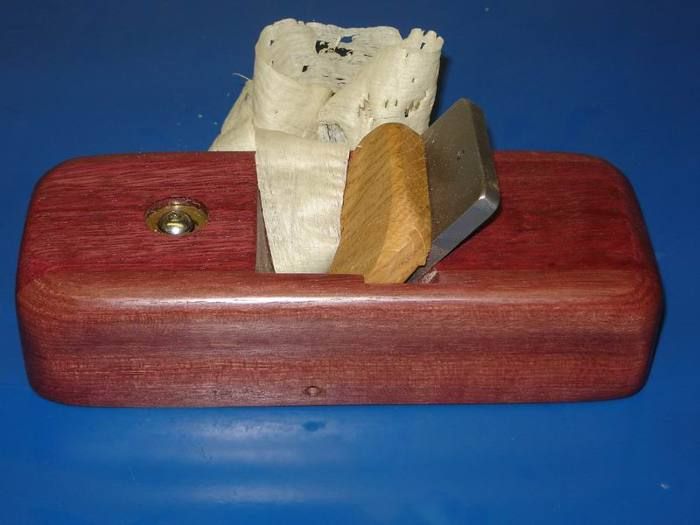
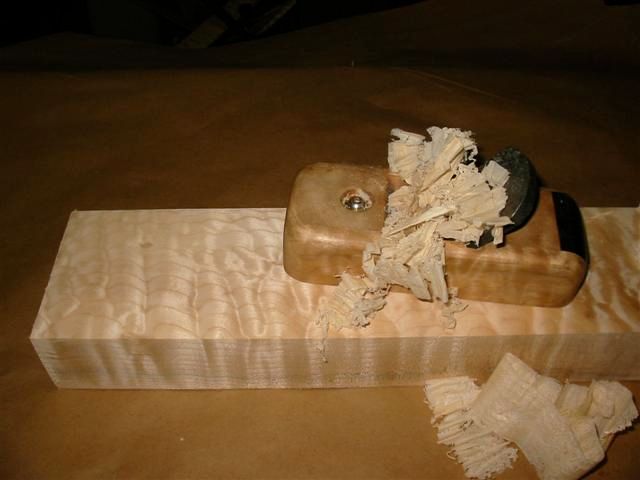
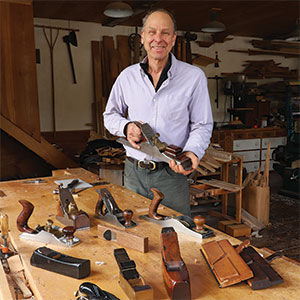
Smoothing plane. Before he sent them out, Steve tuned his planes to take the fluffiest shavings.
It has been at least five years since I first saw one of Steve Knight’s wooden handplanes. I’ve always found them attractive and the word on the forums was that they worked great–and that’s the real test of a plane. I always had it in the back of my mind to buy a plane from him, just to support him. But then I started making my own and I never got around to it. So, I felt a bit guilty when I went to his website recently and discovered that Steve no longer sells wooden handplanes, at least not completed ones. He does sell kits for wooden planes: a smoother, a pocket plane (bevel down), a jack, a jointer, and a scrub. I gave Steve a call and asked him to send me one of the kits–a smoother with a 55 degree frog–for review. I’ll write a separate blog about it. (I am really excited about the prospect of making and using the plane. My job doesn’t suck!)
When I was on the phone with Steve, he and I got to talking about his experience as a plane maker and the story was interesting. I’ve always wondered how hard it would be to make a living as a “boutique” tool maker. There are a lot of guys out there now who are making saws, infills, or chisels for sale. I think that’s cool. I’ve also noticed that many of those guys owed a lot of their success to internet forums. It was on an internet forum that I first heard of Steve, and Mike Wenzloff, and Chester Toolworks, and Blue Spruce, and Ron Breese, and many others. So, I decided to interview Steve and share his story with you. Here’s what I learned. Enjoy.
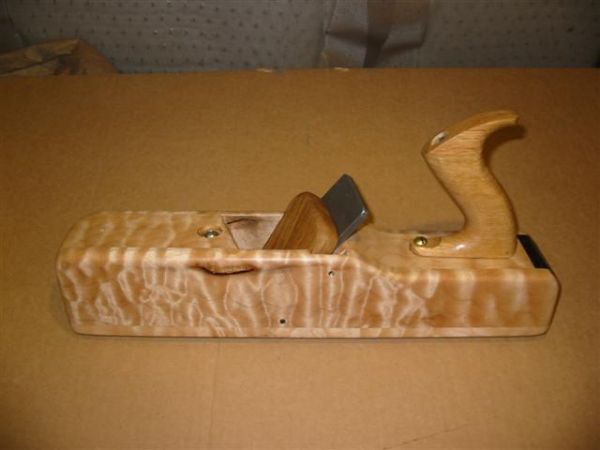 Panel raising plane in curly maple. Steve Knight achieved a high level of craftsmanship in his planes. He used the Krenov method of plane making, even on traditional ones like this panel plane. |
FWW: What was the first tool you made? Why did you make it?
SK: I think it was a smoother. My hands were really suffering from all of the sanding I did making furniture. I had heard about hand planes, so I bought a No. 4 smoother from Patrick Leach. Mind you, I couldn’t even use a plane at that time, and I don’t know if I ever got that No. 4 working. But I did want more planes. Unfortunately, I couldn’t afford them, so I had the idea to begin making them. It was a struggle and for a while none of the planes I made worked. I had a boxful of non-working planes. I made those early planes out of red oak, I think, and glued on an ebony sole to combat wear. I then gave up on woodworking for about a year. I didn’t get back into it until a friend asked to use my shop. I let him, in exchange for cleaning it. My shop, which is small, was so stuffed that it took him about two weeks to clean it! With the shop clean, I started making planes again. This time something clicked and I was off. Those first curly shavings really hooked me. Still, it was a struggle. I was not an accurate woodworker and my planes weren’t square. It took a lot of effort to get the bugs out and to get the planes working. I was learning to build planes, tune them, and sharpen the blades all at once.
| Learn more about plane making with Fine Woodworking • Wood Planes Made Easy  • Shop Made Grooving Planes |
FWW: Why did you begin to sell your planes? Am I right to think that woodworking forums had something to do with it?
SK: Well, there were no forums back then. There was the oldtools email list and rec.woodworking. I posted pictures of my planes on oldtools. Some folks asked me to make them one and that was the start. Without the internet I don’t think it would have happened. It gave me a place to show the planes I was making, but more importantly because I was already using oldtools and rec.woodworking other woodworkers already knew who I was. I wasn’t just some stranger.
FWW: Once you started to sell planes, how did you decide which planes to add to your line?
SK: Well, I wanted to make everything. But I couldn’t. The real limitation was plane irons. I started with Hock irons, but they didn’t quite suit my needs. So I asked around about how to make my own irons. Turns out, it isn’t that hard. I began to buy O1 tool steel in the right thickness and width for my planes. I used 1/4 in. thick steel. [Note from MK: in wooden planes, which don’t have cap irons, thick irons cut down on chatter.] I found a place to do the heat treating for me. They could do it with consistent results and charged me about $1 per iron. So I would cut the steel to the right size, grind bevels onto the irons, and then send them out to be heat treated. Even then, I was still limited. I could only make planes with simple irons. Rabbet, shoulder, and dado planes all have shaped tangs and I didn’t have the tools to make them, so I couldn’t make those planes even though I wanted to. I eventually found a guy to cut irons for those types of planes. But it was still a pain to deal with and I never really sold that many shoulder or rabbet planes.
FWW: At the highpoint of business, how many planes were you making a month? What was your life like?
SK: For the first three or four years I averaged about 30 planes a month. I worked at home and was by myself all day. I would run from the shop to the computer all day long to keep from getting lonely. But I don’t think I ever worked more than 40 hours a week. However, my days were broken up a lot and I worked odd hours, sometimes seven days a week. I think I had more free time than when I was working a normal job since I could work when I wanted to. It was fun, boring, and drudgery, but there was a lot of variety so that was nice.
FWW: What is the most time consuming part of plane making?
SK: Tuning them for use, no doubt at all. It could take up to an hour, and I would tune four or five planes a day. I was worn out after that. Cutting the slots for the wedges and fitting the wedges was particularly tough. Because I used a handsaw (with a jig) to cut the slots, they all differed from one another. The wedges had to be fit one at a time. And that means the planes and their wedges had to be kept together. I numbered them, but still there were times when I couldn’t find the right wedge for a plane!
FWW: Why did you stop making and selling complete planes? Why sell plane kits now?
SK: My sales slowed down. That was my fault, as I did not really do anything to get them up. I just made planes and sold them on the internet. If you want to make money making tools, you’ve got to market them. Without marketing, it’s like you are cold calling people. They don’t know you and they don’t know your tools. I think people are more comfortable buying from you when they’ve seen your tools and have a sense of who you are first. Towards the end I did buy a CNC machine, but to do other work in my shop. By the time a machinist explained how to use it to make my planes, I was getting burned out. I was doing the same thing day after day. But the CNC machine led to the plane kits I sell now. After I realized I could use it to make planes, all of my planes were made with it. At first it didn’t save me much time. The CNC did not cut them as accurately as I could. The planes were more consistent, but they took longer to tune up. I also was making more elaborate planes, so that added to the time I was spending tuning them up. When I first started to make the kits, which I could do because the CNC can turn them out, the planes were still too elaborate and a pain to build. So, I simplified the design, making them easier to build for the person who bought the plane. And that allowed them to spend more time shaping and tuning the plane, and both the shape and the tuning have a greater impact on how the plane works.
-
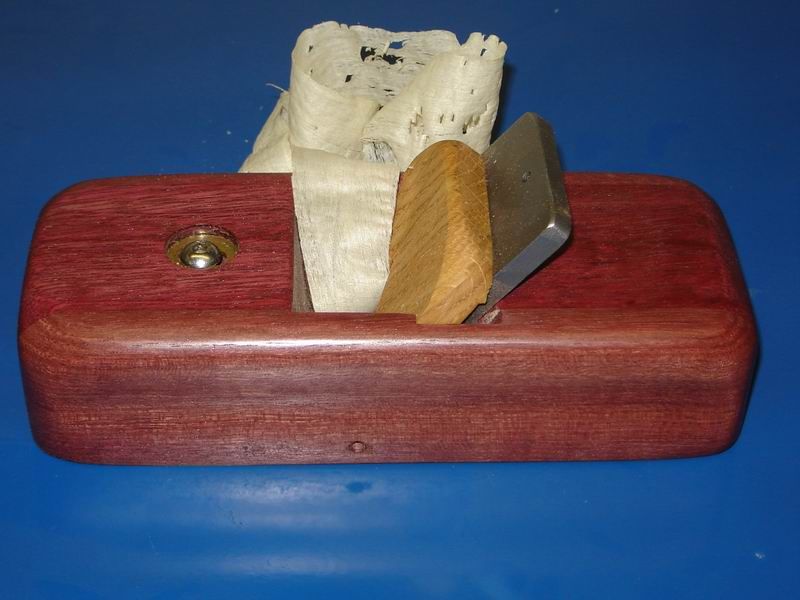
Smoothing plane. Before he sent them out, Steve tuned his planes to take the fluffiest shavings.
-
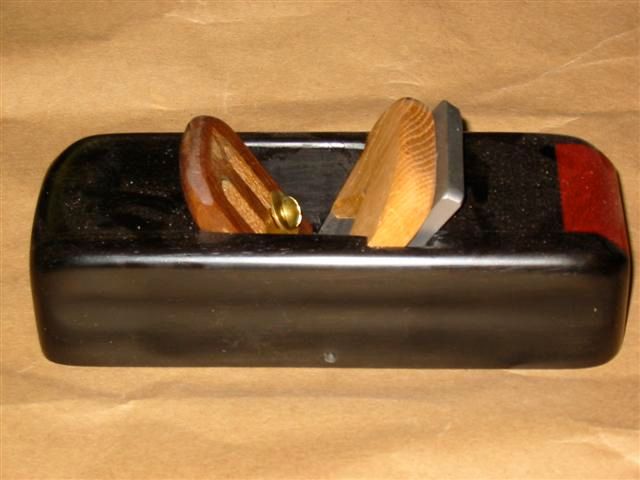
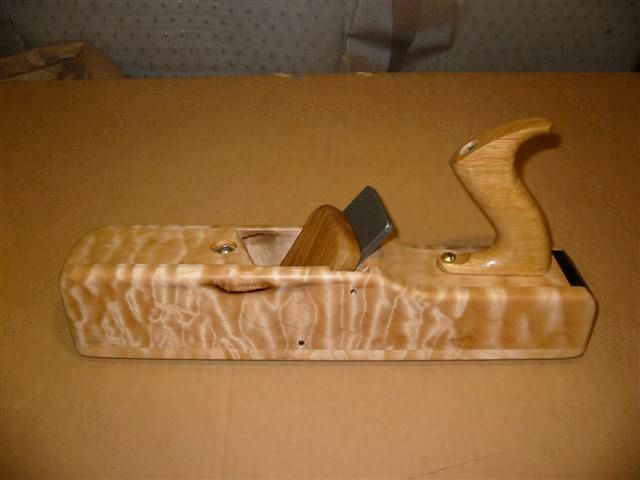
Ebony smoothing plane.
-
Japanese style smoothing plane.
-


Comments
I have one of Steve's planes - an ebony smoother with the blade pitched at 50 deg. It's a superb plane, great on gnarly wood right out of the box. I'm glad I bought it when I had the chance.
I bought three of Steve's planes about eight/nine years ago, when he was selling on eBay. They are works of art and nature, beautiful to look at and hold, and they work great too! A real "organic" experience. As with all wooden planes, there was that learning curve adjusting the blade. Can't imagine how dreary it was for Steve doing the original tune-up. Thanks for a superb product, Steve.
great article with sloppy editing and spelling errors.
D-
thanks guys I had fun making the planes. I still like making them but tuning them up was becoming an issue.
if anyone had problems with my site it is up and running again. I updated it and it toasted. but I got it back up again.
I have five of Steve's planes (and in fact interviewed him years ago for my club's newsletter). The high back infill I have from him (stamped by the way 001) is the best smoothing plane I've ever used. And the jack plane with tote is my heavy lifting plane of choice. His tools were/are simply marvelous.
Does anybody knows if Steve still selling his planes?
Or if his website is down?
I emailed him for information on how to purchase them and never got a answer?
Anybody?
thanks in advance
Nado
Log in or create an account to post a comment.
Sign up Log in