When most of us see an exquisite piece of 17th century royal furniture in a museum, we marvel at the beauty of the work and wonder exactly how all that precision marquetry was put together. When Aaron Radelow sees one, he finds himself staring straight at a challenge.
That was the case when he came across a table on display at the J. Paul Getty Museum several years ago. The table, one of a pair produced for French King Louis XIV in the 1670s, serves as an exquisite example of Boulle, a marquetry technique scarcely practiced these days. Boulle combines fine materials like ivory, horn, and tortoise shell to produce highly decorative inlays that often boggle the mind with their intricacy and brilliance.
Radelow spent six years producing a matching set of tables built entirely to the French monarch’s specifications, and if you’d like them for your living room, you’re welcome to bring them home…for a cool $1 million.
More on Boulle Marquetry:
Boulle Marquetry Basics
Marquetry master Silas Kopf takes you through the process in this Fine Woodworking video.
Boulle Marquetry: Two Panels for the Price of One
How to choose a design, cut out the parts, create the panels, and finish them.
Marquetry Step by Step
Double-bevel cutting makes the process easy and accurate.
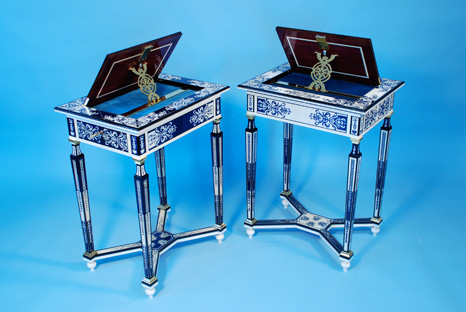
California furniture maker Aaron Radelow produced these two tables to the exact specs of 17th century French King Louis XIV



Comments
im not worthy!!!WOW
This is an amazing piece of work. These tables should definitely be in a musuem or at least with a collector! Fabulous work! I can't believe the detail of these pieces.
Sorry to rain on your nice exhibit but working in IVORY is abhorent. I don't much care what some certificates say. To end the needless slaughter of elephants all trade and use of ivory must be banned internationally and the production of these sort of things denounced rather than praised. 'Legal' ivory is like legal heroin brought to the US in the 1700's before it was illegal. If all you need is someones approval or certificate the slaughter will continue to go on. Its bad and its wrong to admire it.
I’m extremely impressed by the talent, skill and diligence of Aaron Radelow, making his authentic reproduction. It is an absolutely a beautiful work of art.
Regardless of what our PETA members may have to say; culling animals is a necessary fact within harvesting protocols insuring their overall health and well being of an entire species. By using these certified renewable natural resource materials pays it tribute, to ensure their future protection, more over, then any other reliable means, of international tracking of poachers.
Aaron has acted in the most responsible manner and all artists at home and abroad should be taking note of his due diligence.
I’m extremely impressed by the talent, skill and diligence of Aaron Radelow, making his authentic reproduction. It is an absolutely a beautiful work of art.
Regardless of what our PETA members may have to say; culling animals is a necessary fact within harvesting protocols insuring their overall health and well being of an entire species. By using these certified renewable natural resource materials pays it tribute, to ensure their future protection, more over, then any other reliable means, of international tracking of poachers.
Aaron has acted in the most responsible manner and all artists at home and abroad should be taking note of his due diligence.
Aaron,
You have increased the potential and imagination of every woodworker who is blessed enough to see what you have done here and shown that great craftsmanship is timeless and possible in every generation.
Aaron - Bloody Well Done - congrats. Superb in every way.
Now to the carps . . .
I genuinely agree with your 'reservations' about Ivory - but Aaron has done the available right thing to re-create 'exactly' what was done in the original. Please - enough on this distraction from excellence - counterpoint - the people of Paris were starving when this was being made why do you not rail against that too?
I would like to see much more of the how-to techniques that went into this project and I promise NOT to use Ivory.
Mr. Radelow’s work shreds any mental barriers, and gives many craftsmen the impetus to elevate their craft. Well done!
In response to LeeSnyder, put your money where your mouth is. In 2008 South Africa lifted the ban on elephant culling. What did you do about it? Send money? How proactive. China and Japan are the worlds largest consumers of ivories, yet I’m sure you buy Chinese made products. I do my very best not to. Japan still engages in the hunting of whale, yet I’ll bet Mr. Snyder drives a Prius. Poachers operate in many places around the globe. International Trade in Endangered Species (CITES), banned international ivory trading. Under pressure from numerous African countries CITES relaxed the ban, and Africa sold off huge stockpiles of ivory to Japan. Ivory poaching surged thereafter. In 2008, a UN decision to allow the first ivory auction in decades yielded more than a million U.S. dollars from Chinese and Japanese bidders! So Mr. Snyder, until you have the crosshairs of your rifle covering a poacher and dispatch him to the afterlife, your just another talker.
To use the word "abhorent" when viewing such beautiful works of art, is in itself abhorent. The ivory used for these exquisite pieces is many, many decades old and legally obtained. At least this way the ivory will live on for many centuries embodied in flawless and unbelieveably beautiful works of art, which were made with incredible dedication, research, and unparalled skill. Does the critic suggest the ivory be thrown in the garbage or burned and not recycled for something so worthwhile? This is American craftsmanship at its apex.
These tables are just incredible. I'm lost for words...
This is more like alcohol pre-prohibition, rather than heroin brought to the US in the 1700's!! I have never seen such beautiful ivory and cow horn. I am humbled and express my deepest admiration. I made my 17 year old son see the video to know that there truly are talented people out there. I can hardly see what your next project will be.
Wow! Simply outstanding!
Although I disagree with him, LeeSnyder certainly brings up a very valid point. Is it immoral to use ivory in this manner?
I would say no. The damage to the animal was already done - decades ago, and to simply throw out the ivory and pretend it never existed, would be simply awful. At the very least, the material is being used as opposed to simply wasted.
Do I believe we should be able to hunt animals for their ivory? Absolutely not. That said, I don't see the point in tossing away pre-existing ivory.
Lee's effort however, in choosing to "rain on the parade" is noble - especially amid all the accolades for Radelow's work. From a philosophical standpoint, he is staying absolutely true to his ideals, his moral compass - despite the fact the furniture, and the craftsmanship, are stunning, there is no wavering on his part.
There's a lesson here.
Best,
-Ed
Indeed you should be crowned the King of Boulle marquetry in the 21rst century.
You are deserving of wearing the title and a gilded, jewelled crown... Absolument magnifique!!!!!!!! These 2 most beautiful tables are a reminder of the place that craftsmen and artisans had in our history.
Truly the work of a master. The time, the skill, and the commitment, are second to none. Oh yes, and the ivory. I will take ten truck loads, any size, any shape. Ship to anywhere in the GREAT USA and I will pick it up. Let's see...can't kill Whales.... can't cut down Trees...the East Coast is setting records in Snow depth, must be global freeze instead of global warming... can't mine Gold Ore any more...must save the Bull Trout...some political people don't have to pay taxes...and yes, we can Abort Babies.
I guess my point is, let the guy use what he wants. He didn't kill the Elephant. I still use a wooden pencil, I didn't cut the tree down. I like my Gold Watch...gold doesn't grow on a vine. My mother didn't Abort me...praise the LORD!! You have nothing more to complain about??? I'll give you a list if you need one. What about the Cow Horn??? Oh yes, we have plenty of those still running around. I Love my Milk and Steak. Great job on the tables. I wish I had the talent and time to do the same. You are in a class of your own. Teach me!!! I would Love to know how. P.S. I won't need any Ivory, I'll take some out of my personal collection. I've had it since 1971. Let us know what your next project will be...we await your notice. A happy wood worker......"BIGD1"
Truly dedicated craftsmen ship. Aaron's technique is incredibly masterful. I can only imagine what the 17th century craftsmen went through to create such master works. I am amazed the some guys would distract from this master work with non-related tangents. I too work antique ivory as well as tortoise shell on 150 year-old straight razors. Like this masterwork, these items will live on and continue to honor the source and craftsmanship that shows them. I too eagerly anticipate Aaron's next project.
Thank you for all the wonderful accolades and admiration! After reading the third blog I thought I was going into the Hudson faster than Capt. Sully. But I was wrong! Wonderful to see so many in possession of good old common sense.
In some ways, I built these tables for similar reasons Ford built the GT40. I wanted to push the envelope and pass out a slice or two of humble pie. There are a lot of very very talented craftsmen showing up in the pages of Fine Woodworking, so one needs an edge to stand out I feel.
As craftsmen, I believe we all need to go beyond the pale (at least once) to illustrate our abilities to potential clients, etc. I’m very happy my work here is an inspiring lesson to so many.
Hats off to Mr. Pirnik and Mr. Scholfield for assembling an awesome presentation. In closing, I'd like to say it is very refreshing and reassuring to see so many people with their head on straight.
As for my next project... Arts & Crafts library table, I can put my beer on that.
See: http://www.aaronradelow.com
It would be interesting to compare the details in the
Boulle marquetry between the two tables, as in the
XVII'th the blades were much larger than a jeweller's
blade (they were about a #5 blade).
The marquetry donkey was introduced
much later (later XVIIIth early XIXth), the original
was most probably cut with a hand fretsaw.
Just a last question, why use french polish?
(even if it looks great, it is not a technique
of the period, it was discovered about mid-XIXth).
The pair is indeed a great piece of work. Congratulations
and good luck with the coming projects!
-Rondo
I am a conservator who has saved every old scrap of ivory and tortise shell I have ever seen so that I can work on wonderful pieces of art like yours. Long live the artists that create such masterpieces with beautiful materials that have obviously been treated with respect!
In response to Messina. I had my tables in the museum inches form the original.
A wonderful day I’ll never forget. Not the first time I’ve been that close to the original either.
The cutting on the museum’s Louis XIV table is extremely well done, and very fine. Of course my tables are better cut. Modern metallurgy and finer tools etc. assisted in that. I never set out to produce forgeries. I simply set out to create beautifully made artwork.
Handmade blades are created from coils of watch or clock spring. They are filed on the sides to reduce the saw kerf for fine work, the backs can also be rounded. The complexity of the design determines finished blade thickness. The finest handmade blades were 0.012”, about 0.004” less than your #5 blade... close enough. The blades I used are Hurkules, 5/0, or 0.009” (0.23mm), about half the size of your #5 (according to my micrometer). I also used other blade sizes here and there.
As for the marquetry donkey... you are correct. However, I know that most marquetry graduates of Ecole Boulle use this tool. I’d drive a horse and buggy to town, rather than ride a donkey.
French polish is the most beautiful finish I know, and it will keep my tables quite safe from environmental changes. French polish is what’s on the piece in the museum, and the finish on my tables was applied by a graduate of Ecole Boulle.
Thank you for your enquires and kind words. Glad you wrote. Look me up and drop me a line, I’d like to see some of your work and get to know you.
-Aaron
Six years is a long time on one piece. When I come home from my day job I might work on a project for a few hours but after a few weeks or maybe a month on the same project I become stale and frustrated at my slow pace. If something goes wrong I stomp my feet turn out the lights and go in the house. Congratulations on your committment to the highest quality and the determination to see this project to the finish.
Some of you people are real morons. The mans ability is second to none. Have never seen anything quite like it. It would be nice to see you critics take a nice long walk on a very short pier....
Keep up the excellent work Mr Radelow you are truy gifted.
While my woodworking skills are somewhat primitive, I appreciate the dedication and sacrifice that Aaron made to create such wonderful expressions of his talent. I am often at a loss for words when trying to inspire my son who is a classical music composer in a world that is loosing sight of the classics.
This level of craftsmanship is an inspiration to all who strive for greatness. My sincere compliments.
Dude!! Now that is commitment. Congratulations!
One million dollars seems a lot of money, but if you subtract shop and material costs (and also subcontractors fees) and divide it by six years, what's left is about an average salary of good software engineer. I'd say the pieces are underpriced.
Marvelous work. A truly passionate recreation and every bit a work of fine art. Bravisimo! Can't wait to see what your next big thing will be.
What patience! Skill be damned!
Amazing work indeed. But I was wondering....how many of us with mortgages, car payments, families, etc. could spend 6 years making spec pieces of this caliber to sell? We would have to take out a loan, then hope the items sell when done.
Is it 6 years full time or 6 years part time? Is anyone lined up yet to buy these? Help me understand how a regular, non trust funder could try to embark on this?
Mr. Radelow, congratulations on such a feat! Truly an inspiration.
wow! i'm gonna go make cubby holes with birch plywood. i'll spend countless minutes sorting through materials, choosing only the finest quality. then i will measure once and cut 5 times. i will finish with an oil base primer and latex finish paint. And for this i will probably make more per hour than Mr. Radelow. how sad is that. i look at your work and my head hurts knowing i will never have the patience.
My most sincere congratulations! You have matched beauty to age!
A 6 minute film hardly is doing this masterpiece the right it deserves.
I'm advocating a real movie, call it "The making of... ".
Erik
Patriotone, I do believe you are proving Lee's point. If poaching increased after a large sale of legal ivory, that demonstrates that using legal ivory increases demand for illegal ivory.
By using ivory in modern pieces and expounding on the benefits of using ivory you are increasing desire for the product.
"Ivory turns exceptionally well, and takes a polishes like nothing else. It's extremely uniform and has a very fine texture and quite beautiful grain."
I have to say, this quote (and the beautifully turned feet), made me want to work with ivory, since it sounds and looks so amazing. And then I recalled the giant herds of elephants slaughtered and left to rot with just their tusks torn out. That, my friends, is what we are encouraging by using "legal" artifacts from a less conscientious time.
The work done is simply amazing, there is no questioning that. I am stunned by the intricacies of Mr. Radelow's marquestry and attention to detail. However, the use of ivory in our work should be carefully considered.
To ElainP: I agree that working with ivory brings up some troubling ethical issues. That being said, what many people are not aware of is that there are parts of Africa where elephants now have a huge overpopulation problem. Well meaning conservationists often will not allow hunting in these areas, and it is getting to the point where something must be done. In one conservation area alone there are over 11,000 elephants where experts say a truly sustainable population should be 4,000 animals, and the land is being destoyed due to the huge amount that each extra elephant eats. My only point is that, with proper management, we can have good populations of these beautiful animals and still have some ivory for these incredible works of art.
Love all the questions about how could you afford to do this. The time, the cost, the focus and commitment. It would be good if someone of wealth sees these tables and purchases them. By the same token, I suspect that you might have trouble letting them go. Certainly they represent to you a major turning point in your career. A point at which you realized, you could build ANYTHING! I hope that they garner you many commissions, that will provide you with a lifetime of opportunity to make many more amazing works of art, but that you get to keep them a while longer. Thank you for raising the bar.
David from Boston
Log in or create an account to post a comment.
Sign up Log in