Why a Combination Machine Works for Me
A veteran woodworker explains what changed his mind about combination machines and why he's still happy with his seven years later
I didn’t set out to buy a combination machine. In fact, I was poised to buy a free-standing tablesaw, jointer and planer to outfit my new shop seven years ago when a friend told me he was selling his Robland X31. My shop space certainly was tight — about 430 square feet in an L-shaped configuration. But I’d always thought of combination machines as lightweight and gimmicky. My friend talked me into giving his Robland a look, assuring me it was no lightweight.
After trying out all five functions (sliding tablesaw, jointer, planer, shaper, and mortiser), I was impressed. Anchored by 1,100 lb. of cast iron and steel, and powered by three separate 3-hp motors, the machine performed each task smoothly and efficiently.
The more machines the better?
Intrigued, I went home and considered the Robland more carefully for my shop. Now the space seemed even smaller, even more suited to a combination machine — which is to say, I was leaning toward making the purchase. But even at a used machine price, the Robland would be more expensive than separate used machines of similar size and quality. More importantly, I’d have to pay for it in one lump sum. And while I’d used a shaper and mortiser extensively in my previous employment, I didn’t plan on getting these two machines at the outset for my home shop. Still, having more machines could only be a good thing, right? After tweaking the terms of the purchase, the deal was done.
7 years later, it’s still a good choice
After seven years of trouble-free use, it turns out that a combination machine was very suited to both my shop space and the kind of projects I do. After buying several smaller tools (chop saw, bandsaw, router table, drill press, belt sander), and finding the best arrangement for them around the perimeter of my shop, the core space had shrunk considerably. In retrospect, having a separate tablesaw, jointer, and planer would have been far more problematic than I had anticipated.
You’ll notice that my list of ancillary tools provides some functional overlap with the typical combination machine: With a sliding table saw I could make crosscuts without needing a chop saw, and the router-collet adapter for the shaper makes a router table expendable. But this gets to the practical logistics of working with a combo machine in everyday use.
Changing from function to function is no problem
The big bugaboo you hear, of course, has to do with the inconvenience of changing from one function to the next. The fact is, as advertised, that the changeovers are done quickly and easily. For example, on many combo machines a single fence functions for both the table saw and jointer, so going from one to the other is as simple as moving the fence. (Mine required an upgrade to get such a fence.) Switching from the jointer to the planer or vice-versa takes a minute or two at most. Setting up the shaper is as simple as bolting the fence onto the table. And setting up the mortiser is the same — just bolt the unit onto the side of the machine.


Here, O’Malley runs boards through the planer and tablesaw. He put an aftermarket rip fence on the machine, which allows him to leave the standard, double-duty jointer/tablesaw fence on the jointer full-time.
But using two functions at the same time is a problem
No, the major inconveniences of a combination machine are not the changeovers; they have to do with how being set up for one function limits your ability to use another function at the same time, the way you can with independent machines. For example, when I make several rip cuts from a wide board, I prefer to joint the edge of the remaining board before each rip. (Sometimes the board warps and I have to joint it.) With my combo machine I’m forced to move the fence to the jointer, and then back to the saw, and risk getting cuts of a slightly different width.
With the planer, once I’ve planed stock to thickness, I must lower the table in order to use the jointer. (Also, in the planer position the jointer tables limit movement around the machine.) So if I find an hour later that I need another piece of stock at the identical thickness, not only do I have to re-set the planer, but I have to get the piece exactly to the same thickness. Similarly, if I’m mortising door parts and make a mistake, I can’t replace the part without breaking down the mortiser in order to use the planer.
Some inconveniences you can work around
This particular inconvenience led me to purchase a portable planer (and to prepare extra parts in every project). Using the shaper prohibits using the saw, jointer or planer (but not the mortiser). So if I want to repeatedly profile an edge and rip off a small molding, I end up using the router table instead of the combo machine shaper. Using the sliding table saw for crosscutting requires removing the fence to convert to a rip cut. That’s why I use a chop saw for crosscutting anything but wider pieces, or a lot of the same pieces. So it would be inconvenient to build furniture and cabinetry, as I do, using only the combination machine. 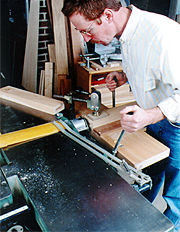 Once he had the horizontal mortiser in his shop and could easily cut matching mortises, O’Malley found himself using loose-tenon joinery instead of standard mortise-and-tenon. Note the shop-made jig added to the mortiser table to keep stock square to the bit. Even with auxiliary machines, using a combo machine forces me to pay more attention to the sequence of operations, and to think things through more thoroughly before getting started, in order to avoid the inconvenience of backtracking. But this is good practice regardless of the machines you’re using.
And I’ve adopted certain techniques specifically because of my machine’s capabilities. For example, I make full use of the mortiser in all my projects, using floating tenons almost exclusively over integral tenons. And for cope-and-stick door work the shaper is far superior to any router table thanks to the heavy table and larger cutters.
And some inconveniences you can’t
Other inconveniences of a combo machine can’t be overcome by adding a portable machine. The biggest one is reconnecting the dust connection hose as I change functions. The last thing I need is an excuse for not using dust collection all the time. Further, many European table saws are designed not to accommodate a dado or molding head. And I still haven’t gotten comfortable with the Euro style jointer blade guard when face jointing. I understand, however, that later versions of these combo machines have addressed these problems.
All things considered, having five high-quality machines occupying a small footprint of space is what made the Robland the right choice for my shop.
Tony O’Malley is a writer and furniture maker. For reviews of six combination machines, see senior editor Asa Christiana’s article in the January/February 2003 issue of Fine Woodworking (#161).
Photos: Matthew Teague
An Online Extra to Fine Woodworking #161


Log in or create an account to post a comment.
Sign up Log in