Are CNC machines ready for Fine Woodworking?
 Dec 28, 2009
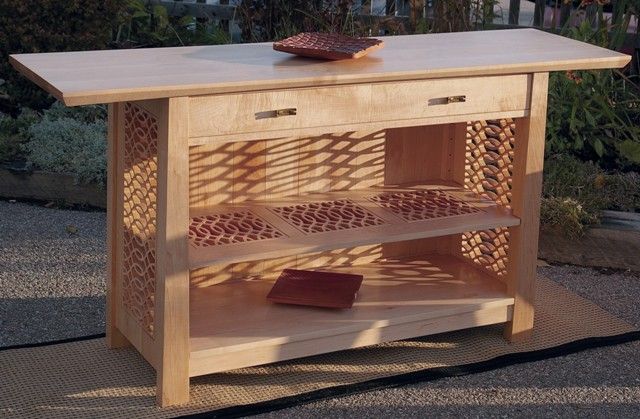
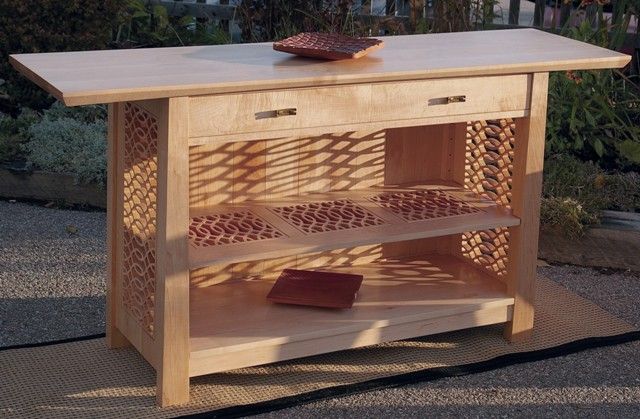
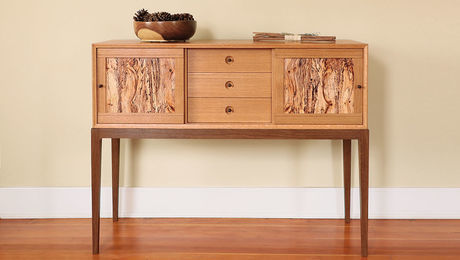
Furniture maker, Stephen Mosher uses a ShopBot CNC to cut the grills in his Asian-influenced sideboard. The machine can do in a couple hours what would otherwise take days or weeks to do by hand.
Many folks equate CNC machines with mass produced cabinets and knock-down furniture, but professional furniture maker, Stephen Mosher of Hampton, Nova Scotia, Canada aims to change that. He told me that he turned to CNC machines 8 years ago when he got bored with conventional hand and power tools after working wood for more than 30 years.
His ShopBot CNC allowed him to make pieces that would be too labor-intensive to make profitably any other way. In addition to his own work, he also does contract work for furniture showrooms and he’s willing to take on projects with hobbyists, too.
Do you think there’s room for CNC in fine foodworking? Have you ever considered buying a machine or contracting some of your furniture making process, like making jigs or prototypes, to a shop that has a CNC? Please leave a comment and tell us what you think.
-
Furniture maker, Stephen Mosher uses a ShopBot CNC to cut the grills in his Asian-influenced sideboard. The machine can do in a couple hours what would otherwise take days or weeks to do by hand.
-
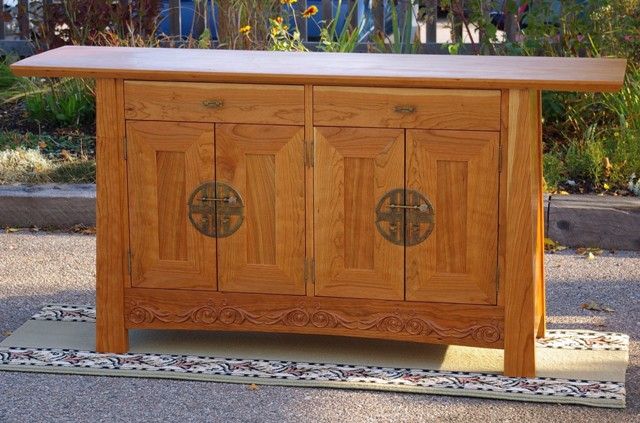
Besided pierced work, Stephen also uses his CNC for 3D carving like the scroll work that's below the doors on this cherry sideboard.
-
With a pair of cutting heads, Stephen's machine requires fewer bit changes than a single head machine. It also produces surprisingly fine work.






Comments
I think I'd pose the question: "Is FINE WOODWORKING ready for CNC machines?" LOL
Betsy,
Received my copy of Craftsman Furniture and love it. The quality of the paper and pictures is outstanding. The projects contained in the book are excellent. I will use this book a lot.
Many thanks,
Jerry Draper
This is an excellent question. I would have to say that Stephen Mosher's work is fine woodworking, but, in my humble opinion, a project looses something when you simply program a machine to do some of the creative work. That may still be fine design or fine programming, but I can't call that fine woodworking.
After reading my reply, it seems a little contradictory. I certainly don't want to imply that Mosher's work isn't of high quality, but I am much more impressed when that CNC work is accomplished by hand, which to me is fine woodworking.
Most definitely, it is time to open up to CNC technology. I own a Shopbot in my one man shop business and the variety and quality of work possible with this machines is incredible. Up to 40% of my work is done with it, doors, furniture, decorative accents, you name it. Parts or even whole projects that would take weeks to complete using standard power or hand tools are possible within hours and otherwise impractical or complex elements are within reach in a CNC. The availability of these machines to the small workshop is increasing everyday and new ideas and creations otherwise hidden would have the right outlet in Fine Woodworking. I understand that not everybody needs or enjoys the speed and complexity a CNC can deliver but there is much to learn from this segment of the woodworking community.
I have to agree with you I am a one man shop the cnc takes a lot of redundancy cutting out basic parts that take time and little skill. Or do complex parts that would make a piece impractical to make because of the time to cost constants.
I don't really see how bringing CNC to the party is any different than the existing arguments about power tools vs. hand tools. Some think that only hand tool work is fine woodworking, and that's their prerogative, I suppose.
It's been many years since I had any dealings with a CNC device, and that was in a metalworking context, but I highly doubt that the grillework in the project above came off the machine looking as good as all that. It probably took some fine-tuning, some cleanup, etc. Some "fine woodworking," you might say, to finish it up. I think most people would agree with me that regardless of method, results are what truly defines whether something is fine woodworking. Methods are important, and methods make a great story to go along with a piece, but in the end, it's all about the piece itself.
Also, fine woodworking is in the eye of the beholder or the client. I think anyone would view Mosher's work as the highest quality. Whether CNC work is considered fine woodworking is a good question for me personally because I feel the need right now to improve my skill with hand tools.
I believe that the Greene brothers would have incorporated them in the production of their furniture, as well as the Shakers. But then again woodworkers usually don’t purchase other woodworkers items so this question should be asked to the purchasers. It would be interesting to ask a client if it made a difference to them if such a device be used in their custom made product, if they know what it is they may ask for a cheaper price tag unless marketing such a device as an ‘advantage to’ or a’ value added service’ (I hate that term) to their end product. But I don’t know of anyone to ask such a question. As for as personal use, yes if I had the money and the room to set up a CNC and as long as I got to keep all my other tools.
An elderly gentleman once told me 'romance sells’, it doesn't matter what one used to build things it was how the client perceived its making that counted.
Don
Don
I think that perhaps the bottom line is: nobody's suggesting CNC machines will take the place of a knowledgable craftsperson. It's more about knowing when to employ this technology and when to say "it's not necessary." Like many things in life.
While I don't have the funds to buy a CNC for my shop, yes, I think fine woodworking is ready for CNC equipment, and I'd buy it if I could. I think it would be great marketing if a company like ShopBot could put together a book(let) outlining CNC basics (CNC 101 if you will) and some examples for the fine woodworker in order to peak our interest. Steve Mosher's photo from this post would make a great cover photo!
I built a cnc a few years back and use it often to cut delicate parts and signs. I use it for shelf pins, duplicate parts in pieces of furniture, and just about anything else I want. Your imagination is the limit within the limits of the size of the machine. I even used it once to fit a tapered barrel into a homemade stock. The barrel fit perfect without even an air gap in the taper. This could have been done by hand but it only took me 1 1/2 hours to write the 3d program and cut the stock. I have never used it for mass production yet. Mostly fine furniture. I think CNC's are no different than the chisel being invented out of steel. No one I know wouldn't use it just because the stone age guys didn't have one. Technology is great!
tony
I think fine woodworking is a combination of design and craftsmanship. Clearly, CNC puts the emphasis on design. If I were a professional then it would certainly add value to my shop and my work. As a hobbyist, I like that my gifts to others reflect my time and commitment to them and that it adds something to its value.
Let's say it takes me a week to carve some kanji by hand on a box where any slip is going to ruin the piece. Compare that to a CNC pattern that takes a few minutes. If I make a mistake then I can just do it again. No big deal. Maybe I'll even be tempted to add more kanji, just because it's easy. I like to think that the former will carry more meaning and make a better heirloom.
I think context is everything on this matter. Sometimes the end product is all that matters. Other times, the process is as important.
I read in some of these posts that people think that because it doesn't take as much time to cut something with a cnc that the value goes down. I think it is forgotten that to do quality work on a cnc, with the imagination that goes with it, can take years to learn. That has much value!
I realize the question was posed from the use of a CNC machine, but it is just as much about materials used as it is the machine. The idea about the use of technology specifically to furniture is about finding a different form. Viewing an object with a form we have seen before isn't going to be the difference maker. It is the form of the object created through the technology that will sell.
I could reference an extremely valued table made of baltic birch ply, but that would turn off (I'm guessing) 85% of viewers in the forum. Oh no, if MDF if mentioned.
Tony hits on the key issue of the size of the machine and another fella below mentioned the amount of clean-up. Costly right now.
The dilemna to a question like this; is that the indivdiual on this forum, isn't the "buyer"/"market" for forward thinking furniture objects.
Neil Lamens
From the comments I've read it seems that this blog group has come to the conclusion that using a CNC machine for fine woodworking is still fine woodworking, and I do not disagree. I like technology, it can make our jobs much easier and cost efficient. However, I think that fine woodworking does lose some of it's value when it's done with a CNC machine. It takes years of practice to master a skill such as fine woodworking. Although it may take years to master the software in the CNC machine or the imagination of fine woodworking, it's not the same as mastering fine woodworking.
I remember when I was a kid at convention in North Carolina I saw this man carving very impressive bowls, spoons, and other kitchen utensils by hand. I remember thinking how cool it would be to do that myself and now almost 20 years later I still wouldn't be able to make something as precise as he did by hand, but I could most likely program a CNC machine to do it.
So I think that when someone that can't do it by hand can do it by computer/machine it loses value overall. Not all value is lost because it is most likely more impressive when done by machine than when done by hand, but a little bit of value is lost when the machine does it rather than your hand.
-StairPartPros.com
This debate has been going on for some time in the Timber Framing industry. Some see CNC as the death of craftsmanship, others see it as relief from tedium (have you ever chopped 237 2x6 mortises by hand, one after another??).
CNC is another tool. It requires knowledge of wood and joinery techniques just as hand-work does. The software and machine setup are not trivial skills, but also require knowledge and hard work to be proficient at.
I've worked at CNC production in residential framing for over a decade now (timbers, logs, SIPS, stud framing...). I can design a furniture piece, then automatically get exploded diagrams, detailed piece drawings, and even CNC instructions (which I could use if I had my own machine). Disagree all you want, but I know in my heart that I am a craftsman.
CNC machines are becoming essential in the stairbuilding industry. The first thing a good stairbuilder has to do is check his ego at the door. The finished product is the goal. How you get there can be easier with a machine or harder by hand. I'm getting too old to let my ego prevail over good judgement. Let the machine do the work and take credit for a beautiful finished product. The machines can do a fantastic job.
Is it a tool? Do Fine Woodworkers use tools? Some of us dote on our vintage chisels and planes, others on our state-of-the-art machinery. Some real eccentrics like both! :-D As George Nakashima so profoundly put it, it isn't a question of using either hand or machine tools but in choosing which tool best expresses what the woodworker wishes to make. You use the tool that is best suited for the job at hand. If it happens to be plugged into your laptop, no big deal.
What is there to say, to make furniture FOR A LIVING in North America you are at a disadvantage from "cheap" imports and low wage earners abroad, if you can compete using CNC technology I say go for it. After all how is this any different than using Sketch-up or even a Table saw? As others have said already, the customer is only interested in the end result, not so much in how we get there. Now with that said, for those who are NOT making furniture for a living but in fact just do it for the love of the process as much as the final result, we know the answer here too.
Robert.
I think the technology for CNC is amazing. I always have. Yup, our ancestors would have used them, but should we?
I can think of MANY applications that CNC machines are useful for, but here is the rub: On most of the examples I looked at on YouTube, the CNC machine is cutting out a part from a block of wood -- NOT very "Green". What do you do with the huge part left over from the CNC 'cutout'? Is this just "waste"? How economical are CNC's in terms of, not just my time, but wood-as-a-resource?
A CNC machine is not going to help me make bent-wood laminations, or help to put fancy veneer over a base, but it sure would come in handy to make a wooden gear! Now, if it could make all those finishing coats of spar varnish ... and sand in between coats ... sure adds noise and mess to the shop too. Is that Fine WWing -- to cut some fancy shape from a sheet of plywood? (I know, I'm being negative -- just trying to make everyone think a bit.)
I am all about the heart, hand and eye approach. Having used CNC machinery for several years in industry, I can honestly say that there is little woodworking knowledge required when compared to a true craftsman, and next to no actual woodworking skill needed. Most of the knowledge needed is computer related – AutoCAD, Inventor, Mastercam, Solid Works, SketchUp.
I am not a purist. I use the best tool for the job, but to a point. In my opinion CNC not only takes the skill out of furniture making, but also the heart and soul. I take far more pride in the furniture I make using my band saw and lathe then using CNC.
I have been dreading it for a while now, when CNC will become affordable to the small custom makers. I think very few will be able to resist the temptation to change over to CNC. It does offer the opportunity to produce faster and make more money. As Technology advances CNC machinery will become more affordable, and also capable of doing a lot more. Is fine woodworking ready for it? Is there room for it? There had better be, because unfortunately, it is the future of Fine Woodworking.
I have been woodworking for over 30 years, and I design everything that I make myself. I have had a ShopBot for about 3 years. I use it like I use any other tool in my shop. If something is best done by hand, I'll do it by hand. If the band saw, table saw, or router is best, I'll do it that way. If the CNC will do it best, I'll use it. My point is that the CNC machine is simply a tool. It only does what the operator tells it to do. It doesn't design, and it doesn't substitute for craftsmanship. I think there is the mistaken impression that you can stick a few pieces of wood on the machine, and presto, you have a piece of furniture.
What's the difference in making mortises using a router with a template, a Multi-Router, a mortising machine, or a CNC? When you think about it, there isn't really any substantive difference. Sure, you can chop the mortise by hand, and if there is only one to do, I'll do it that way. But if you have to do over 50, as there are in a sideboard that I'm currently building, using the CNC machine is far more efficient. Once everything is assembled, no one will see the mortises anyway. Even if they could, would they be able to distinguish them from other machined type mortises? I doubt it.
I enjoy hand woodworking. I like the peacefulness associated with it, and the pride that skillful work brings. But, I also think that being practical has it's place. I think that by any measure, my work would be considered "fine woodworking." The fact that some operations employ CNC technology has nothing to do with it in my opinion. How many woodworkers actually build using hand tools alone, and I mean from the felling of the tree with an ax all the way to the finished product. I would propose that there aren't too many. The point is that most of us use power tools to some extent. They are an extension of our capabilities, and a CNC machine is simply one more power tool.
Any tool, no matter how simple or sophisticated, is no better than the workman using it.
Matt
I view machines/power tools in the shop as the modern apprentices. I see no devalue in a piece of furniture simply because some processes were done with power, be it a tablesaw, router table, or a CNC machine.
In the "good old days" the master carpenter would simply assign the tedious jobs to to his apprentices or journeymen. He still had to know his craft before he could tell them what to do and how to do it.
Main difference now is that swearing at your cnc machine isn't as satisfying as swearing at a clumsy apprentice.
I think using CNC has it's place as long as it is viewed as just another tool that is used in a long process of working wood with other tools (both hand and machine).
The danger comes when you start to say things like "How can I use this more because it saves so much time?" Then you end up with a chair that is designed for ease of manufacture rather than comfort and elegance.
-mj
Looking forward to retirement in a few years and having more time to develop my woodworking skills, this issue of having a CNC in the shop was decided for me by mother nature when I began to develop arthritis in my hands. CNC became the route to add details and carving to my work. To afford this I built my own CNC (Joe's CNC Hybird) and started the process of obtaining and learning the software required.
Designing, whether on paper on on computer, is still the major challenge for me (and many others) and even more so on the computer where a whole different set of skills is required to even start. Poor design executed with the finest skill is still poor design.
So I speak from experience, CNC is a neat tool but that is all it is. It requires a very steep learning curve and is not cheap. Final evaluation though: I can't do without it!
This is a very interesting discussion and I appreciate immensely the different view points. For me it comes down to appreciation. Work done by CNC is certainly fine, but I think I would appreciate it a lot more if it was done by hand (which may not always be easy to tell). If Michelangelo had sketched out the ceiling of the Sistine Chapel and then turned the job over to a giant spray-by-numbers machine it would still be a beautiful sight, but perhaps we'd appreciate it slightly less.
I also think the CNC is more than a "power tool." Too often the phrase "power tool" is used with distain, to mean "hands free," as if the woodworker has nothing to do but turn the machine on and go have a cup of coffee. But in fact most power tools ARE hand tools. I don't know any hands-free table saw, hands-free mortiser, hands-free jointer etc. etc. We lay our hands on the pieces and guide them through these tools with TLC. One slip and a nice piece of wood is ruined. The CNC is totally hands-off, as best I can tell, though I confess I've not used one. For me, the joy of wordworking comes from using my hands. I don't think I'd get nearly as much pleasure watching a robot do it, though I have to say the finished product is certainly nice to behold and the time saved is probably a deal-maker for the pros.
I have no problem with wood workers using CNC machines. My question is how do hobbyists justify the funds to buy one?
I use CNC primarily because I find the interesting part of woodworking to be in the design of the piece rather than the building of it.
I know I can do everything by hand but when I've done it once I don't feel the need to do it again.
Each to their own. If we stretch the meaning of craftsman to include those who can do amazing things with CAD/CAM software then we're covered.
To Joebolt, How do Hobbiests justify funds? "I want one." Part of the definition of "Hobbiest."
I use my ShopBot in my business of making hand weaving looms. Some weavers view their looms as tools and others as fine furniture. It is all in the customers viewpoint.
I do not make all the parts for the looms on the 'bot, only the ones, and only those steps on that part, for which it makes sense to use the 'bots capabilities.
To MLZettl, he's absolutely correct, CNC is a tool...no better than the workman using it.
My ShopBot does only what I tell it (program it) to do. However right, wrong, brilliant or stupid the instructions may be, the 'bot brainlessly follows those instructions.
My Delta table saw cuts only what I push across the blade; right, on the line, wrong, not on the line, brilliant, exactly the right angle and length, stupid, thumb.
My chisel cuts only where I place it; see table saw above.
To tkarlmann, is not the hand wood carver just "cutting out a part from a block of wood?" What does he do with the "huge part left over?" I submit, just like the CNC craftsman, he cuts another part out of it. Do any of us just cut a small part out of a big board and throw the rest away? NO, we all have scrap bins that we constantly pull from. As to "those finishing coats of spar varnish," I submit you have a car in your driveway or garage that had the "finishing coats" of paint and clear coat applied by a CNC machine. It's all in how you, the craftsman, use your tools and what tools you choose to use to do the job at hand.
To Fine Woodworking; the first poster, epirnik, summed up all the later posts most clearly, Is FINE WOODWORKING ready for CNC machines?
Off to the shop...
Is Fine Woodworking ready for CNC?
I think that CNC should be viewed as a tool that could be used to help release our creative and artistic designs. It should fall in the same category as our other power tools.
I have been a paid cabinetmaker for 50 years and the last dovetail I cut by hand was back in high school. I have worked on fine furniture, elaborate lobbies, eloquent reception desks, and simple counter tops. I have used hand tools and power tools with the same results. My last 3 years of work were with the CNC. I LOVED IT! I had little computer skills but caught on fast. You still have to understand wood and how to machine it. It will only do what you program it do do and how to do it.
If you enjoy cutting dovetails by hand, you should but don't get all huffy when some people are not impressed. My grandmother used to make her own bread when I was a kid. She was thrilled when she could finelly buy sliced bread from the corner store. I get the feeling that some of you are still using the foot powered lathe and look down on anyone who doesn't. Farmers use tractors instead of horses and plowshares, it is called progress.
my first "construction" job was working for an old inn that was owned by an archutect(i know im a bad speller, please bare with me). he would not let me touch a power tool for the first year and half i worked there. that is were i learned how to work with my hands to make things beautiful, spacificly matching old with new. latter i learned how to use powertools to affectivly do the same with even more prasition. now if i had started with powertools i beleave my skills would have been tanted as meny carpenters are these days. i beleave CNC's to be fantastic tools for the experianced woodworker to bring there art to the next level with less flaws. but i do not beleave it to be a tool to make anyone a woodworker and that i think is the problem CNC's will be......
Roy Underhill talks about the "craftmanship of risk" and the "craftmahship of certainty". Once mastered, using a CNC definitely weighs in on the side of certainty. That being said, there are many misconceptions about using CNC.
Several posters here seem to think that one just throws the work on the machine and PRESTO! instant results. If it were only that easy. Actually, it is if you are making curb furniture out of sheet goods. Anything beyond that requires considerable planning and preparation. The wood still needs to be flat. Panels still need to be glued up. Attention has to be paid to grain matching. Then there is one other thing to be overcome: Trying to make it look like it did not come off a machine. This is the same challenge faced by anyone who makes things with power tools.
There are some tremendous benefits to CNC machining. It can replace having to build jig after jig to obtain precision cuts needed to build things such as chairs. With the right software and some time spent learning it can just as easily carve a beautiful cluster of grapes in 3D on a panel, or even wrapped around a column. How many one man shops have the time to master all these skills in a lifetime to produce beautiful results?
But here is where the Fine Woodworking comes in: When the machine is done carving, one can always pick up a carving tool and do some Fine tuning to that carving. Some things are still faster to do by hand, so one should know how to use hand tools.
Over the years I have noticed that woodworkers keep looking for the "one tool wonder" of woodworking. It doesn't exist. One might as well go in search of the Holy Grail.
An example of using CNC in Fine Woodworking in my shop was a recent project for our new home. A simple bath cabinet taken from plans in a popular woodworking magazine. I built the entire cabinet conventionally, no CNC until I got to the panel in the door. Then I wanted to carve a dished area with a hummingbird feeding on flowers in 3D relief. I let the CNC machine do that. It took me about 2 hours to do the design and about 3 hours of time on my home built CNC machine. The results are fantastic, my wife just loves it. Yes, I could have cut the contoured side panels on the CNC, drilled the shelf pin holes, cut the dadoes etc. But frankly, it was just as easy to do it conventionally. Besides, I enjoy doing it that way. If I were making 20 of those cabinets I would have done it entirely on the CNC, because it would not have been much fun after the second one.
So you bet that Fine Woodworking is ready for CNC Machines, in fact, in my opinion, it is a moot point.
As a professional woodworker for over 25 years who's never really developed fine hand tool skills, but has done what I'd like to believe most, if not all, would still perceive as fine woodworking, my shopbuilt CNC machine has enriched my work life in ways I hadn't initially imagined. It's opened up a world of possibilities for both "fine woodworking" and income (no trivial matter ever for a professional woodworker, and especially critical these past 15 months). True, there's not much sensual pleasure in hitting a start button, but my work life has always been about converting the image in my mind's eye to finished piece by whatever method i could make work. My CNC not only allows me to dovetail a huge pile of box parts in record speed (while I simultaneously groove for bottoms on the router table a few feet away...) but i can also pull off custom inlays in just a few minutes of my time that just might keep me off food stamps for a few more years...
I think that in all three pieces pictured in the lead article the CNC application made the piece worse, not better.
Is Stephen in control of the machine or is it in control of him? Resistance is futile, you will be assimilated?
The grill work on the first is interesting at first glance but also kind of funky. And a chimp can tell it was done by a computer, nobody in their right mind is going to take much time out of their life. And, as always with this stuff, it looks too perfect. Is it wood or is it injection molded? Don't get me wrong here, the sideboard itself is beautifully done, obviously the work of a talented craftsman.
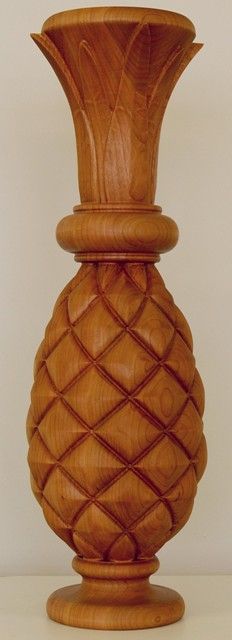
The pineapple is just goofy, we won't waste much time on that. Do we need wooden pineapples in 2010?
What is European looking scroll work doing on an Asian cabinet? Shouldn't it be dragons or something? Again, the work of a brilliant craftsman but one who apparently didn't have a 3D model of anything Asian.
If this is what CNC does to you then it's dangerous and should be banned. I thought I wanted a CNC, even considered building my own, but if this is what it does to you then no thanks.
Just what is a CNC capable of? Could Stephen have used it to cut out those tapered legs? What about the door parts? What about the tops of those sideboards? If it can do those things then I'm interested. But if all you get is funky pineapples then no thanks.
I'm of Irish descent and I'm afraid that the temptation for me to have the machine cut out some goofy Celtic brickabrack and ruin some otherwise nice piece with it would be too great to resist. Then my hillbilly friends would ape doodoo over it and I would be ruined.
As a person whose been in the technology industry all my adult life, I am intrigued by CNC machines. I think it would be fun to have one. However, as a hobbyist I cannot really justify the cost at this point. Either way, I don't think it would change how engage in this hobby that much.
What bothers me most is the fact that with a CNC, my hands and eyes are not on the work in any way. With a table saw, a band saw, heck - even a chop saw, my hands and eyes are on the wood. When I hand cut dovetails, or carve a ball & claw foot, my hands and eyes are on the work... but I am a hobbyist.
Perhaps that's why I enjoy this hobby so much (and don't really mind not having a CNC machine).
,,,,,,,,,,,,,Chet
My own field, which is organ building (that's pipes, not prostheses), involves a vast amount of high-precision woodworking. We are making an enormous machine out of wood. There are a multitude of repetitive tasks for which CNC appears to be the answer to a dream--and I dream of the day when I can acquire this technology for my very small shop. Most of the parts in question are inside the organ, where aesthetic considerations, though still important, often must give way to practical necessities. I would imagine few uses for CNC in building the organ-case itself. On the other hand the decorative grilles that usually surmount the pipes could be prepped with one of these machines, before the detail carving was done, sparing us many long, noisy, boring hours with the jigsaw and router. If I had a batch of linen-fold panels to make, a CNC machine would be a godsend, though I would still want the detailing to be done by hand.
Even those organbuilders who build historicially inspired instruments, hewing closely to the practices of the Baroque era, don't rough out their lumber in a saw-pit and dimension it with hand planes. Nor do I know anyone who does the joinery by hand. I do have some colleagues who to produce what looks like a hand-planed surface, instead of sanding--and they use a wonderful Japanese machine to do it.
Technology is a good servant, but a bad master. Others on this thread have observed that they are glad to have learned to work the old-fashioned way before turning to CNC. I think that is very important. Who would want to be limited to only what CNC can do? To draw another example from my own field, we organbuilders face the question of whether to tune our instrument by ear or to use an electronic tuner. Tuning a large organ by ear is a fastidious and tiring process. Besides, the loud sounds can, in the long run, damage your hearing. Today there are outstanding electronic tuners, so accurate that you can put cotton in your ears. If I could afford it I would gladly use such an instrument. However, I cannot imagine anyone using it intelligently who hadn't first learned to tune by ear.
When considering the merits and demerits of using any sort of machine, we ought to recall that for the first generation of the arts and crafts movement (William Morris et al.) even the table-saw was regarded as a soul-killing abomination. I know of few artisans today who are that hard-core. But it depends on what you are out to acheive. If woodworking is a form of meditation for you, a spiritual practice, you might indeed decide to work entirely by hand.
In the end, each of us must ask, what matters to me? Of what does my integrity consist? Few of us do what we do just to make money, because, if that's what interests you there are a hell of a lot easier ways to do it. So spiritual values must be involved and that always means renunciation at some level. Most fine woodworkers have, willy-nilly, taken a vow of poverty. Many have practiced obedience in submitting to an exacting elder who taught them their craft. There remains the question of chastity, and I think that's at the heart of our worries about technology. And what is chastity? I think that the late Roberston Davies said it best: "Chastity is having the body in the soul's keeping." Who is in charge, we or our machines? Honest reflection on that question should enable each of us to draw his or her own line in the sand--or rather the sawdust. Then we must have the wisdom to stay on the right side of it.
To Joeboldt,
In my view, a hobbyist can justify the expense of a CNC if allows them to do more than before. TKReischl's example of "a dished area with a hummingbird feeding on flowers in 3D relief" is an excellent example. Carving takes a lot of practice to do well, and if you are inclined to spend the time needed to learn, you might just forego the carved panel. Having never seen a CNC carving aside from that produced by the Carvewright in a picture, I don't know what one would actually look like. They may (or may not) be quite fine, but I really doubt that it would be mistaken as hand carved. And certainly a hand carved panel would be distinctly hand made.
Have a look here at my latest project - a 5' long panel for a headboard. There's about 100 hours in this carving, by hand of course.
I have had the wonderful privelege of being a woodworker for over 20 yrs professionally and have been asked and paid to build countless beautiful pieces of furniture. 15 yrs as Tansu Woodworks and going on 5 yrs as Prestige Casework. Basic shop tools were the norm for the first 17 yrs. and I have developed my hand skills to a very high level in both quality of product produced as well as effecient time consumed on each task. I view the CNC as an essential addition to a comprehensive custom casework, millwork, and furniture shop. A good CNC can use a vast array of bits and blades and can even handle up to a 6" long 3/4" router bit with the speed and accuracy un achievable by hand. It can do multiple parts with unbelievable accuracy. For processing plywood sheet goods it is unmatched for accuracy and speed. For hardwood machining it eliminates most jigs, never has tearout, and never complains about deadlines.
My biggest enjoyment of the CNC is finding new and different applications which would be unachievable by hand. In my opinion it is a necessary tool in the future of custom woodworking shops when the workload and tasks at hand need to be done timely and predictably. http://www.prestigecasework.com
There are as many approaches to how to do woodworking as there are woodworkers. There is room for everybody on the spectrum. Some of us like to do as much as possible with hand tools for philosophical reasons. Others have businesses to run.
If CNC processes make a wonderful piece of furniture more affordable for a customer, then the customer is satisfied, will probably come back to the woodworker, who was helped his or her business. This seems like a win-win situation to me. In past centuries, the cost of goods was expensive and labor was cheap, which allowed for a high degree of ornamentation that is not economically practical now. It's one thing for a hobbyist to spend hundreds of hours building and detailing a dream project by hand, but shops don't have that luxury. The picture of the sideboard is lovely and I know several people who would be pleased and proud to display that in their homes. That the grills were done by machine doesn't necessarily detract from its beauty. Beauty is in the eye of the beholder, and if the use of a CNC system allows more people to patronize a custom shop, then yes, computer driven woodwork has a place in fine woodworking. It can't be the only tool in the shop, but its utility makes it a welcome addition.
Very nice, light and airy. good work.
@TKReischl:
It was actually David Pye who introduced the concepts of "[work]manship of risk" vs. "[work]manship of certainty," in _The Nature and Art of Workmanship_.
-Steve
Man/woman has built tools from the beginning, continually evolving them to better do the job at hand. If you are to say that CNC machines have no place in fine woodworking, would it then follow that the router had no place there either? Or, the table saw, band saw or jointer? All these tools made preforming their tasks easier and faster. These are all just tools, made by man/woman to aid in preforming of the individual tasks all leading to a finished product. The key to any finely finished project is the human factor, not the tool, be it powered or operated by hand. CNC is here to stay, until the next better tool comes along.
Designing comes before working wood, hence the predecessor of woodworking is an intellectual activity. So, does it really matter what the process is to realize the design?
The design process for a good piece of furniture is more difficult than many realize. The proportions do not just drop from the air. Like many today, my designing is software based [three different programs], though initially all my designs are a few scribbles on whatever piece of paper is handy.
Besides the 4-axis CNC machine I have, which I built, I have planes, chisels, squares, and saws galore. I love my Lie-Neilson block plane. Two tables saw, three router tables, jointer, planer, mortiser, jigs from Leigh and Trend.
A CNC oriented product requires one to disaggregate all the steps from design start to product finish. Think step-by-step about the simple task of picking up a piece of wood to cut it on a table saw.
With CNC, there is the design program, the design to G-code processor, and the servo controller controller program. And Lets not forget about feed rates, and fixturing.
Of course, Mach3 was a real treat to learn. I had hair when I started.
And, having used hand tools and power tools has meant that using CNC to realize projects has been easier. Tearout is tearout whether it is done with a no. 4 plane or a CNC router bit. There is still a right way and a wrong way to machine wood and there is nothing like a plane to teach.
Ultimately though, it is how beat to realize one's vision.
Ultimately though, it is how best to realize one's vision.
First I should say I am very flattered to have my work shown here.
I would like to add my two cents worth to the fray.
I choose to employ CNC work for mostly the following reasons , it allows me to create things I could not or would not do otherwise. It frees me from tedious work , like cutting out kitchen cabinet parts. The resulting geometry , as in the first Asian sideboard , is perfect , which I love. Whatever work it is doing it allows me to do something else , thereby increasing the shops productivity.
I would like to tell you some other things about my work ( pictured here). First ,when I can , I do things " because it is my whim". Styles come and go ...and come back again , a little different.
In the second Asian sideboard the scroll work was the least amount of CNC working the piece. The underside of the top (in both pieces) was curved and textured with the CNC. The posts were cut out , and also the mortises and rabits and dodos were all cut on the CNC.The door panels were hand planed on the back to fit , just because I hadn't done that in a while.
I have friends who would be delighted to know I could make something "goofy" , this pineapple post I am keeping for myself and I am making two more , one in walnut and one in maple...and maybe one in mahogany. I was inspired to make this by a fellow woodworker in Florida who was working on a house that had five of these , at about $1000. US each.
I do very much enjoy the silence and peace of an all hand tool shop , some day , when I don't need to make money anymore , I may have that kind of shop. There is something to be said for the experience of handwork. Getting to know every turn of grain in a piece of wood.
It is never a matter of "simply" putting work on the table and letting the machine do the work. The programming of a project requires that every detail is dealt with before anything is done. Really you have to know the job to be done as intimately as if you were doing it by hand , in some cases more so. All in all I guess some things may be lost and some things may be gained.
Please remember that the computer age has given us so much to be thankful for, like affordable "precision" power tools and cad drawings.
I am a retired Journeyman Tool and Diemaker and learned the skills to program the CNC machines. CNC requires all of the "Fine Skills" of the trade including the limits of the cutting tolls involved.
CNC raises the quality of precision cutting and in 1/2 the time. As the point was well taken after the CNC then the "FINE" finish is completed by hand.
For production the CNC will keep the shop competitive with offshore labor costs.
May God bless all our craftsmen and Happy New Year.
Please remember that the computer age has given us so much to be thankful for, like affordable "precision" power tools and cad drawings.
I am a retired Journeyman Tool and Diemaker and learned the skills to program the CNC machines. CNC requires all of the "Fine Skills" of the trade including the limits of the cutting tolls involved.
CNC raises the quality of precision cutting and in 1/2 the time. As the point was well taken after the CNC then the "FINE" finish is completed by hand.
For production the CNC will keep the shop competitive with offshore labor costs.
May God bless all our craftsmen and Happy New Year.
I think Craftsman are an endangered species. Soon fine furniture will be done completely by computer jockeys using CNC. There will be little to no skill required, no true craftsmanship.
I have already witnessed it first hand. A friend with next to no woodworking ability built a chest of drawers using CNC. Granted it was designed around the capability of the machines used, but that will change as technology advances. All he had was the knowledge of CNC programs/equipment and some theory behind furniture making.
My dog can chew better dovetails then he can cut by hand. Stick him in my shop and he's lost; he would not even qualify as a hobbyist and he's the first to admit it.
CNC will earn you money if that is all you are after. But personally, I need more then that. I could not take pride in a piece built with CNC, nor could I honestly sign my name on it. It would be like a craftsman signing his name on a piece built by someone else.
Use of a CNC machine is just the next evolution. Does it take any less imagination to create objects using CNC vs. more "established" methods? No. The creativity is there as is the vision of the end piece and the process involved.
The key thin that people have to grasp is that a CNC is as much a tool as is sharp chisel, a mallet, a table saw or scores more. The tools simply make the task of the craftsman easier.
Do we deride the craftsman that uses power tools over one that prefers to human powered? No. Why? Because it is accepted and has been for some time now. No two craftsmen have the same methods to achieve same end.
In the end, yes.. Fine Woodworking is ready for CNC.
Robin9, I would rather have a chest of drawers from a CNC than dovetails chewed by your dog. The chest is useful no matter how it was made. We are not all artists.
I would tend to agree that a CNC machine (indeed any machine) is the modern equivalent of a stable of apprentices that get to spend their time being bored silly with all the tedious bits.
Or, if you want another way of thinking about it, treat them as a router with an infinite number of built in jigs. I'd love one.
I suppose the purist might say true talent is all in the hand but is it really? Unique and captivating design comes from the heart, mind, eye and soul of an artist. Some have the talent and some not so much but a computer can't create. It's just one more tool in the arsenal.
On the other hand, to me knocking CNC is like saying if Bach played a synthesizer rather than an organ he could not be considered a composer. A mind such as Sam Maloof's still reflected pure artistic talent which ever group of instruments or tools he chose to utilize toward an end result. Whether or not he used a spoke shave or a router to round a curve is irrelevant. Would anyone here dare to judge? The end result was pure emotion. Hmm, for that matter, much of his latter work was created not personally but by his assistants under his supervision. His design, the hands of others, so what's the real difference? As long as one possesses adequate fundamental woodworking knowledge and employs solid construction principles in the design, the computer is no less of a tool than any other in the hands of an imaginative mind?
On a final note, let’s not forget that there are many highly artistic and talented people which for one reason or another may be impaired and less able to use hand tools. At 57 my own arthritis sometimes reminds me I'm not twenty any more. I've always been a future child of sorts. In my mind, technology opens new opportunities. Bring it on.
I believe the "CNC" issue is relatively to resolve. There are those for whom the feel of a hand tool, and making that tool perform an intricate function, is very close to nihrvana.
These are people who typically "bond" with thier projects/work. They derive tremendous satisfaction from the experience of the journey.
Then...there's the rest of us. We love to create, and see the CNC as a way to be able produce projects we've only dreamt of. We know these new-fangled gadgets are a short-cut, but are willing to set aside our pride, and use the technology to take our woodworking to another level.
There will always be Traditionalists...true woodcrafting has survived for a couple thousand years of technological advance, it'll probably survive this latest intrusion as well. Heck, if I could purchase anything which TRULY eliminated end-grain blowout.....I'll leave it at that.
CNC isn't the end of craftsmanship, rather it allows more of us to create pieces of increased beauty and complexity. Are any of those who are bemoaning the increased availability of CNC using NOTHING but hand tools? Do you hand joint and plane all your boards? Use a dado plane to cut dadoes? Use a chisel to cut the dovetails for a drawer or chest? or is there a bit of a Normite in there that has a shop full of power tools that can cut dadoes in a few seconds, joint a stack of boards in a few minutes and cut perfect and consistent dovetails time after time.
Sure I've got 2 dado planes that I know how to use, can hand joint and plane and again, have the tools to do it and I've hand marked and cut dovetails that fit nicely. But frankly, I've been there and done that - if I had the extra $8 - 12 grand, I'd have one in the shop today. Major timesaver.
I completely agree that CNC will open up a lot of doors for those that lacked the skill to do the work any other way; and will push furniture design to new levels. There are a lot of woodworkers out there with a lot of vision, but little ability. It also makes it possible to earn a lot more money.
Craftsmen are in danger. As CNC advances there will be less need for anyone to develop their skills. A furniture maker that utilizes CNC is not a Craftsman by any stretch; he is a designer/CNC operator. He designs it, programs it, the CNC cuts it and he assembles it.
If money is priority then CNC is the way to go. But for the small few that are in it for personal satisfaction and pride, that are in it for the journey, then CNC is not so good.
I don't get to keep the pieces I make, so my enjoyment and satisfaction come from the journey and CNC takes that away.
CNC are great for production work, but someone still needs to know how things work. eventually will run out of these people. The work that comes from cnc's will look nice, all the perfect lines and curves. it will look like prodution furniture and not hand made. they have their place, in my opinion not if fine hand crafted furniture. I once work in a cabinet shop for a little while. there was a guy who installed hinges and slides all day. And he made mistakes even at that simple job. he called himself a woodworker, he once told me he wanted to build a dresser and some questions. the parts would come from the beam saw, then to the edgebander, then to the cnc to drill hardware holes, then to the dowel machine, and finally to him to assemble it and call it his. does not sound like the work of a woodworker but the work of an assembler. it may look nice and function well, but is that all that matters. machines do not make better woodworkers, woodworking makes better woodworkers. you can train anyone to push buttons in a short time but it takes years to feel and understand the bueaty of wood. we have all seen some very bad matched boards in a set of cabinets, that is because a labor put them together not a woodworker. sorry i guess i do not know when to stop
On this same e-mail is a display of some of the work from Kinloch Woodworking. How much of that could be done by a CNC? The Carlston chest or the bombe desk finial?
CNC details are limited to what can be produced by a rotating bit. Crisp inside corners, for example, just don't happen on a CNC any more than they will with a router.
Sadly, the volumn of cheap furniture from China that is sold every day is a huge temptation, and many yield to that temptation.
True craftsmanship is still in demand, and thankfully, still alive.
I've had a saying for decades now. it goes like this: To be the best at what you do requires knowing the right tool for the job. To do the pattern he has done pictured above would take an incredible amount of time. He has created a piece of fine furniture that will make even the best woodworker take a second look. I think in this case and so many others, a tool like this definitely has its place in fine woodworking. |We must keep in mind that the idea came from his mind and the execution was done beautifully. I wish I had a CNC
Bill,
While I am in the process of building a CNC router I would warn that an absence of the appreciation of using hand tools is the absence of the appreciation of wood. I've been using power tools and hand tools for years but block planes and scrapers teach me lessons about grain and figure that you cant get from power tools.
CNC Machines are for factories and are used to build mass produced parts.If your ready to call your wood shop a factory and lose that lets say Krenov hand heart connection to your finewoodworking you might as well go to the store and buy it.
My grandfather used a hand saw and built his furniture. My uncle used woodworking machinery to do the same. I won't spend the dough on new technology to build one-off's. But I would hire out the tedious stuff out to someone else who knows how to use the machinery properly and provides their expertise. After all, I already buy material "to size" for my projects and hire out for hand carving artistry.
I will use a CNC machine to build thousands of wood toys for the childrens of the third world. Its a great application of CNC's, lot's of smiles and thankfull hearts. Truly Fine Woodworking has to be Made by HAND.
Thanks.
Roberto Cordova.
I have an ez-router 4x8 scorpion in my shop, and I consider it as the most essential tool I own. I can quickly mock up jigs, patterns, bending molds accurately and quickly. The use of the machine in no way detracts from the quality of the end product. In fact it actuall makes the end product much better.
I would recommend a CNC to any serious woodworker, and especially the folks at ez-router.com
I echo epirnik "Is Finewoodworking ready for CNC" not the other way around!
Sorry for the second post; but after reading some of the comments about CNC, I have to add more to the discussion.
Like so many other readers have commented: CNC is accurate - very accurate, and nobody with a handheld router can achieve the accuracy of a CNC, period.
Example: Darrell Peart, whom I personally admire as a fine woodworker, does much if not all of his joinery using a JDS multirouter? Does this offend the purist? Probably. But ask Darrell if he thinks the multirouter improves is joinery? I don't know how he'd answer, but I suspect he'd agree. Take a look at his book and the x-ray photos of some of the joinery from the Greene and Greene workshop - less than stellar in my opinion, but, it was done by hand!
In bending wood. How fast and accurate can you create 10 identical bending froms from a sheet of 3/4 mdf using a bandsaw and/or router? How long does it take you to build a multi-layered jig for bending? My customers could care less how my jig is made - the final product is what concerns them.
Carving? I agree with another poster: How many years does it take to perfect the art? Can you pass the hours used to create a single carving on to your customer? I doubt it. Have any of you "finewoodworking purists" ever ordered a finial from Osbourn, or some other vendor for a project? Do you think they have a staff of old world German carvers?
Need a jig for your shapper? Spend half a day making the jig and fine tuning it? Or, design it on a CAD program in 15 minutes and then cut and assemble the jig in another 15 minutes - ready for use? Or, do you despise the idea of using a shapper - or your router table in the first place?
I could go on and on, but I think by now you all understand what side of the discussion I fall on.
Yes, it's unfortunate that the world doesn't respect hand work as much tody - but it does! The world demands and appreciates fine hand work - they just don't want to pay for it anymore!
Having worken in hand shops and cnc shops i find that the assembly of furnituer is smoother and more accurate with cnc produced parts, a lot less of the fine resources are not thrown out because of a o shucks. Given the opportunity to build with a cnc or by hand do you think that the Egyptians would still build there temples with hammer and chisel or that Green and Green would still use back saws? Lets pull our heads out of the sawdust pile and accept that just as much if not more can be learned useing machines and for thoese that don't beleave that the dinosores are waiting for you.
bob
I Worked in a custom cabinet shop for a number of years which made single runs. Some of them made it to national magazines. Not too long ago the owner bought a large CNC to cut out parts. His thinking was that the machine would keep him from having to hire more help and of coarse maximize the profits. Well in the end he laid off at least one employee and had two full time people programing and running the machine. I'm not sure that given the cost of monthly payments and two psydowood techs if he saved money or not. That's also three people who weren't becominig craftsmen.
On a different course. I think that sometimes CNC milled things look too perfect. The human body is interesting because its not perfectly symetrical. One side of the face is different from the other etc. Its the small flaws, the inconsistencies that constitute beauty. As wood workers we are always striving for a perfection we can never realize because of our hunman limitations. I think that's a good thing. I believe CNCs are here to stay in the business of woodworking, They are the new apprentice. But where do master craftsmen come from if not from apprentices?
To each his own. If you derive pleasure from using hand tools, use hand tools. If you like power tools and can afford them, use power tools. If you have a high production shop and can afford CNC machines and can justify the cost, by all means use them. I guess what I am getting at is this: work the way you want to work, but don't look down your nose at others who do not agree with you. Far to often in these posts, the tirades of the purist trashing anyone who does not use 18th century methods and tools drown out those of us who just work wood because it is fun and at the end of the day it makes us smile.
For me, this is an easy thing to answer. I build wood gear clocks. I built a number of clocks hand cutting the gears. The clocks run fine but boy is it tedious to cut all of those teeth. I built a number of different non-numerical devices to try to take the tedium out of the process and while they worked ok it was still a pain. The joy I get out of the clock making is on all of the rest of the stuff: designing, fabricating all of the other parts, assembling, problem solving, etc. I designed and built a 3-axis 24 X 36 X 12 inch CNC router to cut the gear teeth. The clock making joy is back. The clock gears need to be very accurate and the CNC takes care of that for me. I'm now building a very large clock with 30" diameter gears. I would never have attempted this without the CNC for the tooth forms. Each gear is made of 6 sectors with male and female puzzle lock features at the ends. When I assembled the pieces it was perfect; the tooth spacing accross the sector joints was +-.002". Actually, the pieces were too perfect; there was no space for glue in the puzzle lock features. I had to go back and desingn in the gap. The CNC has expanded my personal limits. I don't mass produce anything with it and the investment in the building of the machine was not out of line compared to the cost of other "good" power tools.
The use of technology to expand capability and improve my work product is ok with me. For example, I put digital scales on my table saw to improve accuracy over the ruler type scales. The scales did not diminish me as a craftsman in my mind but it made me happier with the results. I still use hand tools for some tasks if doing so makes me happy with the process and results.
The bottom line I think is that everyone needs to look at what they are doing and what it is about it that makes them happy. You use that knowledge to make your decision about what tools you use for your tasks.
In a production environment, I think that the decision process is different. I think, in the case of furniture for example, "fine woodworking" means the combination of fine design, fine materials, elegant details and robust construction. To me, the number of labor hours is not a measure of "fineness". If you want to do this with simple tools and lots of labor I cannot afford your product. If you create the same or better product at a more affordable cost using CNC equipment I'm for it.
If I had the space, I would add this machine to my shop without a second thought... I spend hours on the computer designing... when the design is complete I go to the shop and make sure all the equipment is tuned up, then work hard to convert the idea to reality... why not go from idea directly to the robot?
Unparalleled accuracy, minimum wasted time, material, and effort, and high quality output.
This machine will allow me to focus on the tasks a CNC machine can't do... what's bad about that.
I've been a serious woodworker for 30 years. When I retired two years ago I researched and purchased myself a second hand Canadian made Cam Tech 4 foot by 8 foot cnc machine. It's the best move I've ever made. I cut the profiles, pocketed the system holes, and made rabbets and dadoes on my cnc machine for my new kitchen. I've added professional carvings to some of the drawer fronts (see Vectric 3d for examples). I've always enjoyed woodworking and now I enjoy it even more. It's fun beyond description. Indeed I know a fair amount about conventional woodworking but have taken this all to a new level.
My wife and I have been doing woodworking professionally for about 10 years. We've had a ShopBot CNC machine for 5. For signwork, nothing can touch it. I like the ability to explore the "what if we...." element. The machine has definitely expanded our horizons and brought us business we would not otherwise have gotten.
That being said, I would *never* "make the jump" without seriously considering the cost, your temperament and computer savvy in the larger picture of your work. If you can buy a benchtop or small machine and you're not depending on it for income, good on you, eh? There is a LOT to these machines and the bugs and software can be, at times, frustrating beyond measure.
For the record, the people at ShopBot, without exception, provide THE FINEST technical support. Weekends, weeknights, holidays..... The SB community is truly an amazing group and the jobs and work done are an inspiration. If you are going to buy a CNC, buy a SB. You WILL need support, you WILL have glitches.
On the argument of handwork vs. having work on the CNC, I don't see it as an issue. It's ALL handwork. You might not be using a mallet and a chisel for every stroke, but you sure as hell will be using every erg of your skills on a CNC machine. CNC allows you to create and build objects and projects that simply couldn't be done by hand.
It is a thing of joy to be building something in the shop, having my wife working up a new job for the CNC in the studio, and have the CNC machine in the next room knocking out parts for speaker boxes.
We have a 5x8 CNC with a 3HP spindle and a lathe. Spindles are very expensive, compared to routers, but noise is a big issue for us.
We spent about $18,000 for the machine, shipping and a computer. Bottom line, would we make the investment again? In a heartbeat!
John
The last commercial shop I worked at had two cnc's . When these machines cut sheet stock they are great but that is where I draw the line. I saw so much good hardwood wasted by this thing it would tear out so bad that a lot of time was spent filling and sanding to get a satisfactory surface it really wasnt economical. Any time I tried to cut the stock I was using on a tablesaw I would get some spiel about technology and that I needed to get out of the stone age. I didnt work at this facility for very long as I did not see eye to eye with the jokers running it. To see so much beautiful hardwood destroyed and then filled and packed with bondo to make it appear usable to the untrained eye made me sick. Flagrant disregard for nature. I have been a furniture maker for 20 years and I dont think in my 20 years I have ruined this much lumber as they did in a typical work week. I firmly believe that cnc machines do not belong anywhere near hard wood of any kind
Since the beginning of woodworking it has been a process of shaping wood to suit our needs. From stone tools to today's tool steel and carbide edges the aim is to get what we need (or want) from what we have.
CNCs don't operate any differently than any other tool that uses a metal edge to shape or cut wood. If you'r not getting the cut you want, then your not using the tool properly, or you'r using the wrong tool. I can turn a table leg in about 12 min. and do a set of them all the same. The CNC takes 90 min. and corners are not as crisp as the ones I turn by "hand". It depends on what the customer wants.
I once read "it's a poor workman that blames his tools".
I think for the most part that hand tools are the way to go. Gimme a hand cut dovetail any day. Don't want to see machines take over small shops.
The Woodworking profession is one that has evolved alot over the years, and with that evolution comes a change in technology and process. There was once a time before power tools even existed, and the craft was just as fine and arguable more impressive. Yet we sit here and brag about our own work using Digital readouts, powerfeeders and electric sanders. CNC machines are just a new tool designed to achive greatness in the hands of a skilled user. To say that such a machine does not deserve to be in a periodicle that prides itself on being true to the woodworking profession, is ignorant and unprofessional. Take pride in your work, its your product, don't be intimidated by technology, embrace it.
My earlier post did not involve anything about purists what it did involve is the fact that I saw more wasted beautiful hardwood due to a CNC in a week than I have been responsible for in 20+ years as a woodworker. Maybe it all had something to do with the guys running it but most hardwood that I saw cut on a CNC was basically firewood by the time that the machine was done with it with more tear out in a foot than a full 16 ft hickory board run through a planer with seriously neglected knives on it. I will admit for processing panels out of plywood they are great just keep them away from the hardwood. Someday we will run out of all the lumber that we all love so much and will be forced to make our furniture out of a lesser variety and these inexperienced CNC operator that think they are Norm on speed are gonna make it happen so much sooner.Lumber is meant to be respected as the living thing that it once was. If you cant make something out of it that signifys that then stay away from it.
After some 50 years of woodworking as a hobby, I recently purchased a Shopbot Buddy32 (CNC) for my workshop. I think Sam Maloof's comment about hand vs power tools was on the money: "whatever get's the job done". I equate this to the how surgeons' instruments have evolved over the centuries from hand-held to robotic, with patients being the beneficiaries.
Craftsmanship evolves over time. CNC is a part of the evolution just like the electric motor on a lathe is over a foot treadle.
Fine cars, fine food, fine wines and fine pieces of artwork all retain value, they are in demand, and they were all made with the stroke of a skilled human's hand and mental exercise.
"Fine Woodworking with CNC" is the ultimate oxymoron.
Why would you not want to add something to you shop that can remove the drudgery from cerain jobs. I'm sure when power saws came out there were people who thought it wasn't "pure" woodworking. Well acnc is just another tool, one that can be very useful in the right hands.
As you can see there are a variety of CNC woodworking machines (CNC Machines) available and even though they are classified as such, they are not limited to woodworking. There are all types of CNC machines, one to fit almost any need. You also have the option of designing and building your own which may be your best solution as CNC woodworking machines can be costly.
My experiences with CNC's, at a couple different shops, has not been good. Not because of the machine itself, but because the programmers themselves were not woodworkers. As an industry, the corporate mentality has been devastating. The true woodworker is being ruled by office pukes right out of school, who really have no business in a shop. In the right circumstances, I can see how it could be very helpful, however, the reality is, a seasoned craftsman could probably have the piece done before computer dorks even finish the program.
I am talking to the company man, or woman. What we do is important. You are giving a new life to the trees that were cut down so that you can make a living. If you are good at what you do, you should know that all of the tools you need have already been invented. The Computer navigated control device, takes away the soul, and allows morons to control what you do.
The CNC is just another tool, just like the computer that controls it. It does what it is told, and nothing else. Let's keep it that way. Don't ever think it can solve all of your problems.
I can not help but to notice that most of the people "knocking" the cnc machine as a use for fine woodworking have never actually used one. Well I do, every day. It took me years to learn how to program and operate these very delicate machines. But I will say that it was completely worth it. If you can find an easier way to do the same job, why wouldn't you? They do a great job in half to time. This allows for more business at a higher profit margin!
So if you do not use one, I feel sorry for you! But what do I know, I am not "hands on". Enjoy your painstaking manual labor while I push my button and drink my coffee!
It was harder to get to the blog than it is to run a cnc.
If you think cnc is easy then try to program one.
If you do not have the software for a cad cam then g code.
Not all Machines use the same codes.
So ask before you buy.
You will find out that the Guy that thinks cnc is Easy or the programer is a dork or what ever you want to call him.
This guy may not even be able to add 2+2 alone do the math that is required to get where you want to get to .
If you can make a a product like some of the items shown on some of the cnc web sites. then more power to you.
I would like to see more cnc in fine wood working and how the systems work and most of the vendors want to keep there dirty little secerts as to how thy work so good luck.I have put stepper moters on a mill drill and made items.
Well, epirnik said it best, "nobody's suggesting CNC machines will take the place of a knowledgable craftsperson."
I am a CNC programer and machinist making hydraulic equipment and I can vouch for this personally. At the shop where I work, there is a gentleman referred to as "the old man" who operates the manual machines. He is the master of the mill and lord of the lathe, my words. I am constantly leaning on his experience and trying to learn as much from him as I can before he retires (which he always swears is next week, every week). I will probably never use one of the manual machines in this shop, as I tend to use the CNC's in manual fashion if needed, but I use the knowledge I gain from talking to a true craftsman in everything I make.
JeffB said "a project looses something when you simply program a machine to do some of the creative work." That is just not possible. Maybe you just misspoke, but if you are able to program a computer to be creative that is a true milestone in artificial intelligence. The design and creativity always comes from a human.
Robin9 made me cringe by saying "I can honestly say that there is little woodworking knowledge required when compared to a true craftsman, and next to no actual woodworking skill needed" and that "Soon fine furniture will be done completely by computer jockeys using CNC. There will be little to no skill required, no true craftsmanship." No skill required? The argument that many of those in opposition to CNC machines hold is that it cannot be done, not that it requires no skill. Furthermore it takes a great amount of knowledge and careful setup to get quality results from a CNC machine. Whatever skill is needed to complete a project by hand must be translated into a set of precise instructions that a computer can follow. If you are good, you can do it yourself; if you are great, you can teach someone else to do it.
schwa6970 writes: "I have been a furniture maker for 20 years and I dont think in my 20 years I have ruined this much lumber as they did in a typical work week. I firmly believe that cnc machines do not belong anywhere near hard wood of any kind." This reminds me of an old adage, "a poor craftsman blames his tools" with the exception that you are doing it for them. It would have been helpful to show these people at your shop what they were doing wrong and teach them how to fix it; just because you can control the motion of a CNC machine does not mean you can cut and shape wood. You had the opportunity to make craftsman out of computer programers, take the opportunity the next time it comes up and help keep quality woodworking alive.
I don't want to sound rude (failed) but the idea of a CNC machine as a magic green "start" button that churns out poorly made Swedish furniture is a misconception. Creativity does not come from 1s and 0s in a computer, skill is not as limited as some would think, and for every poorly made project you show me I will show you a craftsman that lacks skill and knowledge. Regardless of the tool(s) used...
Every tool in the history of woodworking has always been dependant on the craftsman who wields it. CNC is just another tool that is now coming down to the price point where small shops and even hobbyist can think about getting into the CNC pool.
There is no less creativity in using a CNC than using a block plane and knife simply because the design is dependent on the woodworker. Run a piece of hardwood through a CNC the wrong way and you'll get tear out, burn marks, and other defects. So the operator really has to understand the piece they are working with and really see the part or final piece inside the wood they want to produce. I think it really comes down to time.
Time in our modern society is the most precious thing we possibly have and for me its more valuable than money. If I had 3,000 or 4,000 dollars I'd get a CNC setup simply because I'd be able to produce more in less time. I'd do so very happily knowing that the design of the part and the final quality of that part was still resting on my shoulders.
Splendid job done! Certainly CNC machines are great choices for fine woodworking.
Beautiful Design!
Great use of CNC machines in wood crafting.
I started out woodworking as a carpenter. I've gone through many stages in my career from framing to finish to custom home contracting. Then moved into cabinetry for 30 years. Then custom plywood manufacturing. All along the way, I've found that one of the most important things to the woodworker is his/her toolbox. Tools come in many shapes and sizes and configurations. From a 28 oz. framing hammer to a dovetail saw to a lathe to a sliding table saw to a twin-table four head CNC router with four 12 HP routers. The one thing in common with all these tools is that none of them produce one single piece of value in woodworking without the carpenter/woodworker wielding them. If you've never felt the thrill of driving 16d sinkers with one stroke to cutting perfectly fitting dovetails to watching the wood blank turn into something beautiful on the lathe to cutting a 5 x 10 x 1 sheet of plywood with ease to using a CAD program to design complex shaped piece of curved crown molding that fits precisely into the other pieces of a project then perhaps you don't understand the relationship between a craftsman and his/her tools. They're all just tools until they're used to produce a woodworking project of beauty.
So I just want to conclude by saying that all the tools mentioned above and any other of the thousands of woodworking tools need a skilled craftsman to guide them. Sure in large manufacturing operations there are cells with dozens of CNC machines run by technicians who just load programs and push buttons and have automatic material handling equipment and may have trouble staying awake due to the repetition and boredom of their job. But that's not the type of projects and woodworking techniques covered by Fine Woodworking. I find beauty and inspiration with every issue and article I read. And I can think of the many different ways tools and machines could be used to produce some variation of the item. To me, that's what encompasses the spirit and meaning of craftsmanship.
user-5579655 is now dbruce49. I updated my screen name to something a little less impersonal.
Log in or create an account to post a comment.
Sign up Log in