Shop Layout
Planning the layout of your workshop early in its development can keep you from spending years in an uncomfortable, poorly organized space Now revised and available in paperback or ebook format, Setting Up Shop is a practical guide to designing and building your dream shop. Veteran Woodworker Sandor Nagyszalanczy shows you how to make the right choices to fit your space and budget. This excerpt from the original edition’s Chapter 6 covers shop layout.
As the comic George Carlin might say, a shop is mostly just “a place to put your stuff.” The physical aspect of a shop is indeed simply a space of some kind — a garage, a barn, a teepee — that keeps the rain, rust, and robbers away and houses a collection of implements needed to saw, plane, slice, sand, and pound raw wood into useful objects. But just like the difference between a house and a home, what transforms a building full of tools into a comfortable workshop goes beyond the mere physical aspect.
Let’s be clear about one thing: No workshop is perfect for everyone. If there were, I could simply give you a precise plan to follow with clear dimensions. Every person who comes to the hobby, avocation, or profession of woodworking has his own particular collection of tools and his own peculiar work style, skills, and desires for the kind of woodworking he wants to do that gives him a unique approach as to how he will lay out a shop: where the tools should go, where lumber and supplies are stored, and how much bench area he needs.
Develop a layout that works for you

Unless you’re a big fan of frequent shop remodeling, planning the layout of your workshop early in its development will save you a lot of time and trouble and also can keep you from spending years in an uncomfortable, poorly organized space. And if you already work in a shop that’s as organized as a trailer park after a tornado, careful planning and a little remodeling is likely to help you make a quantum leap.
Machine placement
Some of the most important decisions in laying out a shop involve the placement of basic machines, such as the table saw and jointer. Deciding where to put them depends in part on the scale of woodworking you do, which determines the clearance area around these machines if you need to handle long stock or large sheet goods. You’ll also want to consider work flow to avoid an excess amount of running around the shop to accomplish tasks, as well as how to power your machines without turning your shop into a snakepit of extension cords.
In this section, you’ll read about the common issues you should take into account when planning machine placement and find diagrams that illustrate some of the more common layouts that experienced woodworkers employ.
Table saws
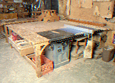
If your shop is long and narrow, option 2 provides maximum space to the left of the fence for handling large sheets of plywood. If you often work with full sheets of plywood or other sheet goods, you might want to build the table saw into an extension table surround, as San Diego woodworker Pat Curci did in his small shop (see the photo). The surround offers support for large panels, as well as provides an ample work surface near the saw.
If you don’t have enough room for ripping long boards, try orienting the saw diagonally in the shop. If that won’t work, you can gain outfeed room by aiming the back of the saw toward an operable door, as shown in option 3.
Finally, if your shop is in a garage where machines are stored compactly when not in use, keep the saw near the door as shown in option 4. You can then wheel or drag it outside when you need to saw stock too large for the garage.
Jointers and planers
Next come two options for the table saw’s trusty sidekick, the jointer, as well as for the thickness planer. Because it’s usual to work between all three tools when dressing lumber, the first option, shown in the illustration, locates the jointer nearest the saw to the right of its extension table with the planer nearby. As with the table saw, it always makes sense to align these tools with the shop’s long axis.
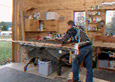
An interesting variation of this layout is displayed in Jim Tolpin’s shop, shown in the photo at right. Tolpin located his jointer to the left of his table saw, its height low enough to allow panels cut on the saw to pass over the jointer. To save space, his portable planer lives beneath the saw. All three tools are oriented toward the garage-style door, which can be opened to allow long boards to be ripped, jointed, or thickness planed.
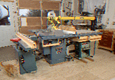
If your table saw is near a wall and your shop is fairly narrow, positioning the jointer and planer against the opposite wall is reasonable, as shown in option 2 in the illustration. If the shop isn’t long enough to accommodate long workpieces, try to put these machines near an operable doorway, as shown in the illustration and in the photo of Doug Warren’s shop.
Crosscut saws
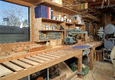
One useful idea for woodworkers who regularly must cut right- and left-handed workpieces, such as miters for picture framing, is to build both into a single cutoff bench, as shown in the photo. This way, they can share the same fence.
If your shop lacks wall space or doesn’t have a long enough wall to accommodate long stock, another option is to place the crosscut saw near an operable doorway with the right-hand side closest to the door (see option 2 in the illustration). This leaves most of the length of the fence to the left of the blade (preferable if you’re right-handed), allowing short and mid-sized parts to be cut to length or trimmed without having to open the door.
Other machines
In most small shops, once the key machines are in place, others are arranged wherever there is room for them. There typically isn’t enough free space for these tools in the middle of the floor area, although sometimes you can tuck a machine into an unused space. For example, in a shop where the table saw is in the center, a shaper (or a router table or spindle sander) with a table the same height as the saw can be put on the outfeed side of the extension table (see the illustration). Also, building a router table directly into the table saw’s extension table is a great way to save space, as well as make use of the saw’s fence for routing operations.
Use the corners — Some machines are perfectly content to live in a corner, including the bandsaw, scrollsaw, disc or combination sander, and lathe (see the illustration). Orienting the lathe’s tailstock end into a corner will leave room for outboard turning. Pulling the bandsaw away from the wall allows the necessary clearance to cut large curved parts, while locating it near a doorway or window permits resawing of long planks.
Line ’em up — Most other woodshop machines work harmoniously when lined up along the walls, where they are easy to power and connect to dust collection. The amount of space left between these tools depends on the amount of room you have, the size of the stock you work with, and whether or not adjacent tools have tables at the same height. You can always pull a machine away from the wall if additional space is needed. Clearly, these options are not the only possibilities and are contingent upon the mix of machines you have, the shape and size of your shop, and the kind of work you do. The bottom line is if the layout works for you, then that’s the best for your shop (and don’t let anyone tell you any different!).




Log in or create an account to post a comment.
Sign up Log in