
Debating our joinery shootout. How practical was our laboratory test? Sound off below.
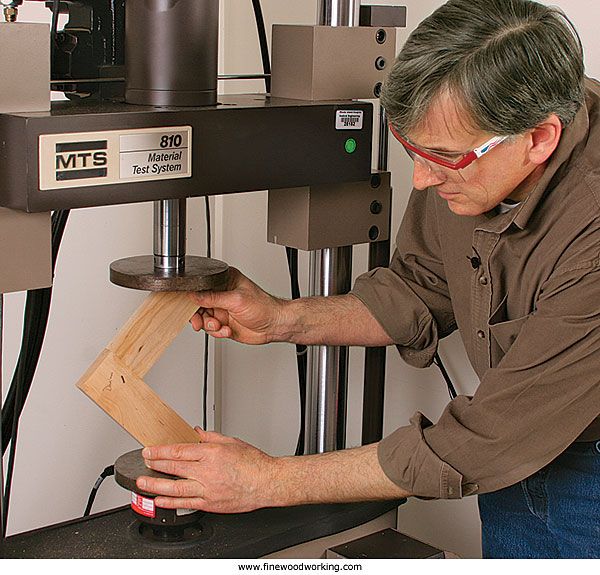
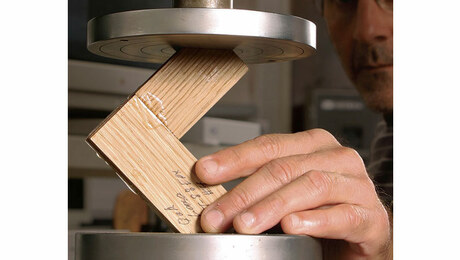
A few months back we published an article in Fine Woodworking that detailed a test we performed on 18 popular woodworking joints to gauge how well they held up under stress. Using expensive testing equipment, a really smart engineer, and a production line of joint makers, we set out to crown the strongest joint.
As you can imagine, the feedback on our test was loud and varied. It sparked a series of conversations in the Knots forum, and we received at least one letter to the editor, which we printed in the magazine and online. Here’s a taste of that:
“Your joinery strength test was flawed and biased,” writes Jim Lindsay, president of Dowelmax. He argued that the test didn’t compare apples to apples, especially where dowels were concerned.
In Knots (our old online forum), one member started a thread questioning the practical application of our test: “Common sense: do individual joint strengths matter so much since there are usually four of them taking the strain anyway, and the weaker ones are still strong enough?” That smart question only prompted a few snarky replies.
Meanwhile, a more analytical thread took shape in the forum prompting a closer inspection of the data: “I found the article very interesting but the ‘stats nerd’ in me wanted to better understand the results.”
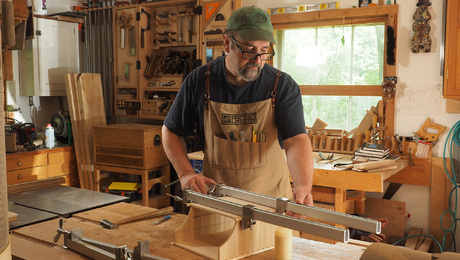
With the release of our recent video detailling the test results we wanted to reignite the debate here in the blogs. So post a question or comment to let us know what you think. Operators are standing by…




Comments
Seemed like a pretty good test to me. Interesting results. I love the look of a bridle joint and I have some ideas for half lap joints as well. It's good to see they faired so well.
I own a Domino machine and I would definitely have put two tenons in that joint, manufacturers guidelines or not. If nothing else then just for alignment sake. But the fact that a single domino made a decent joint was pretty gratifying. One thing to note. Incidentally, the Domino has three width settings on the mortise it can cut. Festool sells dominoes designed for the narrowest setting. When I need a wider mortise I use that widest setting and cut my own larger tenons. Makes a big difference.
There is one test that would be extremely useful. How about testing the pocket hole joint with and without glue. The results of that test would be very useful to me on a day to day basis. I bet a many would like to see the results on a test like that, including the folks at Kreg.
I would love to know how the biscuit joint did. I have used it in many a cabinet and it has held up with quite a load for many years. It has passed my test of strength, speed to build, and simplicity; but I would love to know how it tested.
Joe
I replicated these test in my shop using 2 1/2" stock and a simple vise and my arm. I can't obviously give a psi specification for breaking strengths, but I can tell you that my results paralleled those published. However, there a number of caveats that need to be pointed out. One: the miter joint did show surprising strength when applying downward pressure as seen the Fine Woodworking video, but pushing upwards it let go under very light pressure. Two: dowels have great shear strength and are great when building traditional beds where the head board is held to the rails over time by a bed bolt and the dowels are there for shear strength alone. Dowels however are not suitable glue joints. The FW article fails to point his out. As glue joints they simply fail over time because of the end grain glue surfaces that comprise 90% of the joint surface. So talking about how well they shear or even how they perform in the first few months is completely irrelevant. Dowel max should just shut up be thankful that FW did not share this bit of information. Don't take my word on it. Research the limitation of dowels as glue joints and you will find plenty of corroboration. The biscuit joints were the weakest I tested. The Dominos were next. However two domino one over the other seemed to more than double the strength of the joint and made it acceptable for more stressful applications. The shortcomings of the domino surprised and saddened me. To get two dominos in a 2/12" rail you have to use the 5/30 mm and they tear the side out of the stile in failing because they are too short. Festool would be helping themselves and their customers if they provided the narrower dominos in longer lengths. These set one over the other would provide a really nice joint that could be applied to narrow rail stock.
Is there any possibility that the test could be amended? Some new conditions included? There's something I'd like to know that bears on a lot of the work I do. First here is some data about the Domino machine.
Domino Mortise Data:
Width....5mm, 6mm, 8mm, 10mm
Depth....13mm, 15mm, 20mm, 25mm, 28mm
Minimum Width....add the bit diameter to the
shortest available stroke which is
14mm - this yields 19mm min for the
5mm bit through 24mm min. for the 10mm bit
Maximum Width.......INFINITY!!!!!!!!!!!!!!
With the Domino you can easily make a single mortise 10mm thick, 28mm deep and as wide as the material will handle simply by employing multiple plunges. You have to make your own tenons for these wider mortises but that's no big deal. I do it all the time in my garage. Alternately you can use multiple Dominoes as mcase mentioned. I also do that but it gets pricey, those big ones are 14 to 17 cents each. Much cheaper to use scrap.
If there's any way I'd love to see the results of this slightly amended test procedure. And I'd also like to see results where pocket screws are used without glue.
Hi Fshanno,
Very good point about cutting the wide mortise. I've got to get around to this. I' think I'll have a stock milling session soon.
Another advantage to making your own dominos or tenons concerns the utility of the impressed pattern on the Festool dominos. Initally, I assumed that the beech domino was meant to swell like a biscuit, but this was not the case. After all, a biscuit is a compressed chip. I noticed in the joints I tested that these impressions did not swell out from immersion in a water based glue, but remained impressed. This leads me to believe that Festool has over engineered the dominos with these impressed patterns. I do not know what Festool hoped to achieve by adding these impressions, but they clearly reduce the wood to wood contact by creating a series of gaps along the whole glue surface. I would not be a bit surprised if shop made smooth dominos actually make stronger joints.
I have an update. I have recently made up red oak floating tenons 1 3/4" wide for the #6 domino thickness (1/4"). I cut matching mortises in rail and stiles by lining up 2 Domino machine cuts to make 1 3/4". The resulting joints are far, far stronger than using the dominos. This method was quick and easy and produced true chair-strength joints. So the Domino machine is a great addition to my shop, but without the dominos!
I can't understand the obsession with joint strength that some tool manufacturers and tool users exhibit. I have used biscuits, dowels, mortice and tenon joints, loose tenons, pocket hole screws,lap joints, dados etc etc etc and found all of them to be more than strong enough for furniture construction and all of them to maintain their integrity over a long period of time. What does it matter if one joint is ten times stronger than another so long as the weakest jointing method provides adequate strength for the job being undertaken.
More important than the type of joint is the accuracy with which it is cut,the quality of the glue used and correct clamping procedures.
Biscuit jointers, the Domino, Dowelmax and several other tools and jigs are all excellent at what they do and it is personal preference that dictates which one is the users favourite.
Log in or create an account to post a comment.
Sign up Log in