
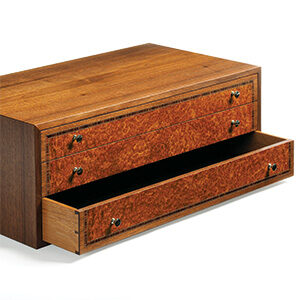
Inlay banding can have a dramatic affect on the design of a piece of furniture. With some work an unlimited number of custom designs are possible.
A nicely inlaid band around the perimeter of a table top, the lid of a box, or down a table leg if carefully integrated into the design attracts attention and adds complexity to a piece. It is first apparent from across the room where it is visible as a defining line breaking up a larger surface into components making virtual shadow-lines adding architectural complexity.
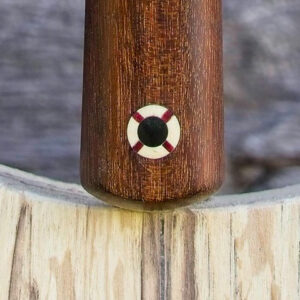
As you approach the piece the eye resolves the inner detail of the banding itself, following the line of repeating elements. The band becomes, for a moment, the focus of interest. How is that made? What are those component woods? A finger discretely, or not, tests how perfectly it is inlaid into the background.

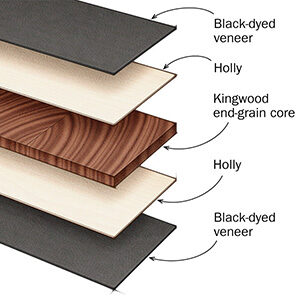
Making a custom one-off band is labor intensive, but a fun exercise in precision and puzzle making as I learned in a workshop by Garrett Hack at the Inside Passage School of Woodworking. It is not as difficult as one imagines if members of a class can make one in an afternoon and quickly inlay at the end of the day.Embellish a Federal card table in the traditional style
| ARTICLES ON BANDING | browse all | |
| Federal Style Stringing and Banding By Steve Latta Embellish a Federal card table in the traditional style |
Router-Made Bandings By Mark Arnold Dress up your work with these unique designs |
Stringing and Banding Made Easy By Dan Faia Low-tech tools deliver high-style results |

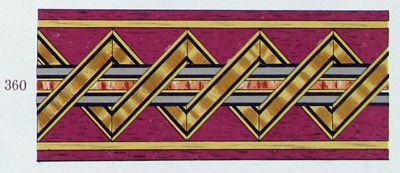
The workshop piqued my interest in banding as I find the “puzzle” like aspect of figuring out how they are put together challenging for some of the more complex patterns. Some of the complex patterns with curved internal components must take very specialized equipment and considerable skill. Garrett told us about the firm Buffard Frères from Paris working in the late 19th early 20th century that made thousands of bands and sold them to furniture shops around the world though mostly in Europe. The company went through bankruptcy in the 1930s. “In 1973, the remaining members of the Buffard family scrapped the special machinery used to make the banding so that it would not fall into the hands of imitators.” (Lee Valley Web site). It would be difficult to reproduce many of these bands with today’s materials and methods.

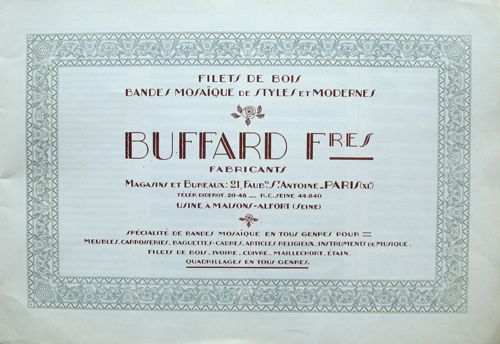
In following up on this topic I tried to learn more about the Buffard Frères. I managed to find at an Antwerp Antiquariat a mint 1926 trade catalogue by Buffard Frères printed not long before their bankruptcy.
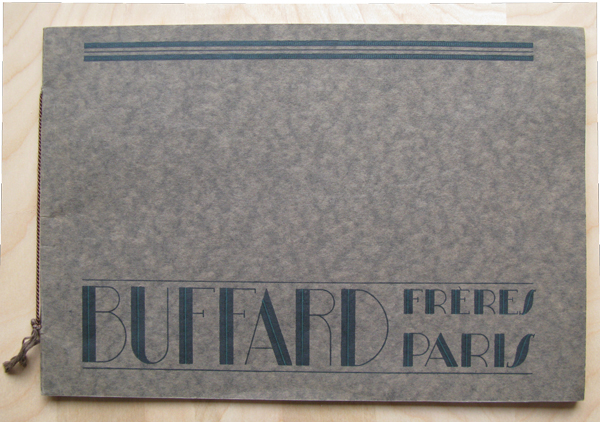
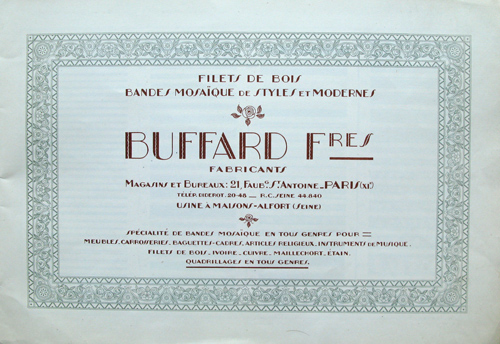
The things you find on the internet. This Art Deco catalogue has spectacular color lithographs of hundreds of bands of their 1920’s offerings. For added historical interest it came with the original covering letter and price list (marked with a 20% discount!). Besides its inherent aesthetic value, I believe this is an interesting reference document and as such should be preserved, shared and promoted.

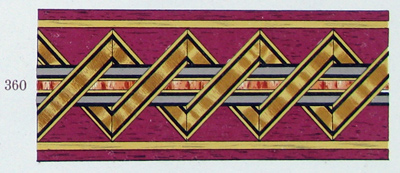
I have started writing a series of posts on my Web site that covers this catalogue in detail. What I want to put up on the web is an on-line catalogue or resource where one can freely browse through pages of Buffard Frères inlay bandings just for enjoyment or for inspiration for a piece one is working on. What is nice about the lithographs in this respect is that pages have subtle variations on particular bands so you can imagine how different bands might look. Also if you inspect various higher resolution images there are hints on how they are constructed as many seem to have “glue Lines” visible in the lithographs. I hope you enjoy them as much as I do.









Comments
Thanks for sharing this article concerning banding. These bandings are truly works of art and at first glance appear so intricate and complex. Then there are some bandings that appear so elegant and simple to create. All in all they can be striking additions to our woodworking.
Recently, I have been researching bandings and inlay. What amazes me is the patterns and techniques of the process. Like you mentioned there are many variables that can be arranged from the members of a pattern.
Please post more on the subject of inlay & bandings as I am hungry for more patterns and more information on the techniques used at arrive at achieving various patterns.
Joseph,
Thankyou for sharing your find with us. If you are familiar with the techniques for making bandings I for one would be very interested. Perhaps you could write an article for fine woodworking.
Thank you Joseph. I too would like to see more on inlays. Even thou some look way beond my talents,I would like to give it a try on some of my projects.
I made a simple inlay band described in "Creating Beautiful Boxes With Inlay Techniques," by Doug Stowe. I also inlaid a box with banding I bought at Rockler. The difference in appearance is unbelievable. The hand-made banding looks like real wood; the store-bought banding looks -- well, store-bought.
It's also a great way to reduce about 5 bd ft of nice wood to a little stack of strips.
I'd love to learn more about this, since I seem to be unable to crack these puzzles myself.
Larry
In the 1989 Lee Valley tools discovered left over stock of these incredible inlay bandings in a warehouse in France. They bought all they could get.
I scooped up a bunch of these beauties and still am sitting on some real gems.
I still have their catalog which shows the items offered in 1996. They also sold a poster showing some of the most incredibly complex designs. They still offer a few of the bandings on their site. Lee Valley Tools.com
True art for wood lovers.
In his book "Fine Decorative Boxes" Andrew Crawford goes into some detail on how to create your own banding. More can be found in his other publication "The Book of Boxes". Andrew makes exquisite boxes, most inlaid with some type of Banding or inlay. His website for those interested is: http://WWW.fine-boxes.com
nice work
Log in or create an account to post a comment.
Sign up Log in