
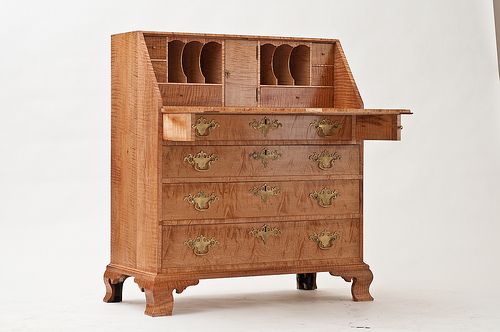
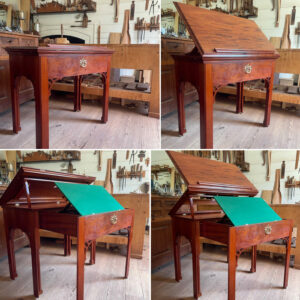
This drop-front desk was made by Tommy MacDonald from 50 year old curly maple. He presented it to his wife.
Fellow period furniture makers:
If you could have three wishes, what period project articles would you like to see in future issues of Fine Woodworking? You can keep it general – “More Federal pieces” or you can be specific – “A mid-18th century Charleston chest-on-chest”. You can also suggest specific techniques that you would like to see covered such as how to construct a quarter column, how to hammer veneer etc. Post your idea as a comment below, and email your suggestions to [email protected] to be considered.
Many thanks,
Mark Schofield
This site is protected by reCAPTCHA and the Google
Privacy Policy and
Terms of Service apply.




Comments
Mark -
I would like to see a video workshop series about that awesome slant-top desk featured at the top of your blog.
I would also like to see a series on hammer veneering and Federal embellishments.
Thanks!
David
Hello. I'd like to see an article on relief carving....similar to convex shell carvings on the lower middle drawer on some case furniture and something on carving the pedestal on a pie crust table. Thanks, Dave
I'd like to see a video workshop on carving the knee on a cabriole leg, and anything on that gorgeous desk above
John
Hey Mark,
How about an article on making a Victorian birdhouse!?
Just kidding of course, well maybe not.
All kidding aside, how about an article on making a cylinder fall secretary? One of my goals is to make one and I've never seen one grace the pages of Fine Woodworking.
Also, I agree with requests for carving on period furniture. If you do one, please don't forget any details with regard to stock preparation, i.e. do I need to leave additional material for relief carving, etc. Also don't forget to include diagrams of the various components similar to Randall O'Donnels Cyrly Cherry Highboy which began in #117.
A neophyte peroid furniture fan,
I would like to see an article on constructing the Townsend blockfront bureau - one example of which is in the MET (http://www.metmuseum.org/toah/hd/jtwn/hod_27.57.1.htm).
I think such an article would instruct on several levels: blockfront construction, shell carving, and bracket feet.
"Period", huh?
How about an earlier period -something really old and unique, like 17th century stuff? Not Louis XIV, but earlier pieces, before they start getting incredibly elaborate. Maybe something Spanish? Gothic? Renaissance? You could do the whole package with an accompanying article on reproducing centuries-old finishes & patina, and then add a Master Class about carving some of the old details and moldings found on the piece(s) you do.
The carving part seems like it's in high demand, and I definitely agree that I'd like to see more on that as well!
Personally I could do without yet another article of a highboy, lowboy, secretary, or for that matter anything with a shell carving on it.
It's time for you guys to try something a little different!
I'll second the Townsend drop-lid block front........covers everything mentioned by previous posters, relief carving, shell carving, the desk above.
USNERDOC, what would you like the video to show and would you want it to be a stand alone video or linked to an article in the magazine?
Johnmcm, we have a master class coming up on carving a knee shell, currently slated for the Sep/Oct issue.
Bob, I've forwarded your birdhouse idea to Fine Homebuilding!
The last time we covered roll-top desks was in issue 13. The article has the nice sub-hed "How King Louis hid his clutter". It sure would be a big subject to tackle. Maybe Steve Latta is game for the challenge.
Kevin, not sure about the Spanish and Gothic furniture but I agree with you on how to create a finish on a period piece. My personal feeling is that the piece on the back cover of 205 (on its way to you) could have had some mild aging done to it.
Townsend fans, that is certainly an iconic American piece altough Randy O'Donnell covered most of these elements on a smaller scale in his article on the document cabinet in issue 178.
Although Fine Woodworking has covered many a traditional American and European piece it rarely covers anything Asian. There is so much history regarding the furniture of Japan, China and Korea, but it's really hard to find. They not only had a different design aesthetic, but different ways of constructing these amazing works of art. There are a lot of interesting stories as to why they built the furniture they did.
So...how about the Edo period from Japan, for my 2 cents worth.
Rob
Mark,
I would like to see more on regional furniture design from the 18th and 19th centuries; e.g. characteristics of Tennessee, southern Atlantic, Louisiana furniture. In my opinion, FWW seems to focus overly on the NE region.
I would like more information on how current designs for period furniture differ from the original, specifically with regard to designing for wood movement. This was touched on briefly by Phil Lowe in an article in FWW 201 and I've found it to be true in a repair I'm doing on an old Scottish tall clock. I'd also like to know why. It's hard to believe that it was done out of ignorance.
I also would appreciate more information on how to incorporate classical design proportions into more modern adaptions.
Thanks, Scott
I would like to see step by step, from layout to finish, knee acanthus carving preferably of the Philadelphia school. I read Eugene Landons article but he just brushed over the topic. I would be nice to have some meat and potatos.
I would like to see detailed plans on a block front desk-either drop front or knee hole design.
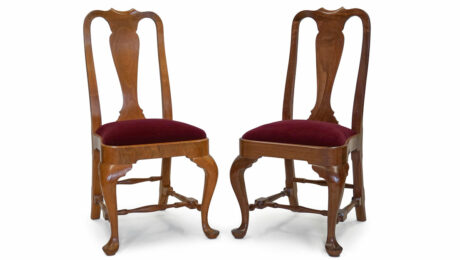
I would like to see articles on making an 18th century chair, Queen Anne or Chippendale. Thanks, Jim
I'm with KevinLBS....info on pre-18th Century woodworking would be great! I love visiting the Met in NY to see the Renaissance and earlier pieces they have; and the works at Plymouth Plantation are fabulous. I like Kevin's idea of a themed magazine covering all the "pieces" from stock preparation (green, of course) to shaping, joining, and finishing. Or...a series covering a few aspects of each of these would be great, and keep people coming back for more....at least I would!
Thanks!
Derek
Anything Federal. Particularly how to do the turned, fluted quarter columns that grace the front corners of some cases. Thanks for asking, Mark.
An Architects Desk or tall desk similiar to the one Thomas Jefferson had that is now on display at Monticello.
I'd like to see more Federal pieces.
Another cool subject would be pieces found in the White House. Maybe show how they were made in their time as well. I think it would be neat to build a replica piece and know it's sibling is currently in the White House.
Just 3?
My top 3 choices would be:
A wingback chair, with a litle aside about different leg choices.
A federal side board. (I think Steve Latta or Rob Millard would be a great source their work is amazing!)
I also think a federal secretary would be great (one with glass in the doord and dividers).
And a built in shell top corner cupboard.
And a chipendale serpentine pembroke table.
And chipendale side chairs with all the carving.
A Charleston step back cupboard.
A federal work table with a sewing bag underneath.
That the first 3 that pop in my head!
I would like more exposure to period carving, beyond the ever-present shell. I agree with the person who recommends an article on carving the drop of a chippendale cabriole leg. I think that too often, people are intimidated by carving and other period embellishments unnecessarily. The desk pictured above is a good example. A nice Philadelphia piece would have a much more elaborate gallery and the prospect door is simply a blank board. The piece depends too much on the wood's elaborate grain for interest. Chair construction is another area of interest - how many people really understand how to put together a Chippendale chair? The angles are hard for the amateur, so the tendancy is for them to straighten the angle of the back legs.
It would be nice to see some plans, measurements and explanations of how the kneeholes are built. The picture of the piece on the site is more than enough for me. If not a complete piece, perhaps an article on convex and concave shells. Its been a while since we've seen an in-depth article on 18th century carving.
I am with pbrenner on the Townsend block front. I literally just completed that piece and would love to see how I should have done it.
A bombe chest would be interesting also.
I agree with pbrenner. I would like to see an article on the Townsend block front that is at the Met,. I literally just completed it and would like to see how I should have done it.
A bombe chest would also be interesting.
Also, finding really nice mahognay for projects like these is difficult. The best source I know of is Irion Lumber, but they have a 200 bf minimum. Can FWW cut a deal with them to have "kits" made up of the right mix of wood that readers could buy specify and buy from irion. Thees projects are probably 50-75 bf.
Thanks
Stephen Gaal
I would like to see modern work. If the Gallery is any indication of what's being done "out there", then there is some substantial interest in modern work. Areas of particular interest include design, unusual construction and methods, and interpretations of period pieces. There is no question that we need to look backward to go forward - we inherited the skills of those who went before us. But, how many period highboys, chest-on-chest, and Newport style desks do we need to see?
If you are looking for styles that you haven't already written many articles on....
I would like to see more European turn-of-the-century. Styles such as Art Nouveau (galle), Glasgow School (Macintosh) or the modern gothic (Pugin). The Biedermeier style of 50 years earlier is also rarely discussed.
Thanks
Anna
Period Furniture comment:
I'd like to see a series of articles over perhaps a year that might start with early european furniture and then progress forward with the significant style changes over time. The articles could high light the development of each style and could include photography of some of the significant details and changes in construction methods from each period. For example the veneer work from the Federal period. I don't really want a how-to series rather a study of the progression of the development of the styles.
An equally interesting idea would be to develop a series of articles showcasing the tools used to make some of these pieces. I would think that many of your readers might find learning how to set up and use a stanley 55 or some of the vast array of other tools replaced by modern powwer tools interesting.
my 2 cents worth,
Madison
Greene and Greene, I love the style and will give your writers ample material for joinery techniques. Thanks
I would like to see some articles on period Southwest furniture, and modern reinterpetations. The furniture produced in American Southwest/Northern Mexico from the 1600s to the mid 1800s is fairly distinctive, and is very rarely covered in woodworking magazines.
Many thanks for all the suggestions. We are already putting feelers out to potential authors on some of the ideas. Suggestions of suitable authors on some of the more unusual subjects (S.W. furniture, regional period furniture, Biedermeier etc.)would be welcome. We may or may not do a full project on these styles but alternatives include a Master Class, a back cover plus How they did it etc. If you don't want to suggest a name publicly, (or you are embarassed to suggest yourself!) feel free to email me directly. Mark S.
I agree with Rob, I'd love to see more Asian, international articles. Also, how about early rustic, frontier, ancient styles and methods. A series on the history and development of woodwork from around the world from the beginning.
No question for my response: Shaker for its simplicity, ease of adapting to all sorts of circumstances, and the relative ease of construction.
The abundance and relative cheapness of pine, oak, chestnut, birch, beech etc here in south-west France helps to make it easier to select different woods for different projects. The local wines help in the decision-making process too.
Richard Bill
Petrou
46310 Uzech
France
Tel: 33 (0)5 65 21 20 07
Email: [email protected]
Website: http://www.petrou.fr
I second (or third) about Southwestern furniture. To be more specific there is a museum in Taos,NM dedicated to Nicolai Fechin, a Russian emigrant artist who came to Taos in the '20's. In addition to his portraiture he built his house and all the furniture in it, incorporating Russian styles in a SW mode. Really nice stuff, incorporating much carving, but very hard to find any thing on it. I have one set of plans that I am making a bench from right now, and am going to visit his museum in May when my daughter graduates from St. John's College/Santa Fe. Hope to come back with enough pictures to keep me busy for a year or two, making sawdust.
I'd like to see more Shaker furniture. I have built several pieces to date, but am looking for a sofa table project next. I do like the looks of the drop front you used for this article though!
I like Arts and Crafts, particularly Stickley inspired, of which there are always a number each year. I am part-way through making a bow arm Morris chair right now. I also like Shaker design for it's simplicity and first class joinery
I would like you to keep it the way it is. I like all types of woodworking and I like to try my hand at different styles.
The problem is you can never get all the information you want in one issue. You just have to be patience for something that interest you.
Bill
The furniture forms that represent America from the Revelutionary War period through 1850 interest me the most. I admire the shaping and joinery workmanship using hand tools, and the different types of finishing techniques including grain painting. Federal, Chippendale, Sheraton, and Windsor chair would be good examples.
Variety is the spice of life. One of the things that draws me to Fine Woodworking is the broad scope of coverage. I love the simplicity of Shaker and the sophistication of Modern, but that doesn’t mean I can’t appreciate (and learn from) the many other period designs you present. Along these lines, I would like to see increased video content. My opinion is to keep a balanced mix. Oh, the Charleston chest-on-chest pictured is beautiful.
I agree with the others in that I appreciate the handiwork of all furniture styles - however, because of my limited woodworking skills and tools, I'm especially interested in Craftsman's style pieces.
Thanks, Garret
Broad coverage and balance, as many have expressed, is the key.
I love Shaker cabinetry, and Chippendale case pieces (though the latter is far beyond my meager skills).
How about something a bit new to the mix - simpler styles from other cuiltural traditions? Awhile ago, there was a nice article on the elements of French Country style. How about a comparable Tuscan, or English, German, Russian? How about Japanese tansu, or something Chinese?
These additional cultural perspectives should feed our need for novel design elements and should give insights to alternate techniques.
What I'm really grasping at is a synthesis - or "fusion" - of different styles. My preference is for simple, strong design that's easy to make with modern materials, tools and techniques. For example, I'm currently trying to wrap my head around a very large cabinet I'll build in my garage - in what I call a "Shaker tansu" style.
Feed me new ideas.
Jim
Though I like several furniture styles, the pieces produced in the 18th century are by far my favorite. I also admire greatly what the Shakers produced, and your magazine has featured several articles on those styles, so, keep it up! I also admire very much the craftsmen in your articles.
Thanks for asking. I'm more sure of what I don't like than what I prefer. My hearty suggestion is that all plans related to the Arts and Crafts style, including Greene and Greene and Stickley, be limited to one issue every (say) three years. Surely their appearance in issue after issue overemphasizes their position in American woodworking. I don't argue their talent or their contribution, only that their style has become tiresome. Seeing their work in issue after issue of the seven (I think) magazines I subscribe to is like attending the Westminster Dog Show and seeing that they have eliminated all but the largest, heaviest and boniest breeds from the competition.
My wife wants me to build her a corner cabinet and I'm confident that she'd prefer something more decorative than Shaker or Craftsman style. So would I. A piece that included shell carving and fluted columns would be fantastic!
And while you're at it, the Lightner Museum in Saint Augustine has a desk I'd love for you to create plans for. It's a writing desk generally oval in shape, supported by only two round columns on each side. I'd love to make a version as a laptop desk, and add some drawers to the columns. Nothing difficult. :)
I am a long-time subscriber, and consider "Fine Woodworking" to be in the top three of current and past woodworking publications. My favorite era for furniture is the late 18th century - e.g., Hepplewhite, Federal, Chippendale. I have already completed a Hepplewhite demi-lune card table with inlays and a companion mirror with gilded carvings, and thoroughly enjoyed the challenge and the appearance of the final pieces. I also enjoy viewing some of the new (sometimes weird) creations by current artists, and the work of past masters, and especially your bios and interviews of great woodworkers. I am also into hand tools, and the best ways of working wood - everything from carving to turning and everything in between. I think you have maintained a very good balance over the years, so, would appreciate it if you not get too wild about embracing any single style over the others - please keep a balance of bios, how-to projects and info on the new and old styles.
Keep the mix of assorted styles that you have done over the recent past -- in fact expand it if possible.
Within the articles:
(1) Strongly encourage a video component that can be added to your website. I realize that quality of these will vary, but should get better over time. If quality is too poor, don't do it.
2. Require that a Sketchup plan accompany the article and make the file available on the website. This software is revolutionary. It is easy to use, easy to learn, etc. I gave up on every other lower-priced 3D drawing program I have used in the past. It is easy to modify drawings -- in particular changing sizes.
My most favorite period furniture pieces are Queen Anne, Chippendale, and Hepplewhite. Of course I truly enjoy 18th Century American as well. You have a great magazine and I look forward to every issue. Keep up the fine work.
I'd prefer you emphasize the mid 18th century, especually the Federal period style. Most of the other magazines I subscribe to have tons of articles and 'how to's' on shaker, greene and greene, and modern styles. I especially enjoy reading and studying the 'masters class' as it really presents finely detailed techniques. I am not a skilled woodworker but I'm learning from Fine Woodworking.
Thanks,
Don
I'd really like to see some mid-century modern on the site. The style is gaining a lot of popularity here in Seattle. As an added bonus, I really dig it too.
I have spent many hours trying to research how to make the feet on a Townsend knee whole desk, also I have never been able to find articles on how to make a Cartouche, I think these would make great articles for future references. As far as a time period of furniture anything 18th century, perhaps an ornate case clock with lots of details, spanning a few issues so that the writer can fit everything in.
Thanks
Add my voice for Southwest/New Mexican/Mexican/Spanish design! This mish-mash of Spanish, Mexican, Mission, early US SW settler and other styles has many very attractive design attributes. The actual joinery can be quite simple, allowing beginners to build pieces they will be proud of right off the bat, but construction and finish can range from extremely simple and rustic to very finely-crafted and finished. Also, in addition to well-executed joinery there is a huge opportunity for hand-carving of details.
One very important aspect of this type of furniture design is that because it has been largely executed by "indigenous" craftsman, there has been a wide variety of design elements emanating from the region. Sometimes it seems that the more traditional periods' designs are too locked in stone for amateurs to attempt, being intimidated by the fine examples displayed in FWW. The Southwest style could provide a new outlet for creativity.
Oh, yes. The suggestion to provide Google Sketchup design files to your readers is excellent. Although I use Autocad at my job as a draftsman, I am using Sketchup more and more for furniture design, as it is much easier to create and explore three-dimensional designs. One fantastic attribute of Sketchup is the "X-ray" viewing option, which makes the pieces of a design translucent, allowing for easy inspection for conflicts in joinery.
I have long been inspired by the Shakers and have built mostly Shaker inspired furniture. I have visited many Shaker villages and studied the Shakers tools and methods and what led to their productive lives. My bookshelf is full of Shaker reference books. As my wood working skills and interests matured my studies have moved backward in time to the early cabinetmakers of Chester County and Philadelphia, particularly the not so plain work of the early Quakers. Winterthur, Philadelphia Museum of Art, Chester County Historical Soc. Museum, Am. Society of Period Furniture Makers, and local present day cabinet makers in and around Chester County that are doing some very spectacular work have been my source and inspiration recently.
Source materials (plans) for building Shaker furniture and more modern furniture are easier to come by than those for the early 1700. I continue to be amazed at the skills these early tradesmen had and how quickly they could build a complex piece of furniture with very modest tools during short day in a very small winter shop illuminated only with daylight. A secretary (desk with bookcase) that they could build in one month for a founding father takes me three or more months with today’s tools. If Fine Woodworking wants a unique roll that would separate their audience from the many other weekend workers magazines they could preserve more of this classical furniture style and the skills to make them commercially. I do not disparage the weekend worker for I was one myself for 40 plus years and realize they are more numerous. Now that I am retired with more resources, I seek bigger challenges.
I have subscribed to many wood working magazine but the only such magazine that I treasure and have continuously subscribed to has been FWW. I think that says a lot regarding the magazine’s appeal to this wood worker. When Gene Landon’s article first appeared in FWW all I could do was admire his work, read and enjoy his accomplishments, and wish that one day I could attempt something like that. Now I occasionally travel with Gene to the PMA or Winterthur and have a learning ecstasy. Too see and handle the stamped wooden planes that one or more of the six Quaker Chandlee clockmakers from Nottingham used to make many of the tall clocks that stand in the Chester County Historical Society was a once in a lifetime experience. I was present when Gene very humbly gifted the planes to Winterthur on a visit.
All woodworkers are fascinated by other’s accomplished shops and learn how the professionals accomplish their modern magic. To follow a modern piece of 18th century Philadelphia design through one of several shops in Chester County with plans would make a marvelous series. The jigs and devises that make the process efficient and accurate would make several side articles. Information such as this would be a service to our knowledge base and place FWW in a field by itself.
I strongly prefer 18th century. Please include styles all the way from upper New England to Charleston.
My preference goes to Art andCraft style of furniture.I love your magazine as we
can find every sound advice in every issue. Keep it up.
I am very much in agreement with those encouraging you to broaden your exhibition of styles and periods. While I am sympathetic to the obvious majority of Early American furniture enthusiasts, there is much to learn from the evolution of furniture from the midieval baron's travelling chest morphing into cupboards and tables creeping over the centuries off the wall into the middle of the room. From Flemish bulb turnings to Louis XV compound curve veneers (how the heck did they do that anyway?) there are elements, proportions, and techniques that are rich with instruction for both the traditionalist and modernist furniture wonk. A series on furniture history? Yes! In addition, some historic "how not to's" might be fun. What was wrong with the joinery of MacIntosh's Glascow School furniture? Why did the glue blocks on Townsend's tea table tops break off? Why hasn't much regional French "everyday" furniture survived? Why didn't the X frame chair design survive the ages? Why wasn't Wallace Nutting able to sell his most excellent Early American reproductions? In other words, some bite-sized "notable failures" of the furniture world might be both fun and instructive.
I'd like to see more articles on 17th and 18th century furniture from America and Europe showing how they were built back then. I think there have been enough articles over the years explaining how to use power tool jigs to recreate period details, I'm more interested in how to use period tools to create period details.
I would also be very interested to see more articles on traditional wood furniture from Asia and information on the woods and tools used in their making and how to acquire in the West.
Cheers,
Josh
I am currently interested in the Arts and Crafts movement. I would love to see detailed plans for some Greene & Greene's more complicated pieces; sideboards, desks, dressers and the like. As well, I am fascinated by modern furniture design and would love to see detailed plans for some of the best of the woodbutchers' art.
I have found that I almost always learn something from articles about building furniture reguardless of which period or style is featured. That said, I really enjoy Arts and Craft, Green and Green, and Shaker furniture because these styles feature the beauty of the wood.
Another vote for Greene & Greene.
/sk
I would like to see a video or article on wood inlay. Not holly string or thin leaves of holly but more along the line of curved inlay with 1/8th or 1/4 in. using different woods. How to cut the inlay in a say table top and inlay the same curves of a different wood species.
Also, as I am a magazine subscriber do I have access to the Fine Woodworking video library and past issues? If so how do I access this?
Thank you for providing a chance to solve my dilemma's.
Tom
I love the Victorian era, and would love to see articles on furniture and cabinetry of this time period.
I would like to see much more information on period furniture. Plans, techniques, how to info, all very interesting to me. I agree with some of the other comments that one can learn something from just about any article about building just about any type furniture;but I think the Greene and Greene, Arts and Craft, and Mission styles are way over emphasized in most woodworking publications. I,personally, have no interest in modern furniture. Just my 2 cents worth.
More Art Deco furniture. Artists like Joseph Urban, Eugene Schoen,Eliel Saarinen, Donald Deskey, Gilbert Rhonde and Jacques-Emile Ruhlmann inspire me. Their use of exotic veneers, simple lines, creative decorative inlay, and combining other materials such as metal and glass with wood are refreshing and unique in furniture. The best of these peices are timeless, and the style is in keeping with modern fine woodworking. At least three Art Deco styles are commonly recognized: streamline, moderne, and zigzag. Each provides rich inspiration for the creative woodworker. Furniture from this era was practical as well as beautiful. It incorporated geometric shapes boldly and seamlesly. Anyone who has seen the veneered elevator doors in the lobby of the Chrysler building in New York City will attest to the craftsmanship of Art Deco era woodworkers. More Art Deco!
Rex Funk
Tucson, AZ
Excellent question.
I would love to see moe articles on "Federal" furniture, and especially the inlay techniques used on this style of furniture.
Thanks
It appears other posts would disagree, but I just can't get enough of Arts & Crafts pieces. Particularly the ones influced by the Stickley family. Whatever unusual ideas you can provide in that genre would be great!
I very much enjoy the simple lines of Arts and Crafts furniture, especially Mission style. Also, Greene and Greene influenced styles.
Enough green and green; I'm for period furniture construction techniques. I'm done making "just a square box" with touches and want to move on into the area of real creativity just shy of the bent wood movement. I'm learning to appreciate the art of inlays, stringing, etc. Love the magazine although a little too much ego in it sometimes.
Keep it mixed up. I am new to Wood working and like to see the mix of styles presented. Maybe one day I will decide on one I like, but for now I like seeing what is out there to like. I have been receiveing FWW for 2 years now and just renewed for 3 more keep up the good work.
I'd like to see more articles on Federal style furniture along with Chippendale, Queen Anne and Hepplewhite.
Mission, Shaker and Greene & Greene I can get from other publications...all of them.
I love to read about and see wonderful period furniture and I do like the Federal style but I'd like to see some more articles about contemporary furniture too!
Thanks,
Ray
I like the clean lines and simplicity of Shaker, Arts and Crafts and Mission styles of furniture.
Im with wcutter, I would like to see more info about federal embellishments. The more intricate items of the Seymours inventory, such as how to make the 'half moon sand shaded inlays' they used in their edge treatments. Also The bellflower swags they inlayed into tambour doors. Samual McIntire carving techniques IE:fruit basket carvings and background texturing tools used. Maybe a step by step on creating a carved,turned and fluted leg for a federal sideboard or secretary
I know I'll be in the minority, but the neo-gothic style has always appealed to me.
I have always liked the "Arts and Crafts" or "Mission" styles the best. I also like some of the Asian inspired styles.
I also enjoy the simplicity of the Mission style but I love the added embellishments in the Arts & Craft style.
I can't remember seeing much about Art Nouveau pieces by the likes of Louis Majorelle, and designs by Hector Guimard. Lots of carving, interesting marquetry - fun stuff.
I would like to see more articles on Federal, Asian, and Modern styles of furniture making.
But above all, please continue to feature furniture from a wide range of periods or styles, and not get in a "rut" with any one particular style. I like to be surprised with the variety of each issue, and would hate to see the magazine become predictable.
I find that the clean lines of shaker, mission and Arts and Crafts appeal most to me.
Like many, I love Shaker and Craftsman, but if I am not mistaken Shaker is more a style than a period. That said, I think there is usually a good representation of styles and periods, but I can always take more Shaker, and less contemporary.
I generally am less interested in the actual piece than I am in the construction. What design choices were made and why (especially with period work). For example, if you have multiples doors how do you decide to size the stiles where the doors meet for a balanced look?
I support the idea of more Art Nouveau (Ruhlmann, Galle, and how about a Biedermeier piece? I'm also a fan of Federal style and French Empire. And I doubt anyone is brave enough (or foolish enough), but how a Carlo Bugatti-type article?
Cheers!
Steve
There are many good comments regarding furniture styles.
During my adventures in woodworking I've found there are amazing styles of furniture the world over.
While refined machine milled work plays the predominant role in the offerings by FWW, there is a vast amount of indigenous craft. The techniques are familiar, and the result common, utility, art, and creative expression. Every continent has something unique.
Please educate us! Predictability is the harbinger of stagnation. What about a historic corner. The makers of the past. Tudor to Stuart, Chippendale, Sheraton, Hepplewhite... Macintosh, Jacobs, Jacobsen, Wegner, Makepeace... The point is there is a history beyond what we see in FWW.
How bout the host of other woodworking techniques such as totem carving, framing for upholstered furniture, or the building of mobiles, whirly gigs, and display stands for sculpture... If you've made it this far congratulations... The point is, a dedicated page or two to something that brings to life the breadth and history of the art, craft, and use of wood. The magazine is called fine woodworking. Not Fine Furniture Making... (I believe that pub is available in the UK.)
Give us something new (old) and innovative in the realm of wood crafting. I still prefer FWW over the other available woodworking mags, and look forward to the ever evolving format. Best from Portland, Oregon
I too would love to see an article about Greene & Greene, with an emphasis on what makes their work so distinctive, and their design principles. There is a challenge in copying existing work, but I have more fun figuring out how styles evolve and what the other guys would have done if, for example, they had been confronted with a multi-media center. This kind of thing is important in figuring out what's important and beautiful to me.
I am interested in articles on Stickley furniture, would rather see original dimensions & finishes rather than "Stickley Style" projects.
Thanks
Bud1
What? You mean there is something beside Queen Anne, Chippendale and Federal?
Barely mentioned is Duncan Phyfe furniture and in particular a Duncan Phyfe Lyre Back Chair. I don't think he gets the credit he deserves for the unique style all his own.
Rounding second choice would be a Duncan Phyfe Pembroke Table to relieve the hands from all the detailedcarving of my first mention.
Honorable mention would be a Chippendale Mantle Clock. Just take a look into Wallace Nutting's "Furniture Treasury" you will find a perspective photograph with no dimensions but alas a good educated guess if a sample can't be found in a museum for the size. I would guess it at no greater than 5 inches deep and 22 inches high with plenty of challenge and reward afterward. But if not done, I'll take a stab at it since I've many concept drawings.
As to period furniture nothing beats Chippendale. The problem is the same old boring Highboys, Lowboys, card, and side tables done ad nauseum without a thought to tackle a more unique different piece of furniture. I can't think of anything to perk period furniture makers than the suggested Mantel clock. The Taft Museum in Cincinnati has probably the most extensive collection of Duncan Phyfe furniture to keep making saw dust for years to come with a deep appreciation for an often overlooked master cabinetmaker.
Don't get me wrong as many have good ideas. I have a tendancy to think "outside the conventional box."
Thanks!
The one style I've never seen anything published on is art neuveau, which, I think, is the most beautiful style man has come up with. Its wonderfully organic and sculptural, and seems like the most sophisticated style I've seen.
When the hand tools come out the profits go down, so I've read. For now I have no concern for profit, as long as I can push a plane I will. I would like to see more articles covering 18th century techniques. Now I am interested in how they made the curved parts of a tombstone frame and panel.
I would like to see some of the William and Mary Furniture.
110236. I would like to see a few samples of William and Mary furniture
I would second the comment on the modern or post-modern period, particularly Scandinavian inspired styles.
All periods and styles of furniture are interesting and require artistry and craft, but there is a lot done with historical styles.
I understand that FWW Magazine is suppose to satisfy every skill level but, lets talk about down grade of quality of articles. Due to this magazine my skills have grown and now I am hard press to learn anything. It is very disappointing!!! I would love to see more period work in William & Mary, Queen Anne, Chippendale, & Federal. As I look back to the black and white issues of FWW and read the articles, I say to my self WoW this magazine was awesome. Well I hope the future of the magazine will be better then what it is. I think FWW should not be competing against magazines like Wood or Woodsmith. Just publish quality articles. Thank God for Phil Lowe, Will Neptune, Steve Latta & Garret Hack because after that BORING!!!!!!!
Fred
PLEASE! I agree with Ruffnek and CAlcoas: we can find Mission, Shaker, Greene&Greene in just about any WW mag or 'crafts' book. Give us something with more challenge and style! Federal, Duncan-Phyfe, how about an article on bench-carvings: how to and how to use them effectively? How about a step-by-step carving for furniture decoration? ANYTHING but more Mission!
While I love 18th and 19th American furniture styles, I would like to see more articles that explore international styles. I have heard that Asian joinery can be very different from European joinery in that it often did not rely on the use of fasteners or glue- wouldn't it help woodworkers of all levels to learn how this is possible?
I also find it very hard to find information about French furniture, such as how to shape bombe pieces, or how to make provincial style doors.
Mark
I like it "Future Period Furniture". Future, works that will last through daily use for generations a concept truly lost in modern furniture, designed fall by the wayside, and apart, with changes in style. Look here http://www.comfyuk.co.uk
I would like to see instructions relative to the Post and Panel style of construction from the mid-19th century.
Log in or create an account to post a comment.
Sign up Log in