
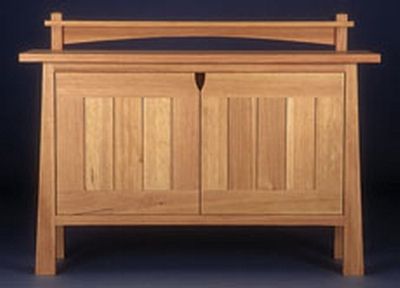
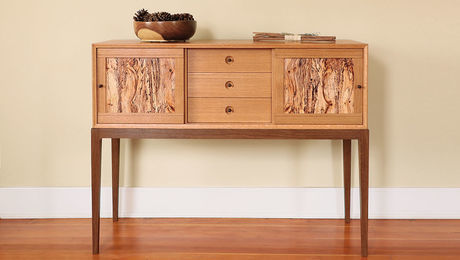
Oh my Douglas! This sideboard is made from Douglas Fir, which definitely is not one of your Colonial ancestor's furniture woods.
What do you do when the prices of your favorite furniture woods, like cherry and walnut, keep going up but the economy and the money you have to spend on wood have taken a downturn? Well, I need your help to answer that question. Do you know of a good alternative to traditional (and often expensive) furniture woods? I like ash. It’s widely available on the east coast, can be had for just a few dollars a board foot, isn’t too hard to work, and is beautiful.
If you have a particular favorite, let me know. I’m working on an article about just this topic, and we’d like to hear from our readers. Ya’ll (as we say back home in the South) are all over the country, and might know of a great, under-the-radar, wood.
You can post a response to this blog, or in this thread on our discussion forum, Knots.
And, thanks for your help.




Comments
Salvage yards offer great options. Most of the older wood is covered under paint and such. Nothing a planner won't handle. Expect lead paint, however, and take necessary prcausions.
I am at that saturation point where no new furniture comes in the house until a piece goes out. As a result, if I decide to build a specific piece of furniture I will often re-condition and re-use the wood from the old piece. I had some old commercially made living room furniture that I disassembled, ran through the planer and constructed a new coffee table and two end tables from. The money I saved at the lumber yard far outweighed what I could have gotten for the old piecs in a yard sale. Even better, I discovered in taking apart an upholstered couch several pieces of nicely figured oak which went into a jewelry box.
I have found a source for hardwoods that keeps me in 1/2" thick high quality material for just a little effort. Contact some hardwood flooring installers. Frequently they are ripping out old flooring and installing new. They really don't want to be bothered hauling the old stuff to the dump. I pick it up at the job site, haul it home, bend the nails back and rip it. The groove side is also ripped and the bottom planed. I end up with 1/2" think hardwood 3 1/8th wide of various lengths. There are a bunch of things you can build with 1/2" material and when planed it looks new. Works for me!
Another place to look is the Habitat for Humanity Restore. Many communities have Restores that take in various kinds of building material, hardware, etc. They sell the material as a money-maker to support their house building work. I recently bought several nice pieces of cherry that had been donated.
I know I have seen this in other articles and have found some nice wood to work with. It involves taking apart used pallets that are being thrown out and removing all the nails. If they are dirty run a belt sander over them to remove any sand or grit that may be in the wood (it will save your planer knives for sure). Run them though the thickness planner and you may be surprized with what you come out with. Depending on the pallet, you can come out with some nice 3/4 and 2X3 stock. I have found that nursuries and brick yards usually have heavier duty pallets than other places which will yield the thicker stock.
I would suggest that you check out any local bandsawmill operator. They are popping up everywhere, and are a great source for cheap lumber. What may be scrap to the operator is valuable to a woodworker.
Simply get the lumber and sticker it in your shed or garage for a few months to get the moisture content under control. I use local walnut and cypress for furniture here in Louisiana. Both are easy to work with. Although red and white oak is also plentiful here, I'm not a big fan since it's harder to work.
I live in Florida and a friend recently told me that one of the boat docks in the downtown area was being torn down. I thought I would check it out. I asked what was to become of the wood and they told me it was going to the dump. Having no clue what it was I decided to take some home. The wood was very heavy and rough from years of salt water etc. Used the metal detector and removed nails and bolts and ran it on the planer. After planing I had several pieces 2"x8"x36". It turned out to be Brazilian Mahogany. I didn't take enough for any major projects, but enough to do some bowl turning and pens. Best part about it, it was free.
Hey folks,
Thanks for all the comments so far. You've got some great ideas on "out of the ordinary" ways to get lumber, and I'm thinking that we'll talk about that too. But I'd love to hear about specific woods that you've used to make furniture. It seems that hardwoods grown locally can be had for a steal, and that many of them (aspen, red elm, alder, sassafras, to name a few) make for beautiful furniture. So let me know about those specific woods too.
I got great oak from pallets left behind from a landscaping stones delivered at my house. The boards were thicker than you normally see, close to 1 1/2 inches. The lengths between nail holes was no more than about two feet so I used it for a lot small crafts mostly. I am considering doing the same thing to mill my own flooring, where the nail holes would add to a rustic look, in which I could use the whole length of about four feet.
I also had great success in the dumpster behind a large mill work company in Connecticut. They allowed me to dumpster dive and you can be really surprised what you can find. Great sizes for any turned bowl, etc, plus table leg stock.
I'm always on the lookout for free wood. I see old furniture set out for the trash, dumpsters with wood, construction sites....
Whenever I see wood that may be free, I stop and look it over to see if I can use it. When appropriate, I ask permission. Then I go home and get my pickup and come back and truck it home. I've gotten pallets from drug stores, doors, shelves, old and solid wood furniture. I disassemble, sort and store the wood.
I also have a gadget to attach to my chain saw that allows me to cut logs lengthwise and have been able to get trees that are being taken down. Last year, I got a beautiful black cherry trunk about thirty feet long and two and a half feet in diameter. I cut it into five foot lengths and used green end sealer on the end grain and it is sitting in my driveway for to be cut into boards next summer, first split in half and then quarters with the chain saw and then taken to the band saw.
Good luck to all of you.
When I have been teaching, I bring up woodowkring and buying lumber. Often a student will bring up that they had trees cut down and cut into lumber. The price is low and the wood quality is wonderful.
Living in Kentucky or the Midwest with lots of trees its a good idea to contact companies like wood -mizer who makes portable timber/lumber machines- There are quite a few out their if you can find the owner/operators. Generally they will have a nice stock of rough cut woods in many species at a really nice price. I just bough 200 BF of excellent barn dry wood for .50 broad foot. Oak, walnut, cherry, popular, ash and pine. When you find a portable saw mill owner/operator they keep their number and you can even get on their calling list based on the type of wood needed. It may require a years of barn drying, but the pay off is good.
The folks generally operate based on a charge to cut the tree down, and or if the tree is down, charge the land owner a fee to haul it away, or perhaps slab the trunk and share 1/2 the wood with the owner and charge him a fee to do this- Nerveless, a great source of turning blanks, rough swan lumber etc. Just goggle - portable saw mills, call the company and get a list of owners by zip- you're then in business. Tom
I love Curb Wood. What? You've never heard of Curb Wood? Look out on the curb on garbage day. One of the best sources of good plywood are discarded kitchen cabinet doors that have been tossed aside during a remodeling. Much of this is much higher quality than the plywood made today. With a little paint remover and sanding, it will be like new. It is an especially good source of wood for retirees, who have more time than money.
I was able to make a beautiful white pine bookcase for my shop books with curb wood, and I did not even lose the pumpkin color of what had been rough, old basement shelves.
Other good sources for outdoor projects are discarded redwood siding and cedar fences. Cedar 2x4s make into excellent legs and rails for tables and the 1x3 or 1x4 slats make excellent table tops. These have resulted in a redwood mailbox on the front of our home, a large cedar flower planter box, a cedar table to winter-over flowers in the basement, and a redwood table for my small gas grill.
Be sure to have an understanding spouse ("Wait, honey while I turn around and pick up those boards...") and permission from the residence where you are salvaging lumber.
Ed Smith
Green Bay WI
I have saved a lot over buying locally by ordering hardwood (red oak and white ash) from North Carolina providers. I have to option of having it shipped to me or going to NC to pick it up. I have saved over $2.00 per board foot even with transportation costs applied. Florida prices for these two species are very high.
I have found that alot of local lumberyards will sell what they call "Shorties" 3'-5' lengths they have accumalated by servicing some of their really finicky customers.
Just the other day I got some beautiful Maple with curling and some birdseye in it for $2.50 bf and most boards were 8" and wider! my best one was quartersawn oak for $1.00 bf
During construction of a freeway near my home, I noticed they were discarding large piles of construction lumber. I asked to salvage some and found 2.5" X 8-10" boards that were mostly twisted and warped. But some were worth working with. I believe it was mostly water oak, but occasionally one appeared to be white oak (noted a difference in odor when cutting as well as appearance. The water oak has a slightly nasty smell!).
I use woods that are normally used for drawers and interior components such as poplar and yellow birch. Poplar treated with an analine dye and then finished with a gel stain can have an interesting look. I think yellow birch looks good with just an oil finish.
I am a big fan of visiting home building sites and showing up with a box of donuts for the crew, and you would be amazed at what they will give you for "Scrap."
I have also found that talking to the local power company/tree trimming companies is very helpful. The tree trimming crews are more than glad to get rid of some of the bigger pieces. Most of the time, if they are working in the area of where I live, they will stop by in the afternoon and deliver it for free. A great source for mulch too. This has been a really good source of aspen, red elm, alder, sassafras, oak and hickory, just to name a few. Also, after ice/snow storms in the winter and thunderstorms in the summer, many trees will be blown over on the power lines, and again, these guys are more than happy to get rid of the logs. I also get and use alot of cedar this way too.
I spent a couple of hundred dollars and bought a chain saw mill, and rough out alot of logs into dementional lumber. I also spent another $75 and bought a really high quality resaw blade for my 18" bandsaw, and made a sled and resaw some of the smaller logs, and also most of the lumber that I mill out with my chain saw mill. It takes a little time, but I have a large supply of lumber for only pennies.
I have also found that going to funiture mills is a very good way to get alot of smaller scraps. They are usually glad to get rid of it, and even load my truck for me. I have found that pallets are a good way to get hard wood lumber as well.
I will at times take a weekend ride out in the rural area where I live and find old barns and sheds that are falling down and many times the owners are glad to give me all that I want. There are alot of good lumber in many of the sheds, and the old barns are a gold mine. I have gotten ALOT of cheasnut this way. I will bring the larger pieces to my shop and resaw them down to usable sizes. Out of 2 large beams alone, I built a new bedroom suite for my daughter out of walnut. Also, I have found that an engine hoist ($200) works great to handle many of the larger pieces and acts as a "hoist."
I purchase hardwood logs, get them milled on site, truck them to a kiln that drys them slowly and then to my home. It is a lot of work and you pay up front, the benefit being incredible boards, cut your way, and ready for whatever you want to build. I listen to people when they talk about something they would like, and if it interests me, I make it for them as a gift. I get to do what I love, and I don't have to find a place for it, plus I make someone very happy. All this and a very low BF cost on wood.
My list of favourite less expensive woods is:
Douglas Fir
White Ash
Birch
African Mahogany (~1/2 the price of Honduras)
Aspen
Soft Maple
Hard Maple (usually a bit more expensive than the others, but still far cheaper than black cherry or black walnut)
Alder
Poplar (for painted or hidden project parts)
These are all a couple dollars a board foot at a "regular" hardwood supplier (at least around here), and the list provides enough contrast and workability to be very useful in furniture making. Also, I don't use much oak, but it is quite affordable also around here.
All the ideas are terrific, I've tried many of them myself but my favourite is using a local mill to harvest "Urban Timber". My first experience was when a friend had a large walnut tree that he was having professionally removed and offered it to me. After turning him down twice I decided to go ahead and harvest the main trunk which was 30 feet long and 30 inches in diameter at the base. I paid nothing for the trunk and my friend saved the landfill disposal fee. A local mill picked the trunk up, after my friend had it cut into three ten foot logs, and they milled it to my specs, kiln dried the lumber, and delivered the lumber to my house when finished. I ended up with 500 board feet of walnut and my cost was $300.
On your request for uses of a favourite hardwood, I love using ash, white ash not black ash which is found more in Northern Ontario. I can stain white ash to look indentical to oak and I prefer the tighter grain that ash has. Occasionaly you will find some pieces with distict graining, flames, curls and ribbons, which really add character to samll projects. It is an easy wood to work with hand tools and power tools. It is a very common hardwood in my area, Southern Ontario, and readily available at local mills from highway expansion projects.
My apologies for continuing to contribute to the "out of the ordinary" ways to get lumber, but most of the work I do is made up from materials I get from demo work I perform in my business, so your "out the ordinary" is my ordinary. my favorite sources is new construction sites, building demos, and reclaiming from irreparable furniture. Flooring guys leave huge piles of scraps heaped up in a corner of the garage. I have been working these scraps into tabletops, as well as scrap pre-finished oak left over from the finish carpenters. 2x scrap material is also plentiful, and I have turned some ugly sticks of pine into pretty nice shaker-style legs. Dismantling furniture often yields pieces that require little to no extra work.
Again, it is not the norm, but there is something very rewarding for me knowing that I am helping to keep waste out of the landfills. I have heard that 75% of landfills are made up of construction debris. I actually prefer NOT to use exotic woods, or anything I have to pay much for when there is such an abundance of free material at my disposal.
I think the "alternative to traditional furniture woods" is not only at looking at different, eco-friendly materials, but design work that incorporates reclaimed/re-purposed materials.
I have often found usable wood for many uses in old flats.
Granted, some of the wood is fireplace material, but I have found oak, mahogony, ash, and other assorted imported woods. All for just being observant. I built a workbench entirely from old flats.
tache
After having spent eight years at a local saw mill, I have learned a few things of wood processing. Locate a local mill and get to know them, if they do not have the species you are looking for, they likely know of a mill that does. I have gotten quite a bit of hardwood lumber from local mills. when they are cutting "grade" lumber, there are lesser grades and mis-cut lumber that can be purchased to help the mill get rid of material that would otherwise accumulate into a fire hazard or be reprocessed into pallet lumber.
Pallets are another source of lumber for small projects. You just need to be aware of pulling nails or screws and be creative in how you process and use this lumber. There pallet makers who generate excessive waste and or recycle pallets for re-use. While employed at the mill I worked for I was able to accumulate numerous mis cut pallet boards that I purchased from the mill for my own use.
Sizes vary from 1/2 inch to 8/4 with widths from 3 1/2 to 12 and lengths of 4' up to 12' in cedar, walnut, oaks, ash, cherry, sycamore, and hickory. Most of this material sits in my yard on sticks until I decide to use it.
I agree about the need to look for cheaper timbers. I live north of Rome which is definitely nut country - hazel, walnut, and chestnut grown for their nuts. Unfortunately no walnut - the trees are all too young, but the chestnut is very good quality and there are a number of wood merchants, who are happy to let me wander around and select what I need. I have found it a good timber to work, it stains well, and with a little care can be brought to an excellent finish. Barrie S.
I am a member of the Guild of Oregon Woodworkers and a couple of times a year someone will broadcast an email with wood for sale. I have purchased 5/4 Cherry for $2 a BF, 8/4 quarter sawn white oak for $1 BF, and big-leaf maple for $0 BF. A guild is a good place for all sorts of opportunities.
I would also like to see some ideas on storing quantities that are econimical and efficient. I have maxed out my current storage area and I'm looking for more ideas.
I like Ash too. I just finished another cradle for my daughter that is expecting in March. For several years now, I have been using pallets and shipping crates, etc. for wood for the toys and smaller projects that I make. I have found oak, walnut, hickory and a lot of pine. After it is sent through my thickness planer they all look really good (even the weathered pieces). Recently, my son-in-law (the landscaper) bought a jig for his chain saw and now has his own little lumber mill operation going. I now have some oak and cherry drying for furture projects.
I have three smaller lumber mills within fifty miles. I get rough sawn oak, maple, etc. from them and plane it myself. Many times they will have such boards that are not an even width from end to end and I get them at a considerable savings.
Also, I have several areas with decent sized trees which include oak, ash, cherry, etc. When I see a decent sized tree that needs to be harvested I will haul the log to one of the mills and trade it for rough sawn boards or have it cut for my use.
Bought a used Woodmizer years ago because I tired of seeing so many good logs going to waste. Right now I have over 10,000 feet of wood on sticks or in sheds and a yard full of logs! Get some really nice stuff though!
I too have found local small sawmills a good source of nice less expensive woods. I also have an uncle that has a small towed mill the wood needs a lot of work, but at $40 a pickup full you have a hard time beating the price. I also find I get a better looking wood from these places. I picked up some black walnut that looks tiger striped for a grandfathers clock. I don,t think I could have afforded it at a wood store.
I live in El Paso. I'm limited to construction scraps and dunage. I've done well though. Steel for several jobs came on 3x3 red oak 6 ft long. I have gotten lots of 2 and 3 ft pcs out of that. Also lots of good straight grained popular 2 1/2 x 3 1/4 x 42. Average humidity here is 11%, so it doesn't take long to air dry.
In my humble opinion, one of the nicest hardwoods is myrtlewood. It is only grown on the Pacific coast in Southern Oregon and somewhere in the Middle East... more or less. It varies from being quite blond to looking just like walnut... it's the variety of shades that makes it so beautiful and one piece of myrtlewood can have many, many shades of color in it.
It's very inexpensive. I buy all of mine at Abe Hank's, 34237 Ophir Rd, Ophir, OR 97444, 541-247-7668, although there are many other sources. I don't mean to be a commercial for him, but he is a nice guy.
I watch local papers for auctions - especially woodworking equipment and lumber - I just bought 1440 b.f. of planed red and white oak and 1525 b.f. of unplaned red and white oak for $550. That's about thirty cents per board foot - can't beat that!
I like to find trees needing to be cut or already cut locally. I've milled a couple of cedar logs down to 1" - 2" thick x 5ft x 8-11" wide with a chainsaw for eventual use in cedar chests and boxes. As time permits, I'll mill a couple of cypress trees on our property after I get them on the ground.
I also look for free solid wood furniture locally on craigslist or freecycle. This has yielded some nice lumber, most notable some hard maple after deconstructing a few older endtables a friend gave me a few years ago.
I've also toyed with retrieving free old pianos I've noticed in the freebie world, selling off the scrap metal internals, and deconstructing cases for furniture building. Some would say blaspheme, but if they're past the point of making usable for a reasonable price, I think it's better to bring them to a new life than burning them or chucking them in the dump - after confirming that they're not gems in the dustpile, as it were. Now - where to put them-that's the next kink in the plan to work out.
Jim in Wichita, KS
A friend who had worked at a furniture company some years ago once told me he had seen "tons" of poplar delivered to the shop. But, when it left as furniture, it was all "oak, cherry, walnut, etc." I guess, with the right stains and finishes, it could be!
The local farm auctions are great sources for all local species at great prices. Some of it has been drying for years. I also got frustrated with watching hardwood going up in flames in the local developments and built my own chain saw mill. Between those sites, down trees found while hiking or hunting and cleaning treetops after the loggers I've built a nice supply of highly figured wood that commercial loggers pass by. Granted some of it is highly reactive when cut but the effort is worth the effect on my finished product. Since most of my projects are gifts the personal effort in harvest adds to the projects value as a gift.
I have found some of the best wood on what is called our counties roadside junk day. You wouldn't believe the selection of woods people throw away. I have Red and White Oak, Maple, Western and Eastern Cedar,and alot of Poplar. I bring the broken and otherwise useless furniture home and cut it and reuse in all of my projects. The only cost is my time and gas. I don't believe you can beat that price and will continue to go out every year in March. I also let everyone know that I'll take any wood they do not want. Most will say come and get it for no cost.
Hi
Here in Australia we have bulk rubbish collections, when people put there unwanted rubbish on the side of the road a couple of days before collection. There is always lots of old furniture and once I collected an old hard wood desk re glued it and French polished it then sold it on for $700 Aussie dollars. I also look for old furniture I can recycle the wood from in Charity shops and have found some good straight boards which clean up OK.
Roger
For inexpensive wood keep a lookout for buisness remodeling, churches and as you riding through the neighborhood. I was given a bunch of junked benches from a church in the area. I took the benches scraped them and then got go looking in books and identified it and I asked friends to concurr that it is mahogany. It is not a nice intertainment center, a curio cabinet and the last looks like it is going to be two bookshelves. I have a cedar tree cut up and built a cedar chest. I have picked up wood from pallets, crates, and you name it and some of it is nothing but fireplace wood but a big part is usable. My problem is I am running out of storage space. I also used a rotting oak tree that was cut down and got a lot of beautiful crotch and burl and a lot of straight wood.
Not a suggestion for a particular kind of wood or a way of getting inexpensive materials ( though many good suggestions have been presented of which I've used many ) but rather when you do get a hold of some nice wood, it makes sense to make the most of it. A bit of free technology can be used to use your materials efficiently.
I've helped develop a free plugin for Sketchup which takes your model and produces a cutlist and a cutting diagram for your selected material sizes. This could be used to minimize waste and maybe squeeze another project out of your precious stock. It works equally well on the free version of Sketchup as the pro version. So, total investment is $0.
You can learn more about it here http://steveracz.com/joomla/content/view/45/1/ and more info and discussion at http://lumberjocks.com/jocks/daltxguy/blog/5143
I have found some great wood on craigslist under Materials.Usually the lumber was locally felled and cut with a bandsaw mill,the price is usually $1 to $2 bf. . Like others have said local municipalities are more than happy to get rid of logs they cut down to protect power lines. All is needed is letting them know your interested,then bringing it to a sawyer. I recently got several black locust logs from a neihbor who removed them form his backyard to make room for a garage, the sawyer will come to my location and cut it onsite.My sawyer charges $50.00 per hour. the five logs should take 3 to 4 hours and yeild in excess of 1000 bf.
As has already been mentioned, a local kiln posted an ad on craigslist under materials. He has KD poplar, oak, cherry, pine, and others for 1.50-3.00/bf. Also found a yard in eastern PA that had a sale on 4/4 cherry shorts, and bought 100 bf for a little over 2.20/bf. sure beats the $3.00+ I paid at home center for mediocre poplar!
I made rich kitchen cabinets out of cyprus, which milled easily and is as durable as a hearty pine with oil based poly. varnish.
I recently worked with hickory making a breakfront and it was only $2.50 ft. for 5/4 x8" pieces. Works beautifully.
Here in the area that I live, we have a lot of Simplots, Resers, McCains, Lamb Westons, and Boise Cascade. Well they all use pallets, But when the get one slate broke in them they stop using them. Most of the time they set them out on the side of the road and people pick them up. But I work in a machine shop that does a majority of repairs for these plants. So therefore I know most of all the maintance personal. And they set all the good strong oak pallets to the side for me.
Then all you have to do is pull the pallets apart and salvage the good wood. Run thru the planner and biscuit join together to make furniture.
See how I am only a beginner at building furniture it is a cheap way to get expensive wood and not be so mad at yourself when you make a mistake.
I went to an auction and bought 1100 bd ft of red oak for $.26 a bd ft. At least 2/3 of it is select. It was just one of those days when nobody there was interested in lumber. My lucky day.
At another auction I bought 100 bd ft of black walnut for $65.00.
Needless to say, I am a big auction fan.
I have used pallets before, I really hate some of the cheap nails they use in them, very hard to get out sometimes..I have found that if your looking for some import wood, or just something different looking for smaller projects, tile/flooring shops/contractors are a good place. Most of this tile is from Cental or South America, and places in the South Pacific, you can find all kinds of interesting wood, but remember to do a little reserch before working the wood, some can be a little "toxic", I made this mistake once and had nose, eye, and throat problems for days. I never found out what kind of wood it was, red with dark black/purple streaks, and remember some dunage woods may have been treated for importation, or could have just had something spilt on them.. Also countertops are shipped on some bulky skids too, I have got some 3"x4" oak runners like this, lots of nails though. Get a metal detector, save your tools!
I have a wonderful sawmill that has most of the lumber that I could ever want to buy. One of the things that I have learned going to them is that they have a lot of left over pieces that aren't dimensional rough cut lumber. They know me so well that when I walk in they just ask- How much do you want to spend today? I usually say $20 and he grabs a cart and starts walking around the building and puts together a nice pile of quality lumber for the money and then he even will run it through his planer. I bought poplar, red oak (one piece was 20" x 3/4" x 10'), white oak, walnut, cherry, and aromatic cedar. To him it's just odd pieces he wants to get rid of, to me it's hours of fun and great project material.
As a female woodworker who is not strong I look to local contractors for alot of free pieces of lumber. They are usually not normal lengths but cut offs or pieces with bark on them. I them plane them and join them for further use.
I had a neighbor lament to me that they had a water leak in the master bathroom which ruined the oak floor in a very small portion of the master bedroom, but the entire floor had to be replaced. Wood is where you find it, right?
I acquired over 500 sq ft of 3/4" thick x 5" wide solid oak. A portion of it went into an oak floor in the workbench/counter/sink area of my woodshop. The rest is being used for various furniture and cabinet projects.
One thing that I have found here is old pallets. Often made of hard wood from back east. These can be used for thigs like drawer sides, etc. Anything where you don't need large pieces.
I have been trying to get to a local sawyer who seems to have good wood. I'll take a totally different angle on this thing. If the economy and the solutions to it threaten our dollar's value, it makes sense to spend our dollars while they still have value on something that will continue to have value. Canned food and usable wood have never been worth nothing.
Here in Perth we are lucky to be able to work with sustainable timber from Marri or Jarrah, both of the Eucalyptus family. Jarrah is heavily produced and we still recycle large pieces of them that are recovered from old furniture or buildings.
Log in or create an account to post a comment.
Sign up Log in