

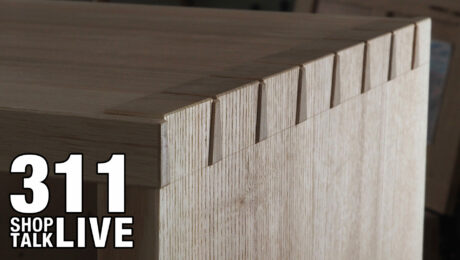
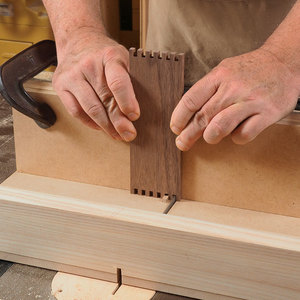
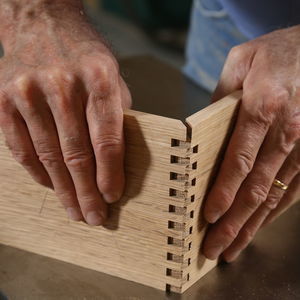
This week on Fine Woodworking magazine's biweekly podcast, Shop Talk Live, we debate the merits of the traditional half-blind dovetail. Talk about stepping on the "third rail" of woodworking!
Every two weeks, a team of Fine Woodworking staffers answer questions from readers on Shop Talk Live, Fine Woodworking’s biweekly podcast. Send your woodworking questions to [email protected] for consideration in the regular broadcast!
Special note: If you’re arriving at this blog post via our September 1 eletter and want to get straight to the “good stuff” on dovetail joinery, simply fast-forward to minute 23:42.
| Listen to Shop Talk Live for free via iTunes. Just click on the logo at right. Hit the “View in iTunes” button and be sure to subscribe. If you enjoy the show, be sure to leave a nice rating. |
Shop Talk Live 14: Who Needs Half-Blind Dovetails?
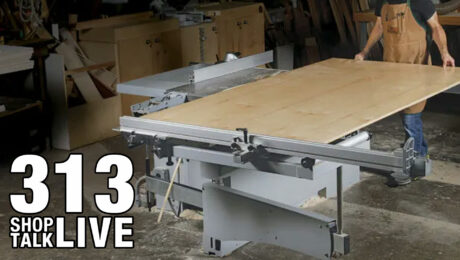
On this week’s edition of Shop Talk Live, Mike Pekovich and Matt Kenney square off on the need to cut half-blind dovetails. Are they really worth the effort? Then, Ed Pirnik reveals his All Time Favorite Tools of all Time…for this Week: a 37-in. tablesaw? Plus, plenty of questions from our readers and listeners.




Comments
Guys,
Congratulations on another fine edition of the podcast. I enjoyed the ca-ching! sound effect. Two points on the subjects discussed:
Mike's Five Minute Jig is a home run suggestion, often overlooked in the craft press and online forums. Added to the screws and scrap in my mental "kit" are builders shims, double sided tape, instant glue, and business cards. I agree about carefully developing and building a jig for a school or production environment, but developing the personal thought process to quickly whip up an appliance is well worth the effort. If the jig gets used often, a pretty, functionally improved version usually isn't difficult to built.
Something I didn't hear in the discussion of classes was the experience of working alongside others in a community shop. I find getting out and actually _working_ with other folks who are as excited and interested in the craft as I am a treat. A class is far different than chatting online, reading, watching video, or watching a live demo at a show. Even after working wood for years, I find hands-on classes to be a valuable opportunity to reinforce the skills that work well for us and refine the rest. I don't think we can ever know it all...
Thanks again!
Where is the video? Appears not to work...
Like peterskier, I too am unable to view or hear the issue on dovetails. What's missing?
I can't find the trick. How do I view the half blind dovetail video?
peterskiergriechersSJSowie,
See this link - https://www.finewoodworking.com/item/47714/shop-talk-live-8-just-a-splash-of-water
The 1/2 blind video won't open.
I can get the enlarged photo of the mike, but there's nothing to get any further, and the "tool bar" or whatever at the bottom of the page says "Error on page".
MP3 doesn't work for me - just get the "Done, but with errors on page."
MP3 doesn't work for me - just get the "Done, but with errors on page."
its not a video , its a podcast only sound.
on top this page, right under the picture of a microphone is a little box. that says shop talk live, right under that box is the words,( stream the podcast) in red type. click on those words. I am using firefox browser. when I click on that link it will download the podcast. when the download is finished you have to click on the downloaded file , at that point using windows 7 it will open a box asking you what to use for viewing the file. first off you cant view it you can only listen to it. my pc gave me the option to use window media player, so I chose it to listen to the podcast. windows media player opened up and now I can listen to the podcast. however I will wait and stream it through my phone and listen to it while I drive. hope this helps every body that is having problems.
cheers
Sorry not going to do anything that requires me to register with iTunes...Why can you just post the audio / video on your own server. I dislike anything i...
Just started listening to last podcast. One guy is not sure when he is teaching and the other doesn't know what tools to bring to his program. This is just so high-school I can't believe it. What a waste of time! You guys are supposed to be professionals.
Everybody needs half blind dovetails. They are great for draws, being much stronger that butt joints. They also look great. Through dovetails can be stunnning when used as an external joint.
The podcast goes on to discuss pocket hole joinery and the author says he would not advise using the joint on tables. Why not? Pocket joinery is a good utility joint for making just about anything for the shop. If looks don't matter, use pocket screws. I have used them for many years and making utility tables and draws is just one function of them. Remember, it's the glue that cements the joint together.
Even in fine furniture, face frames can be used with pocket screws.
Some time ago, a woodworking magazine did a stress test using various joints. Mortise and tenon, dovetail, butt, dowels and pocket joints. The results were surprising. The weakest being butt followed by mortise and tenon, pockets, dowels and then dovetails.
The discussion of half-blind dovetails is predicated on the premise that they're harder than full dovetails, but I would argue they aren't really. The techniques are very similar, just finished up differently. Doing tails first, it's only the pin boards that are different.
At the Lie-Nielsen 30th anniversary open-house, I saw Chris Becksvoort use a method for the full dovetails pins that was almost identical to the method I saw Roy Underhill use for the half-blind pins at a class there this summer (LN naturally being a bastion of hand tools).
The two sets of pins are sawn a bit differently, since the half-blinds can't be sawn through to the front face of the board. But clearing the waste was the same: chisel down across the grain, then in from the end to pop a chip, repeatedly.
The main difference was finishing up. Chris flipped the board to come in from the other side, while Roy took finer and narrower chisel cuts (using a really sharp paring chisel and a very narrow chisel, like the LN 1/10" mortise chisel) until he had cleared the waste.
While the last cruft in the corners of the half-blind is more fidgety to clean out, I would say both were able to make their respective joints in about the same time, with similar quality.
Chris and Roy are both highly experienced, and that experience shows, but I would argue anyone can learn to do both joints just as easily with practice. And I don't mean years of practice, I mean a few hours making each one repeatedly.
Do that a few times and you'll improve quickly, to the point that half-blinds are no more intimidating than full, and doing either by hand is easy. Repetition demystifies.
sdbranam: To your point about techniques - "But clearing the waste was the same: chisel down across the grain, then in from the end to pop a chip, repeatedly" - That's exactly how I was I taught to cut dovetails at RIT many years ago, by a fellow named Rich Tannen - who is still there, I believe. Simple and effective. Thanks for listening.
-Ed
I would like to counter with the question "Who needs podcasts?"
After five minutes there was still nothing of interest. The prospect of having to listen for another hour put me off completely. Please bring back the well-made video's or the well written pdf's that take 5 minutes at most to digest! They inspire! Podcasts make me fall asleep. Am I alone in this?
Too wordy, too much self advertising, misleading - can't navigate to the meat. I give up.
Log in or create an account to post a comment.
Sign up Log in