
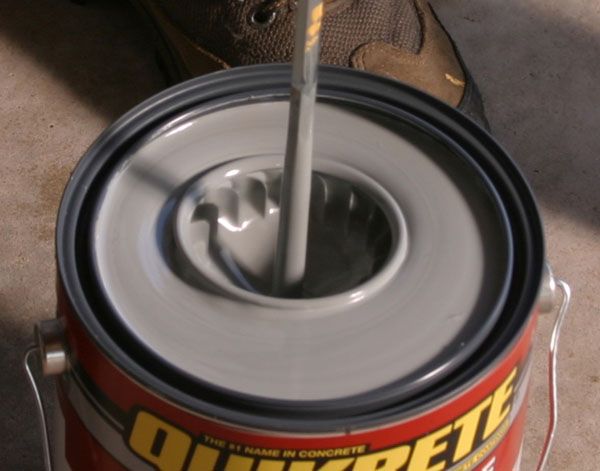
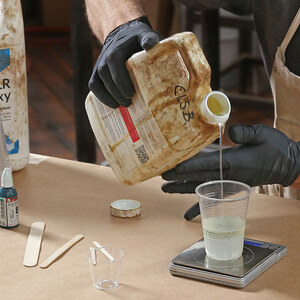
No chunks allowed. When you mix the hardener with the base, the consistency of the epoxy coating should be smooth like heavy cream.
Today we received an email from a reader who says the article in our Tools & Shops issue, “Brighten Your Shop with an Epoxy Floor” by Tim DeKorte, inspired him to begin the long-overdue project of painting his garage floor. But he encounted a significant potential speed bump that readers should be aware of–one we didn’t talk about in the article: stale epoxy.
“Your article was excellent,” says the reader, “but … two-part epoxy floor paint, at nearly $70 per gallon, is NOT a popular project, and the one or two kits in your average home improvement store tend to sit there idle until they are beyond their useful life… or so I discovered.”
As he mixed the hardener with the base, he noticed “crystallized solids” in the hardener that did not liquify no matter how much he stirred. “Not realizing the problem,” he says, “I continued the application, believing that this was some sort of non-slip additive. The final result was good-looking, but overly gritty. After examining the results, I really didn’t know what to think… until I picked up a special order of a final gallon to finish the floor, after I mis-estimated the square footage. Sure enough, the fresh gallon had none of the chunks of crystallized hardener. The surface finish, shine, and durability are noticeably better in the fresh epoxy.”
Turns out the reader had to sand some of the more gnarly areas and decided to recoat the floor with fresh epoxy. He added the colored paint chips to help hide any defects that he couldn’t fix.
So here’s the lesson: If you plan to coat your shop floor with epoxy, check with the retailer to be sure the kits on the shelf are fresh. If you bring home a kit and notice that the mix is gritty as you stir in the hardener, return it.












Log in or create an account to post a comment.
Sign up Log in