Time to end the hand vs. power battle
 Jun 12, 2012
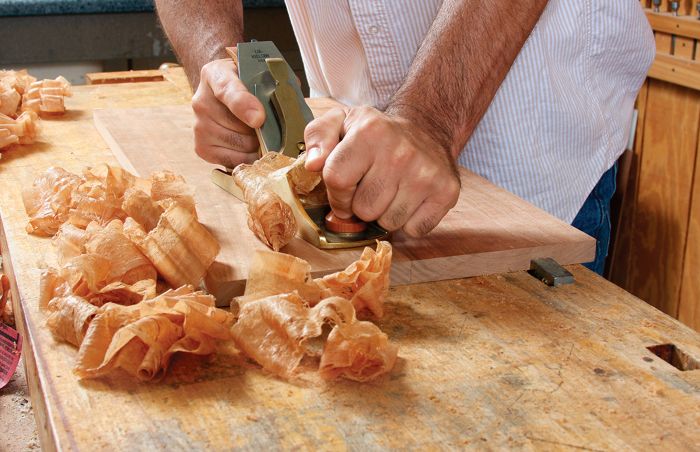
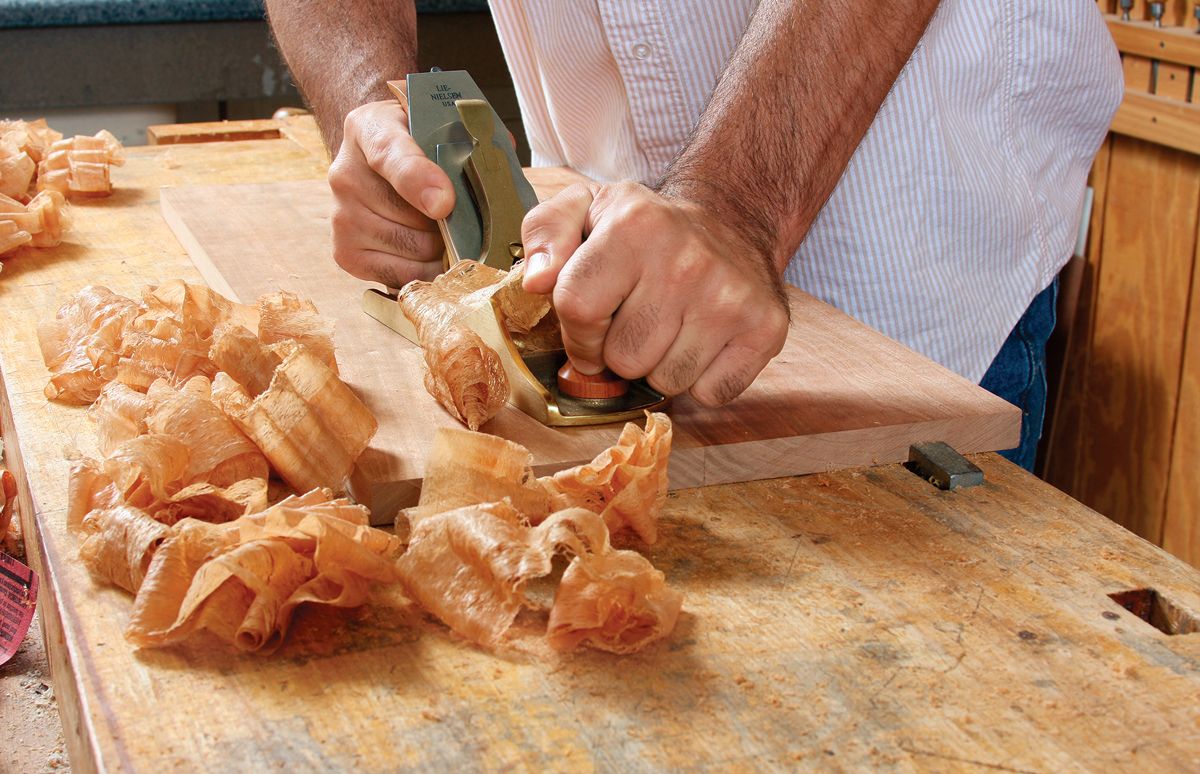
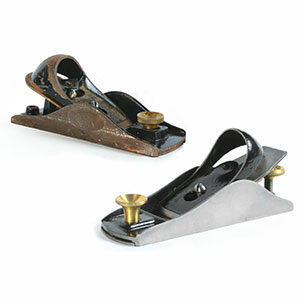
My No. 4 removes milling marks instantly, leaving behind a dead-flat surface.
This is my editor’s letter from the May/June issue. For those who don’t have that issue, I think it is a persepective worth considering. In the magazine I titled it “Hand vs. Power? No Contest.”
Some see hand tools and power tools as two schools, or two religions, or as a pure thing and a polluted thing, and so on. I’m in the school that sees them all as tools. Not so many tiny idols, each with its own shrine dug into my shop wall. Just tools, each born to do a specific job well.
Like most woodworkers, my main motivation is to build things, as flawlessly and as efficiently as possible. As I get smarter and more skillful, I get more done, get better results, and enjoy this craft more and more. That’s my definition of mastery, and I use every tool at my disposal, plugged in or not.
Other than noise, I don’t see a meaningful difference between the physics of my No. 4 bench plane and my bandsaw. I’ve learned to tune the chipbreaker and sharpen the blade of the former, and tune the wheels and guides for amazing results on the latter. After that, both offer a similar symphony of reference surfaces and controlled cutting action.
Both also require finely tuned muscle knowledge and considerable finesse. With the bench plane, I’ve learned how to position my body, transition the pressure from the toe to the heel, and skew the plane’s body on tough grain. With the bandsaw, I’ve learned to apply gentle side pressure for smoother curves, pivoting off the back of the blade to keep it on track. (Try it, you’ll be amazed.)
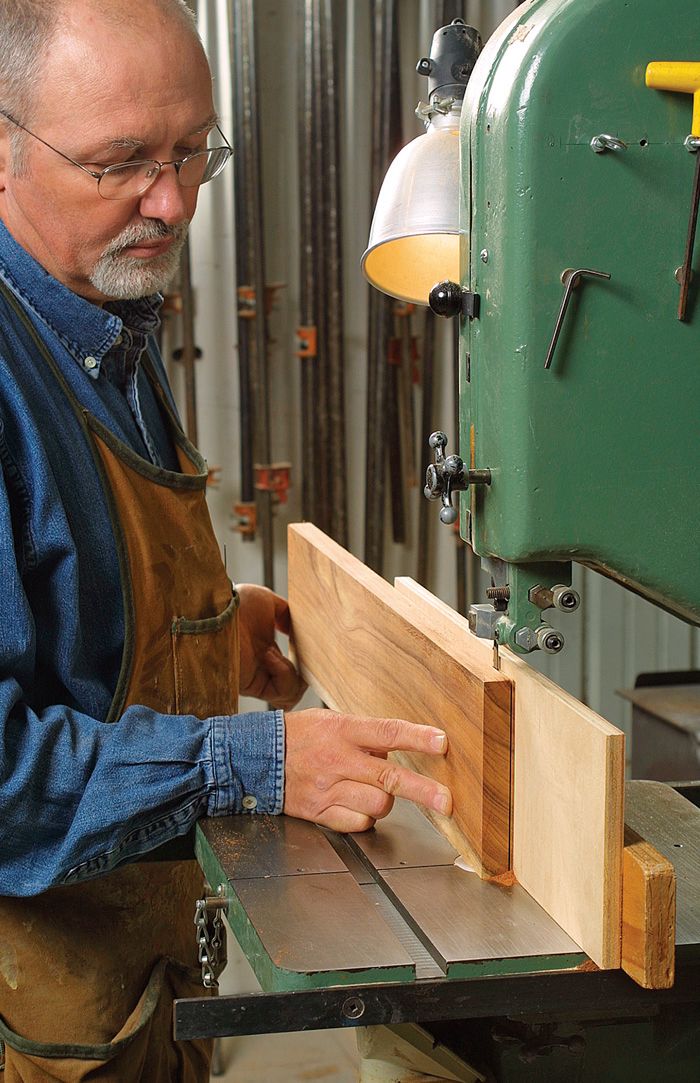
Each tool has earned its place in my shop. There is simply no better or faster way to prep milled surfaces for finishing than my No. 4. Unlike a power sander, it creates a dead-flat surface that makes a finish seem world-class, and it works much more quickly. On the bandsaw, I rough out stock, cut curves, and resaw.
Technology has marched on since the 18th-century apogee of period work, but let’s not forget that those guys were using the best tools available at the time. If the old masters had access to a jointer, do you think they would have surfaced rough lumber by hand? Or turned their backs on a mortiser? Am I not walking in their footsteps?
If you get your woodworking bliss from using exactly what Chippendale, Goddard, and Townsend used, go for it. I get the romance. But if you are in this game to build things, you’ll do it faster and better by seeing tools as tools, each one as hallowed as the next.
-
My No. 4 removes milling marks instantly, leaving behind a dead-flat surface.
-
The bandsaw resaws quickly and smoothly, with very little waste.


Comments
Sorry Asa. I like your blog posts, but as an engineer saying that a bench plane and a band are not different from a physics level is bewildering. The most obvious difference is the 90 degree difference in cutting action. With a band saw the kerf is waste; with a plane the kerf is the finished product. Leave out that sentence and I very much like the post. And I'll try your technique for cutting curves on the band saw.
I tripped a little on the word "physics" as well, but I definitely take the overall points being made.
I think we'll have as much luck ending this battle as ending the shaken vs. stirred battle!
But as you say, they are all ways to get the job done. It's a matter of user preference and priorities which methods to use.
EE, I was speaking in a general sense, not to say the physics are identical, but that both simply employ physics to present a cutting edge to wood. Of course, the precise physics vary greatly.
Try that curve cutting technique--it is amazing! All praise to Micahel Fortune on that one.
In the short time I've been building furniture, I can see a direct connection between the quality of my work and the tools used to achieve it. Power tools get me close and then my SHARP chisels and planes get me exact. But, if you don't know how to sharpen your tools, stick with power until you do know how. If you go into projects using dull hand tools, you may never want to use them again!
-Brian VanVreede
BCcraftmaster
Very nicely written. I am one of those weirdos who does aspire to get my "woodworking bliss from using exactly what Chippendale, Goddard, and Townsend used..." I also agree with you that Chippendale, Goddard, and Townsend would most certainly have used a thickness planer and a bandsaw had one been available. Thank you for your contributions to Fine Woodworking. This is the only magazine that I take and its articles and perspective like this that will keep it this way.
Is woodworking very much different from music? Why shouldn't we use electric instruments just because they didn't exist 200 years ago? To quote Pat Metheny: "If you plan on continuing a tradition, it might be a good idea to find out just what tradition it is that you intend to continue". I like Fine Woodworking because it is about "fine" woodworking, no matter which tools you use. If you get all your boards dressed and planed to thickness from the lumberyard, then take you $ 2000.- custom high tech plane for the final finish, is that really woodworking with handtools or just the spleen of a week-end hobby woodworker?
This reminds me a bit of the frequent question I get asked by people when they find out I work in IT: "What's the BEST computer for me to buy?". I always ask them about their skill set, and what they want the computer for then will talk to them about what the most APPROPRIATE computer for them might be. There's no such thing as the best computer.
I think tool choices are like that too. There are many options for approaching the cutting of a joint and what's most appropriate for one person will be a bad choice for another. It's the final results that count.
Personally, I find that at the start of a project, my shop is a pretty dusty, noisy and chip-ridden place as I use power tools for the milling and other heavy-lifting. As the project progresses though, I find the hand tools come more and more to the fore, the shop is cleaner and I can have some music on. My Jointer/Planer and Table-saw give me my best possible start to a project in that I am able to start with timber that is square and flat (there's no way I am good enough to mill timber by hand) but the hand tools help provide a more contemplative atmosphere in the shop. I wouldn't want to be without either power OR hand tools: a combination of both is what's most appropriate for me.
"I don’t care how it is made – he [the craftsman] can make it with his teeth or a machine – it is still the final product that counts." – Tage Frid
Enjoyed your post, and have learned, and continue to learn, ways to marry hand and power tools in my shop. I recently moved after retiring and my shop is now in the a basement.. I moved out of a stand alone shop in my back yard and sold my very large bench and my table saw prior to the move. I'm working on a project now that required dados. I did it with hand tools, my band saw doesn't have a dado set :) and enjoyed the process. Did it take longer? Yep. Did I enjoy it more? Yep. Woodworking for me is not a race, I enjoy the journey as well as the finish.
Until I have an apprentice or 2 to flatten, joint and plane rough lumber, I will use powertools. I enjoy my hand planes, saws and chisels. They are quiet and I don't worry about losing a finger or hand when I use them. My routers are loud but quality moulding planes are hard to find.
Asa, I too enjoy your posts. My shop is a nice mix of power and hand tools. The latter have moved to the forefront as my projects have changed. I built a number of kitchens and power tools did the majority of the work. I now build guitars and one-off pieces of fine furniture. I still rely on my big power tools to mill and size lumber, re-saw guitar plates and establish accurate squares and surfaces. Hand tools now do the majority of the work, bringing sound boards to final thickness, shaping guitar necks or table legs, cutting scarf joints or dovetails. It’s all good.
EE, I assume from your comments that the “EE” indicates electrical engineering ;-).
Great letter Asa. Thanks for posting here. For as long as I have been woodworking I have been saying exactly what you have said whenever the hand tool vs power tool debate surfaced. When I read; "...those guys were using the best tools available at the time," it was as though I was hearing my own echo.
petcern - Thanks for posting Frid's quote. I'd never heard or read that before.
I would have to ask the question "Why does it matter?". Or, more bluntly, "Who cares?" A dedicated wood artisan is constantly going to strive to expand their knowledge and hone their skills so as to be better able to determine what is best for the task at hand. Perhaps this issue matters to a zealot, in an effort either to validate their point or bring another over from the dark side. However, in my experience, zealotry isn't always effective as a conversion method, which presumably will receive support only from those sharing that view. As often happens, it only entrenches an opposing position.
As far as FW covering the 'debate', I enjoy, and much prefer, the articles which allow me to identify the benefits and challenges of different tools and procedures -- powered or not-- and which help enhance my skills to grant me the inner satisfaction that comes with a completed project, hopefully with a few learnings, as well.
Perhaps a more worthy discussion would be to help elevate woodworking in our society and equip kids today with both the desire and the skills to carry on our millennia-old traditions so that NONE disappear.
The debate is not just in the hands of the maker, it has more to do with value. One must consider what a willing buyer would pay for a hand made, tool marked imperfect piece vs. a mill-finished / 800 grit sanded out piece?
Evidence of "handcrafted" is as important as the design to many. Antique buyers reject perfection, some would say the mark of production. I am formally trained, and own all the big machines, but make and sell handmade because thats what is in demand.
Asa: Sorry. Mildly interesting but mostly irrelevant topic. It's like trying to open a debate on walking VS driving a car VS taking an airplane; all will get you there. With exceptions for the proclivities of individuals with a blind eye or a freaky bias, power VS hand tools just doesn't matter. Fill 'yer boots! Do what you like! Either, both, neither!
Today's woodworker has a bewildering array of equipment at his fingertips to get the job done. Do you prefer horse races, dog races, or NASCAR? Do you like beer, wine, cider, or whiskey? Some more useless topics for the blog.
I'll do coarse works (resawing, ripping, etc.) with machines by avoiding strained hands, because I need them for accurate joints. I do fine/elegant works with extremely sharp planes, chisels, saws etc. If you are looking for spiritual, quiet and enjoyable feeling, the less machines you need to use. With machines you'll get more noise, dust and danger.
I'm in favor of using whatever tool gives the result I want in the time I'm willing to spend. A chainsaw is better at cutting down trees than a coping saw. A block plane is better at cleaning up than a power sander. I prefer to joint and plane lumber with a machine. I understand and respect those who do it by hand.
Do those who preach a doctrinaire hand-tools-only approach to woodworking produce their writings with a goose quill or print their books on an 18th century press? No?
So perhaps they believe only woodworking has gone backwards in 300 years.
Artisans of yesteryear would have used the best available to them at the time and I follow in that tradition.
I use both all the time, I prefer the quickness and relative accuracy that power tools offer but at the same time, when precision is at a premium-it's all about the hand tools.
As an aging baby boomer I find hand tools harder and harder to use. Some of us suffer from arthritis, in fact over 40 Million Americans do. I enjoy hearing both points of view, but in a magazine I look for them to explain how one can accomplish the task by hand, or with a machine. The important part is to show us how each task can be done and the advantages or disadvantages of each. While I might like to finish something with a hand plane, I don't enjoy the pain in my knees and back for the next two days. Each of us have different needs, I enjoy the magazine and thoughts shared.
I don't see why people have to be so elitist over hand work, as though using a machine is a sin.
In reality, as always in a sane World, a nice mix of the two is the perfect solution - use what is best for the job in hand.
I particularly like the bandsaw for very efficient conversion of thick material; I like the table saw for its quick and accurate cuts, and you can't beat the hand plane for silky smooth surfaces.
If it a question of efficiency then it would be a power tool. If it is history then it is a hand tool.
I have yet to hear the question from someone who sees my work asking " Did you use power tools or hannd tools?"
I use both and dream of the day that I have the time, skill and money to create a work with only hand tools. I also dream of the day when i have the money, skill and time to build everything that friends would want using a shop full of every power tool I could dream of. Until that time comes i will use both in my spare time to relax.
Hi Asa. As a fourth generation furniture maker and joiner, I couldn't agree more. Tools are tools. When I need to flatten a 40" wide mahogany table top I reach for my great grandfather's No. 8 Bedrock (of course with a Hock blade and chip breaker) and card scrapers. When I need to flatten 75 board feet of alder, you better believe I'm going to joint and plane all that stock with power tools. I love my grand-dad's back-saws and molding planes, but couldn't do my work, at least at the volume that I need to, without modern power tools. The most useful tool in my shop right now though is the one that I am using right now. The computer has revolutionized how I plan and execute my work, basically because it allows me to make "virtual" mistakes for free before I even walk into the shop. It also enables me to learn from you all. Thanks!
We seek to validate ourselves through our beliefs (Democrat or Republican, Ford or Chevy, Import or Domestic...) by stating our way is THE way. Our pride refusing to allow another his or her own point of view. If they don't see this as I do, they are wrong because I am right.. aren't I? Let's give to the other the same freedom to choose as we have, without all the commentary. Tools are just that, tools. It really is just that simple.
I've been a furniture designer and maker for 30 years and have been weighing in on this very debate nearly all that time. Here's my take.
If one aspires to buiild fine furniture, one must have fine hand tool skills as even today with CNC equipment that will reproduce almost anything you can throw at them there are still surfaces that cannot be achieved through sanding and there are joints that do indeed require the use of handsaws and chisels to complete. Therefore to those who would argue that hand tools are a must, you are correct!
Having said that, I make my living building furniture for wealthy clients. They enjoy knowing that what I build for them is "hand made" but they also would like to receive their new furniture on a timely basis. So power tools save time and I use them as well.
Can any of you imagine John or Thomas Seymour or Duncan Phyfe resawing boards and making raised panels with framesaws and handplanes if there were big heavy bandsaws and shapers sitting in their shops? Do you really think they'd be using solid wood if plywood were available? Me either, so let's all agree to the fact that each of us has a different reason for working wood. For some, the pleasure of working up a sweat and working with their hands to build beautiful pieces with no concern over how long it may take is the tonic needed to relax after a hard day at work doing things our ancesters could never imagine. For others who make a living working wood, the use of power tools AND hand tools allow us to produce enough each year to support our families just as the Seymour's and Phyfe's of history aspired to do.
Enjoy your tools!
Madison
My ambition is to make the most beautiful furniture that my wood supply (cherry, ash, maple, apple) and my hand-eye coordination will permit. The discussion of how that is accomplished, by tool or power, borders on idolatry. Surely, it is the process of "sculpting" wood and the result that are the essentials.
Log in or create an account to post a comment.
Sign up Log in