Spalt Your Own Lumber: What’s In A Name?
Seri Robinson has issues with renaming spalting, just because it leads to confusion on an already poorly understood topic. Jul 23, 2011
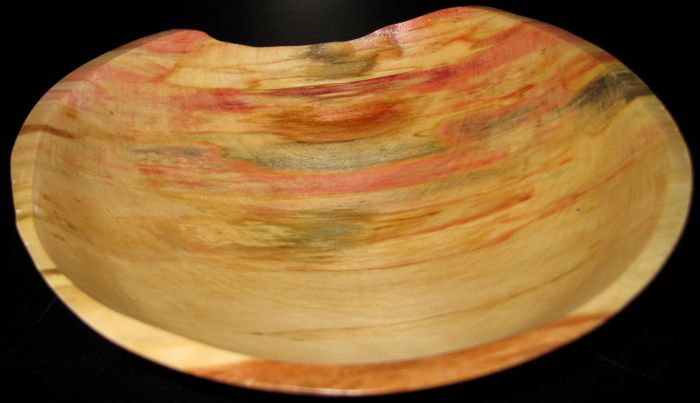
Flaming Lips of Heaven?
It’s been quite a while since my last post, and I apologize. Spalting has really taken off here in Canada, and I’m up to my ears in research and development. I haven’t even made it into the field this year to do any collecting! So a big thank you to a concerned spalter who brought today’s issue to my attention.
A rose by any other name…
…would probably smell as sweet, but if you called it something like ‘African beauty blossom’, would probably cost twice as much. Consumers like to purchase neat-sounding items, especially if they are billed as unique. Unfortunately for the numerous entrepreneurs out there, spalting isn’t rare, isn’t hard to induce, and unless you get into a lot of the pigments, more or less looks pretty much the same.
So how does one market standard zone line spalted wood? Apparently, people have begun thinking up new names for spalted wood, and attributing the spalting to other phenomenon. You’re probably familiar with the more common renamings, like ‘ambrosia maple’ (there is no ‘ambrosia maple’ tree species….that name refers to the staining type, which is still just spalting), but several new ones have cropped up over the past few months. My new favorite, and the one that prompted this post, is the ebay favorite ‘fire-stained maple’. A concerned spalting enthusiast sent me a link to an ebay auction describing this incredible new spalting phenomenon, asking if it was for real. So let me be very clear: there is no such thing as ‘fire stained maple’, no matter how much you might want to believe that fungi somehow can interact with fire to spalt better. Fungi and fire don’t mix.
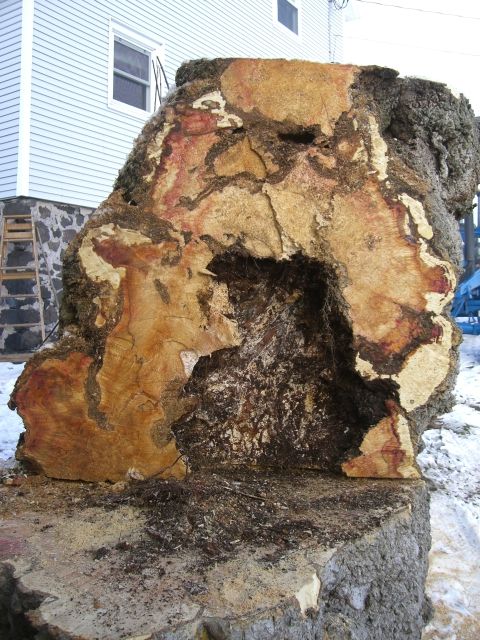
What is ‘fire-stained maple’? Well, from looking at the photos, it looks like figured maple (crotch, root ball, etc section) with heart rot, and by that I mean spalting in the heartwood, not the sapwood. Heart rot is very common, and its occurence in this tree probably made the tree more susceptible to fire damage, since the heartwood provides the structural support for the tree. But the fire in no way cause the spalting.
Ummm…Why Does The Name Matter?
I have minor issues with renaming spalting, just because it leads to confusion on an already poorly understood topic. What bothers me more is after something is renamed, people seem to feel a need to support that name by giving a bogus background story. I’ve been researching, making, and selling spalted wood for years and yes, part of me would love to call pink stain something awesome, like ‘Flaming Lips of Heaven’
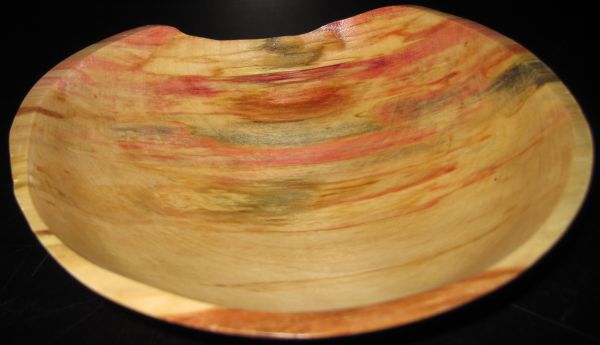
I don’t, because the last thing I need is yet more confusion over what spalting is and isn’t.
Time To Clear Things Up (Again)
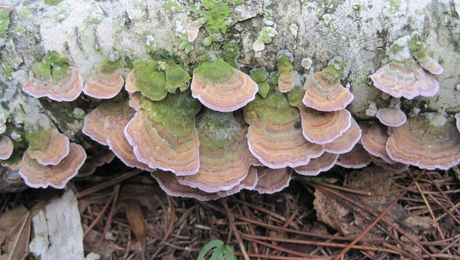
Spalting is pigment and bleaching on wood (including black lines) cause by a fungus. It has nothing to do with angels, fire, or luck. Insects (ambrosia beetle, I’m looking at you) do not cause spalting, although they do occassionally vector fungi into wood that will cause spalting later.
Not all tree pigments are related to fungi. Some trees produce their own pigment in response to stress or wounding, like is commonly seen in boxelder (Manitoba Maple):
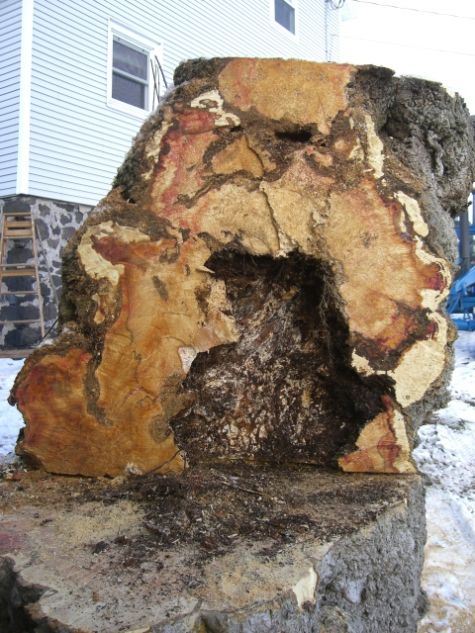
If the stain occurs primarily at knots, burl section, or areas of injury, its not a fungus, its the tree. And those are your two options, my friends, in terms of wood stain in standing trees. Of course, there are a whole mess of stains that can happen once the tree is down, but fungi and host response are the two that happen while the tree is still standing.
So when buying spalted wood, take names and back stories with a grain of salt. If the seller insists that what you have in your hand is some sort of mystical spalting artifact that may never be created again by nature, take a photo and send it to me so we can have a good laugh about it. Just keep your wallet closed and go read some back issues of this spalting blog. Remember – you don’t have to pay for it, its really easy to spalt your own wood at home!
Dr. Spalting
Despite my best efforts, do you STILL think fungi are going to kill you? If so, check out this post.
-
Flaming Lips of Heaven?
-
Boxelder stump with host-response pink stain


Comments
I honestly cannot believe you passed up the opportunity to tell buyers of wood to "take everything the salesman tells you with a GRAIN OF SPALT".
I second that! Though, I came too to support your efforts a bit ;) You probably remember me as being the green elfcup (the almighty Chlorociboria) addict. Well guess what, I found a stump full of fruiting bodies this summer and put them to grow (and started turning some nice stuff with the wood). So far so good, it seems to live.
That marketting issue is a shame, I absolutely agree with you. It's better to inform people about what the stuff they see really is, even if it doesn't sound that romantic or epic. After all, even if anybody could find spalted wood in the wild, not everybody would have any interest in doing so, nor to do something with it. So yeah, spalted wood is ultra frequent, but not everybody works and sells it. I don't know about a single street store selling spalted wood pens, for example. Even when you take a look on etsy, there's not so much of it there, and not many peeps know it or use it. I guess that tagging it as "sustainable" is far more effective towards making the customer want to buy. Anyway, that's how I market my stuff.
mightwombat - I know I know! How could I have missed such a huge opportunity to be punny? I'll do better next time.
Sodabowski - I occasionally stumble upon your lumberjocks page, so I'm moderately up to date on your Chlorociboria work. Glad its working out! We finally cracked it in the lab in terms of culture growth, and are now trying it out on logs. I'm hoping it works this first time around, because quite frankly, after 7 years of fussing with it, I'm ready for it to actually function like the rest of our well-behaved spalting fungi!
Wow that's great news! Please keep us informed on the results! That means that yes, the tiny Hulk can be tamed!
Umm that rare phenomenon know as Bar & Chain Oil Red spalt ?
@netserv666: I saw that red stain occur on broken branches while the tree was still alive and there were no human action involved. Quite rare here in France at least.
@netserv666: I am familiar with the red staining that can occur from chainsaw oil, but rest assured that it is completely different from the pink/red stain produced from 'Arthrographis cuboidea', as well as the red stain produced from boxelder/Manitoba maple trees.
Log in or create an account to post a comment.
Sign up Log in