
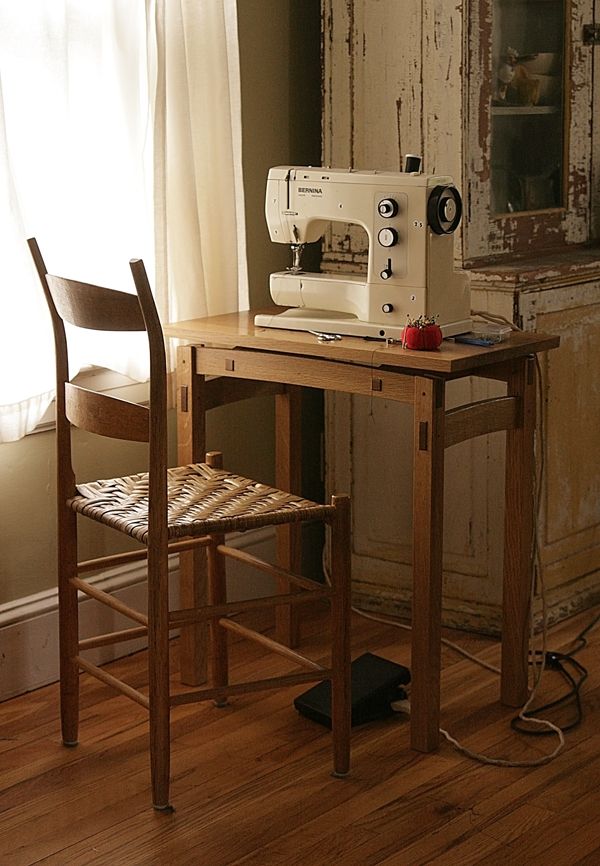
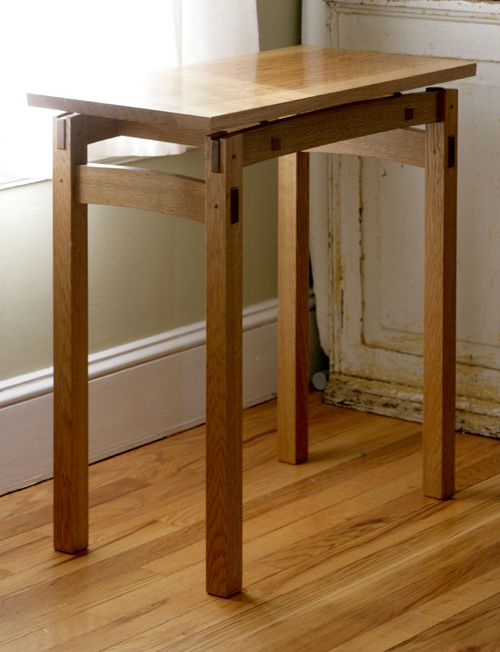
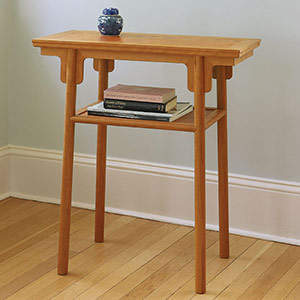
A simple table that suits it's purpose.
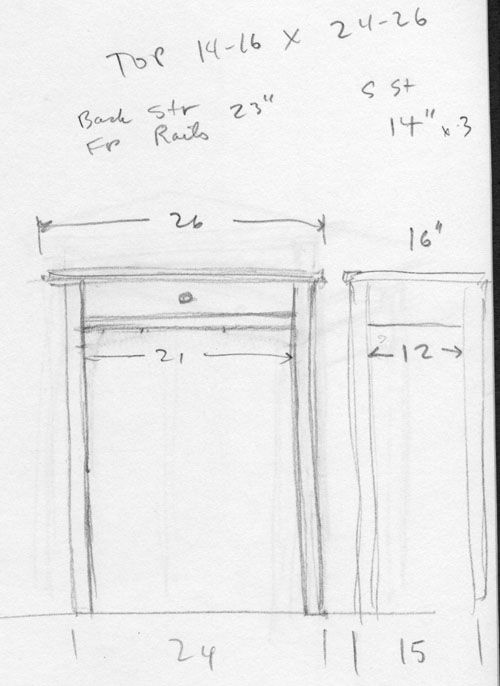
My wife, who does most of her sewing at our dining room table, recently requested a dedicated sewing table. We started by figuring out the dimensions that would best suit her needs. First it had to be lower than the dining table and it also had to be small enough to move around easily and tuck out of the way when not in use. The size we decided on was a 27 in. high table with a 16 in. by 24 in. top.
The low height ruled out a drawer, but I didn’t want to make a simple table with four aprons. I also wanted to try to design something that fit into a sort of east-meets-west combination of arts and crafts elements combined with traditional Japanese joinery that I’ve been working on recently (you can see more examples at www.pekovichwoodworks.com).
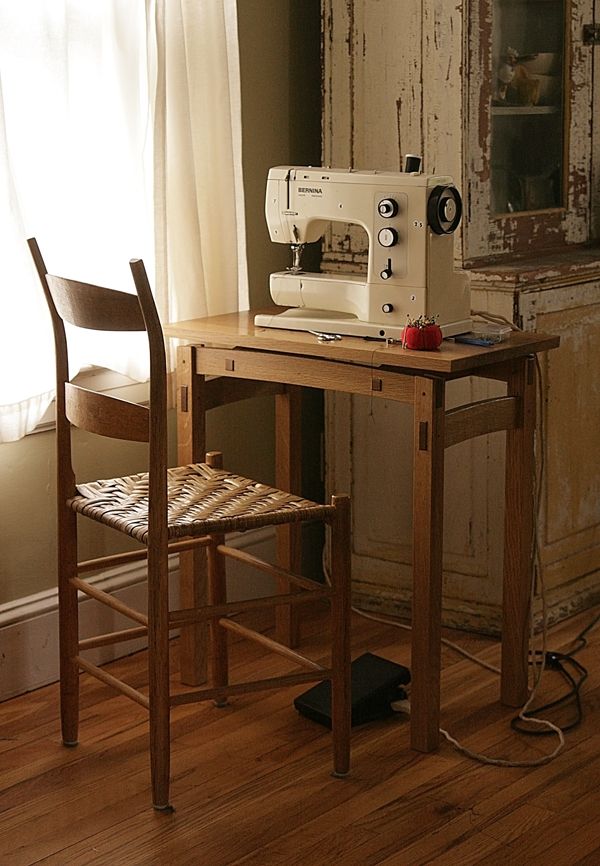
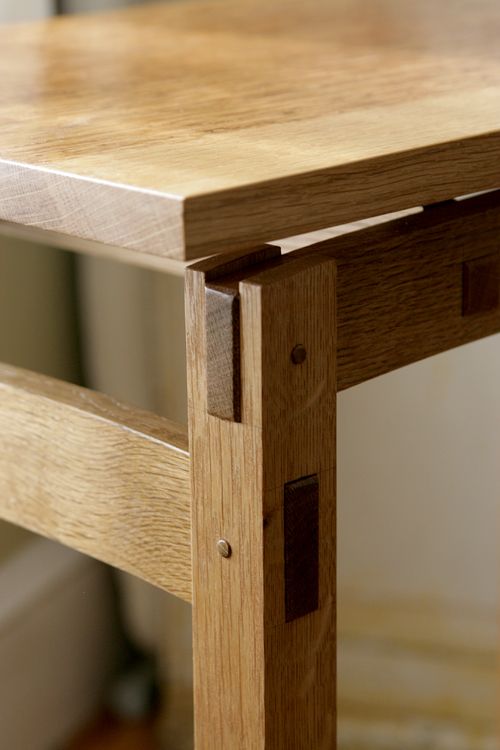
The finished design is a floating top design which I’ve always liked. I arched the aprons to provide some lift, but I kept the legs square and sturdy for a grounded look. I decided to use a bridle joint to join the legs and aprons. The proud ends of the joint and curved parts had me scratching my head when it came to time to clamp it up. The solution was to use draw-bore pegs to pull everything together.
-
A simple table that suits it's purpose.
-
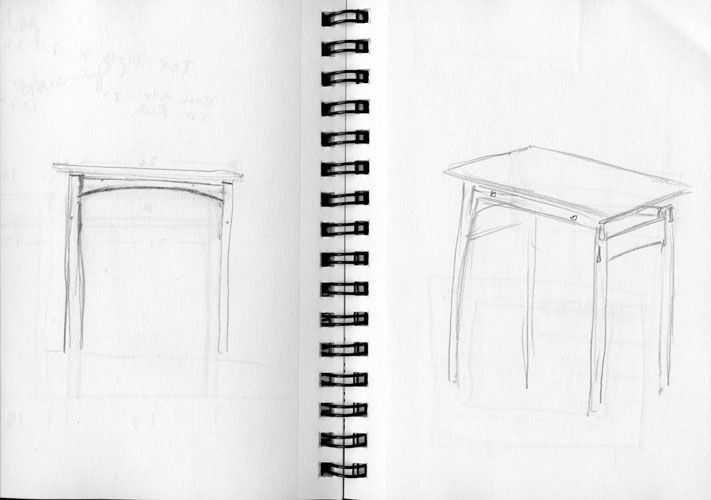
The initial thought was a simple table with a drawer. Not only was it plain, but the height didn't leave a lot of room for a drawer.
-
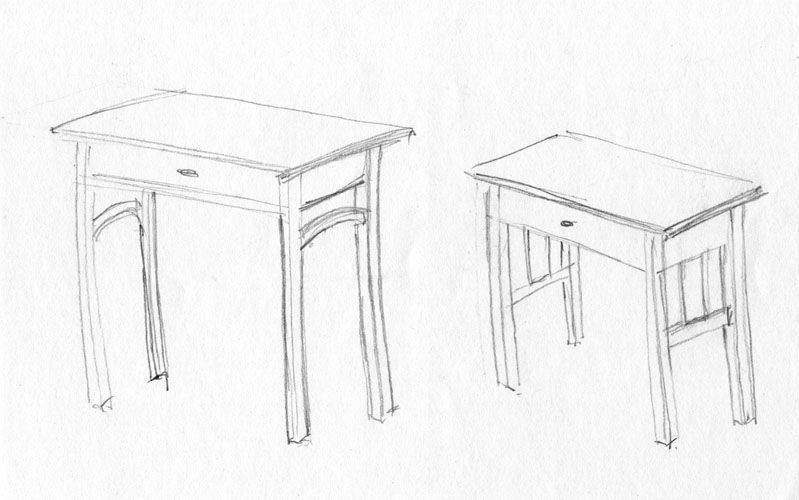
Here are a couple of sketches where I tried to work in some arts and crafts ideas. The shallow depth of the table didn't leave a lot of room to add elements to the side assemblies, and, besides, they felt a little contrived.
-
Eureka! When I realized there wouldn't be room for a drawer, I started thinking about an arched apron to add interest. This idea led to the final floating top design. When I saw that I knew I was finally onto something.
-
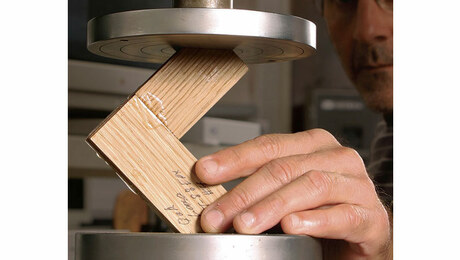
The bridle joint is sturdy and easy to make on the bandsaw.
-
The table is surprisingly versatile for it's small size. Besides sewing, it's also a great height for a laptop, and as a writing desk.




Comments
Excellent design. Bridle joint is a fantastic detail.
This is an awesome design! Simple, yet very, very elegant. Well done - as always:)
E
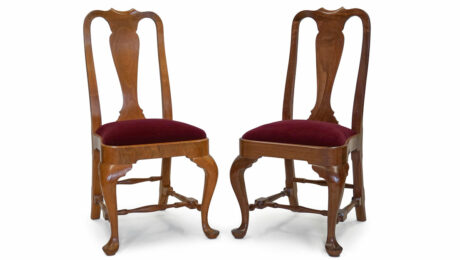
Beautiful!! I also l like the chair. Did you build it too?
c6y- I made the chair a while back with John Alexander, author of Make a Chair from a Tree (a fantastic book). It's John's design and I agree it's a pretty chair and incredibly strong for it's light weight and proportions. The reason is that it was made from green wood (hickory) that we split from a log so that the grain was perfectly straight in every piece. This gives incredible strength to even narrow parts. I rarely work with green wood now, but the class was an incredible education in understanding wood, and what I learned I use everyday in the shop.
-Mike
I took MACFAT class at Drew Langsner's back in the early '80s and have the same chair. We're tall people (I'm 6'5" and my wife is 5'12") and it's a little on the small side for us. I'd make it a little bigger next time.
Which brings to mind another question. My wife is spending a lot of time building quilts since her retirement and getting back pain. What is the correct ergonomic height for sewing or other detail tasks? I've already raised a banquet table up so that it's about elbow height for standing work such as layout and cutting.
My wife is an avid sewing person as well. I'm in the process of designing and building a table for her that will have two additional features: machine set into table so the fabric will "flow" well and foldable so it can be stowed. Although still unbuilt,it does not look like these features will compromise the A&C design which I also prefer.
Nice clean design!
Log in or create an account to post a comment.
Sign up Log in