

Yale University was the site of a tragic metal lathe accident in the early morning hours of April 13, 2011.
 A Yale student’s tragic death serves as a warning to us all concerning shop safety. |
Yale University is situated in New Haven, CT, just down the road from our office in Newtown. So the story of an undergraduate’s death in a shop accident this past week hit close to home in more ways than one. The student, Michele Dufault, was using a metal lathe in a shop where chemistry students and professors are able to make instruments for experiments. Evidently, her hair was caught by the lathe and pulled her toward it. An autopsy by the state of Connecticut medical examiner has determined that she died by “asphyxia due to neck compression.” By all accounts, Dufault was a safety conscious student, and all students who used the shop were required to complete a semester long “shop course” before they could use it. Students and professors who knew her were shocked by the circumstances.
You can read Yale Daily’s coverage here for a more detailed account. And I do ask that you read about the incident before commenting below. Any death in a shop is a terrible tragedy, but the death of a bright young person is especially heartbreaking. Please keep in mind that no one (or at least none of us) knows exactly how this happened, so let’s not assume it was because of foolish behavior on her part.
The fact of the matter is, it’s all too easy for even the most experienced woodworker to let his/her guard down from time-to-time. Maybe you’re tired after a long day but just want to make that one final cut, or perhaps you just don’t feel like taking that extra moment to set up a safer jig–whatever the situation might be, this young woman’s death should serve as a poignant reminder of why vigilance and consistency are so important in the workshop.










Comments
I had some surgery a few years ago and the surgeon told me of a couple of women and a man who he'd done surgery on after their hair got caught in lathes. I cut my pony tail off the next day before I motored up my Jet 12-36.
I had some surgery a few years ago and the surgeon told me of a couple of women and a man who he'd done surgery on after their hair got caught in lathes. I cut my pony tail off the next day before I motored up my Jet 12-36.
I have been around Metal working lathes since I was in High School. They are to be greatly respected. I have seen shirts ripped and shop aprons removed in a split second because of the machine's lead screw. Even the way you tie your shop apron has a safety factor for it. I have seen hair in a lathe before and the only reason the person was saved without serious injury is because another person could hit the stop button. Even with the speed set to the lowest setting that person would have been unable to save them self.
This is very sad and I hope it was over very quick for her. I think, when possible, it's best to have a buddy system in the shop. Also if you are working very late be sure you are not to tired to work.
My heart and prayers go to her family.
Dave M
Having worked in that same building some 28 years ago, as an organic chemist doing post-doctoral research, it hit home. Now still doing chemistry but as a hobbyist woodworker I have to wonder if they had a dead man switch connected between the power supply to these lathes. One can not respond quickly enough in an emergency to search for an off switch. I feel really bad for that student and her family. An unnecessary tragedy. My wood lathe at home is equipped with a dead man switch. Period.
Having worked in that same building some 28 years ago, as an organic chemist doing post-doctoral research, it hit home. Now still doing chemistry but as a hobbyist woodworker I have to wonder if they had a dead man switch connected between the power supply to these lathes. One can not respond quickly enough in an emergency to search for an off switch. I feel really bad for that student and her family. An unnecessary tragedy. My wood lathe at home is equipped with a dead man switch. Period.
This is simply a horrible tragedy. I hope we all learn from the accident.
I doubt a dead man switch would have prevented this. If you think about how fast a spinning chuck moves, an 18" length of hair would represent less than 10 revolutions of the chuck. 10 revolutions at a speed of, say 300 RPM's, represents less than a second of reaction time, not to mention the coast down time after you hit the button. You wouldn't have a chance to react.
@Dan3055:
That's not how a deadman switch works. In the case of a lathe, a deadman switch would normally be implemented in the form of a foot pedal. You have to keep your foot on the pedal in order for the lathe to run. The moment you take your foot off the pedal, the lathe stops.
-Steve
Heck, just using a dull tool on the lathe is enough to scare the pants off me. Catch it on your spinning stock in just the right way and you have a recipe for disaster.
This just didn't need to happen.
-Ed
Took me many years to know and understand the OSHA General Duty Clause: sub1. It is the obligation of the employer to provide a save workplace. sub2. It is the employees obligation to know and follow all reasonable safety rules and practices.
Management is always responsible - (Employee didn't follow instructions, etc. Management has failed to train, hire a person who could understand, failed to discipline employees when they fail to follow the rules.)
In your home shop--you are management and labor. Get off your butt--post the rules, make all information on tools and equipment and chemical safety information available to all users.
Finally, in fatalities and seriously disabling incidents (no such thing as an accident) management should be disciplined with termination. Corporate violators should be held criminally liable into the administrative penalties from OSHA and the employer. Your union will help you get a safe workplace. Oh, no union --
Safe work every minute, every hour, day, month, career. s
SawStop has greatly reduced the risk of table saw injury, and a recent court case suggests it will become a standard mandated by insurance companies, if not the government. Can a similarly-mandated LatheStop be far behind? And DrillPressStop, and who knows what else?
Jackson1:
was in agreement with you until you tried to spin a darn tragedy into promoting unions. You write:
"...in fatalities and seriously disabling incidents (no such thing as an accident) management should be disciplined with termination. Corporate violators should be held criminally liable into the administrative penalties from OSHA and the employer. Your union will help you get a safe workplace. Oh, no union -- "
There ARE accidents. I'll take the semantic point, that if it was preventable then it's not an accident. But there are true accidents: they do really happen in the grey areas between preventability and tragedy. And, if you believe your first paragraph, then why shouldn't any employee who fails to pass safety training also be subject to immediate termination?
You may be comfortable with OSHA/your union rep keeping you safe and warm - good luck with that. Not me. In the real world - coming soon to states that actually balance their budgets - the supervisor and management all get nailed with civil/criminal lawsuits and their insurer backs away because oops - they didn't 100% implement the recommendations in the insurance inspection report...
Now, if OSHA or a union rep blows it, they're the ones that get the "administrative hearing"...followed by a coffee break, and an automatic raise.
Dead man switch, posted signs, better safety training... who knows. Some or all of these things may OR MAY NOT have prevented this tragedy. I believe that by far the most important safety device is an alert and weary mindset. People all over the world work with hazardous equipment, materials, and techniques every day. The key to their safety is recognizing those hazards for what they are.
I look at my power equipment exactly the same way as my fire arms. This is a tool, I can and will use it safely. But, if I let MY guard down, it can and will injure or kill me
When I was in school we spent a whole class just sharing horror stories. That made a huge impact on my safety habits. Nevertheless, it is easy to space out for just a millisecond, and bam, you have a problem. Fortunate for me it was not that major.
......?..a safety sign posted somewhere?....a union??...?..."no such thing as an accident"? Ludicrous comments.
A complete misunderstanding of "accident scenarios". Whenever we place ourselves in a situation involving moving equipment: working tools: unpredictable animals, etc...we are "in hazard's way". Ignoring or forgetting that fact makes us more vulnerable.
Honestly, each of us can look back on incidents that occured in spite of having taken every precaution. I was a carrier aviator in '67,'68 and '69. Men died because of equipment failure; carelessness; a moments indecision; the wrong decision; lack of sleep; an imprecise movement made a moment too soon, or a moment too late, etc,etc.
Power tools are dangerously deadly in a slit second. Only your own determination to be careful, every time, will give you a margin of safety. Sorry about the long post.
Having retired from Dow Chemical, an industry with rigorous safety standards throughout the various crafts, it is easy to spot workers ignoring basics. A work culture has to be saturated with daily checks, whether it is safety glasses, seat belts, rings, fall restraint... the list is long. A familiar slogan started at Dow... Life is Fragile, Handle with Care.
We all agree it's terrible and very, very sad. We all need to keep our guard up all the time and this 'lesson' reminds us. But as to 'perfection': It's never going to happen. It has every appearance of an accident. If you want to be reminded of something you can truly do something about to protect your life .... get off your cellphone in the car and if you text while driving -- you know it's dumb. Stop it. We'll have one lathe fatality this year, we'll have thousands of cellphone deaths and some will be those who were killed by the ones texting. These are easily preventable deaths. There is no way in hell you can text and drive safely.
It always makes me sad when I hear of someone hurting themselves on a tool. However the usual response to the accident always makes me sadder. Whatever institution involved "cracks down" on safty to the point that no one is able to enjoy making something anymore. I cut my thumb off while I was going to college in my own shop. As soon as the facilty and the shop manager caught wind of my accident everyone freeked out about shop safty to the point that they cut shop hours and put so many requirements on the the shop that you couldn't do anything in there. I hurt myself on my own freeking machines in my own shop! I had all safty devices in place, I just hit a very bad spot in the wood. It was an accident! They do happen. We don't need to make yet another cumbersum tablesaw part or make a new company to design a safer tool. We don't need to outlaw lathes because one person had an accident. And there is no need to have to raise insurance rates. If this kind of response to accidents continues we're going to worry ourselve out of being able to do the things we most love to do because "it too dangerous." Bad things happen, take them into your personal safty invantory and move on. My condolances go out the this girl and her family. I hope they honor her by remembering what she loved to do and not what accident took her.
This is a terrible tragedy, and more sadly, one that we will likely not be able to learn from since the only one who knows what truly happened is now deceased. We can all speculate, but no one knows for sure whether obvious safety mistakes were made or not, and so I wish we would all learn to speculate less. My only reason for commenting is that it saddens me that whenever something like this happens, everyone wants to “do something”, and everyone wants blame “someone” – OSHA?, Managers?, Unions? Really?
People, accidents happen. It’s tragic, and if we are wise we learn from them, but blowing off steam looking for places and people at which, or toward whom we may point our fingers does not help. The recent table saw legislation will only make our craft worse, and it is doubtful that it will reduce accidents (given that those who cannot afford a SawStop saw will have to resort mounting a circular saw to a piece of plywood – (far less safe than the standard table saw) - as was done in my grandfather’s day before the advent of affordable table saws. I only wonder why rather than trying to make our imperfect world perfect, people do not marvel at how safe our hobby is rather than clamoring about what could have – or more sadly what should be – done. Given the number of motor vehicle deaths every year despite the vast array of legislatively mandated safety devices that there are in the manufacture of an automobile, woodworking is a very safe endeavor – yet we all hop into our cars every day without a second thought. I’m sorry for the long post, but if there is a message, it’s actually this – value your life and know how precious it I - you could loose it at any time. Take in the joy of what you are doing every moment as if it were your last, but by the same token, take steps to protect yourself so that it may not be. And above all, recognize that our craft, as with nearly all things in life, comes with certain inherent dangers, and learn to love it [woodworking] all the more because, not in spite of this fact. May you rest in peace Michele Dufault.
This is indeed a tragedy.
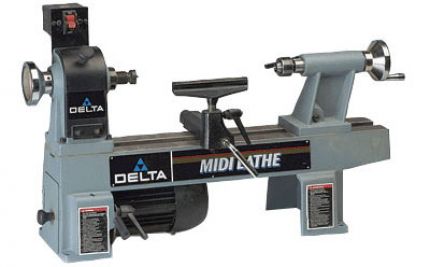
I do take one issue with FWW - that in a story about a persone losing their life on a METALworking lathe - why is there a Delta Midi lathe photographed as though it is the "Murder Suspect".
Contrary to Jackson1 there are such things as accidents - and since you don't know union shops are not safer than non union shops. the story says her hair was caught in the machine at 2:30AM. So I see two possible causes neither of which is a management issue.
I agree with "Mukifli" (11:35 this morning). I worked in a large (probably 500 man operation)(non-union) machine shop in Dallas for nearly 9 years. They ran three shifts and had 16 double-engine lathes, a couple of Belgian screw machines, a couple of dozen mills, 5 or 6 NCR (numerical control machines), 4 or 5 large surface grinders, a sheet metal shop with shears, breaks, punches, and various kinds of welding and dip brazing. They had a chemical shop with 30 or so vats (3 feet by 10) of various acids, bases, plating solutions, with all sorts of other dangerous equipment and processes, yet, in the years that I worked there, the most serious accidents were a half dozen or so fingers were lopped off. Everyone was safety conscious, employees and managment. But years later, after going to college and changing careers I wanted to demonstrate for my kids some elementary chemistry experiments, only to learn that chemistry sets with beakers, flasks, graduated cylinders, etc. were illegal in Texas because some nit-wit legislators were convinced that "kitchen drug cookers" might use them to make illegal drugs. When my kids got to high school, the students weren't allowed to perform the experiments I, and many of you, conducted out of fear for their safety. I don't know how America is supposed to compete in the scientific and manufacturing world when knee-jerk decisions are made about cause and effect. This young woman was trying to pursue her dream and her death is a tragedy, and obviously more training would be beneficial; but her tragedy should not be the basis for handicapping other students from getting back to the shops to pursue their dreams.
Metal lathes are inherently more POWERFUL than wood lathes.
Most of the larger metal lathes are GEAR DRIVEN.
The smaller SOUTHBEND metal lathes and all woodworking lathes are BELT DRIVEN.
If you have ever stopped a WW lathe while turning, it's because the belt slips on the pulleys.
Quite apart from what has already been written, I'm surprised that no one has brought up the issue of not working alone if you can avoid it. Moreover if you are working alone, you should at least let someone in the house KNOW where you are working so they can keep an eye, ear or scissors at the hand to lend aid.
Regretable, sad and thought provoking. A great shame for the young life lost. Accidents cannot be eliminated, only made less likely. investigating the matter to such an end is good. giving in to the spirits of blame and guilt blowing our society appart with great force for the past few decades, is not. closing the entire building and clamping down hystericaly and with no real benefit on machine shops is realy silly and should be avoided. Beacuse in the long run, ignorance kills a lot more people than accidents.
A fatality like this is always a tragedy with effects that are felt far beyond the person's immediate family. My heart goes out to everyone who had the privilege of knowing this young woman.
Now it will be up to the accident investigation team to determine exactly what happened. At the same time, there is a real need for Harvard's safety managers to review the original hazard studies for all machines and operations in the school's shops to determine whether or not there are gaps that could lead to accidents in other operations. Even when hazard studies are done impeccably and procedures are "carved into stone", there is sometimes an almost imperceptible drift away from the original written procedures as time passes. These tiny changes can be difficult to detect, though.
I had the unfortunate experience of having to be part of an investigation into a fatality and a maiming that were traced to exactly that problem - a drift away from procedures that were established via rigorous hazard studies. As we were wrestling with how this happened, one our safety managers wryly stated, "The nasty thing about any accident is that it was likely preceeded by a thousand near-misses."
A sudden loss from an accident is tragic, my heart goes out to her family and friends.
Any time we work with tools we are putting ourselves at some sort of risk. Everything from a chisel to a table saw can do a nasty bit of damage. Bubble wrapping ourselves to ensure a tragic accident cannot happen only ensures that nothing happens. Ultimately the safest position is to do nothing. I feel that we are losing something when fear of an accident or fear of litigation get in the way of activities and learning opportunities that must happen if we are to make progress.
Rather than restricting activities I would prefer see a different culture around safe working practices. Talk to any accident investigator and I think you'll find the "near miss" is under appreciated, certainly under reported. Every near miss should get the full attention of the operator and of the employer. A near miss is the second, third and fourth chance that everyone wishes they could get, the problem is they ignore it. Rather than see a near miss as luck that someone dodged a bullet, it should be used as a warning that something needs improving. Find that something and fix it.
Accident investigators would also have a lot to say about working alone. How many of us like woodworking because it gives us time to ourselves? I have had the experience of getting my foot stuck under some very heavy equipment in my shop. If I wasn't able to free myself I could have been trapped for a very long time. Working alone can multiply a minor event into a tragic event. At the very least it complicates an inherently dangerous situation. Doesn't mean that I don't work alone anymore, I just go about it differently.
Also I think our tools can improve. Most of the tools we use were designed in an era that predates modern sensors and micro controllers. I'm sure engineers could come up with a number of different ways to brake a spinning lathe far faster than an operator can lift their foot from a kill switch. I don't buy the argument that the tools we are using are perfectly safe if only used correctly. I also don't buy the argument that integrating new technology will make tools unaffordable. We know the cost of a death, life altering injury, severed fingers, increased insurance rates and legal settlements. At what point do we realize that the responsible thing to do is make better tools? It took Ralph Nader to shame the automotive industry into building safer cars. More than 40 years after Nader's book "Unsafe at any Speed" no one is arguing that seat belts and air bags are expensive frills that make cars unaffordable. Just because a smaller percentage of the public uses table saws and lathes, these tools don't deserve to be made safer? Unless there is a push for safer tools, the industry will stay where it is.
What we use is as important as how we use it. By maintaining a thoughtful balance of both I hope to enjoy woodworking for many years to come.
Log in or create an account to post a comment.
Sign up Log in