Skil Revamps Router Line
 Apr 13, 2011
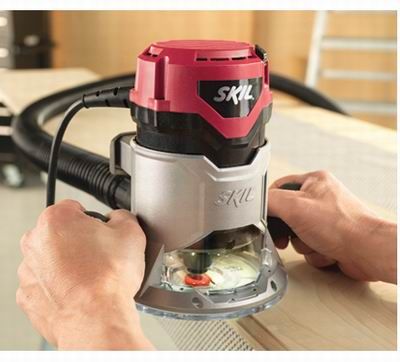
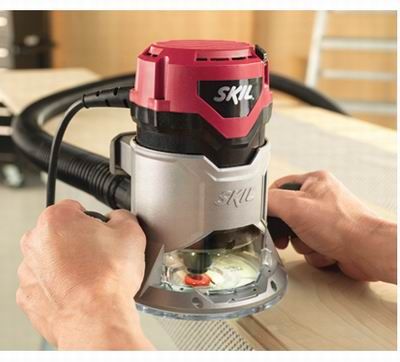
Skil’s 1 3/4-hp fixed-base router (model 1817) has a quick-release lever for easy adjustments. It will sell for around $70 at Lowes.
Skil tools are a familiar sight in big-box home improvement stores. The company offers a variety of power tools for homeowners and weekend warriors, who are looking for inexpensive tools to handle occasional jobs around the house.
Now Skil is revamping some of their product lines, improving features and performance, all while trying to keep costs down for consumers. Recently they introduced a heavy-duty 18-volt lithium-ion cordless drill. Now they’ve updated their routers (models 1817, 1827, and 1830), which have been refined to appeal to more hardcore woodworkers and DIY-ers.
Introduced this month, all models feature soft-start triggers, micro-adjustments for depth settings, LED lights, 1/2-in. collets (with 1/4 in. accessory collets), and improved grips and ergonomics. But individual routers have their own little improvements, according to Skil. Each of these routers comes with an appealing price. But will they stand up to the day-to-day, heavy-duty use of a woodworker? We’ll find out soon enough. Look for a review later this year.

-
Skil’s 1 3/4-hp fixed-base router (model 1817) has a quick-release lever for easy adjustments. It will sell for around $70 at Lowes.
-
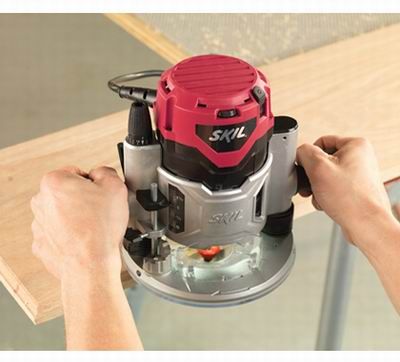
The 2-hp plunge router (model 1827) features a quick- release lever for easy motor adjustments and removal, a depth rod and adjustable turret for repeatable plunge settings, and variable speed. It sells for about $110 from Amazon.com and other online retailers.
-
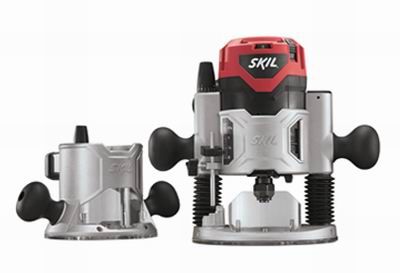
Skil's 2 1/4-hp combo kit (model 1830) is a beefy router that looks like a winner for woodworkers because of its power and versatility. It is sold at Lowes for about $110.






Comments
Hmmm, looks like "Big Brother" Bosch finally threw them a bone. I see a lot of similarities to my Bosch 1617EVSK router.
DC
Valid point there, Dreamcatcher.
I'm really curious to see how this new line pans out. Waiting to see one in the flesh once we get a model in to test out.
Cheers,
Ed
I have been using one for the past few weeks now. Robert Bosch Phil (I am in Manila, Phil) offered to let our handyman club test drive it and I got to be the lucky one.
Everything works as it should. I like the lightness/heft of it.
I find I always start right on the mark because the soft start doesn't jerk me off my target and the LED light really brightly shows me where I am, even in a flurry of wood dust. I tried routing a straight cut without a fence, just eyeballing it, and somehow did it right. I will always use a fence for straight cuts, though; too nerve-wracking without it, just trying to see how stable this router is.
The motor is not as noisy as my Maktec plunge router and runs very smooth. I have not done some caliper-measured accuracy tests but with how solid the router feels when it's working, the absence of any vibration gives me confidence it cuts true. The dual switch also provides flexibility when groping around on turning on/off.
The depth adjustment is just sweet. In my old router I would make several test cuts on a piece of scrap wood to adjust depth and was a chore since the knob was too tight. With the Skil , I test once, measure the test cut depth, adjust using the router's knob, then, usually, just one more test cut. I probably could eliminate test cuts and just stick to measuring (the 1830's gauge seemed accurate so far) but most woodworkers would probably tell you there's nothing more confidence building than a good test cut.
My only complaint is that the base, made of hard, clear plastic looks somewhat brittle. Never tried to test its breaking point but, probably, some care would make it last. Bosch Phil though tells me it's made of tough plastic.
I wish I had the fixed base. I tried mounting it on my Bosch RA1181 Router Table but the spring on the plunge base keeps springing back and haven't had the time and confidence enough to dismantle it and remove the spring. The depth lock works just fine with the router upright. But upside-down, the combination of gravity and spring force is just too much for the lock. But who am I to complain? I was using the plunge base not for its intended purpose.
Looking at the photo of the fixed base, the micro-fine adjustment knob seems to be in the same place as the plunge base. In my often-failed, attempt at using the plunge base on the router table, I waas pleased to find that the adjustment knob's position is well thought: the router is mounted on the table with the knob just right in front of you.
I wonder if the motor is the same dimension as the Bosch 1617/1618. If it is, this would also be a winner paired with the Bosch RA1165 Router Lift.
While I do a lot of woodworking (building a 22-foot strip-planked sailboat at the moment), I am still a weekend hobbyist. For my use, the Skil 1830 is the perfect value-for-money tool.
Log in or create an account to post a comment.
Sign up Log in