
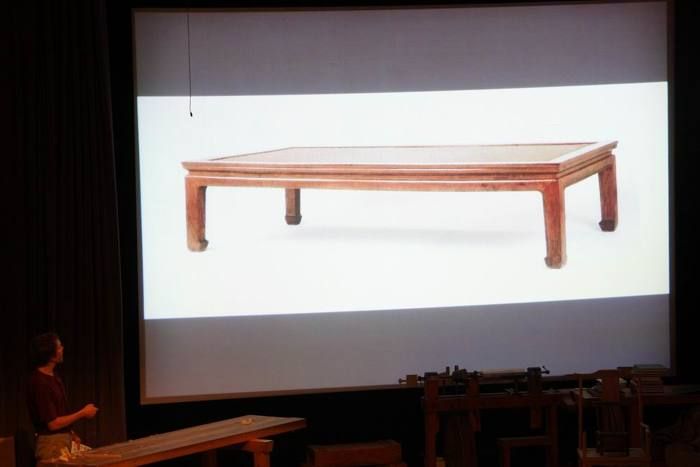
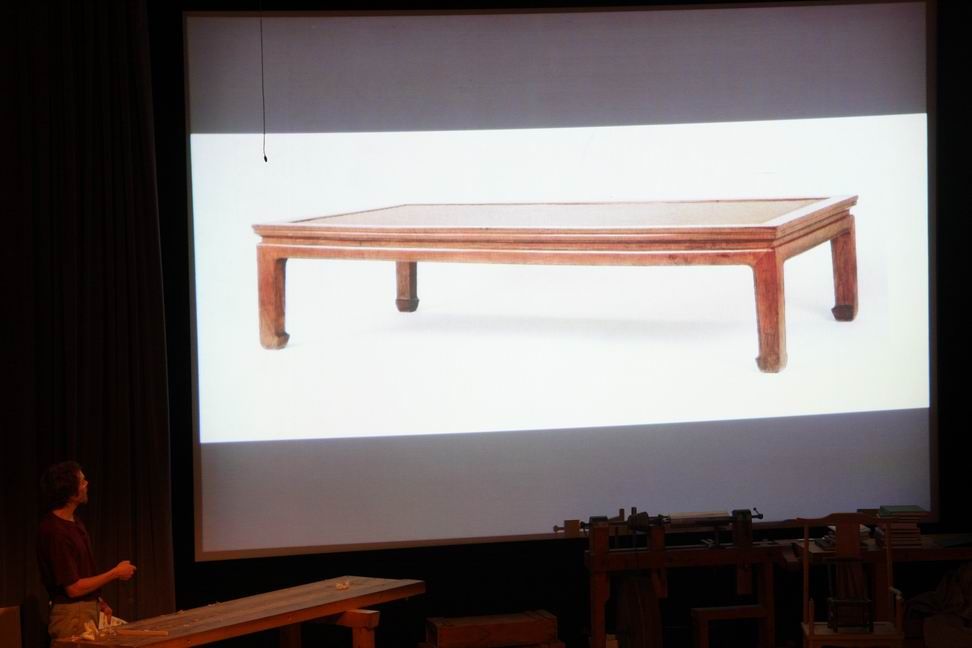
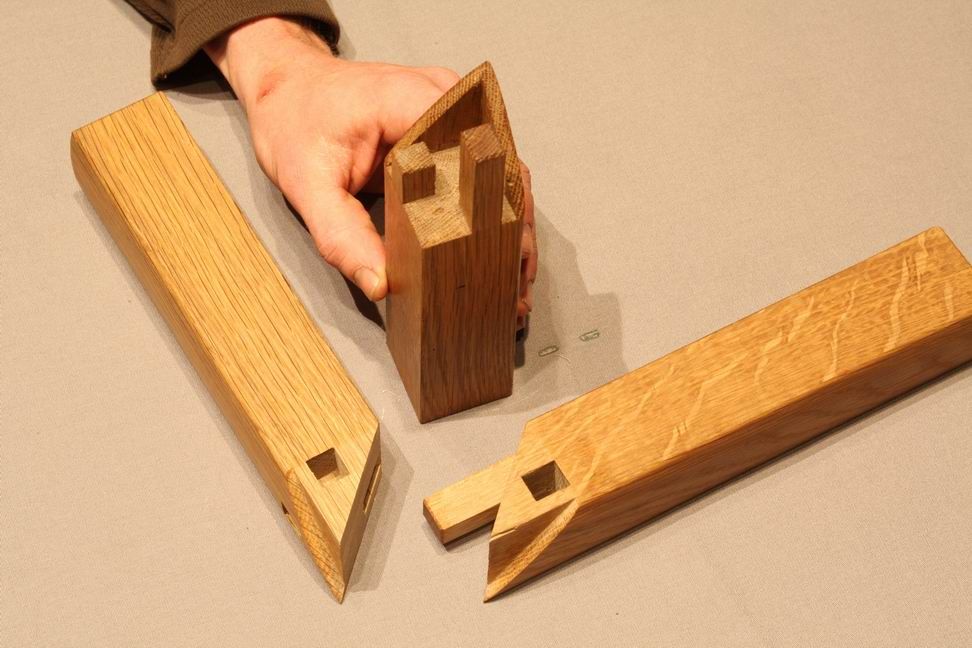
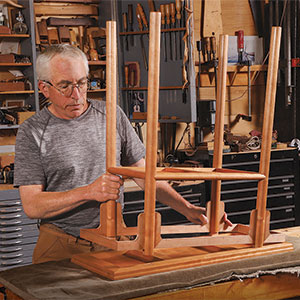
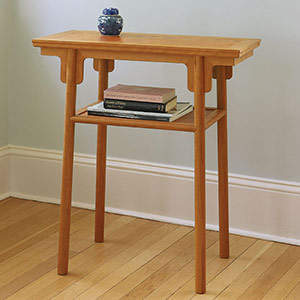
This is a typical Chinese table, with a three-way miter connecting the legs and rails.
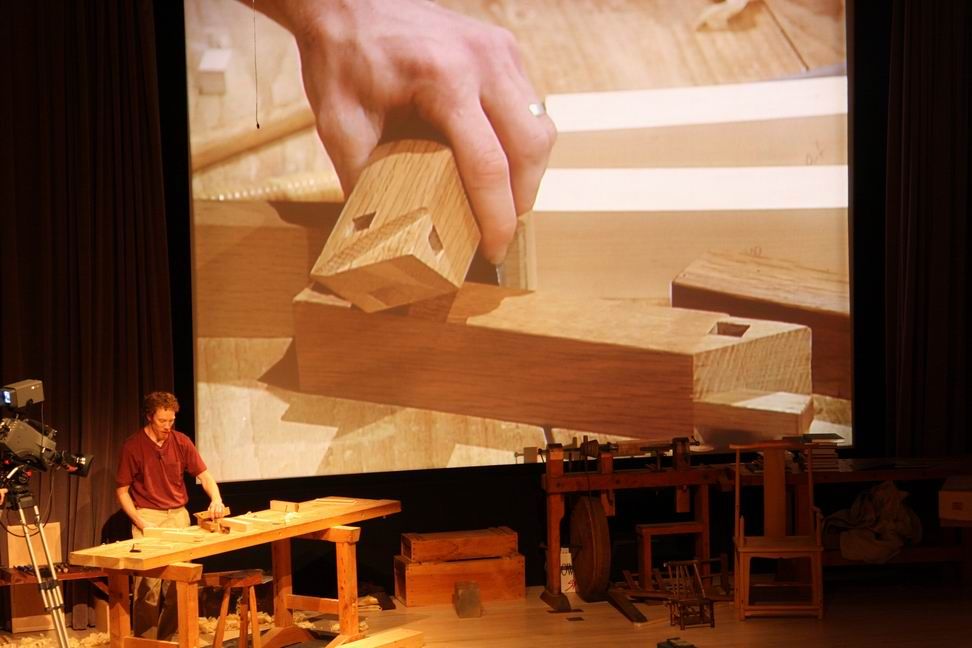
It is Day 2 at “Working Wood in the 18th Century,” the annual conference at Colonial Williamsburg co-sponsored by FWW. After singing the praises of the proper mindset, body awareness, and uncompromising tool setup and sharpness demanded by Japanese woodworking techniques, it was time for Andrew Hunter to put his money where his mouth was, and do some real woodworking.
He delivered and then some, showing how he breaks down a seemingly impossible three-way miter into a series of simple steps. He admitted to the hand-tool loving crowd that he does use power tools when they make sense. In this case he said plowed out precise cuts in the ends of the workpieces on the router table, leaving precise internal tenons behind. But there was plenty left to do for his chisels and rabbet plane.
He mixed in a few more deep thoughts as he went, pointing out why he spends so much time making sure his initial boards are straight and square, and how any problems there will cause problems with the next steps: careful layout and careful joinery cuts, etc. Continuing on his theme of being fully present and undistracted, he said simply, “Start with step one.”
By the way, he still uses the Marples chisels he started out with. He said he hasn’t seen the need to replace them, and hasn’t been able to afford more than a few Japanese chisels. But he plans to add more of those as he goes along. A guy who spent a year by himself trying to learn to plane a prefect board clearly is in no rush.
He also explained the upside of the miter joints seen throughout Chinese furniture:
1. They allow one curved piece to be joined to another cleanly, such as the shaped rails around a tabletop, without needing one piece to be coped to the other, which is tough to pull off cleanly. And the curved profile just seems to flow from one piece to the other.
2. Miter joints also allow grooves and rabbets to be plowed straight through. On Western frames, the grooves often must be stopped, which is more difficult.

-
This is a typical Chinese table, with a three-way miter connecting the legs and rails.
-
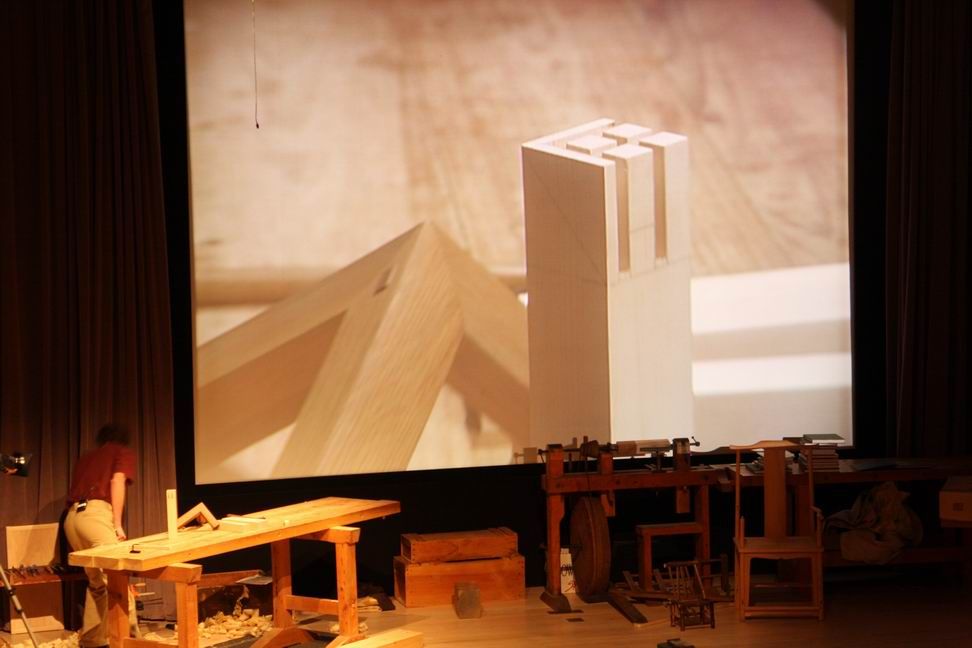
The laughter turned to rapt attention as Hunter began to demonstrate how he makes the joint. He starts on the router table with a straight bit, plunging the workpiece into the bit and resetting the fence until he has a workpiece that looks like this.
-
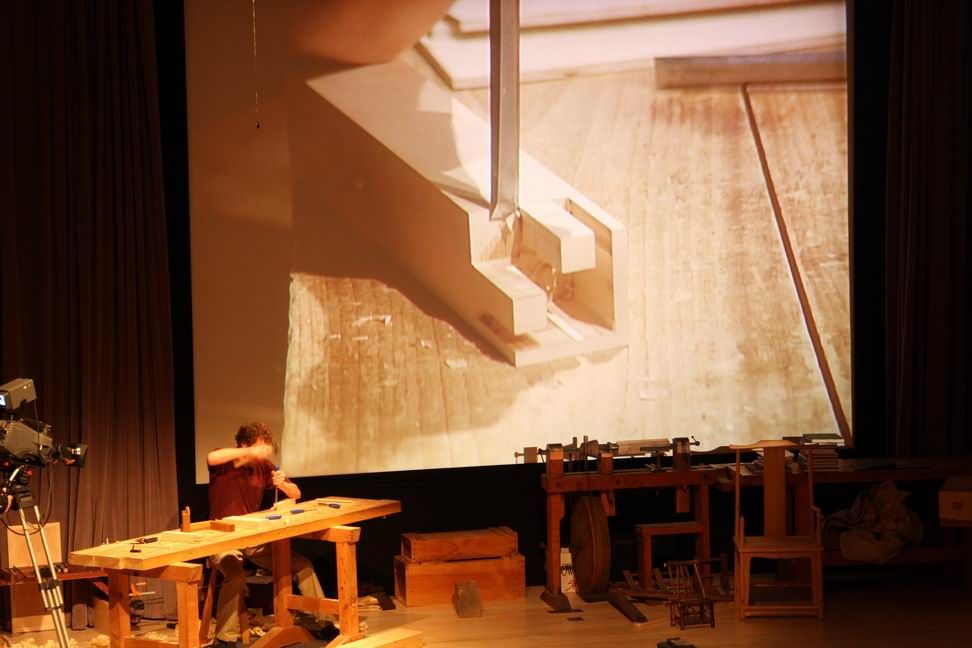
He picked up the process there, using a chisel to remove two of the tenons.
-
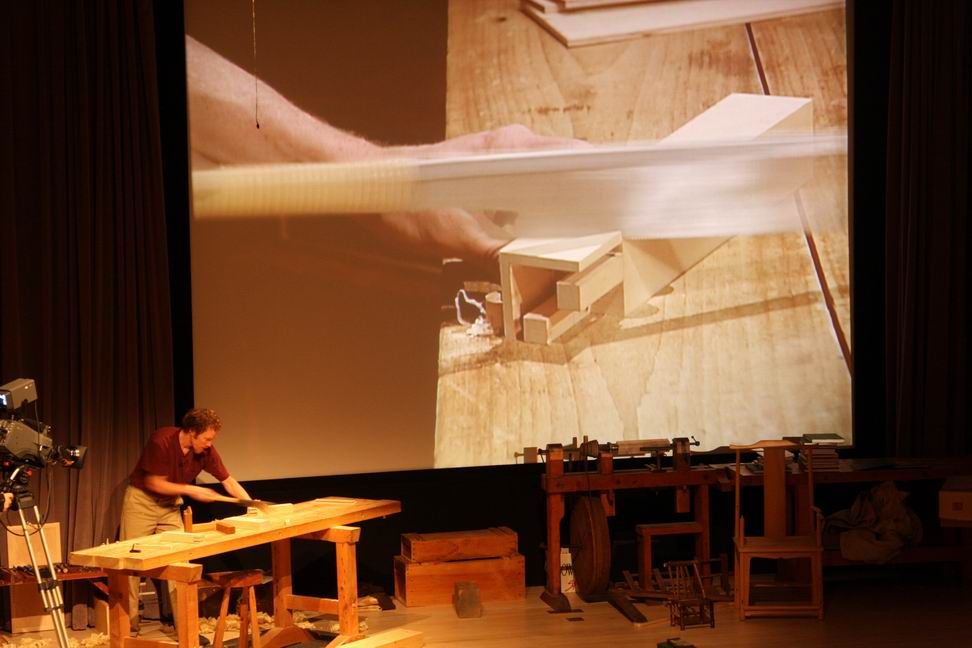
Then he sawed along his layout lines.
-
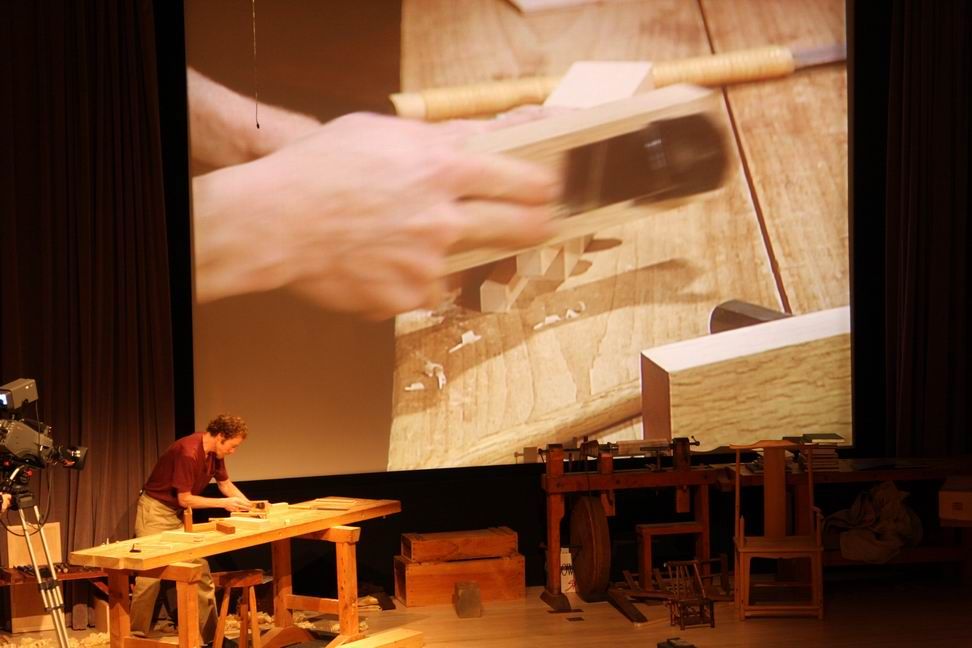
And used a Japanese rabbeting plane to bring those mitered edges right to the line.
-
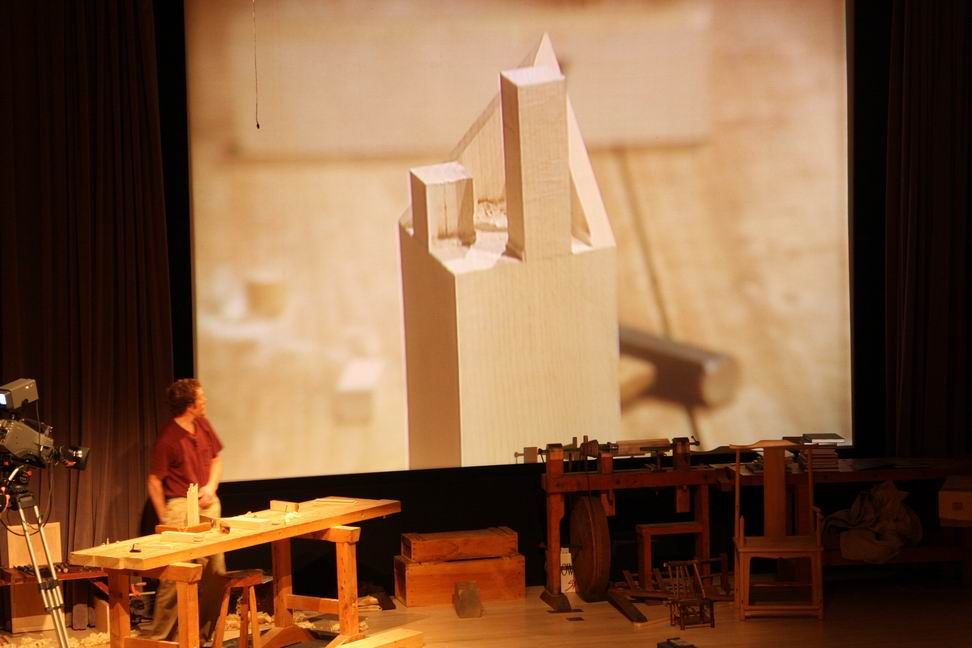
After cutting down one of the tenons to make room for another tenon in the joint, this was the beautiful result.
-
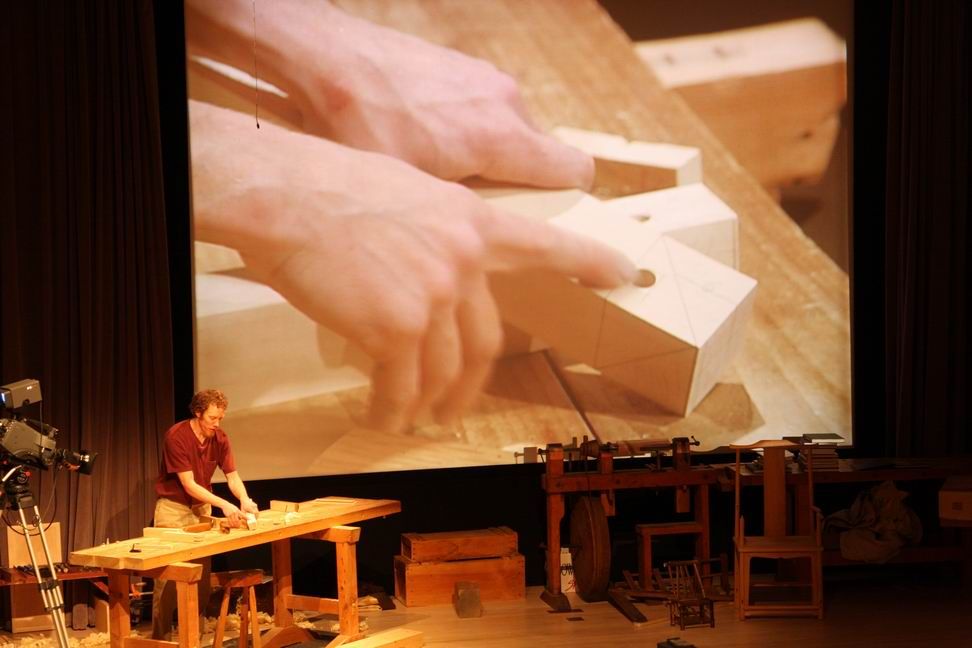
He then described how he lays out the other parts of the joint, and drills out the waste.
-
And finally showed us the finished joint again, explaining how the shaping happens last. The beauty of the miter is that one pillowed piece can flow right into the next.
-
And here is the ingenious but complex joint that was used during the Ming dynasty. Jaws dropped and their was some wry laughter from the crowd when Andrew displayed this joint..






Comments
So much beautyful, this is exactly the work I most like to use at building furniture
And here is the ingenious but complex joint that was used during the Ming dynasty. Jaws dropped and their was some wry laughter from the crowd when Andrew displayed this joint..
"their" ???
Beautiful joint. I cant beleive someone can put a side the fact of the awesome craftmanship involed in making this peice and complain about one wrong word. I think people like that should be ashamed of them selves.
Wonderful! Would love to see this entire joint done in a FWW article.
Asa, I agree with Kidscientist. I too would like to see a Fine Woodworking article on how Andrew Hunter makes the 3-Way Miter Joint. Thank you.
I just got home from the first session at Williamsburg and it was by far the best of the three I've been to. Andrew's precision joinery was amazing yet he made it seem achievable; discussing the combination of router work (by his admission his router table is a piece of plywood with the router underneath- very basic) and hand-sawing with some final handplaning to the pencil line.
Wholeheartedly I agree this is worth a fine woodworking article!
You've got me convinced! I think readers would love to see Andrew execute this joint, step by step. Thanks for the great feedback! Stay tuned.
Would love to see a full length video of the making of this joint!
a zoom in picture on the final assembly would be great
I have just completed day 2 of the second session Colonial Williamsburg and it is one of the best of the six I have attended. Please get that joint by Andrew in FWW
I just would like to add my vote to those wishing an article or a video. I would buy the video in a heartbeat. I have done a similar but simpler "Ming joint" using illustrations from Ecke's fine book Chinese Domestic Furniture. Doing it increased my admiration for chinese craftsmanship.
john s
I would also like to see Andrew include the two-way miter joint he used on his framed piece with the sliding dove-tail. That two-way joint would be perfect for heavy picture frames and glass mirror frames. Maybe a separate article or combined "Japanese two-way and three-way miter joints."
By the way, the second session was great, too - but just not enough time for some of the presentations - a lot of material this year!
Yes, please, an article . . . soon. And a video would be nice too.
Not to bring attention to an FW competitor, but American Woodworker just published my article on three-way miters in their December/January 2011 issue #151. It is admittedly a slightly dumbed-down version, but it is a good place to start exploring this kind of joinery. I give detailed instructions for making the joint either with all hand tools or incorporating power tools.
You can see a preview here: http://americanwoodworker.com/blogs/resources/archive/2010/11/09/preview-2-ways-to-cut-a-3-way-miter.aspx
Maybe some stores haven't switched out to the next issue yet!
Log in or create an account to post a comment.
Sign up Log in