Router Jig To Flattten Large Slabs
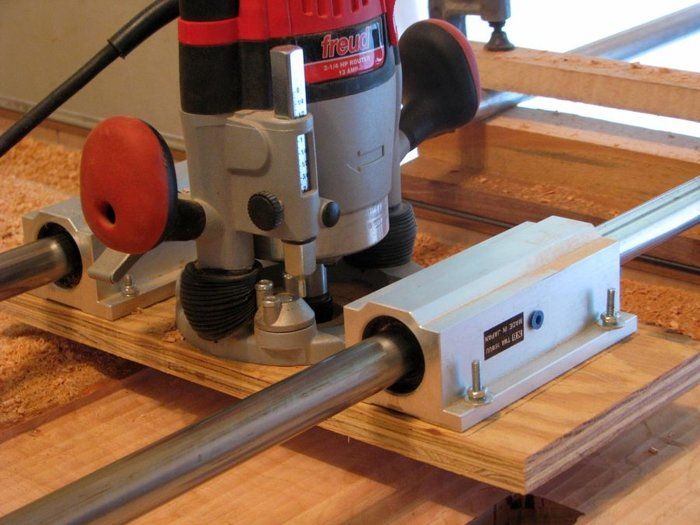
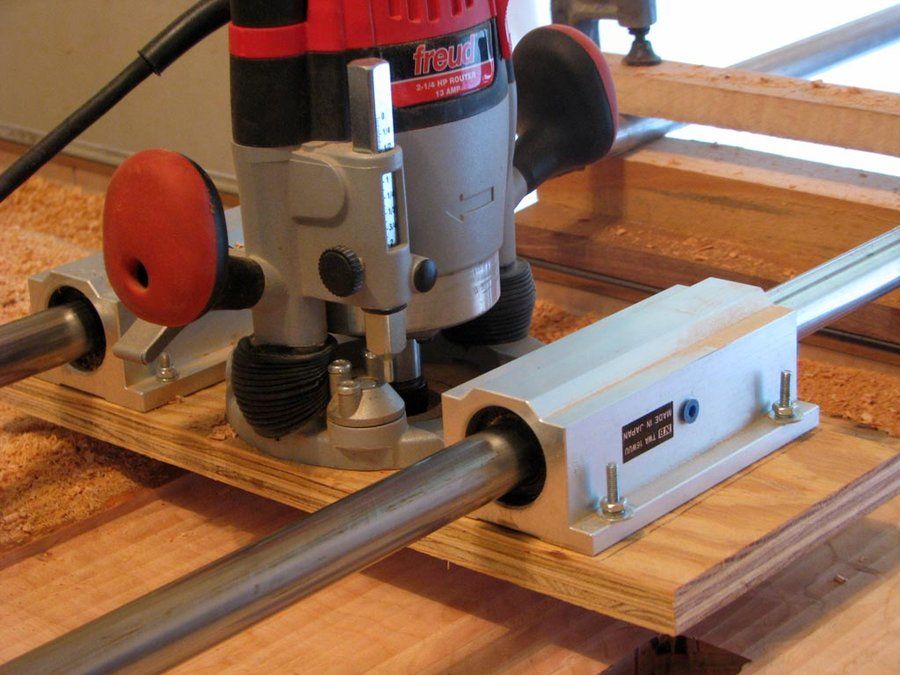
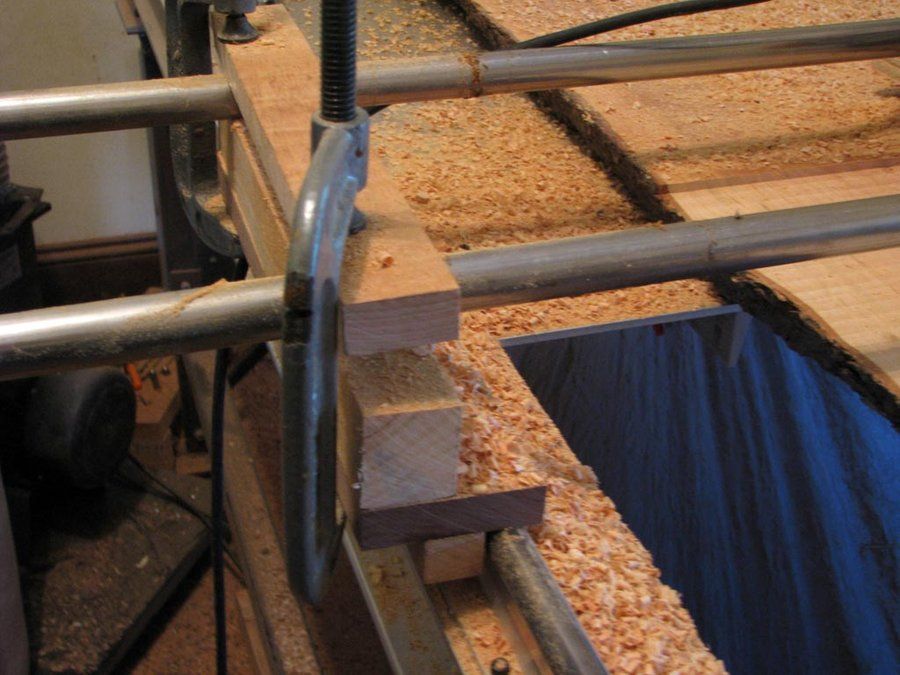
Linear bearings make the sled very accurate. They can be purchased on E-Bay for much less than new ones. These were$50.
My jig is to help me flatten large slabs of wood to use in making benches and tables. The slab can be as large as your support rails will allow. Most of the slabs I use are 25 to 35″ wide by 5 to 6 ft long.
-
Linear bearings make the sled very accurate. They can be purchased on E-Bay for much less than new ones. These were$50.
-
I have a gunstock duplicator with very precise side rails to keep the face of my slab flat. However a good side rail can be made from 2x4's. and can be as wide and as long as you want.
-
I use a 3/4" straight bit to flatten the slab. You can see the router marks, but you can't feel them. A card scraper removes them in seconds.
-
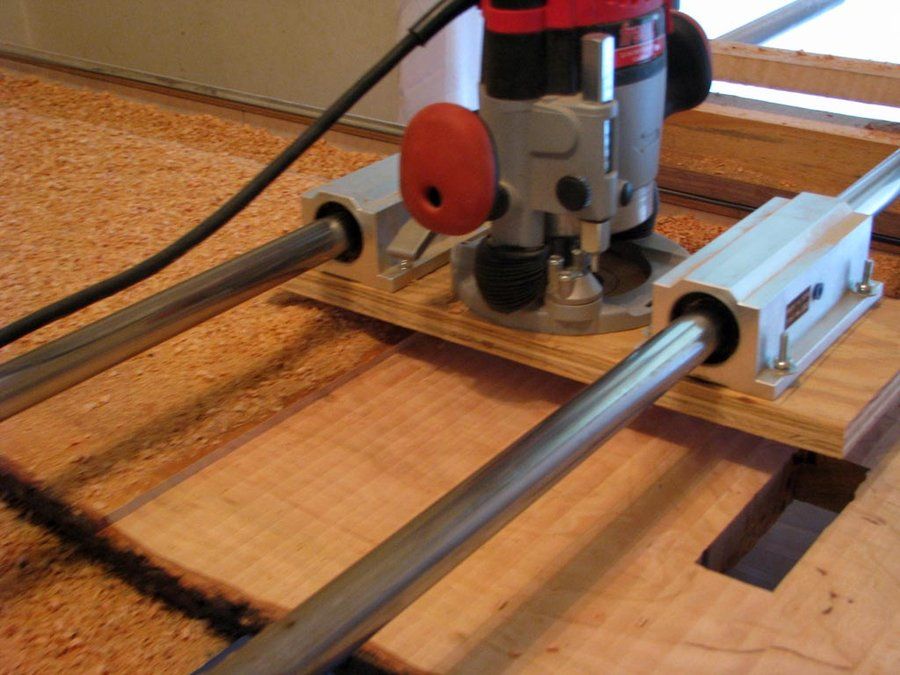
Here's a closeup shot of the work area showing the rough slab with the freshly flattened section. I make a pass with the router, then move the sled 1/2" and make another pass.
-
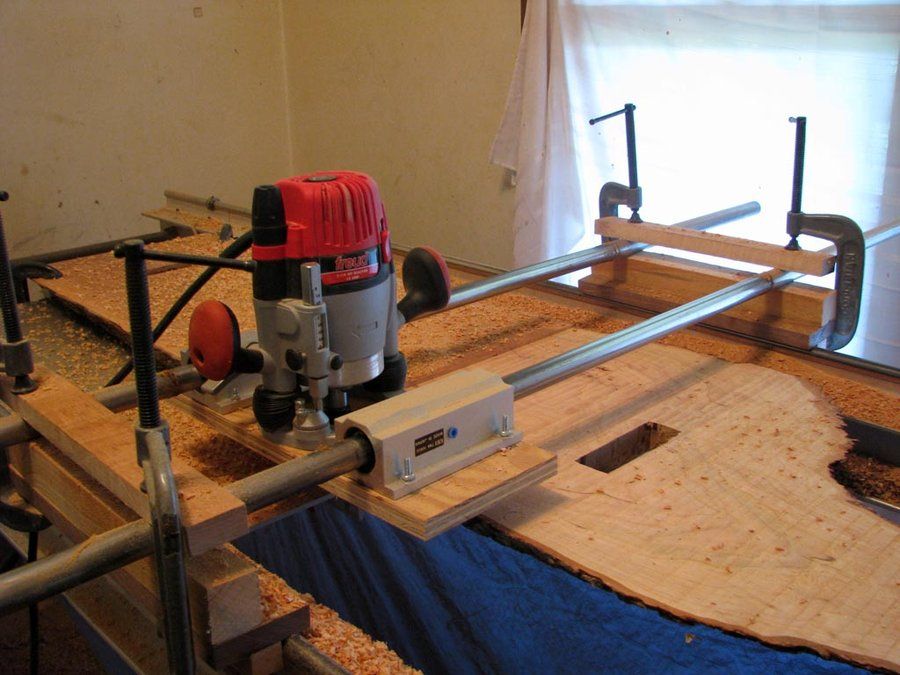
This was the simple setup I used to see if my sled would do what I needed it to do. After using it on one slab, I bought more bearings to make my sled a little more accurate and easier to use.









Comments
Cool stuff. Have you considered automating the whole thing?
I have been interested for a long time in the linear bearings on e-bay. $50 is quite a good deal. The unit appears to be made up of 2 linear bearings per unit? What exactly are these units called. Also how much did you have to pay for the precision ground shafts?
I used to do something like this using a wood sled system. Your setup is awesome !
Does the weight of the routher cause any say in the middle of the bars
It's so easy to use, I haven't even considered automation. Just slide the jig down 1/2" and push sideways, slide down another 1/2" and push the other way. I take off from 1/16" to 1/8" on each pass. My bandsaw mill gets the slabs roughed out so the slab doesn't need more than 1/16" taken off to flatten it, unless the blade is starting to dull and I haven't changed it quickly enough. The jig doesn't sag in the middle. The 1" thickwall tubes don't flex enough to measure without a dial indicator. Hey, this is a wood project, wood moves more than that. After flattening, I can't see any high or low places with a precision straight edge on the slab. That's good enough for making a bench. After flattening, I use a card scraper to get a final surface ready for finishing.
The best bearings are "Thomson Linear Bearings" or "Thomson pillow block bearings" They are listed almost every way on E-Bay. Plus there are other companies making the same type bearing. All sizes both inch and metric are available. Just make sure your shafts and bearings match. Bearings are easier to ship than shafts and most of the time you can find cheep steel shafts locally. I got the ones I used at a scrap dealer in my home town for next to nothing. The base is part of a custom duplicating machine... The base is 115" long and I use about 35 inches to duplicate gunstocks, which leaves a lot of room to flatten a slab for a table or bench. The base would also be easy to make using flat rails with skate board wheels on the top and sides for front to back movement. That's what I used to use before I started making gunstocks. The key to any jig is to use what you have or what's easily available to do the job at the lowest cost and least effort. Some jigs take so long to make and set up, you might as well buy them. I spent about 30 minutes putting together this jig from what I had on hand.
I have used a poor man's version made of 2" angle iron and a couple pieces of wood. I flattened a workbench top made of 2x4 lumber with it. Looks like this one is way more accurate
Greatidea the use of linear bearings makes for precise movement. Good thinking and follow through. If plans are available I will put one together for my chair seatat out of slab wood, thanks Bobswood
I like this jig because it is a unique, cost saving approach to a tough problem. Most of the others are home made versions of jigs that are available on the open market. However, this uniquely solves a problem with a commonly available router that would otherwise require the purchase of a drum sander or a really large planer. Great Job!
Any plans available? There's not enough information in this view to build one.
I take it the slide bars are solid steel?
Excellent Idea! This jig will be on my short list of things to build. I have 30mm x 64 inch shafting already. What diameter of router bit works best?
This is an awesome design! It looks just as well engineered as the 37" sled I bought from WoodHaven, and likely didn't cost $180 either.
Congrats on a very well thought out design, and apparently good working design!
I do highly recommend buying the 1-3/8" down-shear bit from WoodHaven. It's a 2 piece design, head and shaft, and is also a down-shear bit, which leaves an excellent finish. And with a 1-3/8" cut, it makes things go really fast.
http://woodhaven.com/Woodhaven-13537-138-diameter-screwon-cutter/M/B002UZ8ZM8.htm
For you guys out there who would rather buy one than build it, Woodhaven makes 3 different versions from 27" wide to 51" wide, and they do work really well.
But I think it would be a lot more fun to build this!
These do work VERY well for flattening large panels and glue-ups, and for planing rough stock as well.
I made a dedicated "table" to use mine on with a torsion box design, so it's very flat. It's a break down design that just rests on saw horses and hangs flat on the wall when not in use. I included hold-downs at the ends so the stock doesn't move. It doesn't take up much room at all to store, definitely a lot less than a conventional planer with similar capacity and cost a lot less too.
I highly recommend either building one or buying one. I rarely use my Porter Cable lunch-box planer since I bought mine, as even planing rough stock is just as fast if not faster with the sled. I just lay boards edge to edge across the 37" space and plane them all at once. They all come out at exactly the same thickness, no snipe and rarely ever any tear-out. Just too easy.
One more thing to mention, this will also remove a cup or a twist from a board, where a standard planer often won't unless you use a planer dog (AKA planer sled).
I did attach a dust collection hose to mine though, as this creates a lot of dust and chips! The dust port keeps it down pretty good though.
Great information!! Sounds simple to use.
Very nice solution Wrangler. I recently made a wooden frame to guide a router and flattened the top of my 6x3 foot workbench top. It gave an okay finish for a workbench but wouldn't do for a showpiece. I have been mulling over making something out of angle iron or slotted wooden beams. your jig is very cleverly put together and must leave a very level surface.
I live in Brazil and all this talk of "readily available" or "ebay" are the stuff of dreams. Bent nails and rubber bands are things more readily available and certainly add to the challenge of making jigs. Keeps me out of the pub!
I also have a Woodhaven planing jig and the two cutters that go with it. I also sometimes use a 2 inch bottom cleaning bit or a 2-1/4 inch drawer lock bit. I built the table based on Woodhaven plans, but added 30 evenly spaced 1/4-20 T-Nuts for clamping wedges down to hold the stock in place. Some boards can be held in place with carpet tape but I buy a lot of rough sawed lumber so I can mill it to the thickness I want and carpet tape doesn't work so well with it.
I am presently working on a router ski that is much smaller to mill my small stock. It will be built with 2 sections of 24 inch long 1x3 aluminum extrusion with 3 slots and a cut down router table insert plate drilled for my Milwaukee 5616-20 router that will slide in the center slot of the 1x3 extrusion. The initial milling depth will be adjustable by raising or lowering the extrusions that are attached to a slotted board at each end and held in place with 1/4-20 knobs. Then adjusting the router depth for fine tuning the stock removal with each pass. I am not sure yet what size stock I can plane with it, but it will be more than adequate to thickness plane the 50 or 60 pieces of 6x12x3/4 stock I use for my boxes and clocks.
Log in or create an account to post a comment.
Sign up Log in