
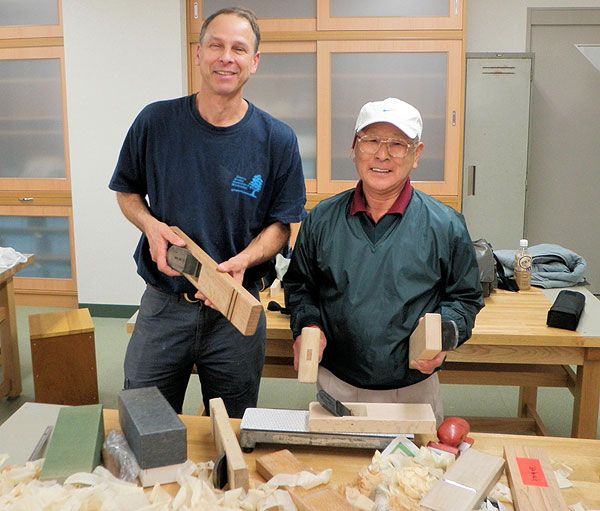
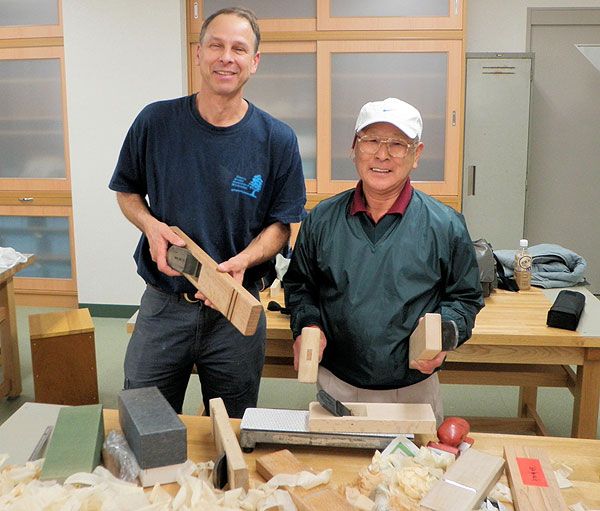
Two plane gurus. Hack and a master carpenter from Japan pose for a picture.
By Garrett Hack
Japan is a very different place. The country is highly modern and thoroughly westernized, yet permeating every aspect of Japanese life is a deep and ancient culture. It’s easy to appreciate but very difficult for an outsider to really understand.
I traveled to Japan for 2 weeks in December to learn more about one small part of that culture— the Japanese love of wood and their unique tools. Craftsmen have a long tradition of using them to build temples, shrines, houses, and wooden objects.
West did meet east as well, since I was also there to teach a class on our western planes.
Japanese tools
Japanese woodworking tools (or eastern tools in general, since Japanese tools are very similar to Chinese and Korean tools) are as different as our cultures.
Besides the obvious difference that we tend to push–they pull–we Westerners are often in awe of innovation and technology while Japan reveres tradition.
Where a Stanley bench plane has dozens of mostly metal parts and a modern alloy steel blade, a typical Japanese plane has a minimal blocky wooden body (a dai) and thick short high-carbon iron.
Their simplicity belies their sophistication–especially in the forging of the iron and the subtle and difficult tuning they require. This also helps to explain why Japanese hobby woodworkers are increasingly interested in the easier-to-tune-and-use Stanley-type planes. Another plus is the fact that the Western-style planes are more stable in our climates since they can cope with wide swings in humidity
Pull vs. push
Why pulling a tool evolved vs. pushing was always curious to me, until I saw craftsmen at work in Japan. Unlike saws (which can be thinner since buckling is not an issue), planes don’t work better one way or the other, so I didn’t understand their preference for pulling.
But if you spend most of your working day on a small cushion on the floor or working on a raised platform (nearly every craftsman I saw there worked this way), then using your body as a vise and pulling against yourself makes total sense. A heavy workbench is impractical in a country with such tight space constraints. However, Japanese carpenters do set up planing benches (stiff beams on X braces) to work longer pieces.
“Plane-Off” with a master carpenter
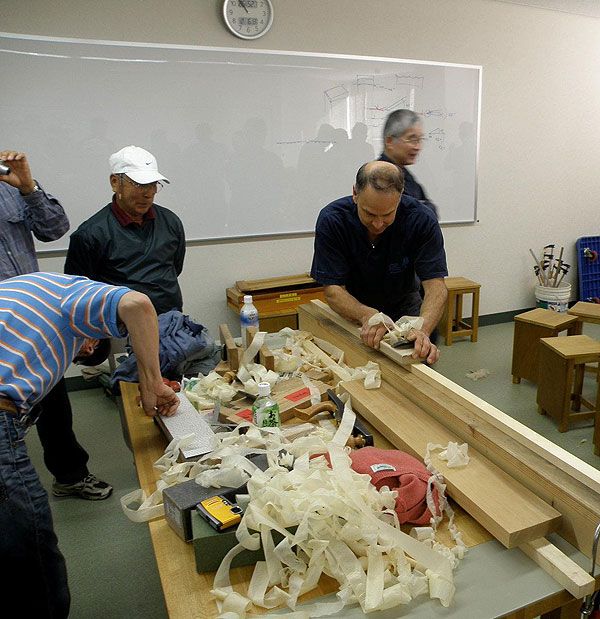
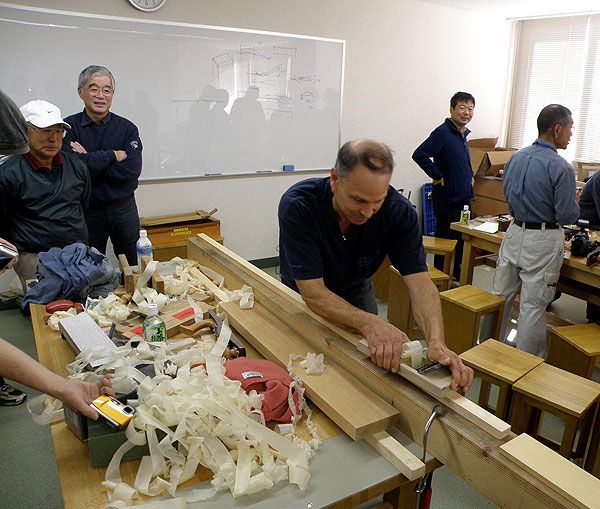
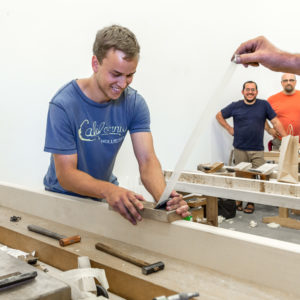
At the end of the class I taught, a master carpenter set up a bench and we had what I jokingly call a “Plane-Off”. He used typical wooden planes of various lengths; I used Lie-Nielsens.
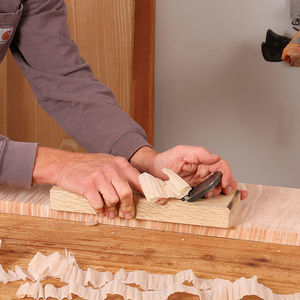
Naturally the class had a lot of laughs seeing me push his planes. They also got a lot of smiles testing my tools. Some were trying Western tools for the first time and were impressed by the beautiful thin shavings.
The master craftsman’s planes had cutting angles of about 37°, which made glassy cuts on the clear pine. But they didn’t perform as well on a piece of curly Vermont hard maple.
My LN #4 left a flawless surface, but Japanese pride made it very difficult for them to agree. It didn’t matter.
I went home with a gift of one of the master carpenter’s planes to use and learn more about, and I know I intrigued them with the precision of our quite different tools.
For more, read part two on Hack’s visit to Japan to learn about a visit to a dai maker and a blacksmith’s shop where they make plane irons and chisels.
-
Two plane gurus. Hack and a master carpenter from Japan pose for a picture.
-
Beautiful shavings. Hack nears the end of his cut as a Japanese master carpenter looks on.
-
The plane off. Hack tests out a Japanese-style plane during a recent visit to Japan.




Comments
Hey Garrett, I'm glad you had a good time, you are certainly welcome back anytime you like!
Stu
Log in or create an account to post a comment.
Sign up Log in