Here is an important helpful aid in modeling in 3D. Since it can be challenging to stay on axis, SketchUp has some handy ways to help us. There are four Arrow Keys on the computer keyboard -up, down, right, and left. If you need to draw a line on the red axis, click the mouse to start the line, then tap the Right Arrow Key. Note that no matter which direction you move your mouse the line is forced to follow the red axis. To force the line on the green axis, tap the Left Arrow Key. And to force the line on the blue axis, tap either the UP or Down Arrow Key.
These Arrow Keys work also with the Move/Copy Tool. So to force movement of a copy or component on the red axis, tap the Right Arrow Key. And similarly use the other arrow keys to force movement on the other axes.
As your model becomes bigger and more busy with multiple components, these Arrow Keys become a necessary feature to keep things moving and organized on the axes.
SketchUp provides another way of forcing the action along a specific axis using the Shift Key. In this case, you need to start the line or the movement on the axis of choice, then hold down the Shift Key. This will cause the line or movement to stay on that selected axis. So the Shift Key will work with any of the axes, but it is only depressed after the action is already going along the selected axis.
This site is protected by reCAPTCHA and the Google
Privacy Policy and
Terms of Service apply.
Get It All!
UNLIMITED Membership is like taking a master class in woodworking for less than $10 a month.
Start Your Free Trial
Up Next
Featured Workshop
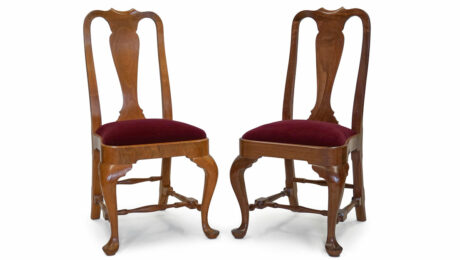
With its graceful curves, cabriole legs, and ornamental back splat, a Queen Anne side chair is a bucket list build for many woodworkers. Dan Faia had a very specific Queen…
Featured Projects & Plans

Discussion Forum
Highlights
-
Shape Your Skills
when you sign up for our emails
This site is protected by reCAPTCHA and the Google Privacy Policy and Terms of Service apply. -
 Shop Talk Live Podcast
 -
 Our favorite articles and videos
 -
E-Learning Courses from Fine Woodworking
-
-

Comments
Is there any way to move slowly to a point? Let say you want to draw a line 20" and you don't want to type in the 20 in the lower right box. The mouse seems to have a mind of it's own and will go on either side of 20 but not to 20. I know this is a stupid example, but you get the idea? I have used other programs that use the arrow keys to do this.
Thanks for tips above, that will come in handy.
Thanks Tim thats a great little tip. I've been wondering if the arrow keys were useful. Keep those little tips coming.
Paul
To tom8021: Click your Line Tool to start the line. Move the mouse toward the direction you want to go. Hit the Right Arrow Key to force the line on the red axis, for example. Then type 20 and hit the Enter Key.
(I'm assuming, but I can't tell from your note above, that you don't type into the Measurement's Box. That is, you don't click there. You just type and SketchUp puts the 20 in the box).
I'm encouraging you to type your exact lengths. You can waste a lot of time trying to make a line exact length by nudging the mouse.
However, if you set Precision in the Units Dialog Box - that is, from Window/Model Info/Units - to larger increments like 1/8, then it is easier to nudge to an exact length.
Tim
Tim
CORRECTION: In my previous note I made a mistake in the fourth paragraph. In lieu of changing the Precision variable in the Units Dialog Box, I meant to say to change the Enable Length Snapping value to 1/8 or 1/16.
Changing the Precision variable will not help you achieve a precise length by nudging your mouse.
Tim
Log in or create an account to post a comment.
Sign up Log in