When You Have Your Accident
My apologies for being so upfront with the news. Most new woodworkers show surprise on their faces when they hear this. But it’s true. It’s not a question of if you’ll have an accident. It is only a question of when. So many factors are at work here of course.
There is your inexperience working against you. If you’ve had more time in the shop, then you have your experience working against you. You see, as I tell my students, there are two people most at risk here on the [insert name of tool], the newest student and me. The newest student often doesn’t know what he’s about to do wrong. I, on the other hand, am at risk after so many years that I can grow complacent and let my guard down. Either way you can end up doing something stupid and avoidable. Therefore I have instituted rules for myself that I adhere to as religiously as any ex-altar boy can.
Your Stupid Days
On your Smart Days, when the Sudoku melts away in a blur of numbers before you or Will Shortz is taking it in his for the speed of your puzzle solving, on those days, you could push boards through the machines with your elbows and get away with it. You’re sharp, you’re alert, you’re focused on the work in front of you. Those days you have some general safety habits and you’re good to go.
But it’s on your Stupid Days that you need diligence. It is on your worst days, your triple low days, when you are distracted and not all there that you need iron clad habits. Those days when you’re still cursing the idiot that cut you off in traffic. Or you’re worrying about your taxes or dinner or why the banks want to charge you for too low a balance or any number of things except the imminent danger you have placed yourself into by walking into the woodshop.
It is on those days you need habits in place. Habits that even with a hangover the size of Rhode Island you will not disobey. For it is those habits that will save you when you have your accident.
Habits for Your Stupid Days
Here are some simple habits to adopt around machinery. When these conditions occur, then a little bell must go off in your head and you must pay attention. As I also tell my students around a band saw, your butcher uses one of these. Pay attention.
No sudden movements around a blade. Do not dust off the table of any machine when it is running. Always use a brush and not your hand to brush away sawdust. It seems simple but you’d be surprised how many people brush off their table with the blade running.
Wear eye protection. Wear eye protection. Wear eye protection. Not a misprint. You cannot blink fast enough. Something in your eye all day long is better than a Zen retreat when it comes to focusing your attention. You will be in pain all day and every time you blink. Wear eye protection.
When using chisels, always stay behind the business end of the tool. That way you can’t poke yourself. Get in front and you’re at risk no matter how smart you think you are.
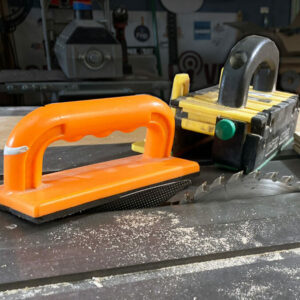
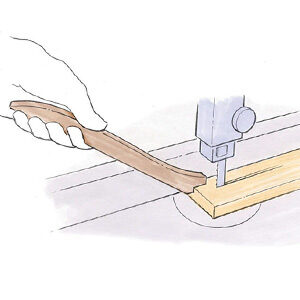
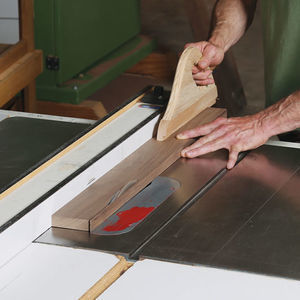
Use pushsticks when pieces get too small. When is too small? On the table saw when ripping, if the fence is closer to the blade than the width of my fist, I get a push stick. Even in the middle of a cut, if I discover my mistake, I stop and get a push stick. I stop the feed, hold the work carefully and having my push sticks always close by, I can reach for one and use it.
On the jointer, if my hand will even graze the jointer blade guard, I get a push stick. I have four push sticks of different sizes close by for use. Use them for thin pieces, long pieces that need to be held flat, extra thin pieces and extra long pieces. But have something between you and the blade if you’re going to get close to it.
I never get my fingers close enough to touch the housing of the planer while it’s running. That’s too close to the blades. I stand out of the way of the planer when it’s running and never, ever, look inside it while it’s cutting to see just how things are going.
Go head laugh. Like that gal with the long hair who turned on the drill press and yanked out a top knot because she wasn’t wearing a hat or hadn’t tucked her hair in. Remove your jewelry, men take off those neckties, get rid of the rings, bracelets, amulets, and charms you wear throughout the work day to ward off evil spirits. Take them off and be safe. Use a fence on a drill press to prevent pieces from spinning if you cannot clamp them down.
On the table saw, stand out of the way of kickback but stay on the left side of the fence so you can see what’s happening there. Usually a problem starts at the fence and ends up with kickback at the blade. Always know where your hands are at on a table saw jig, crosscut sled, or rip cut. Never get them behind the blade.
These are just a few things that I try to remember when I walk into the shop. It’s like knowing which hand is your left one. Have that information always at the ready and you will protect yourself the day you do something stupid. You probably have other methods for keeping yourself safe. I’ve just scratched the surface here. Let me know your habits for your stupid days and we’ll all be safer.
Gary Rogowski is a Contributing Editor for Fine Woodworking Magazine and teaches at The Northwest Woodworking Studio in Portland, Oregon. http://www.NorthwestWoodworking.com




Comments
The recent settlement because the saw did not have a finger protection capability; i.e. SawStop . . . this is why we urgently need liability reform in this country. I'm sure the saw "jumped up and grabbed him". When we buy and operate machinery that has the potential for serious injury we accept the responsibilities that go with that piece of machinery. What ever happened to defects in material or workmanship of the product determining liability? Operator error is not one of them. How much more will our tool costs increase if this becomes a trend?
My trick to stay safe is... to stay scared! Since I've started woodworking last year, I remember being affraid of my roaring table saw. I stepped back the first time I started my router wondering when it would reach it's full speed(It didn't seem to want stabilize and kept accelerating until finaly reach it's peak!!) I broke a Jigsaw blade while taking-it out of my piece and forgeting to release the trigger before doing that. I could tell more, but my ego is getting hurt a little ha ha ha!
Now, that my dumb novice performances are done, things go much more easier. And so I keep wondering: What's the next thing that will happen. With that in mind, I'm always working with an anticipation of something might happen soon, because something HAPPENED before. Sometimes a breaking piece of wood kickbacks in the air, or a bad fixed fence moves suddenly. But I don't jump by surprise putting myself in danger or doing reflex moves when it happens because I'm almost waiting for it to happen. I'm wearing glasses, earplugs, good shoes, and no gloves. I do what I have to keep myself out of risky danger.
So keeping my mind alert, without over stressing about-it keeps me in good balance mentaly enough to enjoy what I'm doing as well. It doesn't garanty accidents won't happen, but at least I think I put chances my way.
Hi Gary, I just read your article, and yes it WILL happen. I don’t have a lot in the line of power tools, radial arm saw, and a ryobi router and table, just as dangerous as any machine. When I go down to my shop, I generally have a smoke and during this time, I walk around and collect my thoughts, as well as any thing I think I will need close at hand. Before I start I check for any adjustments, make sure every thing is square, tight, and in working order. Should I find I am NOT paying enough ATTENTION!, every thing gets shut down till I can FULLY CONCENTRATE!, this is my way of being safe. garyowen
@HowardA thank you for saying it. Our Tort laws need to change, stupidity seems to be an income now a days (Along with your own dull life on a reality TV show).
It truly saddens me that individuals seem to have lost respect for tools and general objects around them, almost like the subconscious is saying, "If I get hurt I don't have to work anymore". Those of us that make a living doing this are going to be hurt terribly I fear. Not to mention most building industries. I don't want to have to replace tools cause of insurance premiums.
I've actually been in the market for a new table saw and as much as I love the concept of the SawStop, I worked with technology for almost 15-years before getting fed up with it, and I have to say I don't want it between me and the business end of a very important tool. Don't get me wrong it's a great idea but I fear over time a failure could cost me a lot of money in both time and parts. Besides who wants to have to download an update for a power tool? Next they will have a monotoned woman barking directions at me cause I'm feeding the board to fast/slow/whatever.
It's kinda like an automobile, some people just shouldn't have one.
Everyone always seems to be worried about the equipment causing an accident, When many times it is something the operator has not noticed about the wood. Take a close look at your wood before it meets the cutting edge of the tool. something as simple as grain direction, knots, or snipe are usual suspects. Yes snipe. Listen to the wood as it is being cut. Learn the sounds of wood as it is being finely sliced by each rotation of the blades. Smell the air for smoke. Its telling you your binding or your blade is not clean or sharp. Don't get me wrong inspect your equipment and use good safety practices with your equipment. It just seems wood inspection gets left out of the equation to often. Know your woods an their tendencies also.
I am a full time woodworker and policy regarding machinery is simple, it is 100% attention or no power tool work for the day. Going to bed late at night, overworking, worries, and so on will surely lead to disaster. There is still enough work to be done without risking a crippling injury. I would rather skip over a deadline than skip over my fingers any time. Couldn´t agree more with you about push sticks, make a bunch ank keep them close at all times.
Great article... and very true.
For me it was on the router table using a lock mitre bit without a supplmental tall fence... the piece stood on end (a short piece to test set up) got pulled into the split fence gap by the bit and my off hand (guiding it) went with it. It wasn't bad, but enought that it merrited a trip the local ER to have it looked at. They described it as an "angry wound" ... i.e. "you made hamburger out of the tip of your finger!".
I had a thought a split second before the accident that this wasn't as safe as it could be... then it nipped me. Oh... should mention it was really late (1am) I was trying to finish a project for a deadline...
A co-worker cut about 1/2" off the tip of his finger at the tablesaw about the same time.
You'd be amazed by the collection of push sticks and work holding devices I have now to keep my fingers safe.
Thanks for helping keep us all on our toes.
One rule I have in the shop is that if I make three mistakes in a day, and it doesn't matter how small or silly those mistakes are, I shut up shop. I'd rather lose a day's work than a finger.
An amateur U.K. cabinet maker.
Before I start I assume that I will be badly damaged. Thus, I make doubly sure that router bits, fences, hold downs and guards are firmly in place - same with all machines. I then assume that the timber is going to kick back and I ensure my body line is not in line with the timber. I do a dry run to ensure free timber movement etc. Goggles, mask, ear defenders on and a final eyeover check. I am aprehensive on using the weighty 1/2" router freehand particulary on the Leigh jig. So gently does it. Hand tools follows a similar practice. Blades are always moving away from you.
I never start if I don't feel like it or not up to it. I also ensure that someone is close at hand to pick up the bits. After some years, I have only suffered minor cuts and abrasions usually from the timber itself. A copious supply of plasters etc are at hand - I hate to see my blood on timber. I always assume I will get damaged.
I don't mean to get personal, but PATWRECK should stop wood working before he kills himself. No-one can be a safe woodworker let alone a fine and creative craftsman whilst being terrified of the machinery. Fences should not slip, kickback should not happen. Wearing any ammount of body armour to protect ones-self from timber projectiles, whilst being a sensible precaution, is not the first line of defence. Why are PATWRECK's fences badly locked, or tablesaw regularly kicking back, to the point where it is expected? All the machinery should be working correctly, fences rigid and adjusted so kick back is prevented. Being English, I'm used to our tablesaws always being fitted with riving knives (with crown guard) by law. More recently, motors have to be fitted with brakes to stop blades quickly after hitting the stop button. I would advise all American woodworkers to have both these modifications to their tablesaws and enjoy much safer and less nerve wracking woodworking. I have NEVER had a kickback in 20 years of woodworking because I always used a tablesaw with a riving knife and a correctly aligned and rigidly locked fence. I bet that statement will make American woodworkers think, but it is true. SawStop devices would be seem as un-necessary as hands aren't going any where near the blade, are they?
Anyone who feels unsafe whilst using machinery should spend some money on good woodworking lessons. Knowledge is a great safety feature and as worthwhile paying for as goggles, dustmask or ear protection. Then spend a little more on some high quality fences and guards. Too much? Then seriously consider giving up woodwork as a pastime, because the loss of digits and eyes will only be a matter of time.
Safe woodworking,
Mike.
Thanks for the comments, Gary. Totally agree that each station, each machine requires its own kind of "safety policy" for operation. And that includes everything from hand tools to the radial arm saws. As someone who used to see a lot of workplace injuries, I will add that even the best safety programs become stale after a while, so I recommend some kind of new plans every so often. Make a new push stick that will force you to pay "new" attention on your saw; put up a new safety sign; add a new fence. We are creatures of pattern and habit.
Just a quick word to the tort reform fanatics:
There is little evidence that tort reform actually does anything to reduce prices in the market. And the vast majority of people truly injured by faulty products and people, never sue. Personally, I think that we need some reform on frivolous suits, but I like the idea that someone is looking out for lead in my kids toys, hanging and collapsing hazards in his crib, etc. The people that benefit from tort reform are not us, it is the insurance companies and the Chamber of Commerce. Don't believe everything you hear on AM radio.
I have had the accident of which you speak, badly damaging the tips of my middle three fingers on the jointer. It just shows you that taking your mind of of something in the shop for even a second can change things permanently. I know that Norm always used to say "Read and understand all the rules that come with power tools," but that bit of advice is priceless too. My first inclination was to question the jointer, but I soon realized it was all me. The accident has put a sense of fear and awareness in me when I turn on any tool in my shop, which I hope will be enough to keep me safe.
Another thing I have found important is to let family or friends know you are working on a project. It is easy to be ripping a piece of stock on the table saw and be distracted by someone coming into your line of sight or hear someone yell for you, and take your mind off the workpiece. It may cause an argument with the wifey, but she wouldn't want you to get hurt, at least I hope not. Good article.
I always begin my shop session with a simple question, "Where are my fingers?" The answer to this informs my day and as Dan points out, make 'em habits! It takes 30 days to make a habit AND 30 days to break one. Some of us need to evaluate our process and put the fix in BEFORE anything happens.
always,
J.C.
HowardA. Thanks for sharing the safety tip with all of us. Always nice to see someone stay on topic.
Ahh. wait. you didn't.
Thanks
Gary
Thanks for all the tips. I use all of them. What frightens me is that I have no idea where I learned them unless I learned them from reading FW and watch television shows.
I learned something new last weekend. When you are used to working alone, someone else in the shop is a distraction that can lead to bad results. For the first time in 27 years, I caught myself putting a table saw blade in the wrong way. I have never done that before but I was doing some work for a friend and he was in the shop with me. That's all it took. I doubled my guard the rest of the visit.
Also.. Rule number one. I don't go near anything with a blade other than a kitchen knife after I have had (or while I am having) a drink. Never have and never will. ( and I do like to drink ;-))
Great set of rules Gary. Some I have already figured out but I'll certainly be adding the rest to my checklist.
Speaking of my checklist there is one additional rule that I follow religiously. Whenever I operate my tablesaw or any power tool with an exposed blade I always plant my feet securely before I turn on the machine and don't move them until the blade stops. It sounds awkward but I've always found a position that will allow me to feed the machine and stay out of the way of potential kickback paths. It's all too easy to stumble and fall onto a spinning blade or router bit.
(Yes, I realize that I should have a blade guard but the guard/splitter that came with my old Rockwell Beaver is more of a safety hazard than a protection.)
In my years as a cabinetmaker and a shop teacher, I have had my share of of cuts on the table saw and router and seen much worse in the cabinetshop... (fortunately only a few minor nicks to students) but there has been one common theme to all of the "accidents"*: being in a hurry! We tend to do dumb stuff around machines when we are in a rush, or think that we don't have enough time. "the truck is waiting", "gotta get it out before lunch", "the glue is going to set up" whatever. The result is the same, we move faster than our brains can keep up and get too close to the cutting edge. Funny, I have always had a "feeling" just before I got cut that what I was about to do was not right, then Ouch! Fortunately, still got all 10. Always managed to cut myself with the grain, not across! [*I told my students there was no such thing as an accident, you did something the wrong way, and need to figure it out so you do it differently next time!]
I appreciate all the suggestions here to stay safe. I have another one. I always have several projects drawn up on gridded paper, one or two in the woodworking stage, maybe one waiting on the glue to dry and one in the finishing stage. On my stupid days, I put down my chisels, unplug my power tools and go work on my finishing. I've never been injured applying another coat of Danish oil, shellac or wax.
Does anybody have experience using a power feeder? I am thinking of buying one for my table saw.
Gary said accidents are more likely to occur when you're tired and distracted. Perhaps this is true, but my worst accident came when I felt sharp and everything was working really well. I even noted to myself how efficient I was working one day, just before I cut off the end 3/4 inch of my left thumb.
I was ripping a relatively wide boards into 2" strips using a push stick in my right hand. My left hand was handling the board to the left of the blade. On the last cut my left hand was following through with the offcut and the thumb went through the blade. I consider myself lucky in that I still have most of my thumb.
Also consider this: cutting off the thumb hurt, no question about it, but what really hurt was the long recovery period. I've never felt such pain as wet-to-dry bandages. It also hurt my confidence, and I felt like I let down my wife who trusts me to be carefull in the shop.
HowardA - you're almost there. Yes it is a HUGE problem that we now live in a world that our carelessness, stupidity, or laziness can be blamed on others, and make us rich. The answer however is not more laws. What is needed is for America to return to Constitutional law (common law). When most people look at the money and corruption in elections, they immediately think "campaign finance reform", but only those who sit and think about realize that the campaign money is the symptom, NOT the problem. The problem in that case is that politicians break their oath to the Constitution by giving away trillions of dollars in clear violation of the 9th and 10th Amendments (MOST of the things that Congress does today is against the law (Constitution)). Te same is true here. An honest judge would refuse to even hear such a case, let alone allow it to a full trial. Read the Constitution over as many times as you like, you will find nowhere in it a right to be reimbursed for not protecting/defending/taking care of yourself. Thus rather than Tort Reform, we need to start voting out judges that hear such cases (and voting out politicians who appoint such judges in the case of judges that do not stand for elections). Sorry for the rant... I completely agree on ALL other points... makes me ashamed to be a woodworker in America
There are no accidents. Only mistakes
RE to Mickey T
I'm not taking your comment personal because I think you over-react the situation and got me wrong, probably due to my unclear description in my comment that I wanted to keep short and sometimes I don't know how to realy explain what I want to say because in fact I speak French. I'm Canadian, so please stop blaming the Americans...
I don't say all I described happens everyday, but it did all happened at least once, and I'm not a shamed to say I had bad working habits and little knowledge of my equipement because I was in the learning process. Now if everyone would give up the first time they don't succeed, I think there wouldn't be a lot of woodworkers around us.
I didn't take lessons, but all I know and learned to this day is almost all in Fine woodworking magazines and by reading people on this website. I can tell you today that I know what a riving knife is and it's purpose, but I don't think I'm the only one who as a begginer, took off the guard and told himself why the heck do I need this thing before.
But I have to admit that I totaly agree with you when you say people should take good lessons to get knowledge because safty is always what comes first in lessons and all I described might not have happened if I had the knowledge at that time.
And what I meant by being affraid of my tools was a way of saying "alert". And with all of this happening, I know now that all my tools can be dangerous, so I don't need a Sawstop and work stupidly and lazyly until the day the Sawstop device fails and cut myself a finger.With that said, I have to admit that the sawstop is indeed a great invention that should be used in industries where everything isn't quick enough for the boss and the chances of accidents are high, but in my tiny shop I prefer to stay alert and keep in mind that anything can happen, and that doesn't stress me at all. In fact, I'm more scared in the trafic with people not knowing how to drive around me.
With that, I still have my 10 fingers And I hope it's not just luck. But like Gary say's, "when it will happen" Well that day might be tommorow, or in 10 years when I stop being alert or careful because I'll be thinking how experienced I am.
So I tried to make a light and short comment the first time, but had to make this big explanation. So next time I'll try to make myself a little more precise.
Thank you
Pat
Gary, thanks for the post. It is a good reminder. Having a kid around when I was doing some work helped drive home these key safety points. One, I wanted to model safety for him, and two, I wanted him at least 15-20 feet away when I was using table saw, drill press, band saw, etc. - and out of the line of fire. Of course, he had to have both eye and hearing protection. He learned these safety rules and if he ever comes in to the shop when I am working, he follows them - knowing he will be kicked out otherwise! :) And I owe a lot of my appreciation for shop safety from an old cabinet maker that lived up the hill from my folks - with shop equipment dating back to the mid-30's/40's. Fun times and a great learning experience. Even so, I have had my share of accidents - kickbacks, pieces grabbed by a blade - but no serious injuries,and each one made me operate a little more safely - and walk away if if I could not maintain focus. I think this latter is one of the most important safety rules - walk away when things don't look or feel right - they aren't.
Hi Gary...thanks for the article. It immediately caught my attention...I'll give you 3 guesses why but you're only going to need one. :( ....I was resawing a 3/4 peice of walnut on my table saw, and on the second cut, the OUTER piece kicked back and took a good 1/4 inch chunk out of my rt middle finger. Then the inner piece kicked back into my stomach. Sheesh. It happened because of my inexperience....I also have been really stupid lately.....lot on my mind. I have a list of things to do tomorrow: 1. Already bought some bifocal safety glasses. 2. Install the guard and antikickback thingy on my table saw. 3. Change the dressing on my finger....(that really hurts). 4. Look into a band saw for resawing. 5. Not sure. Any suggestions out there?
Thanks, Dale .....Michigan (sharp objects scare me)
To DaleJo, I don't have a bandsaw yet, but can't wait until I have an 18" one so I can resaw rough boards and save some of the lumber yard milling costs. I would not use my table saw to resaw boards. First, you are severely limited by the depth of cut, so you can't saw a board more than about 4" wide - or "tall" in reference to the table - and second, the saw kerf of a circular blade is going to waste more wood that a bandsaw would.
I have been involved in a lot of dangerous hobbies in the last seventy years, skin diving in the 50s, sky diving in the 60s, hunting in the 70s, rock and ice climbing in the 80s, not to mention motorcycles and shooting sports, and I have found that getting complacent is the number one problem for safety. Pushing the envelope is number two. Every hundred jumps or so I used to sit down and have a long talk with myself about how lax I was becoming. "The important thing is not getting that perfect photo of another freefaller, dummy... it's the ground coming at you at 120 miles an hour" I would tell myself. I managed to bust myself up a bunch of times over the years but I'm still alive. None of the accidents were during "dumb days" and most came out of the blue because I was getting too comfortable with the potential dangers. I used to have a light hanging over my table saw with a pull chain. For years I looked in vain for one of those joke-store severed rubber fingers to hang on it as a reminder of what could happen. Recently I noticed some drops of brite red paint across the floor of my shop I must have spilled and every day I see them and think "that could be my blood." That helps as does seeing the big red first aid kit haning on a peg just waiting for me to screw up. Flying Magazine used to have a regular feature called I Learned About Flying From That recounting near accidents and their causes. Might be an idea for some woodworking mag.
Thanks for the comments Gary. I just looked at a post over on Lumberjocks.com with pictures of an unfortunate accident and this is very timely for me. I've worked in manufacturing plants for over twenty years around dangerous equipment and settings that can take your finger or your life. I have gone through educational classes about safety many times. I am convinced that there is much the woodworking community doesn't know about the nature of accidents because information is expensive. You're correct about two things that cause accidents - unfamiliarity and complacency. There are other things such as inherent risk. My favorite example of this is the "push block or stick". If you will look at the literature and videos available with the GrrRipper, you will see the design flaws of a push sticks. I don't work for them either. I use them though because I see the safety advantage. Another of the risks of woodworking that doesn't get a lot of attention is back injuy. How many times do we go to bed sore? Years of poor posture bent over a bench set to the wrong height is not a recipe for a happy retirement. And, don't get me started on trip hazzards. Anyway, stay sharp and safe...
Gary et. al.
Safety, while often in the back of our minds, rarely receives the time that many other aspects our craft see.
Reading through the numerous suggestions and approaches listed below, one simple routine which can help is to have a printed list posted in the shop.
I've worked in manufacturing for 16 years and the one thing that never fails is human nature.
We want to improve our process. Shorten the time it takes to go from A to D or E, just don't let E be the Emergency room.
Clearances:
** Floor --- Slip, trip, and fall hazards are the #1 workplace cause of injury. Musculo-skeltal disorders...
** Overhead --- if there is something for me to hit my head upon... I will... Clear your work space.
** Clutter --- Tool surfaces free of debris, floors clear, air clear.
** Dust Extraction --- This goes with floor, clutter, and air.
** Chemicals --- Not talked about as often at the obvious spinning metal cutter, though chemical exposure is a serious hazard during the final phases of any project.
Of course we could go on and on...
If you are rushing to complete a job or project... Stop
It is especially during this time you need to leave the shop.
Fatigue causes impaired judgement...
Do you want to explain to your children, spouse, coworkers that you were foolish enough to cut off your fingers or worse, because you were rushing to get to the end of a project before going to a movie?
Mike D. Portland Oregon
Having flown helicopters in the navy for 20 years I can tell you that the safety concepts described here are universal. Pilots are at greatest risk for an accident when they are flying very rarely (low experience and proficiency) and when they are flying too much (fatigue and complacency). The concepts seem to apply to just about every dangerous activity. In the middle is the perfect mix of sufficient skills and experience. It doesn't mean there can't be an accident, just that there are fewer of them.
Great article on developing safety habits. I try to live by the mantra "The woodworker's mind must be the sharpest tool in the shop." I do woodworking for pleasure so if I'm not mindful of why I'm in the shop, I don't go into it in the first place.
Peace.
good info... i've just read it too late, and had my stupid day.
thanks for all the tips!
Log in or create an account to post a comment.
Sign up Log in