
The late Tage Frid wrote, in his 1979 book Tage Frid Teaches Woodworking, “I don’t care how it is made – he [the craftsman] can make it with his teeth or a machine – it is still the final product that counts.”
Sure, tools and methodology are essentially means to an end. However, the way we accomplish things and the nature of our work-life is important too. This is particularly true for the avocational woodworker who is under less production pressure than a full-time professional and thus has the luxury of choice as to how he feels while he is working. In general, I feel better when I’m using my hand tools than when I’m using my power tools, and so there’s one point in favor of hand tools. I also feel good when I see steady progress through the stock preparation phase of a project along with the repeatable precision of machine work, and so score a couple for electricity.
Yet, there’s more to this issue. Hand tool woodworking is a mentality, an approach, almost a philosophy. It does not mean the absence of power machinery. Rather, I believe the hand tool woodworker is one who recognizes that he can impart degrees of quality and personalization to his work with hand tools that are unlikely or impossible with machinery.
This applies to two aspects of woodworking:
The first is methodology. The hand tool worker thinks and plans work differently than those ruled by machines. Processes are incremental. For example, relying only on the table saw to crosscut a drawer front is not likely to produce as excellent a fit as shooting with a hand plane, where fitting can be done in increments of just a couple thousandths of an inch. This level of control builds a relaxed confidence.
Hand tools also allow for error compensation and avoid error build up. For example, in making tenons on the table saw, a machine woodworker is likely to measure stock thickness and assume a sort of perfection, even though the slightest inconsistency in stock thickness can create poor fitting tenons. A hand tool woodworker would work from one reference face of the stock, cancelling small imperfections in stock thickness. If he did use the table saw to make the tenons, he would adjust the machine with a one-sided tolerance, mindful that he can later remove a shaving or two with a plane if necessary to produce an ideal fit. Machines, yes, but on your own terms.
The second aspect of hand tool work has to do with the aesthetics it engenders. Interesting joinery, resplendent surfaces, subtly treated edges, and satisfying contours are some of the distinguishing personalized features we are at ease producing with hand tools. One may use a bandsaw to do most of the work of creating a pleasing contour on a table leg, but a spokeshave and rasps will refine it to a quality that a power sander alone is not likely to achieve. Maybe a round-over router bit gets an edge close to what you want, but a plane gradually alters the mathematically produced edge to something that is less readily definable, but is just what you want. The vision, the work, and the product are personal.
It’s nice to drive to the mountains and even drive through the mountains, but it’s not as nice as hiking them. Power tools drive you there, but hand tools walk you through.
Hone your hand tool technique with these classic Fine Woodworking articles and videos.
Hand Tool Tech from the FWW Archive
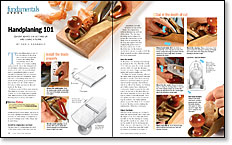 |
Handplaning 101  Learn the basics of handplaning a surface so that it is flat, straight, and smooth. Handplane users who have struggled with technique will find tips from expert Chris Gouchner to guide them along the way. |
 |
Mastering the Card Scraper Learn card scraper techniques which once mastered, will help you smooth surfaces and transform your work. Plus, be sure to watch this free video on card scraper technique. |
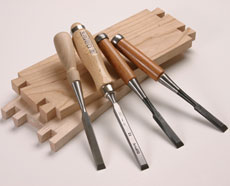 |
The Essential Chisel Set (video) Garrett Hack answers questions on choosing and using chisels. Learn about the eight chisels this seasoned furniture maker can’t live without. |


Comments
I think one problem with handtools is that we pass along the fantastic information too late in life, or we inherit the want too late in life. Should always be shown to young woodworkers early in an effort to encourage confidence.
ITS ALL IN HOW TO DRIVE IT, WHERE TO DRIVE IT, AND HOW TO HIDE IT.....
Power tools for hogging out - hand tools for final fit...Oh yeah, and I wish I had become comfortable with edge tools at an earlier age. Starting with them later I lacked confidence and very literally held on too tightly which has caused tendon problems in my hands. In fact, I am now three weeks into recovery from surgery to remove a ganglion cyst and clip a "pulley" at the base of my right hand middle finger...
Slide your table saw fence to the mark, flip a switch, push a board past a spinning blade and you'll get the same result as anyone else who uses that procedure. Now rip that board with a good handsaw(preferably one you've sharpened yourself), square the edge with a jointer plane and then tell me which method gave you the most satisfaction. I use power tools sometimes when I don't want to take the time to use my hand tools, but I always feel that I have cheated myself out of a satisfying experience just to save time. Also, power tools are dusty, noisy and dangerous. I could probably cut my finger off with my Disston D-15, but I'd have to work at it. Bottom line - I don't think it's possible to achieve the same level of pride and satisfaction when you build something using mostly power tools as opposed to making that same item with hand tools using tradition methods.
A finely tuned jointer plane will always leave a straighter edge than any machine, and you can hollow your edge joints if you like....to within two thousandths of an inch over a 28" edge.
A finely tuned smoother will leave a finish that does not necessitate sanding, one that is not muddled with dust when you apply the finish.
Why do antiques demand such a high price? It is the workmanship.
Owning and running a metal fabrication repair shop business equals a lot of stress. At home, just a few minutes woodworking, especialy with hand tools seems to suck the stress right out, and brings things back to level.
As a new woodworker, I'm finding that some 'on a budget' power tools are better for getting close to a final product which has forced me to start using hand tools. Boy am I grateful for that experience! The best of both worlds.
I AM-
;)
I love to obtain a fine result however I need to. I can do things I am not capable of with hand tools on my tablesaw. But, I can do other things with a surgically sharpened Sorby chisel that I cannot do by machine. I love to hit the balance. I derive pleasure from both disciplines. I can produce fine work and immense satisfaction from both disciplines. What I intensely dislike is elitism and aloofness that would have me feel small because I do something else. It is the kind of thing that taints my other interests- music, cycling, etc. I built my own muzzle loading rifle 20 years ago- took a couple of deer with it. Took a couple more with a modern weapon. Result was the same- harvetsted my own, dressed and butchered my own, at it, tanned the hide, etc. Lots of satisfaction and good eating. But, don't make me feel badly because I chose one way over the other.
I spent a lot of time and (unnecessary)money learning to sharpen plane blades and chisels, but once mastered - there's nothing sweeter. An old Stanley No.65 with a Hock blade is an incredible tool!
It sounds like you have achieved balance in your woodworking life. As a general rule I have found that if I am wearing ear protection I am not having as much fun as when I don't have to.
It is similar in the Sailing, and Wooden Boat building community . . . There is a phrase -"It is often more about the journey then the destination".
I find the balance between the two by using power tools to perform apprentice tasks like dimensioning quickly and shifting to hand tools for craftsmanship elements.
Mr Frid must have read/ heard this quote somewhere along the line as they are very similar:
"A craftsman is one who understands his tools and his material and uses them with skill and honesty. It does not matter whether his tool is a chisel or a planing machine, it is the work the he does with it that counts." - Thomas Hibben, The Carpenter's Tool Chest, 1933
At any rate, I find myself returning to the use of more hand tools in my work. I still use a table saw, band saw and jointer/ planer but, the hand tools remove saw marks and clean up the edges better than sandpaper or any other method. It also makes time in the shop more enjoyable for me. I feel more connected to the project at the end. And taking pride in your work is what it's all about I feel.
It doesn't matter if you are using power tools or hand tools, keeping a constant reference is vital to not compounding errors. If you do not do this it is because you either don't know any better (ok), you don't think you make mistakes (naive) or you don't care (?)
It's interesting to note that when using power tools I get purposely stressed to remind myself that I could loose a hand if i'm not careful. My mind is racing 1000 mi/hr. 'make note of the emergency shut off, where is the fire extinguisher, where is that first aid kit, where is that push stick, protective glasses, ear protection! etc. When I use hand tools I am purposely calm in order to reflect on what I am doing almost like I am standing outside myself. They are polar opposite methods of working with wood.
For me, the key issue is balance. Most of us probably come to woodworking through the usual route of being frustrated with the dull hand tools our fathers let us use early in life, bought our power tools as soon as we could afford them, then realized their limitations and overcame those limitations by acquiring and building our skills in using, and most importantly sharpening, a set of hand tools. I'll never give up my tablesaw or router but at the same time my hand tool and water stone collection is growing -- and being used.
I like using hand tools because I make my mistakes slower.
Often they are caught before they are done.
Give me car in the mountains any day over walking in them, but I just find it boring walking up mountains.
A combination of Machines and hand tools are essential for efficient building of furniture - Machines do all the grunt work, ripping, flattening and thicknessing boards etcetera (saves on the cardio vascular workout), then start the enjoyment of using the hand tools to fabricate a piece of art or heirloom
There is little or no doubt in my mind, that if our woodworking forfathers had power tools they most certainly would have used them.
I can appreciate fine hand work. I have a brace of planes, chisels, and other hand tools that I cherish. However, I don't let the use of one tool prohibit the next. I use tools as they were meant to be used. And that's settled by ashking, "whats the best way to do this".
I think power tools for the hobbyist are dangerous, harmful and create anxiety out of an activity that is supposed to be meaningful and creative.
The power tools sold to us create unacceptable decibel damage to your hearing. The cheap lunchbox planers should be outlawed and the failure of manufacturers to use the latest safety technology is borderline criminal (sawstop technology needs to me mandated). Power tools prevent us from working at certain hours or in crowded conditions (noise) - they create unnecessary tool purchases to clean up the air left by the power tools. Woodworking forums and magazines are replete with articles on how to work safe. Yes, a saw and chisel can also be unsafe if used incorrectly but just ask yourself whether you are enjoying the experience of power tool interaction when you are worrying about toxic dust, high RPM routering or fear of kickback, etc.
I say this as a power tool worker. I think the argument for/against hand tools is only necessary or interesting because we have failed to produce better technology to combat the noise, capacity for harm and the polluting effects of power tools. The argument for hand tools is a reflection of the poor quality of power tools.
However, too much technology is also bad - like those CNC routers where everything is carved or made by machine. Is that really woodkworking or just manufacturing. Likewise, who wants to spend multiple hours with a handsaw and hand plane to do what a bandsaw and planer can do to make 3/4 inch thick planks.
This is not an easy either/or discussion. I advocate a balanced approach and pressure by us to force manufacturers to improve safety as well as cut down on the decibels. Think about it - there is an article in FWW on how to close all the gaps in your contractor saw to improve dust collection. So we are fixing stuff that manufacturers did not bother to include in their products. I would rather buy a saw that has all those fixes - I hate spending money or time to make a machine better because of poor manufacturing - but others like to tinker so market forces drive sales of substandard products courtesy of harbor freight. We need to band together and stop buying crap and demand better machines.
I use both power tools and hand tools. Power tools are fast and easy to to the rough cutting. And they are accurate. But hand tools can sure do a better job of finishing. In my judgment no power tool can get a table top as smooth as a hand plane. I also cut my dovetails and mortise and tennons by hand. Not as fast but I like them better.
I'm in the "balance" camp. I genuinely pursue two things to improve my woodworking experience:
1) Quieter, cleaner power tools.
2) Sharper, better tuned hand tools.
Empires you are so right,I had a classic apprenticeship 5yrs then stopped fine woodworking to make much needed money in mass production,now I am 57 and realise I made the biggest mistake of my life,I am now trying to pick up where I left off and man its the hardest thing I have ever done,sure I am rusty but I will get there,I repeat this over and over,who knows maybe one day?Im not moaning,but like you say I wish I knew then what I know now
I think a key issue is the cost. I have all the hand tools (and of the very best quality) I need to make every imaginable joint/cut for less than the cost of a decent table saw. Unless I'm getting paid for production, paying thousands of dollars to reduce the time I get to spend woodworking doesn't make a lot of sense.
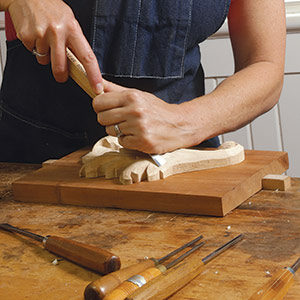
When I started woodworking about five years ago, I bought all the necessary power tools and I enjoyed using them to create boxes (first) and basic furnature such as tables and small cabnets. Eventually, I needed a small plane to finish the edges of my panels. As soon as I started planing the edge, I was hooked. I love hand tools and now have several planes, chisels, gouges, etc. While I do not hesitate to use power tools for initial shapinf (dimensioning), I finish every project with hand tools. I just finished a reproduction of a 17th century Chippendate chair (ball and claw) and I have never enjoyed woodworking so much as when I shaped the ball and claw using chisels and gouges. Do that with a power tool!!!
I started getting serious about woodworking as a hobby two years or so ago. I am stationed in Germany and we have a very nice woodshop available at the base where I am at. So I started using those machines in earnest. As I started developing my skills, I soon found that achieving the level of accuracy that I desired was not happening in the shop. I then started to think that if I had my own power tool shop, I could get better accuracy and better results. But my small garage will not allow me to do what I was thinking of. So I moved on to looking at hand tools to step up my work. This was a correct choice. I am able to get much better results with the small arsenal of hand tools I have obtained than I ever dreamed of in the power tool shop. I think I went about it in the correct way: I read, and read, and then read some more. I learned a lot about hand tools and their use. During my recent deployment to Afghanistan, I read many books during my off time. I bought a slew of used hand tools and from my reading, I learned how to tune them for optimal performance. The first "tool" for my small hand tool shop: a workbench. I watched the basic bench video on this site and I altered mine to fit my needs and materials available (can't seem to find MDF in Germany at a decent price). I then learned proper sharpening techniques and got my tools ready to use. It has been a joy all around. Hand tools also mean no dust removal system and no noise pollution. My shop vac is all that is needed to clean up the mess. And I can listen to my Ipod without the interuptions of noisy machines. And when it is 2200 at night, the neighbors don't get mad while I do my thing. I am a hand tool user and to me, it is a great experience.
I wish someone had pulled me aside when I first started woodworking and told me that I didn't have to spend hundreds of dollars on noisy, dust-spewing machines to be a woodworker - that all I needed was a few hand tools and time to practice. Learning those things the hard way (by doing them incorrectly for a few years) is usually how I learn anyway, so I guess I'm consistent.
I am the type of person that loves to use his hand tools for most of his own personal projects.When it comes to client time is always of the essence so I have to use mostly power tools.thehandtoolco.com
Log in or create an account to post a comment.
Sign up Log in