Provincien’s Prowess
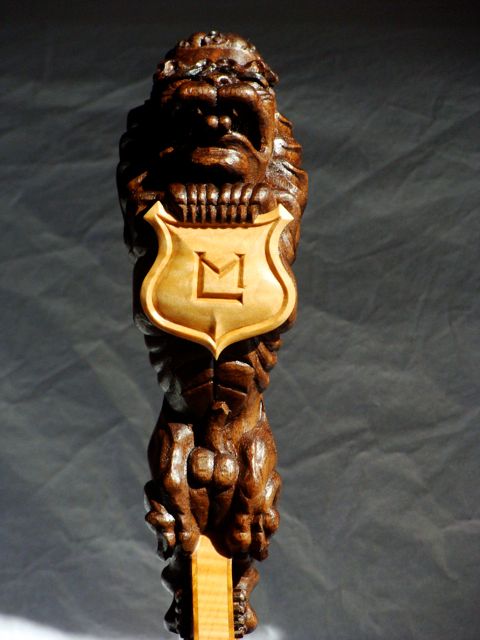
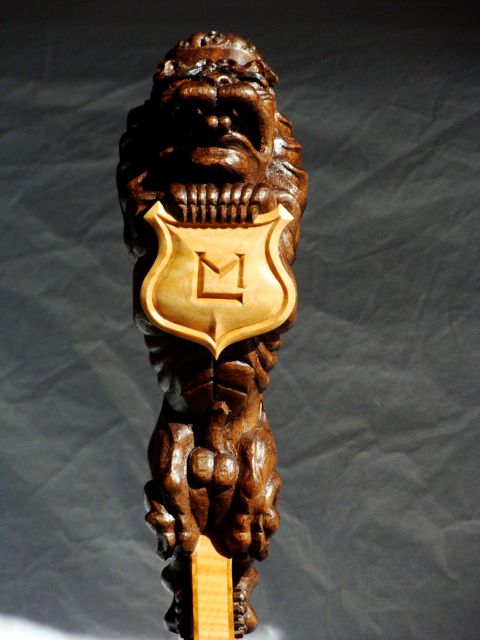
The original designer of the carving intended for the lion's paws to wrap over the bowsprit "head" timbers - as was traditional 17th century shipbuilding practice. However, In designing this walking stick, I did not want to sandwich the figurehead between head timbers. Instead, I decided to affix a shield with my trademark so that the lion's paws would be occupied with something.
While designing this cane, I decided upon a nautical theme that would incorporate my interpretation of a 17th C. Dutch figurehead carving, that I had first seen while on a working vacation at the Batavia Werf shipyard, in Lelystad (the Netherlands), during the summer of 2003. The name of the work references the ship to which the figurehead was attached (De Zeven Provincien, flagship of Admiral De Ruyter, 1666), and is a play on words; a ship’s figurehead was affixed to the prow of the ship and was symbolic of the crew’s heraldic pride in their vessel.
The master carver on the Werf, Timon Pasterkamp, had carved a 1:10 scale model of this lion as a potential design for the figurehead of the replica ship De Zeven Provincien, which was under construction, at that time. In arriving at his design, Timon had made a very close study of the grisaille drawings of the Van de Veldes (a 17th C. family of Dutch marine painters who were highly revered for the accuracy and detail of their ship portraits), particularly the Elder, in order to breathe new life into the old Dutch style of Baroque 17th C. ship carving. While I had done some light relief carving, up to this point, I had never attempted to carve an animated figure before attempting this lion.
Initially, I tried to carve the lion in solid satinwood, but soon realized that the monumental effort required was not worth the result: satinwood loses its iridescent ribbon-striped figure when it is carved. The abrasive quality of satinwood dulls tools almost immediately. Ultimately, I decided that walnut would provide a nice contrast to the cherry cane. It is dense enough to hold a reasonable degree of detail, and it is relatively easy to carve.
My lion is actually a very close copy of Pasterkamp’s original work. To realize the carving, I relied entirely on photographs I took of Pasterkamp’s model, while on the Werf. As it is a nautically themed piece, the lion is affixed to the cane cross-member, which recalls the head-timbers of a 17th C. ship. Just below the pommel is a gothic window to the North Star, in curly maple, which is intended to guide the bearer on his way. The cane staff, itself, is reminiscent of an arched ship’s tiller. It was, in fact, the arc of the grain in the rough cherry board that determined the shape of the staff. The decorative painting was conceived and executed by a Pennsylvania artist and friend of the family, Carol Hillestad, who is a master of the Norwegian folk painting called Rosemaling. Her braided design recalls both the rippling ocean and the hemp rope of a period sailing ship. The ebony pegs are a tribute to the Arts and Crafts style of Greene and Greene, whose work I admire. The hand holding the cane is an extremely accurate study of my left hand.
In all, this cane incorporates five distinct species of solid hardwood: American cherry, American black walnut, curly maple, satinwood, and Gabon ebony. The wall plaque is made from mahogany and curly maple. All of the material began as odds and ends and cast-offs that I had collected while working as a pattern maker for the Steinway & Sons piano company, in Astoria, New York.
The project, which became ever more elaborate, consumed a fair amount of my free time, over a two-year period. Ultimately, I presented the cane to my parents on the occasion of their 40th wedding anniversary in August of 2007. It is their initials that are monogrammed onto the wall plaque.
-
The original designer of the carving intended for the lion's paws to wrap over the bowsprit "head" timbers - as was traditional 17th century shipbuilding practice. However, In designing this walking stick, I did not want to sandwich the figurehead between head timbers. Instead, I decided to affix a shield with my trademark so that the lion's paws would be occupied with something.
-
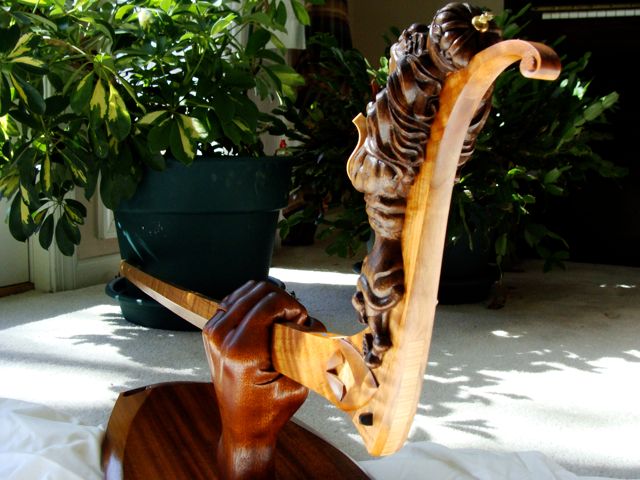
This shot provides some sense for the tiller-like shape of the cane staff. It also shows good detail of the lion's mane. The brass ornament on top of the crown was turned on a machinist's lathe. The cross was hand cut with a jeweler's saw and cleaned up with jeweler's files.
-
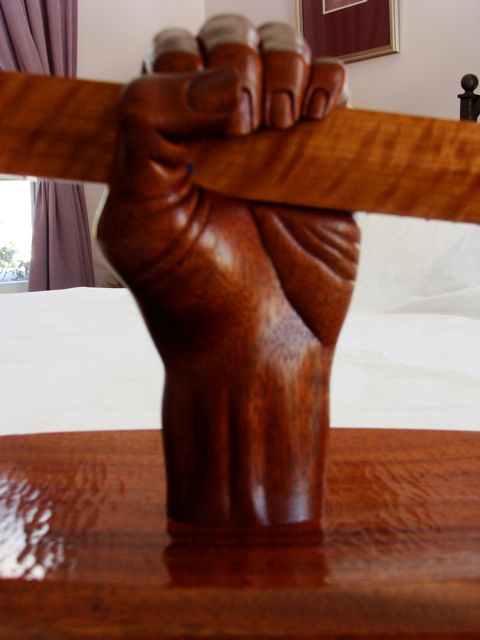
My own left hand served as the model for the plinth mount. This aspect of the project was the most fun because I discovered just how difficult it is to suggest tendons, muscle, and bone beneath skin.
-
The dramatic figure of the cherry and mahogany are plainly visible here. Less so, is the tight curl of the maple that serves as a slip-tennon to join the cane staff with the cross-piece. Viewed in person, the piercings just below the lion's feet represent the shimmering North Star.




Comments
Initially when I looked at this, I was thinking "tour de force". On reading further the word "patternmaker" emerged, allowing my appreciation to settle into....appreciation. My word, remarkable and my compliments to you. Having only joined very recently, there is this plethora of creativity I am enjoying, peeping into the minds of other craftsmen. Whilst most distort the truth with words, there is not much to hide between craftsmen.
My hat off to you sir
Thank you for the gracious compliment. What is truly awesome to me is the enormous scale of the full-size carving. It must be about 15' long, or more. In fact, many of the carvings on the ship are within the 6' to 12' range; owing to the relative size of an 80 gun wooden warship. The effort to translate the original scale model - something that amounts to 12 inches, or less - into something so enormous is truly an accomplishment, IMO. If you ever find yourself in Amsterdam, with a day to spare, take a train out to Lelystad and a cab to Batavia Werf. No woodworker will leave disappointed.
Its an honor to have an artisan such as yourself like my work.
Your carving is impeccable and is nothing short of inspiring.
To answer your questions:The legs are laminated from two thick pieces or walnut with two three quarter pieces glued on either side to create a pair of wings.The legs were then carved by hand.The bottom four drawers are from a single board of walnut as well as the top two drawers.The drawer faces are 2in. thick angled back and are hand carved then scraped with a curved scraper.Everything on this piece was made by hand tools only.No machines were used.
Continue your awesome work
Thanks Greg. I really appreciate that.
Log in or create an account to post a comment.
Sign up Log in