Is a college professor any smarter than a skilled furniture maker?
 Feb 05, 2010
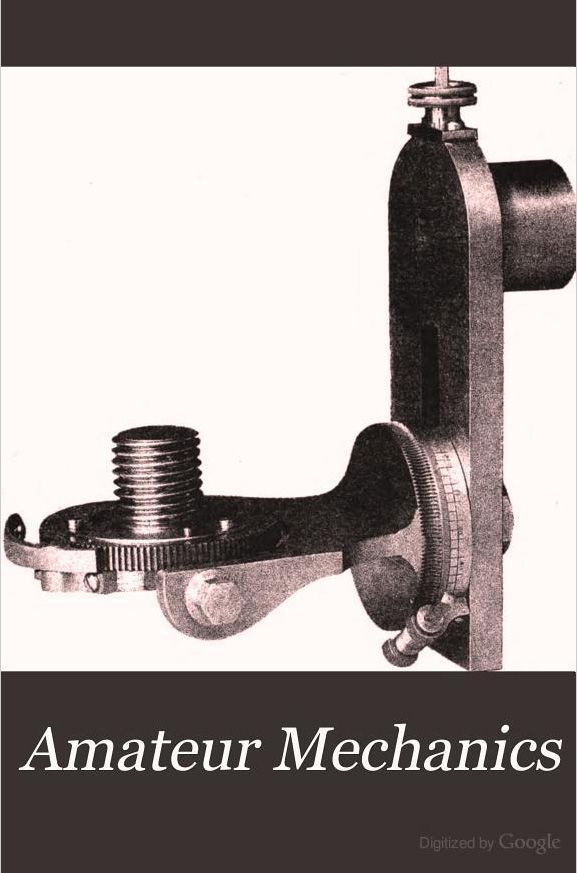
An 1883 issue of Amateur Mechanics Magazine has plenty to offer to the modern woodworker.
A lot of ink has been spilled over Google’s plan to digitize many thousands of books and make them available for free. I won’t take a position on that here, but I will say I was tickled to page through an 1883 issue of Amateur Mechanics magazine, available for free at Google books.
It is amazing how little has changed in our craft, including our need to remind the world that not all intelligence is picked up in a classroom or a book. A woodworking friend pointed me to this essay, on page 186 of Volume 1. An anonymous author observes:
“The average “educated” man assumes a superiority over his mechanic brother of the shop that is in a large degree a false assumption, inasmuch as knowledge is only comparative.”
And strikes back with a telling blow:
“Emerson holds that no man can be called ignorant, the most illiterate man having observant faculties. Nay, more; his very lack of book knowledge sharpens his observation.”
I agree with Ralph Waldo (Emerson). With a graduate degree in American Lit., as well as a number of years in a machine shop, and more as an amateur woodworker, I’ve been on both sides of the fence. I know that book knowledge can be as much a stumbling block as a stepping stone. And woodworkers are some of the most powerful, creative problem-solvers that I’ve ever met, with a deep and direct understanding of the world around them.
The anonymous essayist continues:
“A musician cannot speak half a dozen sentences without bringing in his ” staccato,” ” pianissimo,” ” over tones,” ” crescendo,” ” diminuendo,” ” harmonics,” etc. … A chemist must clothe his thoughts in HOa and “chloride of sodium,” even when speaking of common things. So it is that every specialist, being wedded to his methods and technology, unconsciously, perhaps, helps to build the Chinese wall, shutting in knowledge much higher than ever by means of his secret cipher.
How often has the remark been made, ” Oh, that’s too deep for me!” The chief trouble lies at the outset in mastering the phraseology of each and every individual science. The bare facts are not such mysterious things when one gets the nut cracked open.”
That last phrase reads like a mission statement for FWW magazine!
The entire essay is worth reading, and if you page down through the issues of the magazine, you’ll find wonderful articles on joinery, workbench design, projects, and on and on. The authors are long gone now, but I wish I could sit down and talk with each one of them. I’ll bet we would get along famously.







Comments
For those of you interested in the topics this blog entry and the referenced essay bring up, I strongly recommend "Shop Class as Soulcraft" byMatthew B. Crawford. Mr Crawford's perspective is drawn simultaneously from his training as an academic (Ph.D. in philosophy) and his past and current experience as a motorcycle mechanic. It makes a strong argument for the intellectual merit of craft work and points to the potential losses we as a culture incur when career "guidance" points everyone to jobs in the "information economy" doing "knowledge work".
As a victim of the educational paradigm of the 60's that discouraged shop class for the college prep crowd, this essay and Mr. Crawford's book are a welcome tonic
I've read passages of this article. It was re-assuring to read of someone leaving behind the "cookie-cutter" corporate lifestyle to follow a passion. I am on the fence of leaving a tech job that although is "comfortable," is not really for me as I am more "hands-on."
I agree that "ignorance" is best defined as simply a lack of knowledge, without any assumption as to the source of said knowledge. And, when discussing such matters, it is helpful if one eschews obfuscatory sesquipedalianisms. ;-)
I would second TedFurlong's recommendation of "Shop Class as Soulcraft." I read it last month and enjoyed it a good deal. One argument that Crawford makes that particularly struck a chord with me is that craftwork is, in a fundamental way, more honest than a lot of white collar types of jobs because the physical object created by the craftsman is an unassailable demonstration of skills. As Crawford puts it, the shop forman can grab the piece and whip out his micrometer and see whether the machinist has or has not performed to spec. There is no corporate lingo, business jargon, or fuzzy language that can change whether or not the piece is what it ought to be.
In the end each of us has some skill and we depend upon each other. You just can't know everything. And what seems simple to one person is impossible for another. We forget that we are part of a whole. We need each other. And down this road we come to embrace some of the ideas of socialism and communism. The underlying ideas that led to those two "isms," aren't dead, but lies slumbering in old magazines and ancestral countries waiting for a new label. Hand work, real craft has a value. It should be rewarded.
Ranking work has a long history and is deeply ingrained. I was amused to learn that notion of "Fine Art" started as a way to raise the social status of a group of artisans. Fine Art (unlike what you do) they said, serves no useful purpose and springs from the mind. Poetry was at the pinnacle and painting and sculpture right behind. The mind is pure. The hand is dirty. And with the help of some philosophers they managed to firmly fix the idea in our conscious. Isn't that basic idea, the ranking of the worth of trade skills that the article is tilting at?
Mostly I find it humbling that after years of book learning and more than 30 years practicing a craft how little I seem to know. We need each other.
Peter
I never read much Emerson, but I do know that Mark Twain once observed that everyone is ignorant about something or another.
Log in or create an account to post a comment.
Sign up Log in