
Last week I got an email from Tim DeKorte, an author I worked with last year. He was just dropping a line to catch up, but he brought up a topic that got me thinking. Tim writes:
“As we all grow in our skill level, I think there might be some “Tipping Point” skills or conditions that give us the ability to make what are seemingly quantum leaps.
Perhaps these are common to the superstars that do make a living or at least create wonderful works of art I could only hope to get close to. I realize that sadly Krenov and Maloof are gone, but there are others who might have some insights on this.
Let me explain by sharing what my leaps have been…
1. Having a dedicated, well lit work area.
2. Mounting a Jorgensen front vise to my old solid core door bench.
3. Up grading from a contractor saw to a combination machine.
4. Using a grinder with aftermarket tool rest and a proper aluminum oxide wheel
5. Learning to sharpen tools (I’m a big fan of glass and W/D sandpaper )
6. Finally having a proper Bench
7. Learning to cut dovetails efficiently
8. Learning how to plane a transparent shaving (from reading Garrett Hack’s book on planes).”
Tim made me think about what my Tipping Points are. What inspired me to get into woodworking? What skill developments lead to my “quantum leaps”? Here are the top Tipping Points along my woodworking path.
1. My high school woodworking teacher, Mr. Kachel, helped me overcome fear of the tablesaw and bandsaw.
2. I took a hand-tool class with Phil Lowe at The Center for Furniture Craftsmanship. It was there that I realized the full potential of my chisels and handplanes
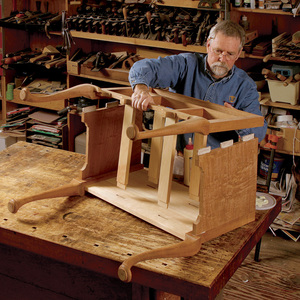
3. I became an editor at FWW. There’s no better school out there. I get to visit the best woodworkers in the world and watch them build stuff.
4. I learned to sharpen.
5. I bought a tablesaw and 14-in. bandsaw.
6. I made a dovetailed drawer that actually fit nicely.
7. I learned to use a router.
Those are my top seven. I’m curious. What are the Tipping Points on your woodworking journey?



Comments
I've been woodworking for about 6 years now. I am, as many of your reader are, self taught. I've learned primarily through reading and through watch podcasts. I credit many oh my aha! moments to the podcasts. For instance:
1. Watching Tommy MacDonald built the Bombé Secretary on the rough cut show podcast. (now grandslamtools.com). Watching him really taught me how to use chisels for fine joinery work.
2. Bob Rozaieski's hand tools and techniques podcasts for his episode on accurate layout and marking. Learning to always reference off of the same show edge has made my work better.
3. Fine woodworking project video series. Especially Tim Rousseau's small cabinet and Garret Hack's small tool cabinet. Tim's discussion of grain selection, joinery selection and installation of kinfe hinges are top notch. Garrett Hack also delivered with his explanation of sliding dovetails and efficient transferring of layout.
I've learned a lot from Garrett during various photo shoots in his shop, not only about woodworking but also about design. He has a great eye.
1 My woodworking changed in working style and quality, when I discovered hand tools. My sister bought me a couple DVDs as Christmas gift, several year ago (thanks Sis). They were by David Charlesworth and Rob Cosman. This was the biggest game changer for me. It lead me to so many other great woodworkers and hand tool users.
2. Buying my first high quality tool. The first were hand planes by Lie-Nielsen. Recently a new table saw by SawStop. I will delay a purchase if needed, to save for a quality tool now.
3. Taking quality training. Sorry most of the half-day classes at the woodworking store just don't cut it. 2 to 3 day classes maybe, but 1 or more weeks is much better. Those longer classes are vacations for me.
There are more, but these I think are the biggest game changers for me.
Mike
Yup, hand tools are a big jump for most woodworkers... me included. The refinements you can make with hand tools are unrivaled by most machines.
For me, it all comes down to watching others at work - especially working with other folks - with greater technical ability than myself - in the shop, at the same time.
-Ed
My turning point came very unexpectedly, as I suppose most do. Since I was a teenager I've considered myself a novice woodworker; more of a wood butcher, really. A hack. I had taught myself to do everything with an old radial arm saw, a sander, a drill and some ratty old hand tools. A few years ago, at age 55, my wife bought me a really nice table saw. I decided to make some jewelry boxes with it. With a smooth table top, powerful motor, accurate miter guide and practically no blade runout; the first box seemed to make itself. What a revelation! A blinding flash of the obvious! A quality tool makes for quality results. I then sprang for a good router, a decent thickness planer, some quality hand tools and presto! The projects came as in a dream. I now enjoy the work way more than before and the finished pieces look more workmanlike. This experience has changed my entire outlook on woodworking.
My first turning point was when I moved to a new city and started a new job. I am a shop teacher, I think it is the best job out there. I went from a neglected cramped basement shop that I inherited as a first year teacher to one year later working in a shop three times the size with some decent money to keep it running. The second turning point was sharing an office with a very experienced teacher and woodworker who in addition to introducing me to this magazine, inspired me to learn and get better. My third turning point was making my first mortise and tenon joint, I felt like there were no limits and I realized that to be a good woodworker you need patience and time. I think and hope that I have a few more turning points yet to come and that I can share what I have learned with my kids and maybe be a "Mr. Kachel" to some of my students.
I am still very new to woodworking. I want to say the video on your site and youtube are really really helpful. I have watched several and a couple multiple times. I think I am going to build Matt's Monster Bench and Garrett Hack's small tool cabinet next.
Thanks Matt Moore
I knew when I started learning woodworking that I didn't need 75% of the stuff various people tell you you absolutely must have. The turning point for me was when I figured out which 75% that was. The best thing I ever did was spend time learning woodworking from a furniture maker who grew up with very little money and very few tools.
Right now I barely use hand planes (outside of a block plane now and then) and the bench that I do all my work on has no vise. Cardinal sins for some, but I get by just fine with chisels, sandpaper and clamps.
orko
Like most of you, I'm self taught.
My first turning point was when I finally developed the patience you need instead of rushing through things to get to 'the good bits'. I now regard the entire process as one big 'good bit'.
Another big point for me was finding this website. The video tutorials are so inspirational. I'm currently making a mock-up version of Garret Hack's small tool cabinet just to try out the entire process before I build the real thing.
And I don't think I'll ever forget the first time I cut a mortice and tenon joint that was a perfect fit. The triumphant feeling when the joint slides together and there's no wobble or rattle. In a word - 'Fantastic'.
1. Getting a summer job during college working in a shop with 2 older guys who were willing to take the time to show me how to do things right. One of the guys had lost half of one arm in a sawmill accident many years ago, but he could do more with 1.5 arms than I could do with 4. Most of what I did in the shop was stock prep, but I came out with the ability to easily work with any rough material.
2. As others have said, sucking it up and spending the money to buy good machines and tools and setting up a real, dedicated shop. I now have a dedicated, separate 875sf space with good lighting and no wife nagging me about dust. Now that I think about it, not giving my wife keys to the shop may also be a turning point.
3. Seeing hand tools put into action by real artisans. Woodworking is unusual in that you usually work in isolation and teach yourself, but need to see first hand what is possible before you can really elevate your work. I don't always have the opportunity to do this first hand, but the FWW website/community is a good second.
4. Maybe the most important tipping point was a loss of the fear of failing. My woodwork really improved when I stopped caring about mistakes. Since then, I've challenged myself to do all kinds of things that were way above my abilities and that has resulted in new skills.
I've been working wood since the age of twelve. For me my turning points have been;
1. Overcoming my fear of a bench top band saw
2. Buying a set of bench chisels
3. Buying a 10" table saw
4. Building my first true workbench
5. Using hand planes
6. Buying a Tormek
7. Becoming an advid member of Knots
8. Understanding proper finishing techniques
9. Upgrading my band saw with a 5hp motor for resawing
10. Attending The Woodworking in America Conference
The Future ---- Someday buying a Router Boss. It will change how quickly and accuratley I will be able to cut woodworking joints
I can see myself in almost all the comments here.
1. Learning to sharpen. You just can't do good work with a lousy edge. And sharpening has to start with the last thing most people associate with "sharp," and that is flattening the bottom or back. Get that and the bevel right, and maintenance sharpening takes a few seconds.
Oh, and shaving hair off your arm? Yes, it impresses non-woodworkers, but being able to shave a translucent shaving off end grain hardwood takes a truly sharp edge. And if a butcher like me can learn to do that, so can you.
2. Truly flat granite or plate glass and wet/dry sandpaper for flattening backs and bottoms.
3. My Lie-Nielsen dovetail saw. The light went on.
4. Learning to sharpen, and use a scraper. Wow.
5. Taunton videos.
6. I'm not sure why this was a big deal to me, or why I did it, but I took a piece of oak firewood from a wood pile, and planed two sides flat, square, and glassy smooth. I guess I had always thought of wood as something manufactured that comes from a store. But taking a piece of bark-on stove wood to finish-ready really showed me I was in charge, and could do this. If I were teaching, I would have students do this, too. It's like the difference between microwaving a plastic bag, and actually cooking, I guess.
Hey, one out of two ain't bad.
I had my first taste of woodworking helping my Dad build a holiday cottage starting in 1959 at age 16. It took a few years to complete but I experienced stick frame construction, sheet roofing and some finish carpentry.
Then I didn't do much until 1980 when as an owner-builder I built my first home, now with the help of my Dad for a few years. I learnt how to do it at technical college, 3 years, 8 hours per week. It was the course that apprentices take, but I could do it at night. On our home I did everything except excavations, concreting, brick laying, plumbing and electrical.
In 2004 I returned to technical college, again for 3 years, going at night again now doing Cabinetmaking (apprentices' course), because I was to retire in 2008 and I wanted to get ready for it. I have since made quite a few items and I have a small workshop (250 sq.ft.) at the back of my garage.
Last year I went back to college again, now attempting Furniture Finishing including a full training on French Polishing, colour matching and spray lacquering, again for 3 years at night, and the apprentices course.
For me the turning point for obtaining information is the FWW on-line subscription, of which I make full use. Cabinetmaking took me down the hand tool route to start with and I always do quite a bit of hand work in my projects.
For more hands-on I came to USA in November, 2008 and went to a hand tool conference in Kentucky, Then I went to a woodworking school in Indiana and made a Morris Chair. Both of these events have been real eye-openers for me.
Could I do any more courses at College? Yes -- Wood Machining, but I think that I'll have had enough by the time I complete my present Finishing course.
I was introduced to woodworking by my grandfather, Guy A. Blake, when I was a very small child. His shop was a two car garage with a bench running around about one half the length of the walls. There were vises everywhere and drawers the entire length of the bench with cutouts for every hand tool he had. He used to say that the tools were in their correct place only twice. The first was when he finished building them and the second when I, at about age 6, put all of the tools in their proper places. His power tools were a table saw, with a four by eight foot table that he designed and built, lathe, jig saw/scroll saw, drill press, grinder, and others I cannot remember. His hand tools ran the gamut from his pocket knife to chisels and planes, all of them freshly sharpened. My grandfather taught me that a cheap tool is exactly that, cheap. He would never use filler on a miter joint. He would redo it. Sand with the grain of the wood. Clean those brushes. Don't be in a hurry. Plan ahead. Measure twice. Cut once. His words of wisdom were endless. I spent 20 years in the Air Force and then 15 years in retail so my workshop is a late bloomer. I am working out of an 8' X 18' truck body right now with plans to put up a real shop later this year. With a table saw, a table saw mounted router, and a 10' by 30" bench containing a 24" scroll saw, a drill press, a grinder, and other assorted stuff, I can hardly wait for the new building. A band saw is next on my list. This magazine, and others, is a great help. Not an issue comes in the mail that doesn't teach me something new or make some difficult task more simple or give me an idea on something else to build, just as soon as I finish this current project. I just hope I live long enough to make up for lost time. Maybe I will even live long enough to finish all of those current projects.
I was just starting to dabble in woodworking in the early eightys, when through a colleague who grew up in his neighborhood, I received an invitation to visit Sam maloof in California where i was attending a convention. His house was almost completely full of his projects including the kitchen cabinets. His wife collected artifacts also, and i commented to him that he lived in a museum. After a whole afternoon imersed in his kindness and advice, he told me to go and build my own museum. Since, I have done so as now about 80% of the furniture in our house are my own projects. We have run out of wallspace so probably need a new bigger house.
I posted this a while ago in the Handtool forum, so for those that do not frequent the best of Knots :)
I have a special fondness for the Stanley #3 handplane. I inherited my father-in-law's English-made #3 at a time when I was still solidly into powertools, and so it disappeared into the back of a shelf. About 15 years ago, having built a new house, I was deep into attaching doors and using a noisy, messy, powered Makita plane to trim the edges, suffocating under the usual earmuffs and eye protection needed for this tool. At some stage the blades on the Makita became too blunt to use and, being a weekend, the store that stocked replacements was closed. Then I recalled the little #3 at the back of the shelf. I'd never used one before, and only had a general idea what to do with it. Indeed, my FIL had passed on several years before the #3 came to live with me, and so the blade had not been sharpened for a couple of decades.
I must have done something right, or Bob was smiling and doing it for me, but the moment I place the sole on the edge of the door and pushed forward, I got this "schhhhiiiiiiikkkkkk", and a long ribbon of wood appeared in the silence of the workshop, getting longer and longer as I pushed the plane forward. There is no way to forget that moment - it was the moment I turned away from powertools towards handtools. I was hooked!
The #3 is smaller in the hand than a #4. It has a narrower blade than a #4 (1 3/4" versus 2"). It is a more intimate plane that a #4. I just loved using this plane.
Now here's the embarrassing part. My confession is that I am a compulsive modifier, and have been ever since I could walk (so my parents tell me). I read about tuning planes. One of the tips was to file a chamfer inside the mouth to aid the flow of shavings. But I clearly misunderstood the directive ... and filed the outside of the sole .. effectively opening the mouth! I didn't recognise what I had done for a few years (as I only really used the plane on softwoods), until I became educated by Badger Pond. And then I felt awful! How could I have done this to Bob's plane?!
I never told anyone in the family. I very much doubt that they would have understood the issue anyway. Years went by with the #3 on the shelf again. Every now-and-then I searched eBay for another plane as a donor. A month ago I found one that was identical to Bob's. I was not interested in a better #3. I just wanted the same English casting, one in the same condition - but the #3 is not easy to find ... Onto the "new" base I placed Bob's frog, blade, knob and tote. I sharpened the England-made blade for the first time in many years and ran it over a piece of Karri Pine. It went "Schhhhhhiiiiikkkkk". I could swear that the jazz piece on the shop stereo became sweeter.
Regards from Perth
Derek Cohen
I purchased a 100 year old Diston Saw at a garage sale and the feel of the handle made me awake my feelings for wood.
I found a pair of book-ends I made at school in Scotland, and started a collection of old woodworking tools ........
Now retired I have my own insulated shop and am making walking sticks, and other useful things....and loving it.
The best thing is the saw cost me $1.00...........!!
Thank you for your article, and oportunity to reply.
Brian S. Campbell.
I bought a 100 year old Diston Saw at a garage sale, because of the lovely wood handle.
It awakened my love of nice wood.
I found a pair of book-end I made at school in Scotland and that started me collecting old woodworking tools.
I am now retired and have my own insulated shop, and back making walking sticks, and other useful things.
The great thing is the saw cost $1.00....!!
Thanks for your article and the oportunity to reply.
Brian S. Campbell.
Agassiz B.C.
My tipping point was a chance encounter with a 70 year old man. The most ambitious thing I had made to that point was a shaker nightstand from Moser's book. I had been woodworking off and on for ten years and was about 40 years old. During lunch with this gentleman he asked if I wanted to see a picture of a piece of furniture he had just finished. Of course, I said yes, and he produced a few pictures out of his wallet.They depicted a Newport blockfront kneehole secretary! I was stunned.My first question was: "How many pieces of furniture have you made?" Answer: "THis was the first one". Regaining my composure, I asked him how long it took. "Ten years" was his answer.
At that moment I could feel my whole brain re-calibrate. The first thought was I did not want to look back on my woodworking life from the age of 70 and see a large number of mediocre , non-challenging objects in my wake. I also realized the old guy was really brave.Bravery is a very under-celebrated trait in our society and it shows up in many ways.Coincidentally, the Fine Woodworking issue that had just come featured Norm Vandal making a Queen Anne Lowboy.I resolved to make it and have now had ten years of enjoying it in our dining room.All subsequent efforts have required me to learn skills I did not have at the beginning. If they are not scary to embark on, I'm not challenging myself enough.
I grew up in India at a time when there were no power tools. My father was amazing at everything and he had some wonderful old Stanley tools and he used these to build the odd things around the house. Seeing him use these tools got me interested and as a young boy I tried my hand at sawing and using the planes.
When I immigrated to Canada 35 years ago, I went into a hardware store the very next day and was amazed to hold a router in my hands! I looked at all the tools and knew that one day I would be able to buy them.
When I got a job as an Engineer three months later, I rented an empty apartment, bought a Black & Decker hand drill and a jig saw and circular saw attachment for it. With these and a few sheets of ¾” plywood, I made the furniture for my apartment, in my apartment. It was with screws and glue and paint but it lasted and is still in use in a friend’s house.
One day, while at Sears, I bought a radial arm saw and a jointer on impulse. The radial arm saw was the scariest machine I have ever owned and I still have nightmares about what all I did with it. But the turning point was when I bought my first Woodsmith magazine. The joints looked so difficult compared to the butt ends and screws that I had used earlier. But there were good tips on how to make dados and dovetails and so I built a ladder to start. Then I built a router table as per their plans and felt so elated when that turned out well. I said to my wife that I thought that I might finally become a woodworker some day. I started buying Fine Woodworking and got inspired to make furniture.
I worked alone in my basement and slowly built much of the furniture in my house. Most of these were in mahogany with French Polish, a finish that I knew from India and which suited me well in a dusty shop. After a trip to Santa Fe I started building Southwest furniture in pine and some of these I painted in bright colours.
I now have a small insulated and heated metal shed in the backyard, fitted with power tools but hope to someday to build with mostly hand tools. My wife has lined up projects for me but I read FW and want to make things that I have not tried before. I have currently finished a small spice box out of walnut, cypress, luan, pine and African blackwood for a friend’s wedding, based on a FW article.
I may not have made this journey without first my father inspiring me and later Woodsmith and Fine Woodworking. I wish I could work with other woodworkers so that we could share ideas and techniques. But with FW woodworking available to me I feel inspired enough to continue.
Ever since that first class in junior high school in 1987. I remember walking into the shop class for the first time and seeing a real woodshop. Our first project was a sanding block out of pine using only hand tools; once I finished that project I knew I could do anything. It must have been the smell of finishes curing and saw dust that went straight to my head. Woodworking has been a passion both professionally and personally ever since.
Oh, this is easy. My potential Father-in-Law was a woodworker. How better to impress the girlfriend than to show an interest. 30 years later, he admits I'm way better than he is!
I started woodworking when I became disabled and needed a cane. The horrible aluminum canes were both ugly and uncomfortable. I looked for custom canes through the internet and bought a $100 cane that looked nice but was uncomfortable. So I went to Woodcraft and bought a concave spokeshave, some Jatoba, and made a cane that was comfortable and looked nice. Out of necessity and dumb luck, I was able to come up with a design for a Lady's handle that was a big hit. I later switched to the Lie-Neilson Boggs concave spokeshave, learned to sharpen (with 3M honing films), and have made many dozens of canes since then that I donate to friends and others. The next step up in quality was obtaining Auriou rasps so that the fit and finish of the canes is now perfect. I decided I liked woodworking so I ended up with a real workshop and all the equipment in the basement. Last addition a Sawstop Professional tablesaw which is allowing me to expand what I make. The biggest problem is the lack of project plans for furniture - it takes me forever to design something from scratch. My last project was a half dozen Sapele shoe racks - I'm sure I'll be making more. Next step is veneering. I'm not able to go to woodworking classes but I bought a bunch of books and several magazine subscriptions (FWW!) but as lohg as I keep reading I keep improving.
Here are my milestones. The access to and love of using:
1. 10" tablesaw
2. 36" wood lathe with a 12" swing
3. Good quality hand planes
4. a cabinet scraper and a hand scraper
5. my own workbench with my own wooden screw vises
6. my mind and heart to bite off big bites of work
7. what I had learned about using and applying clear finish
I started as a painter and thus learned the last thing first. I easily learned refinement later. The tablesaw made cabinet work achievable. The wood lathe is a fascinating tool and holds my attention to this day. Thanks to Richard Raffan for his books on design and technique. Hand planes marked the real turning point though. Beyond the hand plane, the humble scraper teaches that much can be accomplished with a very simple tool. At that point my own bench, designed and built after reading Scott Landis' book on workbenches, revealed how much I really needed one.
I then set out with a foundation of basic skills and tools to bite off big bites and find ways to chew them.
I often think of the artists of Bali who make exquisite masks for their opera with only a small blade of steel to carve and scrape them and grass brushes to paint them. This reminds me that it is not the tools, but the mind and hands that count for the most in craftsmanship. But to all the tool manufacturers out there - thanks to for the great tools, they certainly help.
My largest jumps came from.
1) Reading a book on finishing. (understanding wood finishing)
2) Rosewood studio class that taught me to sharpen my hand tools and make dovetail joints. Rosewood rocks.
3) I read somewhere, "Why not practice on all your shop fixtures. Since then, I've handmade everything in the shop.
Oh, and buying a Jointer, Planer, and Bandsaw helped!
My largest jumps came from.
1) Reading a book on finishing. (understanding wood finishing)
2) Rosewood studio class that taught me to sharpen my hand tools and make dovetail joints. Rosewood rocks.
3) I read somewhere, "Why not practice on all your shop fixtures. Since then, I've handmade everything in the shop.
Oh, and buying a Jointer, Planer, and Bandsaw helped!
My largest jumps came from.
1) Reading a book on finishing. (understanding wood finishing)
2) Rosewood studio class that taught me to sharpen my hand tools and make dovetail joints. Rosewood rocks.
3) I read somewhere, "Why not practice on all your shop fixtures. Since then, I've handmade everything in the shop.
Oh, and buying a Jointer, Planer, and Bandsaw helped!
My first ephiany was in 1977 when I witnessed a man building a Paduk record cabinet. I subsequently now own the inspirational piece. I had to be able to build one I thought.So off I went on my tool buying and learing curve.
The second epihany and probably the most profound, was when I found the Legacy Woodworking machines. No this is not a sales pitch. The opportunity and easy ability to take my woodworking from square to round was the quintisential turning point in my progression. I am still riding that wave.
The third milestone came when I met a woman who LOVED wood, epecially quatered white oak antiques. We shared this tremdous attraction for both the wood and the antiques. She prompted me to add hand carved features to my work. This was new territory, but with a lot of practice, and some good tools, it is now the standard for most all my projects.I am still using antique turn of the century designs to mimic my work. It is simply a blast! Wood is an ever present thought in my mind. Rarely does it leave me,really. I find design ideas everywhere all the time.
My journey into woodworking started 2-1/2 years ago after purchasing a wooden file cabinet from an office supply store. It was the best, most expensive one they had, I couldnt wait to get it assembled. After 2 hours I got it all together, and there were numerous things that were wrong with it, not due to me installing it incorrectly, but were all things related to the overall quality of the cabinet. Luckily, they took it back, and I then vowed to myself that I would build one, and it would be many times better than the store purchased model.
That was the turning point that got me into woodworking. After realizing most of the products sold in many stores were more of a "temporary" peice of furniture. After a few beginner projects I made a file cabinet that I bet could hold a thousand pounds of weight!
Although I enjoyed woodshop in high school it was the New Yankee Worshop that was responsible for me becoming more serious about woodworking. Norm's instruction made woodworking more fun for me. His instruction gave me success in my projects giving me a lot more satisfaction. Thanks Norm for the years of inspiration.
Leap 1: Grandfather from Germany helped me build tree fort. Used crosscut handsaw. Had a blast. Thanks Opa
leap 2: 14 year old dragged to a craft show. Could not take my eyes off of Chuck Conner, Toy maker and Lathe man. After an hour my parents tried to drag me off. I promised not to move and watched Chuck for another two hours (Thanks Chuck, you changed my life on that day). Next day, off to middle school shop. Look out Mr. Bell. "Can I please use the lathe--I know all there is to use one" (as a future shop teacher many years later, this phrase now scares the **** out of me). Luck and patience. My first set up was with the spur bit in the tailstock. Whoops!!! Luckily nothing happens when you do this!!
Severe Bump in road: 16th Birthday present from my dad: 5' long 12"/12" kiln dried Mahogany. Oh, what to make???? Ahha!! 4 bowls patterned off of European beehive in picture books ( tapered bead pattern) with lids. Took 3 months. The day I felt they were done I put 3 in lockers and took one to show a teacher who had been following the work. I came back 1 hr later and the other 3 had been stolen. I did not touch a lathe for over 15 years.
Leap 4: CSU Thank you Dr. Lee Carter for building a fire from an ember I thought had gone out a long time ago. Got my degree as a shop teacher and proceeded down one of the most rewarding periods of my life. I taught middle school shop for 14 years and have never regretted a minute of it. The only downfall is that I'm (at least I think I am)an expert at teaching beginning woodworking and know little to nothing about larger more complicated projects (I've built one table in college the first time, turned less than 200 bowls, made a book shelf or two and that is about it). I organize an awesome shop (who wouldn't when you work with over 150 kids a day).
Leap 5 Retired very young-50. Moved to western Colorado. I'm building my new shop this spring. 32'/28' heated, insulated, well lit, and am ready to embark on a new part of my life. I hope to teach small classes while improving on my own skill at wood working.
Who knows what the future will bring.
If I were to point to one thing that affected me more than anything, it is people, not tools. I have worked with some of the best, worst, worn out, and brand new tools. People have meant the most to me.
Thanks for reading
Anthony Prough
1) The elderly gentlman that lived next door that would let me come and watch him work in his shop when I was only about 5 or 6 years old. Sometimes, he would even let me help.
2) Mr. Mack's Shop class at O. D. Duran Jr. High School where I first used a lathe and band saw.
3) Working with my father to build a crude basic work bench out oak lumber that we salvaged from pallets. It wasn't pretty, but it was strong.
4) My wife gave me my first table saw for Christmas the first year after we were married.
5) After my father died, In inherited a #4 Stanley Handyman, #5 Stanley Bailey and a #7 Stanley Bedrock planes that belonged to his uncle that had been a cabinet maker. Then learning to sharpen and use them.
6) Finding an old Disston hand saw at a flee market, cleaning it up and getting it properly sharpened and then realizing that power tools are overrated. I made my wife a little keep sake box as my first all-hand-tool project. Also my first chance to work with mahogany and it is still my favorite wood today.
7) Learning to use a router and building my first router table. I made some cool stuff on that very simple router table with only basic bits.
8) Getting a midi-lathe and turning a set of handles for some old chisels that I found in my grandmothers basement.
9) Getting and tuning my first wooden hand plane. An old beech english style smoother I picked up in an antique shop. Nothing leaves a polished surface like a wooden plane.
10) Finding and old brass backed dovetail saw, getting it tuned up and then cutting some dovetails. There is nothing like it.
When I was about ten years old, I was in Cub Scouts. One day my den mother told us that when we met the following week we were to bring a stool to sit on. I was heart broken. I didn't have a stool, and growing up generally poor, we couldn't just simply go out and buy one. My mom talked to my Great Grandfather, who was a carpenter. A couple of days later, I was in his basement workshop. He pointed to a pile of lumber and told me my stool was in there, we just had to bring it out. He proceeded to pull out boards, and after a bit of measuring, we went to the table saw. About 45 minutes later, I had a brand new stool to sit on. I was amazed that a pile of what looked like junk wood could become a pierce of furniture just like that.
Years later, having lost my job just in time for the Christmas season, I needed to come up with gifts despite my lack of income. I remembered my Great Grandfather, and that stool. I went to construction sites, lumber yard scrap piles, and even grabbed wood from discarded furniture. A few days later, I had presents for everyone. I've been working in wood ever since, and not just to save money at Christmas. My house is filled with things I have made, many of those things made from scrap.
mi esposa me pidio construirle un tejaban para el patio y como las maderas estaban chuecas compre un cepillo stanley economico nunca habia usado uno y ai descubri mi amor por la carpinteria manual
Log in or create an account to post a comment.
Sign up Log in