Safety Manual: Routers and Router Tables
 Apr 01, 2009
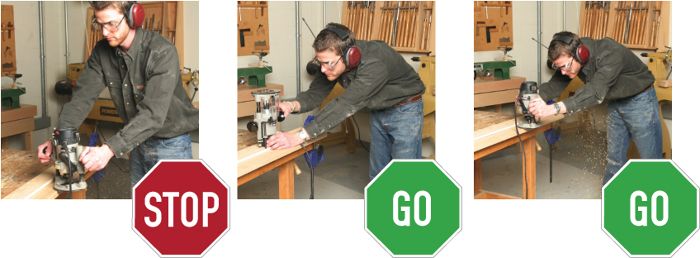
Routers and router tables have become essential tools for working wood. They do two main things, shaping decorative moldings on edges and making joinery cuts, such as dadoes, rabbets, and mortises. The shape of bit determines the shape of the cut, and with thousands of bits available, the possibilities are almost limitless. There are two main types of routers, fixed-base and the more expensive plunge type. Both allow precise adjustments to cutting depth, but the plunge router does it on the fly, and in precise increments, allowing a spinning bit to be extended and withdrawn for stopped cuts such as mortises. When it makes more sense to move the workpiece than the router, the router can be secured to the underside of a table, with a fence added. The table and fence provide much better support for workpieces, although plunge cuts are problematic.
For more, read 12 Tips for Router Safety and Routing Safe and Sound.




Comments
Am I missing something? I thought this was supposed to be about safety with a router. It looks more like a description of what a router does, not how to do it safely. Not even a mention of the most basic router safety tip, router direction.
Add to that the 3 TINY pictures which I can hardly make out, and you've pretty much got nothing here. Very dissapointing.
I agree with pisdoff. Not much value here. Dissapointing!
I agree with pisdoff. Not much value here. Dissapointing!
I agree with pisdoff. Not much value here. Dissapointing!
Yeah could be better
Log in or create an account to post a comment.
Sign up Log in