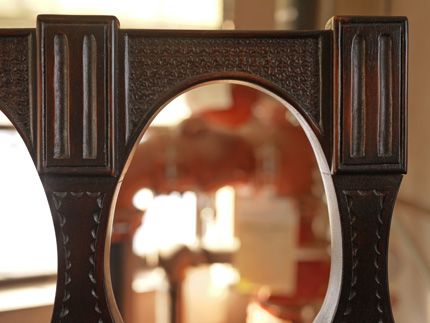
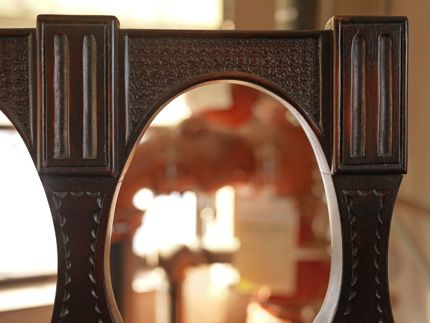
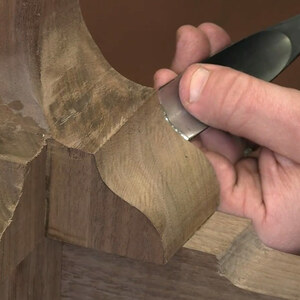
The punches used to texture the chair's framework are handmade by Lowe.
I’m just going to put this bluntly: period furniture maker Phil Lowe has been a woodworking wiz-kid (OK, so maybe he’s not a kid anymore) ever since he stepped onto the scene in 1968. An instructor at the esteemed North Bennett Street School from 1975 to 1985, he now owns and operates his own furniture shop in Beverly, Massachusetts, as well as a school: the Furniture Institute of Massachusetts.
Stepping into Phil’s shop really is akin to being a kid in a candy store. His walls are lined with hundreds of furniture patterns, story sticks, corbels, rosettes, carvings, you name it. The walls of his humble shop tell the story of an accomplished furniture maker and are just so inspiring, it makes a woodworking journalist want to, well, blog about it!
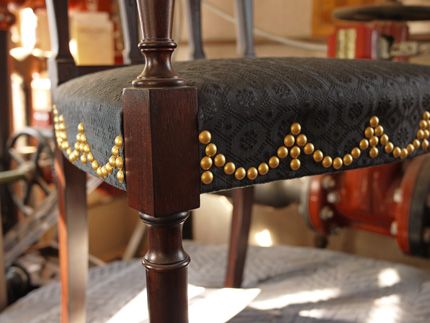
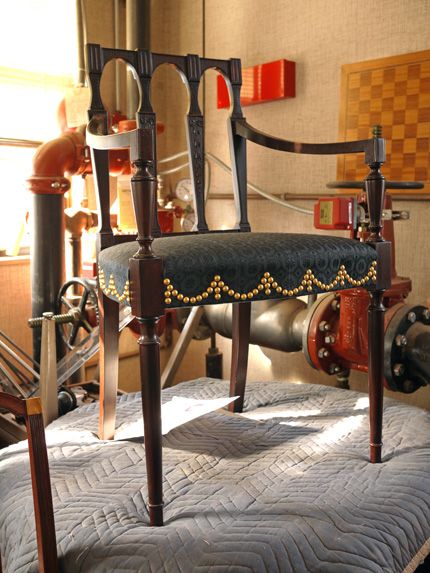
On the first day of a video shoot this February for a series on building Phil’s “Workbench that Works,” I got the dime tour of the shop and stumbled upon his reproduction of an original McIntyre chair dating back to the 18th century. Phil’s execution was flawless-from the handmade punches he used to texture the beautifully-carved back splats, to the custom-made horse hair fabric and gold (yes, it’s real) upholstery tacks, it’s the kind of piece that makes you want to drop whatever you’re doing and go build something-right away!
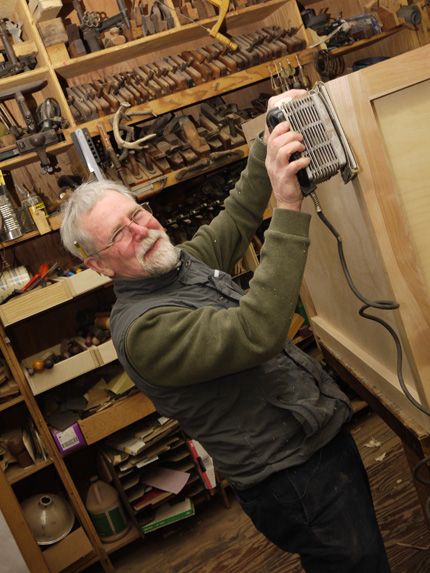
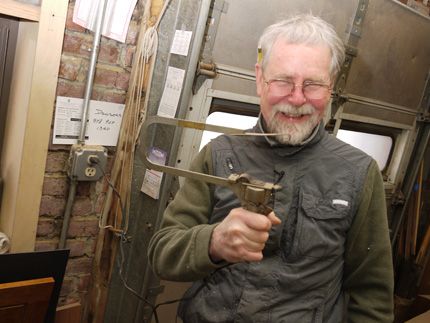
 Like most furniture shops, Phil’s is chock-full of typical machinery: tablesaws, mortisers, miter saws, bandsaws, lathes, etc. That said, Phil has a few particularly hilarious tools at his disposal as well. During our lunch break on one particular afternoon, he pulled out two gems that were originally his father’s. One is a Dremel sander which, when fired up, is more likely to cause palsy in the operator’s hand than it is to impart a smooth surface on a workpiece (photo-R). Even more smile-inducing is an electric-that’s right, electric, coping saw. The video crew just couldn’t stop laughing as Phil fired this little gem up. Quite frankly, if we’d had more time to spend up in Massachusetts, we most likely would have had Phil cut a few dovetails with this thing.
Phil is an amiable, accomplished craftsman with a fantastic sense of humor-heck, I guess you’ve got to be somewhat light-hearted when forced to deal with the regular stress of conserving or restoring original pieces of period furniture sometimes valued in seven figures!
Phil Lowe to Appear in Upcoming Podcast
For even more on Phil Lowe-including a hilarious story concerning ripping plywood on a Navy ship in stormy seas-don’t miss our upcoming interview on Shop Talk Live #27. Look for it on Friday, March 8, 2013.
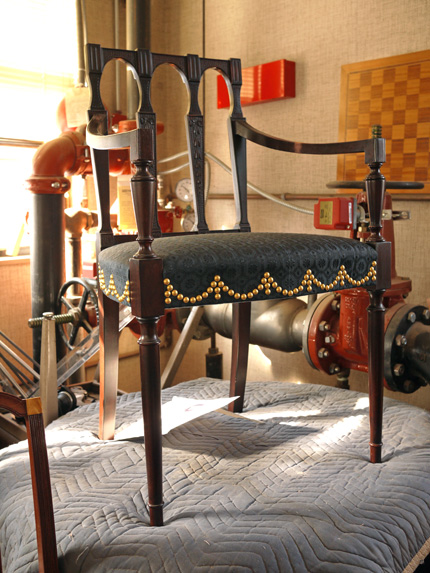 A Chair to Remember
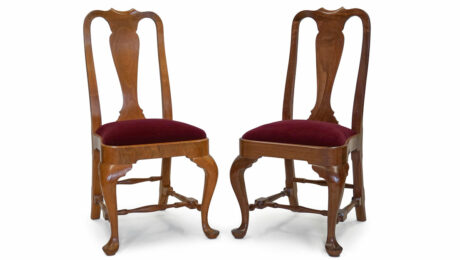
Lowe’s reproduction of an original McIntyre chair is stunning. From the gold upholstery tacks, to the intricately carved legs and back splats, this chair is a sight to behold. Ironically however-according to Phil-these chairs were anything but comfortable. For even more photographs, be sure to browse the gallery of images at the top of this post.
Dueling Workbenches
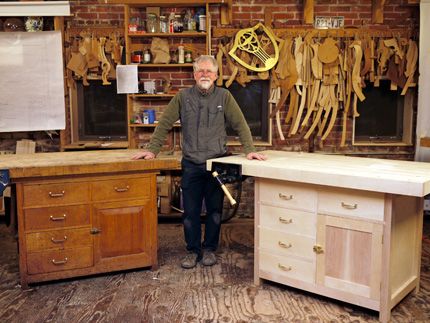
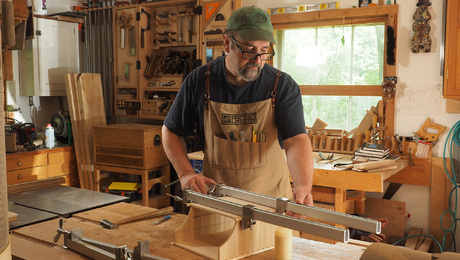
So exactly why was I at Phil’s fantastic workshop earlier in the month? As mentioned earlier in this post, we were shooting a Video Workshop series on building a reproduction of his original workbench (see photo below). Built a bit over 40 years ago, on his parents’ cellar floor, this bench has served its master well over the years–so much so, that we’ve decided to cover its construction from start to finish. Look for it sometime this summer or early fall. We’ll keep you posted!
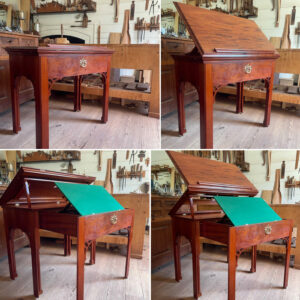
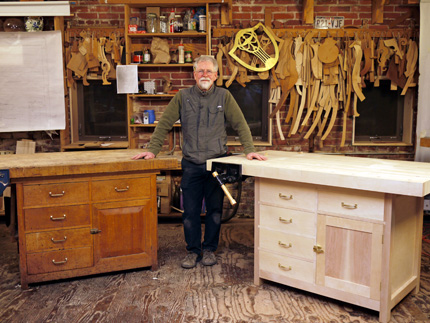 Period furnituremaker Philip C. Lowe standing beside the workbench that got him started in the craft (at left) and a newer version scheduled to appear in an upcoming Fine Woodworking video series. |
-
The punches used to texture the chair's framework are handmade by Lowe.
-
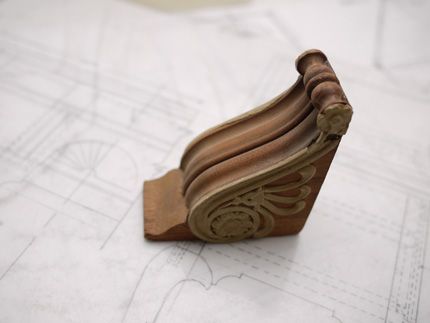
Several years ago, Lowe was hired to produce 100 of these small corbels for a New Hampshire state house. Each corbel is composed of three pieces of mahogany and two compo aplique's.
-
It's not all about serious furniture-making at the Furniture Institute of Technology. Here, Lowe attempts to bring his latest project down to a mirror smooth finish using his father's 60-year-old sander. It didn't work out so well. And yes, we're joking.
-
The hand-woven horse hair fabric really fooled me. I thought I was looking at some sort of silk at first. Who knew this came straight off a horse's tail!
-
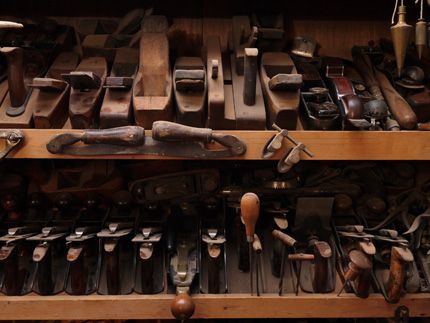
Lowe's workshop is a pleasure palace for woodworkers. His wall of hanplanes is capable of inducing envy in just about anyone with an interest in woodworking. We counted approximately 175 in all!
-
This reproduction of a Samuel McIntyre chair really caught our eye. Gold tacks, hand woven horse hair fabric, and gorgeous carvings make it a wonder to behold. It wouldn't be appropriate to talk about the value of this reproduction, suffice to say, you could probably get a decent used car for the cost of one of these gems.
-
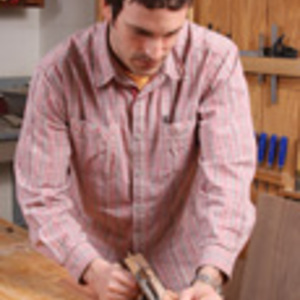
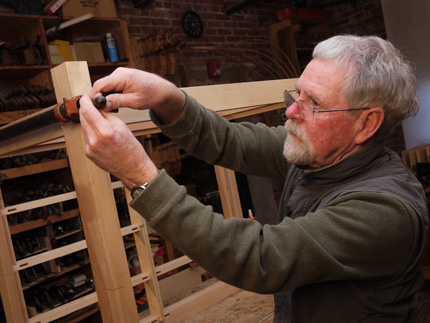
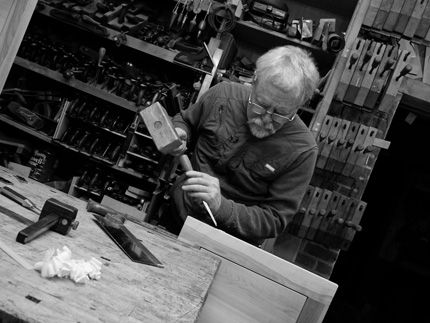
The master craftsman at work.
-
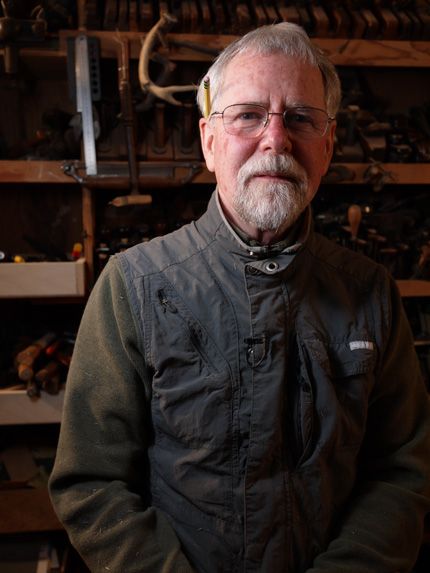
Period furnituremaker Philip C. Lowe at his shop in Beverly, Massachusetts.
-
Another tool oddity in Lowe's shop is this electric-powered coping saw. Nope, he doesn't use it but certainly gets a kick out of firing it up!
-
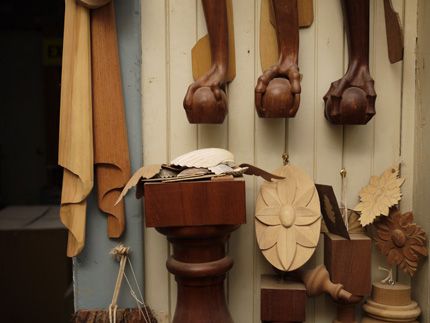
Every inch of space along Lowe's shop walls is covered with patterns, ball and claw feet, rosettes, carvings, and any number of examples of period furniture details.
-
Stay tuned! We were visiting Phil at his Massachusetts shop to tape an upcoming Video Workshop series on reproducing his original workbench.




Comments
I'm a huge fan of Phil's. His articles and DVD's are excellent, right to the point and full of information. His craftsmanship is superb.
What separates Phil from the crowd is that he is fast and what he puts out is great. This is rare.
Hi guys,
Thanks for your comments. I must say that I truly enjoyed the camaraderie that's always present in Phil's shop. And as I said in the post, all of the wonderful carvings, joinery examples, patterns, and other bric-a-brac on his shop walls is just a sheer joy to go through.
Best,
-Ed
My shop is 1/2 of a two car garage, plus I can move the car out when I need to use the table saw. So I am seriously jealous of Phil's work space. But inspiration is where you find it. If he has suggestions for my shop, I would be thrilled.
Anything about layout and use of space could help. I recently moved things around, to get better access to the sawdust collector and to hook things up. But I am sure I haven't found the optimal arrangement yet.
Nice article, thanks.
Steve
My dad had an electric coping saw and had forgotten about it until I saw the picture. He used to turn it on and while vibrating would let me touch the blade. Touching lightly it would simply tickle my finger. A very safe tool.
I never saw him actually use it though, so I don't know if it ever really worked. Kind of just hung on the tool bench wall. Nice stroll down memory lane.
In Japan, craftsman like Mr. Lowe are designated "national treasures". The quality of the chair depicted speaks for itself.
I'm so jealous, why is it so much fun to tour a fellow craftsmans workshop? Of course Mr. Lowe would be ten times the craftsman I am so using the word "fellow" is hardly fair. l enjoyed this article, looking forward to the video and workbench project.
I'm here at Phil's shop now taking a two day class and checking out the bench. Can't wait to see the videos
My father bought me an electric coping saw exactly like this when I was a kid some 70+ years ago! I got a lot of use out of it building all sorts of kid projects. It was quite capable of doing intricut cuts on thin materials.
Just completed another weekend course with Phil at the Institute. What more could you ask for practically one on one instruction from the Master. Make sure you get there!
-Rich
I think I took my first class with Phil in 2007. We built a small mantle clock. I learned a tremendous amount from Phil and the other people in the shop during that week. I have been back to FIM every year since.
I usually take at least one of his week (or two week) class each summer. I often take one (sometimes two) of his week-end classes during the winter -- just because his shop is a great place to hang out. Phil always has sidekick in the shop and Artie Keenan has been there for 3 or maybe 4 years now. He is a great guy, and will do anything he can to help someone in the shop who might be struggling. He is the kind of guy that will not come over to you to say your doing it wrong, but if you walk over to his bench and ask him -- he will put down his tool and help you until you are back on the right path.
Anyone who enjoys woodworking should experience one of Phil's classes. He is a patient and skill full teacher. His knowledge of the furniture forms and techniques is unprecedented. When you come to class you will learn good solid layout, cutting, and furniture construction techniques, but make sure you leave your block plane at home; you have to take Phil's class to find out why!
I can remember being a little intimidated by the look of period furniture, but Phil quickly put me at ease. You will see what I mean when you take his class. If you are still undecided if you have the chops to take a project class, then start with a sharpening class and then maybe a hand tool fundamental, or a dovetail weekend class, but take something to start out. By the time you finish these classes, you will feel that you can build a highboy -- or at least a really cool looking birdhouse... with a flame finial, and tombstone paneled doors... I think I'll head out to the shop right now and get to work!
Log in or create an account to post a comment.
Sign up Log in