
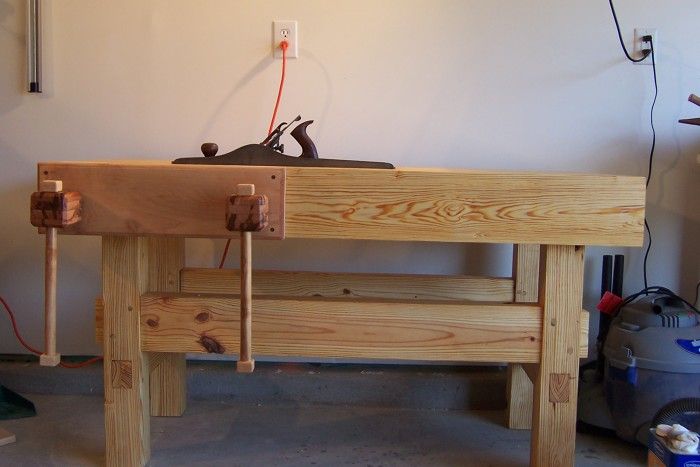
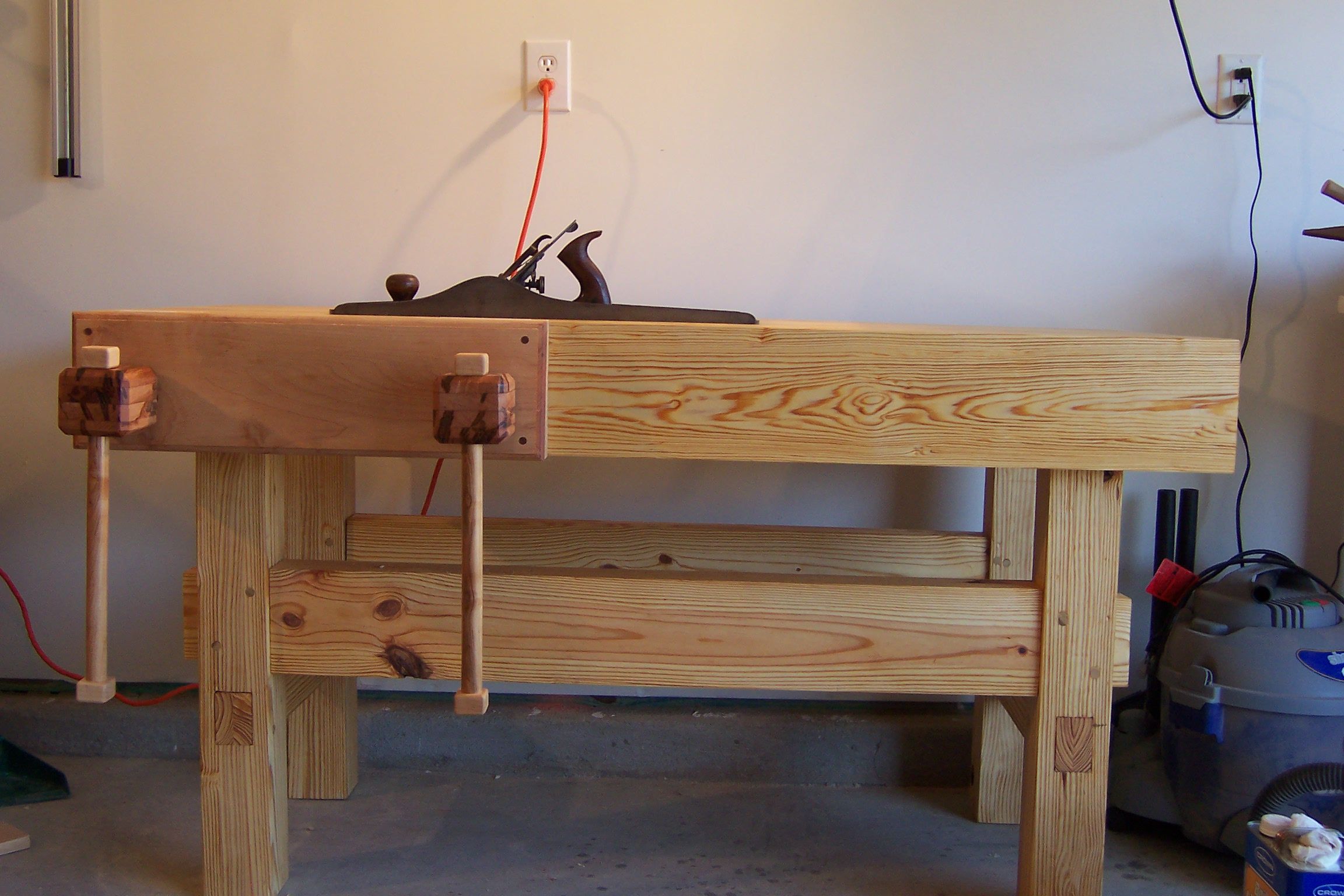
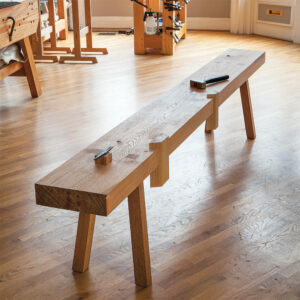
The bench that started it all. I spent a lot of time planning (and building) this one, but it gave me a very good understanding of what a bench needs to be.
Back in 2004, I was living in South Carolina, was a new father, and had just moved into my first home. After emptying the moving van, I drove to the closest Lowe’s and bought a bunch of southern yellow pine construction lumber. No, I wasn’t starting my first home improvement. Those boards were earmarked for my first real workbench. In the apartment we had just moved out of, I had a stand that served double duty as a router table base and as support for my MDF-topped workbench (no vise). I was excited and couldn’t wait to start building the new bench. By the way, I chose yellow pine because my dad is a contractor in Florida, where I grew up. I’ve seen lots of houses during construction and they were all framed with yellow pine. If it can stand up to hurricanes it must be good for a workbench. I’m glad that Chris Schwarz became such a big champion of yellow pine. It really is a great wood for benches.
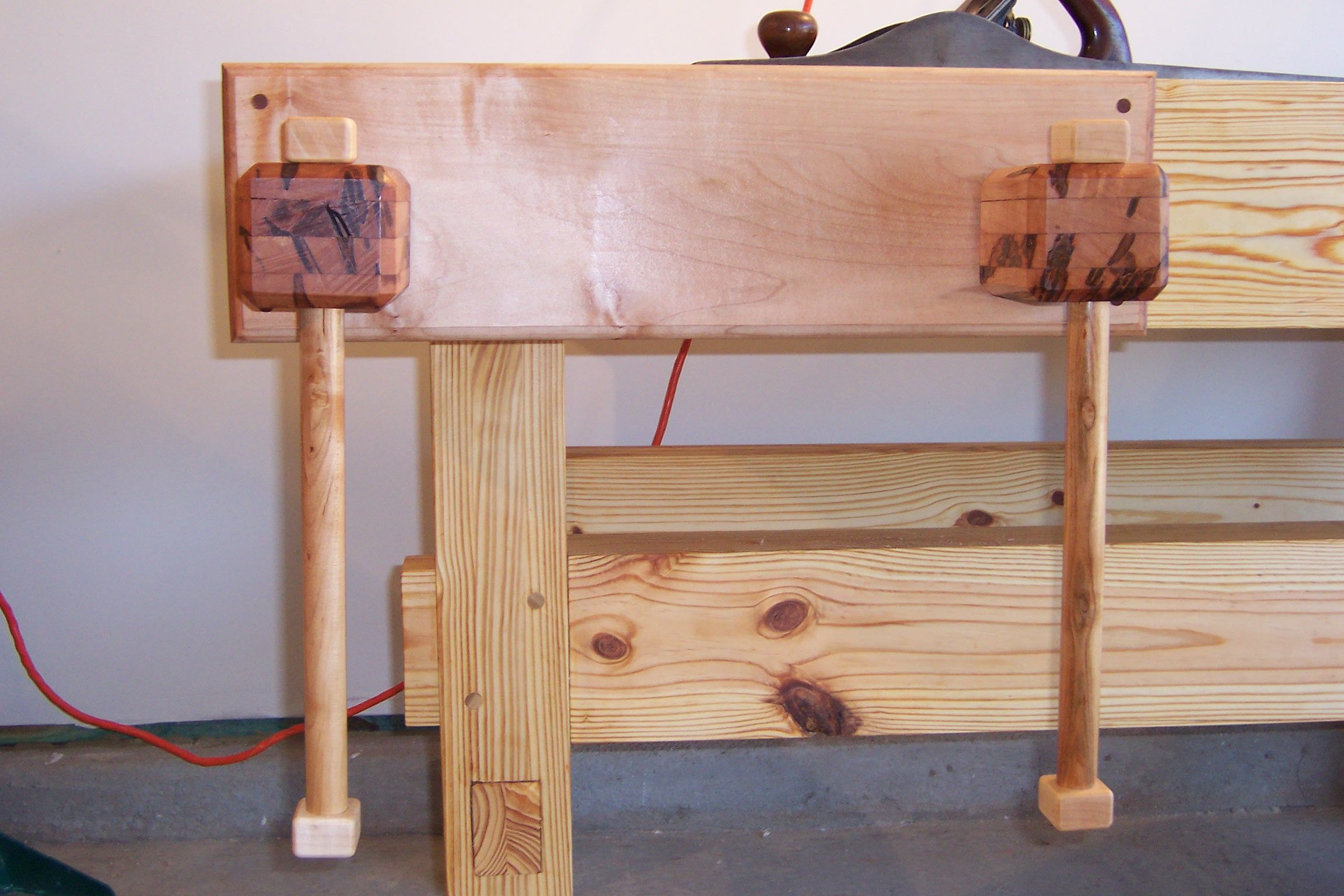
After letting the boards sit for a while in the garage (construction grade lumber often has a MC over 15%, even over 20%), I ripped the boards for the top on my benchtop tablesaw and started gluing it up. I cut all of the joinery by hand with a ryoba saw for the tenons and a brace and chisel for the mortises. Well, I only resorted to the brace after I fried a corded drill. Also, I made the screws for the twin screw vise with a Beall 1 1/2 in. 5 TPI threader. (I still have those threads). That was a great bench. When we moved up to Connecticut (so I could start working at FWW), I gave it to my neighbor. By that time, I had already built a second bench and I brought the second one with me. Now the second one is my tablesaw outfeed table.
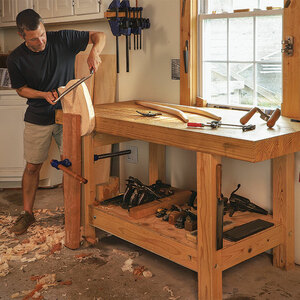
If my first real bench looks familiar, it’s probably because of the workbench I built when I got to FWW. We did a video workshop on that bench (someone, not me, called it the Monster Workbench). The base is different, but otherwise it’s the same bench. A twin screw vise on the front and a stop built into the end of the bench (I eventually added one to the first bench, but it’s not in the photos). I’ve been using the monster workbench for about four years now. I really like it. But I’m also restless when it comes to benches. So, I think it’s time to build a new one.
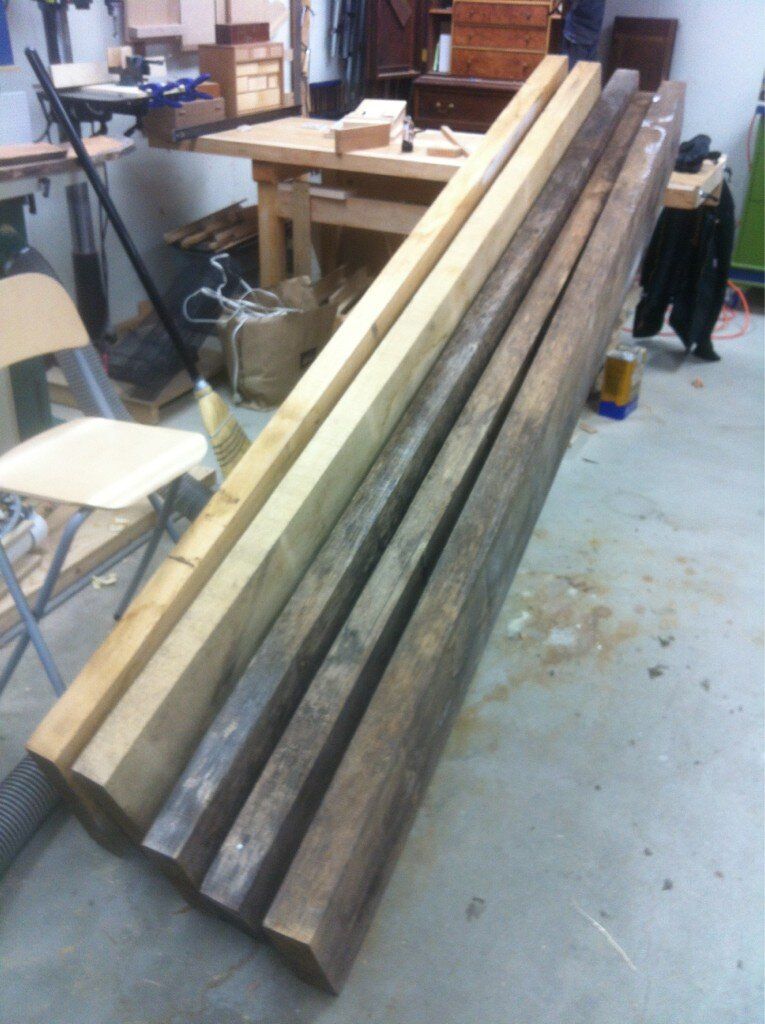
I probably wouldn’t be motivated to do it if not for a recent lumber find. About one year ago I went to a guy’s house because he had several thousand board feet of ash and red oak in his barn (way up on the collar ties, about 20 ft. off the ground). I went for the ash, which I really like. I bought some nice boards then, but knew I would be going back, because about 15 ft. off the ground, up above the overhead door, he had three huge ash timbers, and when I saw them I said, “That’s my next bench top.” So, this past weekend I went back to that barn (along with two co-workers) and bought them. I also picked up two really big oak timbers. The oak is really nice. It’s northern red oak, which is very blonde and much prettier than the nasty red oak that so much furniture is made from. Here’s what I drove away with: 2 oak timbers that are 3 in. thick by 14 in. wide by 8 1/2 ft. long, 3 ash timbers that are 3 in. thick and at least 9 ft. long. Two of them are 10 in. wide and the other is about 8 1/2 in. wide. I think I’ll go back soon and get another oak timber. The oak is really nice and those might end up being the top. At any rate, I’ve only just begun to think about the new bench, so there isn’t much to tell. But I’ll be sure to document it as I build it and share it here on the website.
I won’t tell you about how we got those big timbers down from the collar ties. I’ll just say that it’s a bit freaky moving big, heavy timbers around when you’re standing on narrow collar ties at least 15 ft. off the ground.
-
The bench that started it all. I spent a lot of time planning (and building) this one, but it gave me a very good understanding of what a bench needs to be.
-
Homemade vise. I wanted a Veritas twin screw vise, but couldn't afford it. So, I bought a wood threading kit and made my own vise. It was a really good vise.
-
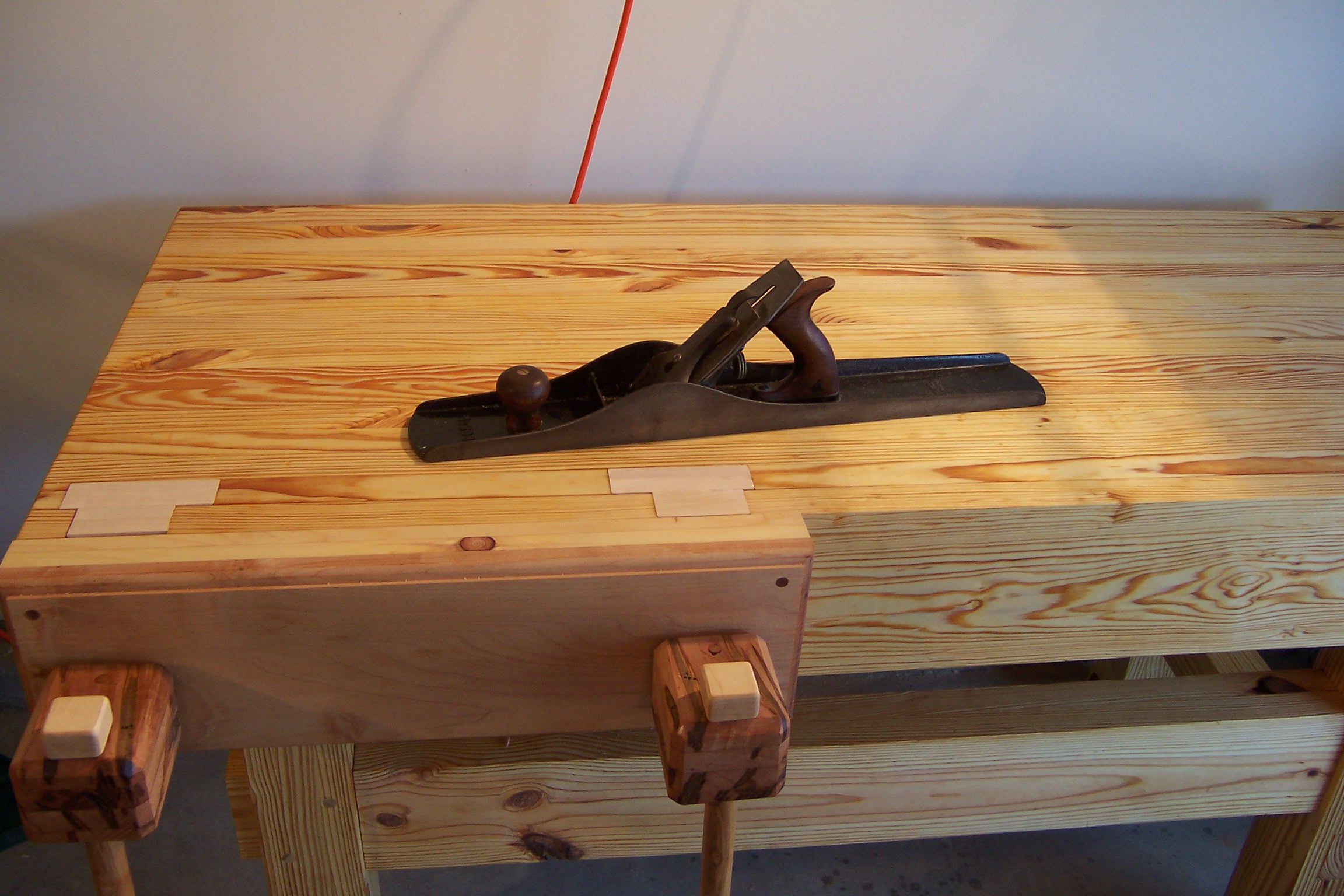
My #608 did the flattening. This plane, which is a type 3 Bedrock, was one of the first nice tools I bought. I paid dearly for it, but it is a great plane and I still use it quite often. (And check out those homemade screw nuts.)
-
Here's my next bench. All of these boards are heavy and big. I can't wait to joint them.





Comments
HUMUNGO workbench
Great job I think that anew bench would be a great next project.
Can anyone tell me how Walt's Monster workbench top is secured to the to the trestle? Floating tenons, bolts, screws? I did not see this in the video or plan I purchased.
Log in or create an account to post a comment.
Sign up Log in