
Abraham and David Roentgen. Now, these guys could have given Steve Jobs a real run for his money.
Like the late founder of Apple Computer, the Roentgens – 18th century German furniture makers – were masters at creating beautiful household objects filled with brilliant and entertaining functionality. Their meticulously constructed work is a stunning combination of art and engineering. They also knew how to market their work, with a client list that included much of Europe’s royalty and aristocracy.
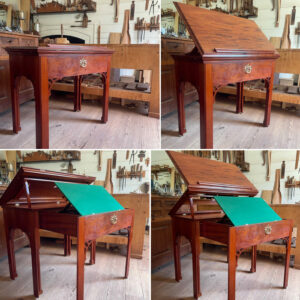
More than 60 pieces of furniture from both father and son are currently on exhibit at New York’s Metropolitan Museum of Art. Their furniture is meticulously constructed and adorrned with dizzying marquetry and gilded inlay. Like any Apple product, the work is also filled with hidden magic. The hallmark of the work is the Roentgen’s ingenious and complex mechanical devices that open concealed writing surfaces, easels, candle stands, drawers and other compartments.
The exhibit, which runs through Jan. 27, also includes shop drawings and virtual animations of the mechanical workings.
A Woodworker Preserved by Fate
 Born in 1711 in what is today Cologne, Germany, Abraham Roentgen learned the art of cabinetmaking from his father. After working for several years in Holland, he later settled in London. In 1737, Roentgen joined the Moravian Church and set off as a missionary in North America. But fate would deal him a different hand. A shipwreck off the coast of Ireland forced him back to his native land, where he picked up his tools anew and worked in partnership with his son until retiring in 1784.
Lauded by Europe’s nobility throughout the 18th century, the work of both Abraham Roentgen and son, David continues to fetch high prices at auction. A multipurpose table built by David in 1785 brought in over $133,000 British pounds at Sotheby’s in recent years, and works by his father can command even higher prices.





Comments
Fantastic furniture and I wonder how they crafted it all by hand back in the pre-mechanized world. Just one criticism of the write-up: what is $133,000 British pounds? Is it dollars or pounds? Can you have a portrait of the Queen on one side and Abe Lincoln on the other?
That is one great piece of furniture, I can't imagine what tools they used and how much time it took to complete.
300 years old and still functioning like it was when it was first created, that is an amazing feat of skill and craftsmanship. Only time will tell if any fine furniture built today will stand the test of time for that long, but I'm sure that our future readers will find it right here in FWW of the 24th Century.
Oh and 133,000 pounds is aprox 211,000 dollars in todays market.
MSnovice
I suggest that you visit the fine cabinetry shop in old Williamsburg. They have master craftmen there who are constructing dupicate reproductions from the 18th century with the original tools & techniques. They have apprentices who work their way up to the master level taking several years.
Terrific content. Do you know what animation software was used to generate the Mechanical Table video?
Imagin what they could have done with MDF and Melamine.
My husband does almost as well...NOTT!
Nice work.
Looks just like the one i made last weekend. Dont know how they did it without Kregg screws and a pin nailer.
Just goes to show what some of us could do if we didn't have television, the internet, honey do lists, and thousands of other distractions they didn't have in the 17th century,. Oh and did I mention craftsmanship ! Nice find, thanks for sharing.
@santafewoodworker : Looks like Stop Motion Animation -- en.wikipedia.org/wiki/Stop_motion .
Those high end pieces of furniture were made by the Roentgens, and also by other German born makers like Oeben, Riesener, Weissweller , for the Royal courts of the time. They are extraordinary and worth to be seen;
Basically they were intended to flatter the owner's vanity, and to advertise the maker's skills. Little has changed : we have high tech luxury cars, diamond rimmed smart phones, haute couture dressings. Sometimes even the owners don't dare to use them . Made for millionnaires, bound for museums, and prototypes for fashion and mass production.
That desk is amazing, but geniuses still exist even in the world of TV and smart phones. If I win the lottery, I will find someone to build me such a desk and prove it. :-)
Super thanks for sharing, I can't get enough of these master works, just great, thanks.
Dear all,
Please find more of these goodies at:
http://antiquaire.hautetfort.com/archive/2012/11/09/decouvrez-les-fabuleux-mecanismes-des-meubles-de-roentgen-en.html
Have fun
I really would have like to have seen this exhibit. It started in October yet FWW does a piece on it ten days before it ends. Oh well.
Vince Paris writes very cogently about this.
These are interesting pieces, but in my mind almost "wretched excess". Certainly other pieces of European furniture that are gilded fall into the "wretched excess" category for me--I say to myself, "Where is the wood?"
As an amateur woodworker, I want to SEE the material in the finished product.
That's why I love American furniture so much, and American architecture: sometimes having only gilt mounts instead of complete overall gilding, and having bricks with limestone quoins instead of completely stone-built houses, leads to more beautiful forms.
I'm a fan of hidden drawers and inlay, but the frontispiece illustration of the princely desk is over the top for my taste. What is that platform at the bottom, a foot rest? The desk is so tall, it takes a throne to sit at, which therefore needs a footrest? Putting your feet on inlay? Not for me! Am I wrong about that lower platform being a footrest?
I see. The Met shows that lower platform is a "folding prayer stool". So I guess it would have been intended to have a pillow on it in use. Still, i wonder how many knees in fact graced its inlay, how many people prayed facing their desk, even with a niche for "devotional objects".
Well, Brothers & Sisters in Woodworking. David
By the way. The Metropolitan Museum of Art has made the book published for this exhibit available online.
https://www.metmuseum.org/art/metpublications/Extravagant_Inventions_The_Princely_Furniture_of_the_Roentgens
Whether it's overdone to some matters little to me. It's an amazing piece of work, all their pieces I've looked at (in books) are amazing. Added not only to the visual impact of the pieces are the intricate mechanical devices, hidden drawers and exquisite use of the space in a piece. I am in awe.
@user-14571 that's a huge document! I'm halfway through it, thanks for the link *thumbs up*
Log in or create an account to post a comment.
Sign up Log in