-
T-Track is a Smart Workbench Accessory -
How to Drill Windsor Chair Mortises -
Dedicated Sled Delivers Perfect Finger Joints -
Tablesaw Tapering Jig is Safer and Faster -
Buying and Using Trim Routers -
Five Minute Guide: Glue-Ups -
3 Steps to Great Glue-Ups: Sliding Dovetail Joints -
How to Apply an Aerosol Finish -
Router Jig for Perfectly Aligned Dadoes -
How to Sharpen a Card Scraper -
Upgrade Your Jointer with a Segmented Cutterhead -
Box Making Tips and Tricks -
How to Make a Simple Jig for Offset Knife Hinges -
Best Tabletop Finish -
Fixing Woodworking Mistakes -
How to Cut Sliding Dovetail Joints -
Five Minute Guide: How to Use a Tablesaw
Reader's Gallery
FWW Magazine Gallery, member
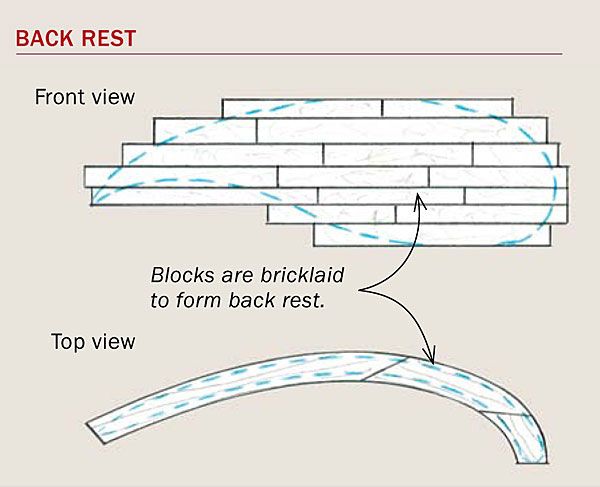
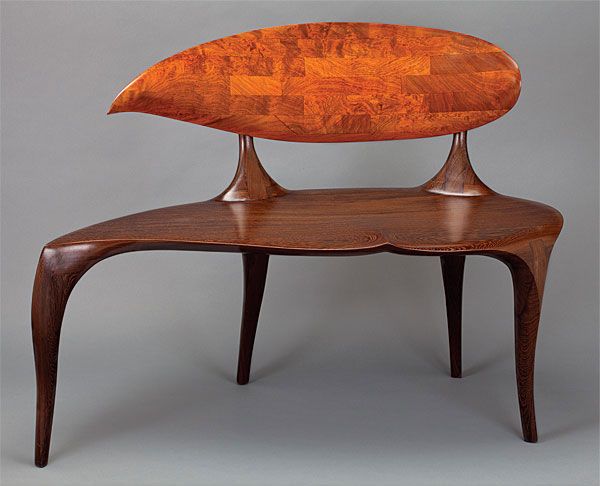
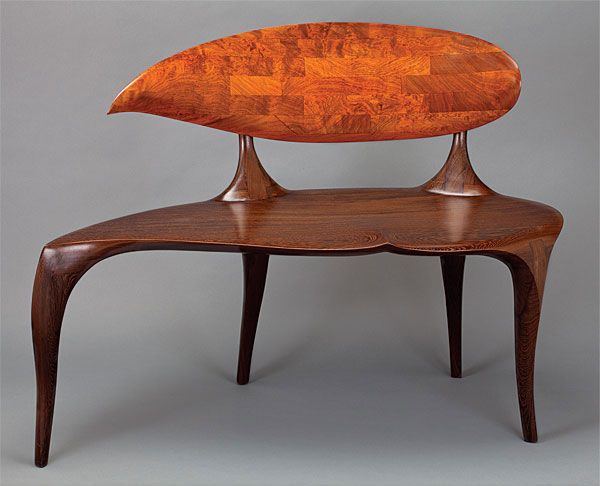
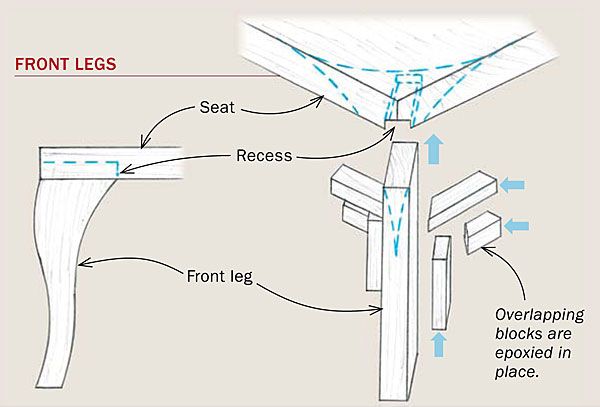
DiNovi likes to work spontaneously, more like a sculptor than a cabinetmaker. He rarely draws his pieces before building them. But he doesn’t take any risks with structural integrity or function. With training as a mechanical engineer and 40 years experience doing custom woodwork, he has developed methods of gluing up his pieces that provide maximal strength at the stress points while giving him freedom in the carving process. Where the leg meets the seat, for example, DiNovi epoxies in a series of blocks in an interlocking pattern, creating a rigid gusset on either side of the leg. The technique DiNovi uses to build up his carving blanks was traditionally used for making carousel horses and religious statuary. He does his carving with power planes, angle grinders, and pneumatic chisels. About working without reference surfaces, DiNovi says, “with the type of work I do, you are the fence.” His wenge and bubinga chair is 22-in. deep by 48-in. wide by 32-in. tall.
Design or Plan used: Not specified
posted in: Reader's Gallery, bubinga, wenge
Sculpted Chair
comments (1) October 24th, 2012 in Reader's Gallery
DiNovi likes to work spontaneously, more like a sculptor than a cabinetmaker. He rarely draws his pieces before building them. But he doesn’t take any risks with structural integrity or function. With training as a mechanical engineer and 40 years experience doing custom woodwork, he has developed methods of gluing up his pieces that provide maximal strength at the stress points while giving him freedom in the carving process. Where the leg meets the seat, for example, DiNovi epoxies in a series of blocks in an interlocking pattern, creating a rigid gusset on either side of the leg. The technique DiNovi uses to build up his carving blanks was traditionally used for making carousel horses and religious statuary. He does his carving with power planes, angle grinders, and pneumatic chisels. About working without reference surfaces, DiNovi says, “with the type of work I do, you are the fence.” His wenge and bubinga chair is 22-in. deep by 48-in. wide by 32-in. tall.
Design or Plan used: Not specified
posted in: Reader's Gallery, bubinga, wenge


Comments (1)
Posted: 11:03 am on November 11th
You must be logged in to post comments. Log in.